If you asked me where to spend money on blacksmith gloves, my answer is boring: a box of plain cotton hot mill gloves for the tong hand, one good leather pair for the ugly jobs, and the rest of the budget into better tongs. Gloves are the cheapest thing in the shop that people overthink and the easiest thing to get wrong in a way that costs skin. I have run cotton hot mill gloves and leather welding gloves in my own shop for years, but I have not bench tested the specific models below, and I am not going to pretend otherwise. The picks lean on published maker specs, owner reports from the forums, and twenty five years of watching how a glove actually fails at a forge.
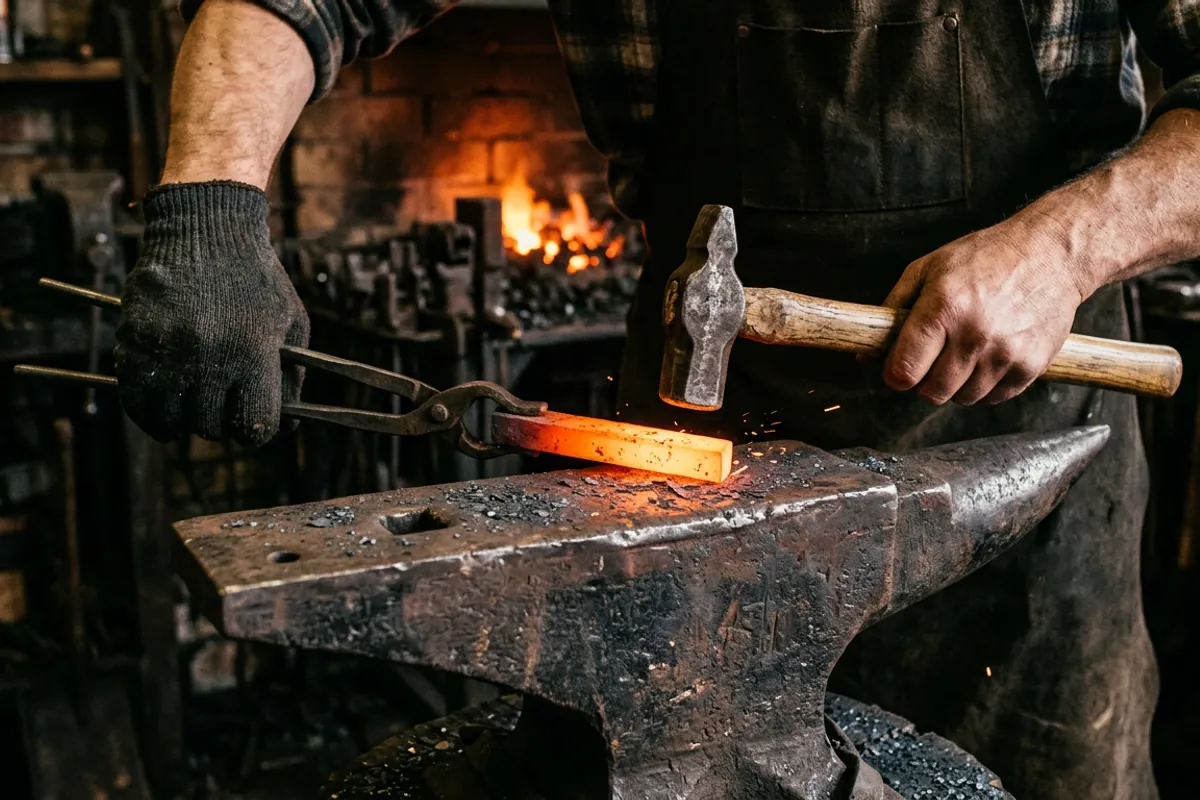
Which hand to glove is settled elsewhere on this site. My blacksmith safety gear guide covers why a glove on the hammer hand kills your feel for the hammer and can trap hot scale against skin. Two sentences is all that argument deserves here, because the part almost nobody has read is what the national organization actually recommends about materials, and that is where this guide lives.
What ABANA actually says about hand protection
The Artist Blacksmith's Association of North America publishes a safety guide with a section on hand protection, and it is more specific than the forum arguments give it credit for. You can read it yourself in the ABANA Safety Guide, Revision NC1, Hand Protection. The document does not carry a publication date, so treat it as current guidance rather than something you can pin to a year.
The first thing it says is the thing gear sellers never say: the need for hand protection is a matter of choice, and some smiths use no hand protection at all. It records the same split the site already covers, and then goes where no article here has: what the glove should be made of.
The material guidance is where it gets useful. If gloves are used, ABANA recommends they be made of cotton or Kevlar. Leather shows up only conditionally: if leather gloves are used, the glove on the tong hand should be loose fitting so it can be removed quickly, loose enough that it can be shaken off the hand. Note what that is not. It is not "ABANA recommends leather gloves." It is "if you are going to use leather, here is the condition."
Then the line that should end a lot of marketplace shopping: gloves made of synthetic materials, except for Kevlar, should not be used, because synthetic materials can melt onto the skin if exposed to hot sparks or flame. Melted synthetic on a burn is a different injury from a burn. It has to come off before anything can be treated, and it comes off with skin.
Two more that are worth taping to the wall. If a glove becomes hot it shall not be soaked in water to cool it, because cooling a glove in water can produce steam in the glove. A glove soaked with sweat can also produce steam. The actionable half of that is simple: it is necessary to have dry gloves available. ABANA also recommends that jewelry not be worn while smithing, and a ring hiding under a glove is exactly the kind of thing you forget you are wearing until it conducts.
The gloves side by side
Only published figures are in this table. Where a maker does not publish a number, it says so, because inventing a temperature rating for a glove is how people get talked into trusting one.
Scroll horizontally to see all columns.
| Glove | Material | Published construction | Cuff | Published rating |
|---|---|---|---|---|
| PIP 94-928G hot mill | Cotton canvas, burlap liner | 28 oz, three layers, nap side out, knuckle strap | Starched gauntlet | None published |
| Wells Lamont Y6243 hot mill | Cotton | 24 oz natural cotton, nap out, sold by the dozen pair | Knit wrist, safety cuff | Protects up to 300 degrees F |
| Tillman 850 | Elkskin leather | 14 inch length, cotton and foam lined back, unlined palm, Kevlar thread | Straight cuff | None published |
| Steiner 0224K SensiTIG | Goatskin leather, para-aramid twill lining | Seamless index finger, straight thumb, Kevlar thread, sizes S to 2XL | 4 inch split cowhide gauntlet | ANSI/ISEA 105-2016, cut level A2 |
Sources for those figures are linked in each section below. Three of the four publish no heat number at all, which is the honest state of this category.
Cotton hot mill gloves, and why I would buy them by the dozen
A hot mill glove is the industrial cotton glove used around foundries and steel handling. It is thick woven cotton, usually multiple layers, usually with the nap turned out so sparks have something to die in. It is cotton, which is one of the two materials ABANA names, and it costs about what a sandwich costs.
The PIP 94-928G is the pattern I would order. A distributor listing at Ace Tool publishes 28 oz, three layers of cotton canvas, a burlap lining that creates an air pocket, the nap side out on the palm, a knuckle strap, and a starched gauntlet cuff, sold as a box of 12 pairs. No temperature rating is published for it.
The dozen is the point, not a bulk discount. Go back to the ABANA line about dry gloves. On a real forging day your gloves get sweat soaked, and a sweat soaked glove can produce steam inside itself. If the only pair you own is damp, your options are to keep wearing it or to stop working, and everybody picks the wrong one. With a box on the shelf you swap, you hang the wet pair somewhere warm and away from the fire, and you throw out the one that took a spark through the palm instead of nursing it for another month.
The honest tradeoff: cotton chars. It will scorch, it will burn through, and once thick cotton has soaked up heat it holds that heat against your hand, which is the failure mode nobody warns beginners about. It is a consumable, so treat it like one.
Check price on Amazon (paid link)
Elkskin leather that comes off fast
Leather is what most people picture when they picture blacksmith gloves, and it is the one ABANA hedges on. The hedge is about removal speed, not toughness.
The Tillman 850 is the pattern I would put on the tong hand if I wanted leather. Harris Welding Supplies publishes 14 inch length, gold premium elkskin, a cotton and foam lined back for heat protection with an unlined palm for dexterity, and lock stitching with Kevlar thread. No temperature rating is published.
The straight cuff is what makes it usable under the ABANA rule. A straight gauntlet with nothing cinching your wrist is a glove you can shake off your hand, and that is the entire behavior you are buying. If a spark lands inside the cuff or the glove picks up heat, the glove leaves your hand in one motion. A snug elasticated glove, a knit wrist, or a strap over the wrist is the opposite of that. It is a glove you have to peel off with your other hand while the first one cooks.
Buy it loose. Size up if you are between sizes, and check that you can actually flick it off with a wrist snap before you rely on it. The tradeoffs are the ones all leather has: it stiffens and shrinks a little every time it takes real heat, the unlined palm trades protection for feel, and elkskin at 14 inches is more glove than you want for fine work.
That RAPICCA pair that shows up in every blacksmithing gift roundup lives in my smithing supplies guide rather than here; it is a fine cheap gauntlet, but it is not the pick when removal speed is what I am shopping for.
Check price on Amazon (paid link)
Kevlar lined goatskin for close work
Kevlar is the one synthetic ABANA does not rule out, and para-aramid is that same fiber family. The Steiner 0224K SensiTIG is the cheapest honest way I know to get it into a glove that a smith would actually wear.
Steiner Industries publishes premium grain goatskin, a full para-aramid twill lining described as cut and heat resistant, a seamless index finger, a straight thumb, a 4 inch split cowhide cuff, lock stitching with Kevlar thread, sizes S through 2XL, and compliance with ANSI/ISEA 105-2016 at cut level A2.
Read that rating for what it is. A2 is a cut rating. It describes how much force it takes to cut through the glove, and it tells you nothing whatsoever about hot steel. I include it because it is one of the very few numbers in this category any maker publishes, and because the gap between "has a published standard on it" and "protects you from the thing you are worried about" is the single most useful thing to understand when buying gloves.
Where it earns its place is the work around the forging: filing, wire brushing scale off a cooled billet, handling sharp cold stock, hardware fitting, layout with sheared edges. It is a thin, close fitting glove, which means it is also a glove you cannot shake off, so I would not reach for it as my tong hand glove on heavy hot work.
Check price on Amazon (paid link)
What a temperature rating really tells you
Most glove makers publish no heat number at all. Tillman, PIP and Steiner publish none for the gloves above. Wells Lamont Industrial is the exception in this group: its Standard Weight Hot Mill Y6243 is published as 24 oz natural cotton, nap out, with a knit wrist and a safety cuff, and the page states it protects up to 300 degrees F.
That number is a lab result under a defined contact time and a defined test. It is not a promise about a bar at forging heat, which is well over a thousand degrees hotter than that figure and is not going to consult the spec sheet. Glowing steel wrecks the assumptions behind every one of these ratings, and the difference between a glove rated to a few hundred degrees and one that is not rated at all is much smaller at the forge than it looks in a product listing.
So here is the claim I will make and the one I will not. No glove makes hot work safe. A glove buys you seconds, which is enough to move your hand off something you touched by mistake, and that is worth having. The same glove also traps heat: once the material soaks up heat it holds it against your skin, and you cannot get a glove off as fast as you can drop a bar you were holding with decent tongs. Tongs that actually fit your stock will do more for your hands than any glove on this page.
If you see a listing advertising a specific degree rating for a forge glove and the maker's own site does not publish it, treat the number as marketing. I will not repeat a rating here that I could not find published by the people who made the glove.
Cuff length and the gap at your wrist
Scale finds gaps. The one between a glove cuff and a rolled sleeve is where a hot flake lands and stays, and it is why cuff length matters more than most people expect.
A gauntlet cuff, like the starched one on the PIP or the 4 inch cowhide on the Steiner, covers the wrist and a bit of forearm and sheds fast. It also funnels scale straight down your arm if you wear your sleeve outside the cuff, so the sleeve goes over the gauntlet, not the other way around. A knit wrist, like the Wells Lamont, is better at keeping scale and grit out, and worse at everything else, because a knit wrist is precisely the thing that stops a glove coming off when you need it gone.
That is the tradeoff in a sentence: keeping debris out and getting the glove off fast pull in opposite directions. For the tong hand at a forge, I pick fast removal every time, and I take the scale.
Two more wrist notes. Jewelry comes off before you light the fire, per ABANA, and rings are the worst offender because they hide under a glove and conduct heat straight to bone. And natural fibers over synthetics is not just a glove rule: it applies to whatever sleeve is meeting that cuff, along with an apron that actually covers you. A polyester shirt cuff will melt for the same reason a polyester glove will.
Gloves near the grinder
This one is not a preference, and I am going to be exact about what the guidance says and where it stops.
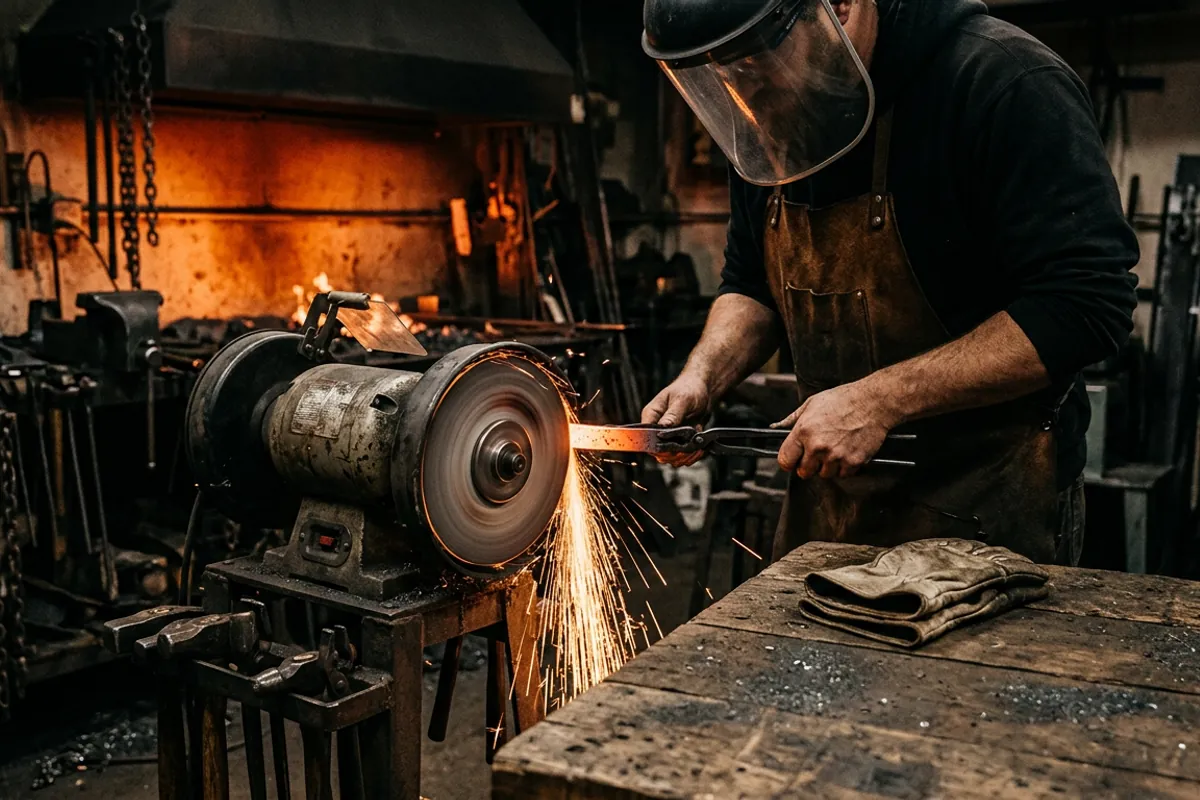
ABANA says loose gloves and clothes should not be worn near rotary devices such as bench grinders and angle grinders, because they could be caught by the rotating parts and draw the covered body parts into the machinery. That is where the guidance ends. It does not go on to recommend a snug glove instead, and it does not recommend gloves at grinders at all.
That silence lines up with standard machine guarding practice, where gloves are avoided around rotating machinery because entanglement is a far worse outcome than abrasion. A glove that gets grabbed by a wheel or a belt takes your hand in with it. A bare knuckle that touches a wheel gets a burn and a bad afternoon. If anyone tells you the fix is a tighter glove, they are guessing, and they are guessing about a machine that does not forgive.
What I do at the grinder is take the gloves off, roll nothing loose near the wheel, and rely on ANSI Z87.1 rated eye protection with a face shield over it. Same rule at the belt grinder, and it applies just as hard to an angle grinder in your hands, where the wheel is the thing moving toward you. Hot parts get set down and picked up with pliers rather than gloved, and the rest of the shop's protective kit is laid out in the safety and PPE hub.
What owners say
Nobody should buy gloves on my say so alone, so here is the state of the forums, honestly reported.
The I Forge Iron thread To glove or not to glove, a poll is the closest thing to a head count that exists. The votes split across every option with no single answer taking a majority. The two largest blocs are a glove on the holding hand only and no gloves at all, which is exactly the split ABANA describes rather than a contradiction of it.
Real Blacksmiths Don't Wear Gloves? runs long and is worth reading for the tone alone, because it is mostly experienced smiths pushing back on the macho framing while still declining to glove the hammer hand. In Gloves again and the older Gloves? thread you will find the same habits described over and over: a glove on the left hand only, cotton gloves for hand hammering, and at least one poster who cuts the cuffs off so the glove leaves the hand easier.
Where the signal is genuinely thin is specific models. Smiths argue about whether to wear gloves constantly and almost never about which hot mill pattern is better, and I could not turn up a solid consensus thread on any of the four gloves in the table above. That is why this guide is built on published specs and material logic instead of a fake ranking. If somebody hands you a top ten forge gloves list with confident heat ratings on every row, ask where those numbers came from.
What I would tell a friend
Buy the box of cotton hot mill gloves. It is cheap, cotton is one of the two materials ABANA names, and having a dozen pairs is the only practical way to honor the rule that matters most: never cool a hot glove in water, and always have a dry pair on the shelf. Add one loose leather pair like the Tillman 850 for heavy scale and hot handling, sized so you can shake it off your hand, and a Kevlar lined goatskin pair like the Steiner 0224K if you do a lot of filing and finish work.
Skip anything with a synthetic shell or a synthetic lining that is not Kevlar, no matter how good the listing photos look, because synthetics can melt onto skin. Skip the snug elasticated forge gauntlets for tong work, because a glove you cannot shake off is a glove that holds the heat in place. Skip gloves entirely at the grinder.
And keep the ranking straight in your head. Tongs that fit, eye protection that meets ANSI Z87.1, natural fibers, and dry gloves in that order. The glove is the last line, not the first, and it buys you seconds rather than permission.