If you buy one pair of blacksmith tongs and want it to still be earning its keep in five years, buy a V-bit bolt tong sized to the stock you actually forge, then a wolf jaw as the second pair. That is the honest answer to a question I get from weekend students almost every month, usually phrased as "which one pair does everything." No pair does everything. But a V-bit bolt tong grips round, square, and flat stock better than anything else at the price, and a wolf jaw covers the odd sizes in between.
Fair warning about what this guide is. I have forged with tongs for about twenty-five years and I have opinions about what makes a pair worth owning, what makes a pair worth throwing in the scrap bin, and how to fix the ones in between. What I have not done is buy every model below and run it down in my shop. The picks lean on published maker and retailer specs, owner reports from the forums, and general shop experience with these tong patterns. Where I am reporting what other smiths say rather than what I have felt in my own hand, I say so.
What a pair of tongs actually has to do
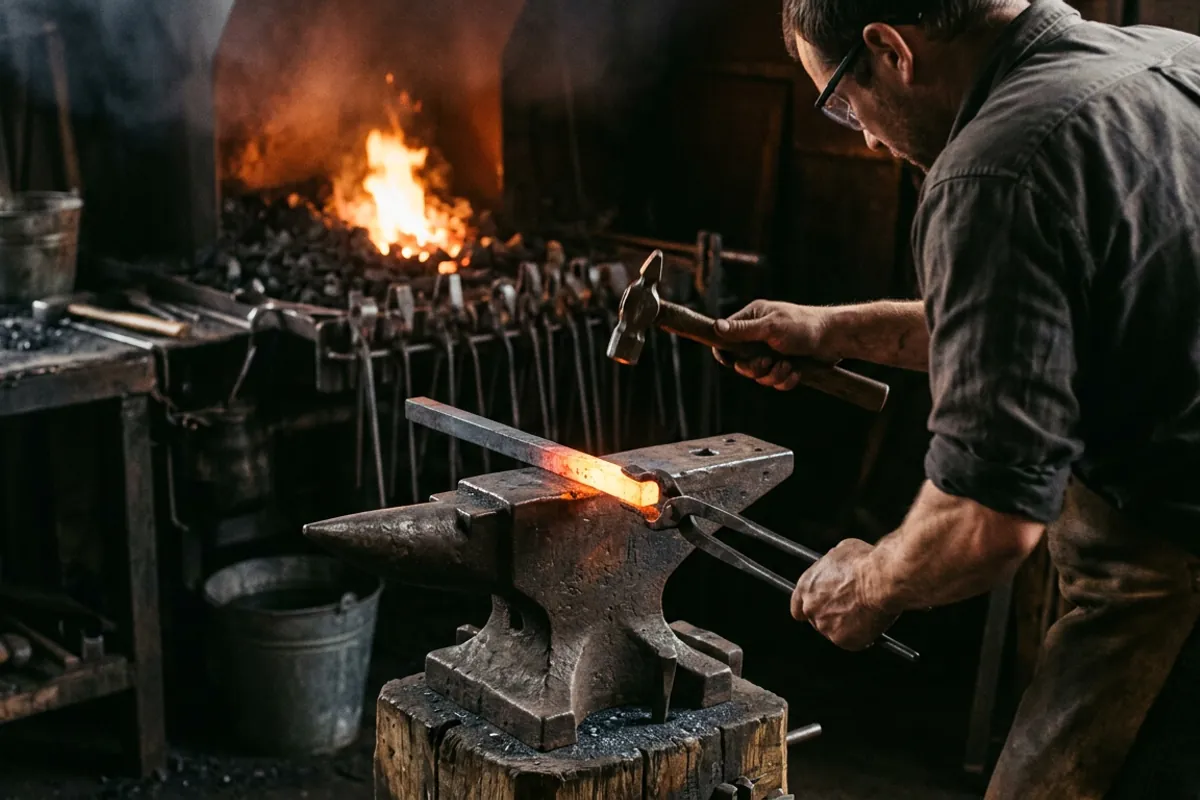
Tongs have one job: hold hot steel exactly where you put it, without moving, while you hit it with a hammer. Everything else is secondary. A tong that slips a quarter turn on an impact has failed, and the failure mode is a piece of orange steel leaving the anvil at speed.
That is why I get blunt about grip. A loose tong is not a minor annoyance. It is the reason smiths get burns on the back of the leg and holes in the shop floor. If a pair will not hold your stock when you lean on the reins, either it is the wrong jaw for that stock or it needs fitting, and until one of those is fixed the tong stays on the rack.
Second job: keep your hand out of the fire. A 16 to 18 inch tong puts your fist a comfortable distance from a forge mouth. Shorter tongs exist and have their place for delicate work at the anvil, but for a beginner reaching into a forge, longer reins are the safer default.
Third job: not wear you out. Tong weight matters more than people expect. Two pounds hanging off your off hand for an hour is real work, and heavy reins with a bad balance point turn into forearm cramp. That complaint shows up constantly on the forums, and it is the main argument against cutting up farrier tongs to make your first pair.
The rest of the starter kit matters just as much. If you are still assembling one, I wrote up the short list in the black smith tools you actually need to start, and the hammer side of this cluster lives in the blacksmith hammer I would hand a beginner. All of the hammer and tong guides sit together in the hammers and tongs hub.
Jaw types, and the two that earn their place first
There are dozens of jaw patterns. Four of them cover almost all beginner work.
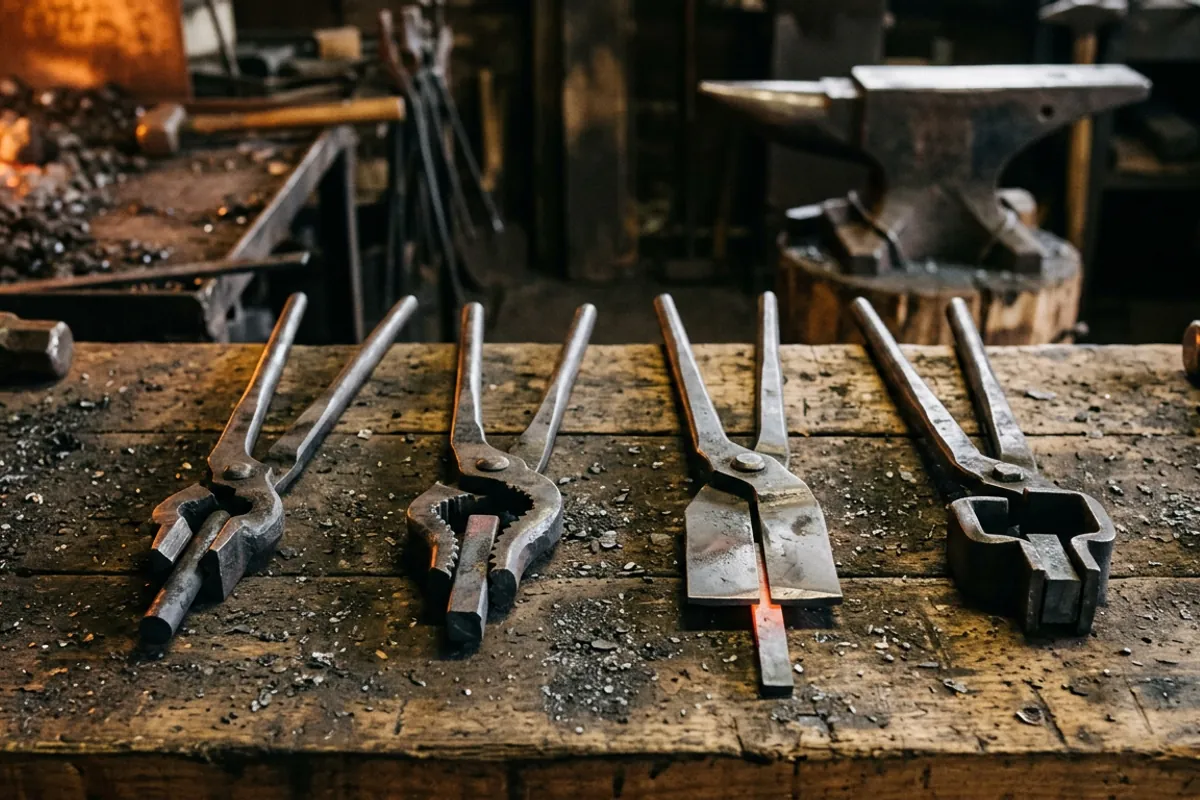
V-bit bolt tongs
Two V grooves facing each other, one in each jaw. The V self-centers round and square stock, and the groove depth means a hammer blow pushes the work further into the grip instead of squirting it out. This is the pattern I would buy first. It is also the pattern I would use on a railroad spike, which is the project half the people reading this are here for. If that is you, the honest version of that project is in the railroad spike knife, honestly explained.
Wolf jaw
A combination jaw with a V section, a flat section, and usually a small round pocket, which is why it gets called the do-everything tong. On BladeForums one member calls the wolf jaw "the Leatherman of tongs" in a thread on where to buy tongs, and that is a fair summary: it does a lot of jobs adequately and none of them perfectly. Second pair, not first, unless you forge a wide range of sizes.
Flat jaw
Two flat bits for holding flat bar. Cheap, simple, and the pattern most worth buying as a blank and reshaping, because flat stock is where a slightly mismatched jaw slips worst.
Box jaw
A jaw with a raised lip on one or both sides that boxes the stock in on three or four faces. For knife work the box patterns (U box and Z box) are what experienced bladesmiths keep reaching for. They are also the priciest and the most size-specific, so they are a third or fourth purchase, not a first.
How the picks compare
Only published figures here. Where a maker or a non-marketplace retailer does not print a number, it says not published, because guessing a spec in a buying guide is how readers end up with the wrong tool.
Scroll horizontally to see all columns.
| Tongs | Length | Weight | Material | Jaw | Price tier |
|---|---|---|---|---|---|
| Caliburn V-bit bolt | 18 in (450 mm) | approx 2 lb | Forged steel, grade not published | V-bit bolt | Budget |
| Caliburn wolf jaw, large | 18 in (450 mm) | 2 lb | Forged steel, grade not published | Wolf jaw | Budget |
| Picard 49c, 400 mm | 400 mm (15.75 in) | 750 g (1.65 lb) | C35 steel | Not published | Premium |
| Picard 49 wolf's jaw, 400 mm | 400 mm (15.75 in) | 850 g (1.87 lb) | C35 steel | Wolf's jaw, for material 3 to 12 mm | Premium |
| No-brand import wolf jaw | 16 in, seller listed | Not published | Not published | Wolf jaw | Budget |
| Three piece knife making set | approx 14.84 to 16.53 in, seller listed | Not published | Not published | V-bit blade, blade, flat | Budget |
Specs above come from Caliburn Tools and its V-bit bolt tong page, from KC Tool's Picard 49c 400 mm listing, and from The Hammer Source's Picard wolf's jaw page. Note what is missing across the budget field: nobody publishes a steel grade. Treat "heavy duty steel" as marketing text, not a spec.
Caliburn V-bit bolt tongs, 18 inch: the pair I would start with
This is my first-pair recommendation for a beginner working 1/4 inch to 1/2 inch round or square, which describes most starter projects, spikes, hooks, punches, and small tooling.
Caliburn publishes 18 inches overall and about 2 pounds, forged steel, with a money back guarantee, and describes the jaws as suiting round, flat, and square stock. They do not publish a steel grade or a rated stock capacity, which is normal in this tier and worth knowing before you buy. The company describes itself as a US-based supplier; I have not seen a country-of-manufacture claim I would repeat as fact.
Why this pattern first: the V groove does the work for you. A new smith has not yet developed the habit of constantly re-seating the stock, and a V-bit forgives that. On a railroad spike, where the head is a lumpy off-center thing, the V takes the shank cleanly and the head stops the work from sliding back through the jaws.
Check price on Amazon (paid link)
Tradeoff, said plainly: 2 pounds at 18 inches is not a light tong. If your work is small and delicate, a shorter, lighter pair will feel better at the anvil, and you will still want this one for reaching into the forge.
Caliburn wolf jaw, 18 inch: the one pair that does a bit of everything
If you forge a mix of sizes and you genuinely can only buy one pair right now, this is the compromise. Caliburn publishes 18 inches overall, 2 pounds, forged steel construction, with an extended wolf jaw head giving multiple grip points. No stock capacity is published, so match it to your stock by eye and be prepared to fit the jaws.
I run the equivalent pattern in my own shop as a general-purpose tong and reach for it constantly, though not for a specific model I can point at in a listing. The honest description of a wolf jaw is that it holds four different profiles about eighty percent as well as the dedicated tong holds one. For scrolls, hooks, and general bar work that is fine. For a blade you are drawing out with heavy blows, it is not, and you will feel the work shift.
Check price on Amazon (paid link)
Picard 49c, 400 mm: the buy-once German option
Picard has been making forging tools in Wuppertal since the 1800s, and the current tongs are C35 steel, made in Germany. KC Tool publishes the 49c in 400 mm at 750 g, C35 steel, made in Germany, which is a notably light tong for its length and the reason these are pleasant to hold all day.
What you are paying for is consistency: reins that are actually straight, a rivet that moves smoothly and stays where you set it, and a jaw that was forged to a drawing rather than eyeballed. The Amazon listing for the 0004930-400 also prints a material thickness figure, but I could not confirm that capacity on the maker or retailer spec pages I checked, so I would not buy on the strength of it. Buy on the pattern and the size, and confirm the jaw suits your stock before ordering.
Check price on Amazon (paid link)
Tradeoff: this costs multiples of the import tongs, and a beginner who has not yet decided what they forge may be better served spending that money on fuel and stock. If you know you will still be at this in three years, the Picard is the cheaper purchase.
The 16 inch import wolf jaw: what you actually get
There is a whole shelf of near-identical no-brand wolf jaw tongs in the 15 to 17 inch range, all with similar listing copy about three-point grip and heat-resistant steel. This is the tier most beginners buy from.
They work. What you should expect is a tong that arrives with jaws that do not quite match your stock, a rivet that is either too tight or too sloppy, and reins that may need a little straightening. All three are fixable at the forge in twenty minutes, and doing that fixing is genuinely good practice. What you should not expect is a precise fit out of the box, and you should not accept a tong that will not hold when you lean on it.
Check price on Amazon (paid link)
The three piece knife making set: where sets help and where they do not
Sets are how most people end up with tongs they never use. The V-SEK three piece set (V-bit blade tong, blade tong, flat tong) is a reasonable version of the idea, and the seller lists the pieces at roughly 14.84 to 16.53 inches, forged from steel round stock with a wax finish. No steel grade published.
The case for a set: three patterns for not much more than two singles, and a flat tong you can freely reshape into a box jaw, wolf jaw, or V-bit once you know what size you actually need. The case against: if only one of the three fits your stock, you paid for two wall hangers. Buy a set only when at least two of the patterns match work you are already doing.
Check price on Amazon (paid link)
Fitting tongs to your stock, and the safety part
Almost every tong in the budget tier improves enormously with fitting, and this is the step new smiths skip.
Heat the jaws to a bright forging heat, close them around a piece of the stock you intend to work (a cold offcut of the same size), and tap the jaws down onto it with light hammer blows until they sit flush along the full bit. Open, check, repeat. Cool in air, not in the quench tank, because you are not trying to harden them. Reins that spread too wide can be adjusted at the same heat. When you are done, the tong should hold that size hard enough that you can lift and shake the work with the reins held in one relaxed hand.
Two hard rules from the fire, and I do not soften either.
Eye protection is not optional, and it needs to be rated. ANSI Z87.1 impact-rated glasses or a face shield over glasses, every heat, no exceptions. Hot scale flies off the anvil in every direction when the hammer lands.
Wear natural fibers. Cotton, wool, or leather. Synthetics melt onto skin. I learned this the expensive way early on, quenching a blade in oil that was too cold while standing too close in a cotton shirt with no face shield. The oil flared and took my eyebrows, and I kept my eyesight by luck rather than judgment. Tongs are part of that story too, because the reason you hold work with tongs and not pliers, and the reason you check the grip before every heat, is that hot steel that gets loose goes somewhere you are not expecting. More on the full kit in blacksmith safety gear: what matters and what to skip.
One more habit worth building: for heavy work, a tong ring (a slip ring driven down the reins) locks the grip so your hand is not the only thing holding the work. Cheap, and it turns a marginal grip into a solid one.
What owners say
For the specific budget listings above, forum signal is thin. Smiths on I Forge Iron and BladeForums mostly discuss named makers and their own homemade tongs, not no-brand marketplace listings, so the review counts on those pages are the main data and I would not weight them heavily. That is a real limitation of this category and I would rather say it than dress it up.
On patterns, the consensus is much clearer.
For a first purchase, threads in the I Forge Iron tongs subforum keep landing in the same two answers. The buying tongs questions thread and the what tongs should I buy thread both point beginners at V-bit and box jaw tongs before anything else, which lines up with what I would tell a student.
For knife work, BladeForums members in what kind of tongs y'all using overwhelmingly favor blade box tongs, with Z box and U box patterns named repeatedly, and one knifemaker in that thread gives a useful sizing rule: box tongs hold about plus or minus 1/8 inch around their marked size, plain blade tongs about plus or minus 1/4 inch. Same thread includes a warning I would repeat: a member who reworked farrier tongs into forging tongs reported his forearms cramping within twenty minutes from the weight and rein spacing. Heavy tongs cost you endurance.
For where the money goes, the where to get tongs thread names Centaur Forge, Blacksmiths Depot, Ken's, and Off Center Products as the usual sources for tongs people keep for decades, and several members point new smiths at cheap tong blanks as a way to get a fitted pair for very little money plus an evening of work.
What I would tell a friend
Buy the V-bit bolt tong first, sized to the stock you actually forge, and fit the jaws before you use it. Add a wolf jaw second for everything that does not fit the V. If you already know you are forging blades, skip both and put the money toward a box jaw pattern in the size of your bar stock, because that is what bladesmiths on the forums keep going back to.
Skip the big multi-piece sets unless at least two patterns in the set match work you are doing this month. Skip any tong you cannot lift and shake the workpiece with. And if you are choosing between one good tong and three cheap ones, take the good one; the cheap ones will need the same hour of fitting anyway.
The rest of the shop matters more than which tong you pick. If you are still buying the big items, the blacksmithing supplies I would actually buy first and what size anvil do you actually need are the two decisions that will shape your work far more than a set of jaws will.