Research is solid and the two ASINs are live-verified (DEWALT DPG82-11 Concealer goggle B01A12J3GI, Jackson Safety F4XP face shield B088BQZ9GW). Here is the article.
If you go looking for a treadle hammer for sale expecting to drop one in a cart and have it on the porch by Friday, you are going to be disappointed. There is no shelf for these. The honest picks come down to three roads: buy a finished commercial hammer like Uncle Al's if you have the budget and can track one down, buy a bolt together kit like the Christ Centered Ironworks unit if you want in cheap and own no welder, or build one from plans such as the Clay Spencer In-Line or the Grasshopper if you can run a bead and have a weekend or three to spend. I do not keep a treadle hammer in my own shop, so nothing here is a bench test of mine. What follows is published specs and owner reports off the forums, weighed against twenty five years of swinging hand hammers and running guided tooling over Bessie, my 148 lb Trenton.
What a treadle hammer actually does, and why the market is thin
A treadle hammer is a foot powered striker. You stand at it, set your hot steel and a top tool on the lower die, and step on the treadle to bring the head down. One press, one blow. Pump the treadle and you get a string of them. The whole point is that it gives you back both hands. Instead of holding a chisel in one fist and swinging with the other, or begging a buddy to strike for you, you hold the work in one hand and the top tool in the other and let your foot do the hitting. For guided tooling, punches, fullers, veiners, chisels, and spring swages, that is a genuine third hand.
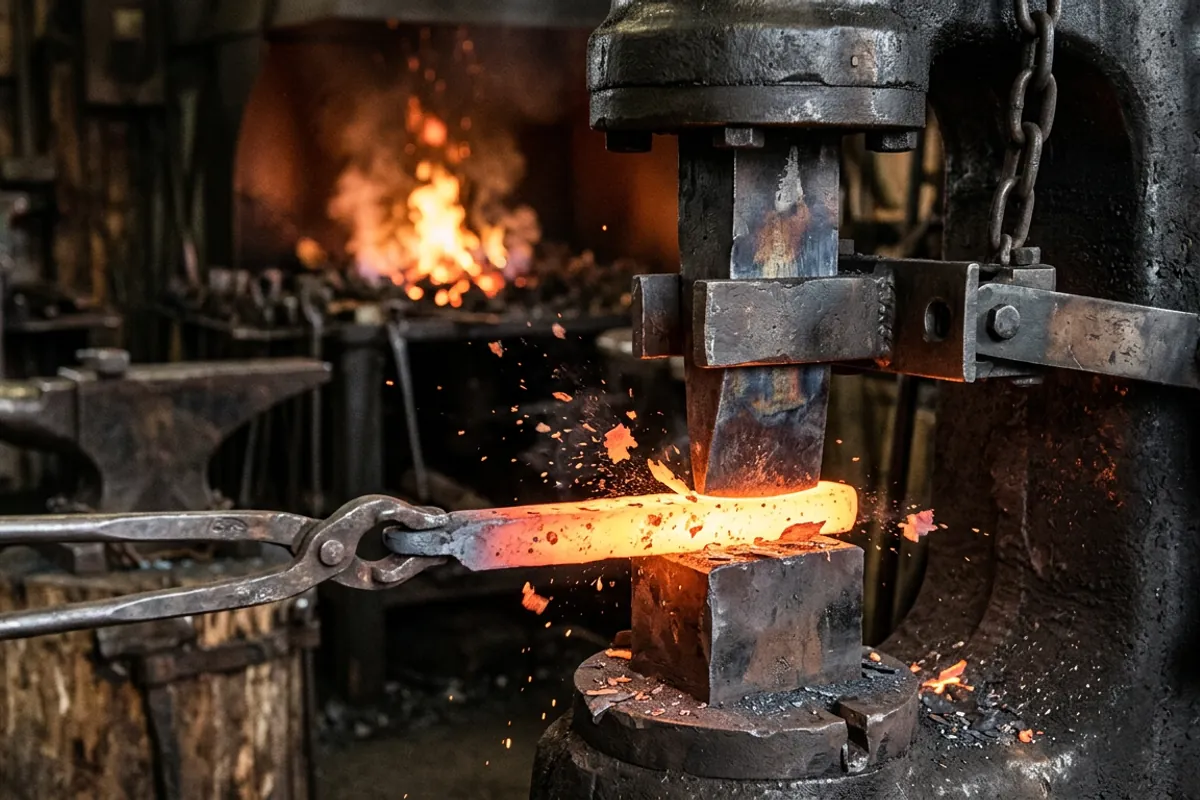
It sits between a hand hammer and a power hammer, and it does a different job than either. A power hammer moves mass fast and draws out heavy stock. A treadle hammer is slow, quiet, and precise. Every blow lands on the same spot with the same face angle, which is exactly what you want when you are stamping a maker's mark, sinking a chisel line, or setting a shoulder. If you have read my take on the blacksmith power hammer, think of the treadle hammer as the opposite tool: control instead of horsepower. It also overlaps with a hand held guillotine tool, which does similar guided work but still leaves you to swing the hammer yourself.
The market is thin for a simple reason. These are heavy, niche, and mostly shop built. There is no mass manufacturer stamping them out, so a finished one is expensive to make and expensive to ship, and most of the ones that change hands were welded up in somebody's garage from a set of plans. That is not a knock. It is just why "for sale" here means classifieds, kits, and plans more than it means a product page.
The treadle hammers worth knowing, at a glance
Here is the field the way I would lay it out for a friend. These are the makers' and plan authors' published figures. Where a spec is set by the builder or simply not published, I say so rather than guess.
Scroll horizontally to see all columns.
| Option | Type | Ram or head | Strikes on | What you get | Price signal |
|---|---|---|---|---|---|
| Uncle Al's (Riverside Machine) | Commercial, spring return | 65 lb head | Integral die and base | Finished hammer | Four figures |
| Christ Centered Ironworks kit | Bolt together kit | 6 to 12 lb sledge you supply | Your own anvil | Bracket kit, no welding | $500 |
| Clay Spencer In-Line (ABANA plans) | Guided vertical | Set by builder | Welded frame and die | Plans, you fabricate | Plans plus steel plus time |
| Grasshopper (Freeman plans) | Pivot vertical, 34 inch stroke | Set by builder | Welded frame and die | Plans, you fabricate | Plans plus steel plus time |
Those four cover the honest ways a home smith actually gets one. Let me take them in turn.
Uncle Al's and the finished commercial hammers
If you want to hand somebody money and get a working treadle hammer back, the best known option is Uncle Al's, sold through Riverside Machine. It runs a 65 lb head, which is a serious amount of mass over a small die, and it comes as a complete spring return hammer rather than a pile of parts. This is the same lineage as the old Off Center hammers that a lot of American smiths bought at hammer ins over the years, so you will see the design referenced under a few names.
The tradeoff is exactly what you would expect. A finished commercial hammer costs four figures, and because the thing is a heavy welded steel structure, freight is real money on top of that. Buy one and you are done: no fabrication, no chasing pivot tolerances. That is worth a lot if you do not weld, or do not want to spend your shop time building a tool instead of using one. I will not print a price, because the sellers quote these directly and the number moves, but go in expecting it to cost more than a good used anvil.
If a new one is out of reach, the used commercial market is where these actually turn up. Off Center and Uncle Al hammers get resold when smiths downsize or pass, usually through club networks and the classifieds I list further down. A sound used one is often the smart buy, because the design is simple and there is not much to wear out as long as the welds are good.
The bolt together kit route
Here is the option I would point a new smith to who has five hundred dollars and no welder. The Christ Centered Ironworks treadle hammer kit is a complete bolt together bracket kit that needs no welding at all. Per the maker, it goes together in about 45 to 60 minutes with basic hand tools, mounts to a 2x4 stud, and it lists at $500. You supply two things: a sledgehammer head in the 6 to 12 pound range to act as the ram, and your own anvil for it to beat upon.
That last part matters more than the price. Because this kit strikes down onto your anvil, the hammer is only as good as the anvil under it. A treadle hammer wants mass beneath the work so the energy goes into the steel and not into bouncing the base around. You want as much anvil as you can get under it, and a hard face that hits back. My Bessie is 148 lb and I would not want much less than that as a striking surface for repeated treadle blows.
If you are buying an anvil to sit under one of these and you are on a budget, a cast single horn anvil is a workable starting point, with the honest caveat that a budget cast anvil rebounds worse than a good steel faced one and is a compromise, not a forever tool.

Before you buy any anvil for this job, read my anvil weight guide so you match the mass to the work. The kit is a clever way in, but pair it with a rattly little 60 pound anvil and you will feel the difference in every blow.
Building from plans, the Clay Spencer In-Line and the Grasshopper
If you can run a welder and read a drawing, building is the cheapest road to a good treadle hammer, and it is how most of the nice ones out there got made. Two designs come up over and over.
The Clay Spencer In-Line is the guided vertical design distributed as ABANA plans. The ram travels straight down in guides so the blow lands flat and on center regardless of how tall your tooling is, which is the whole advantage over an older swinging arm hammer. Builders report it hits far harder than they expected for a foot powered tool. It is a real fabrication project, though: frame, guides, pivots, springs, and a base heavy enough to matter.
The Grasshopper is the other one worth knowing. It gets its vertical motion using only pivots, with no sliding guides to wear, and the published design runs a 34 inch stroke with a light kickback spring that only loads at the end of the stroke, so your leg is not fighting a spring the whole way down. You can read the design notes on the Grasshopper build site and more treadle hammer history and variants at spaco.org. Both of these assume real fabrication skill. If you like building your own tools, my notes on a homemade forge hammer are the same spirit: buy the plans and the steel, spend the weekends, and end up with a tool you understand top to bottom.
What owners say
I have stepped on a few treadle hammers at club forges and hammer ins, but I do not own one, so this section is owner consensus off the forums rather than my own long term use.
On the Clay Spencer In-Line, the signal is strongly positive. In the I Forge Iron review thread, builders describe being surprised at how hard the thing hits and how useful it is once the tooling is dialed in. The common upgrades that come up are practical, not corrective: a heavier base plate for stability, bronze bushings in the arms, better pivot pins. Over on BladeForums and in the American Bladesmith Society tooling forum, the same theme repeats: the smiths who built one keep it, and the value is in guided tooling and repeatable blows rather than raw drawing power.
The honest complaints are about the road in, not the tool. Building one is a real project, and a bad weld or a sloppy pivot shows up as lost energy at the die. Finding a used commercial one is luck and timing more than shopping. And owner signal on the newer bolt together kits is still thin, because they have not been in enough shops long enough, so treat that route as promising rather than proven.
Buying used without getting a boat anchor
A used treadle hammer for sale can be a great deal or a welded up headache, and the difference is visible if you look. Here is what I would check before handing over cash.
Start with the welds and the frame. Cracks at the joints, a base plate that flexes, or a repair weld over an old failure are all reasons to walk. Then work the mechanism by hand: excessive slop in the pivots, a notchy or seized guide, or a tired return spring all steal energy and get worse with use. Look hard at the die and striking surface for mushrooming or a sway, because that face is doing the work. Check that the base has real mass and can be anchored down, since a hammer that walks or rings on every blow will drive you crazy and rob the work. Finally, ask what tooling comes with it. A hammer with a set of shop made dies, fullers, and swages is worth meaningfully more than a bare frame, because that tooling is where a lot of the value lives.
Where do these surface? Not on a tidy product page. The live ones are the I Forge Iron classifieds, the American Bladesmith Society tailgate listings, the dedicated treadle hammer group on Facebook, eBay and Etsy for the occasional unit, and above all the tailgate area at any regional hammer in. Bring a friend and a strong back, because a treadle hammer is a two person lift.
Safety, this tool bites differently
I am safety serious about everything in the shop, and a treadle hammer earns extra attention because of how you stand at it. Both of your hands are down at the work holding stock and a top tool, your face is close over the dies, and your foot is on the treadle. That is a different risk picture than a hand hammer, where one hand and your whole upper body stay clear of the strike. Scale flies up off hot steel, tools can slip, and the ram comes down with real force an inch from your fingers.
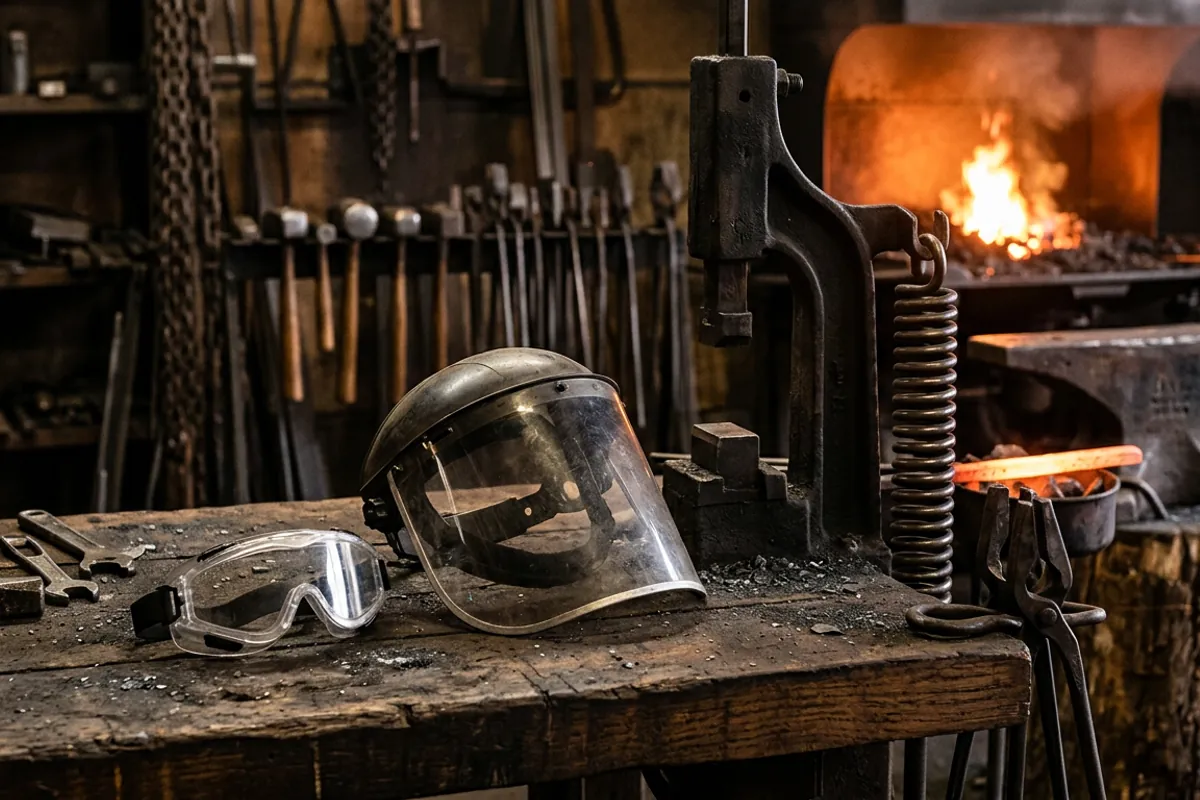
So protect your eyes first, every time, with glasses or goggles rated to ANSI Z87.1. That standard is the whole point: it is the impact rating that means the lens will take a flying chip instead of shattering into your eye. A dual mold goggle like the DEWALT Concealer (paid link) seals against scale better than open temple glasses and is cheap enough that there is no excuse. Over the top of that, a face shield adds coverage for the rest of your face, and something like the Jackson Safety F4XP (paid link) is inexpensive and rated to the same standard. Understand the order, though: a face shield is secondary protection worn over your safety glasses, never instead of them. A shield alone is not eye protection.
The rest is discipline. Keep your fingers out of the ram path and never rest a hand where the head travels. Anchor the hammer down so it cannot walk. Keep the treadle clear so you do not trip a blow you did not mean to. I quenched a blade too close in a cotton shirt with no face shield early on, the oil flared, and it took my eyebrows; I kept my eyesight by luck, not by being careful. Do not learn that lesson the way I did. Natural fiber clothing near heat, eyes rated and covered, and a clear head about where the moving parts are. My full rundown lives in the blacksmith safety gear guide.
What I would tell a friend
Three roads, pick by what you have. If you have the budget and can find one, a finished Uncle Al's or a sound used Off Center hammer is buy it and forget it. If you have a welder and a few weekends, build the Clay Spencer In-Line and you will end up with a better tool for less money and understand every joint in it. If you have neither, the $500 Christ Centered bolt together kit onto a solid anvil is the honest cheap way in, as long as you put real mass under it.
What I would skip: any used unit with cracked welds, a flexing base, or no tooling, and the temptation to run the bolt together kit on a light rattly anvil. And whatever you end up stepping on, wear the Z87.1 eyes and keep your fingers out of the ram path. For where the treadle hammer fits alongside the rest of your striking tools, the hammers and tongs hub is the place to wander next.