I have verified two live Amazon listings (B098JRTG52, B07LDQTQDB), non-marketplace spec sources (Centaur Forge, Simond Store), and real owner-consensus threads. The VEVOR refs are both anvils, so they don't belong in a tongs guide and I'll leave them out. Here's the article.
If you are hunting old blacksmith tongs at farm sales, flea markets, and estate auctions, here is the short version before you hand over any money: a sound old pair usually beats a cheap new one, because the steel tends to be better and someone forged it to hold real work, but only if the jaws still close square and the joint is tight. If you cannot turn up a good old pair, do not stall your forging over it. A wolf jaw tong grips most of what a beginner heats, and I will point you at one below that costs about what a decent old pair fetches at auction. None of this is a bench test of a specific model. I buy and use old tongs, so the "what to check" part is hands on my own rack. The new-production picks lean on published specs and what owners report on the forums, weighed against years on the anvil next to Bessie, my 148 lb Trenton.
Why an old pair can beat a new one
Most old tongs on the table at a farm auction were forged by a working smith, either for the shop or to sell. That matters. The body is usually mild steel or wrought iron drawn out by hand, and the jaws were shaped to actually hold something. Nobody wanted them cheap for looks. They were made because a smith needed to pull a specific bar out of the fire without dropping it on his boot.
The cheap imported tongs you see everywhere are a different animal. Some are fine. Plenty are not. The common complaints on the forums are soft jaws that spread under the hammer, jaws that do not line up when you close them, and reins so short your hand cooks. On I Forge Iron, smiths who have bought the budget imports treat them as a starting point you study and rework rather than a finished tool, and several say the honest move for a beginner is to buy one or two, use them, then forge your own once you understand what a good pair does (I Forge Iron, "Buying tongs"; I Forge Iron, "Tongs: roll your own or buy them?").
So the appeal of old tongs is simple: for the price of a fast-food lunch you can often get a hand-forged tool that grips better than a new import out of the box. The catch is that you have to know what you are looking at, because a worn-out old pair is worse than a mediocre new one. If you want the full deep dive on the vintage market, I wrote a companion piece on the antique blacksmith tongs worth buying; this guide stays focused on judging a pair in your hand and what to do when the old ones do not turn up.
What to check before you buy old tongs
Pick the pair up and close the jaws on a piece of stock the same size you would forge. Then run through this, in order.
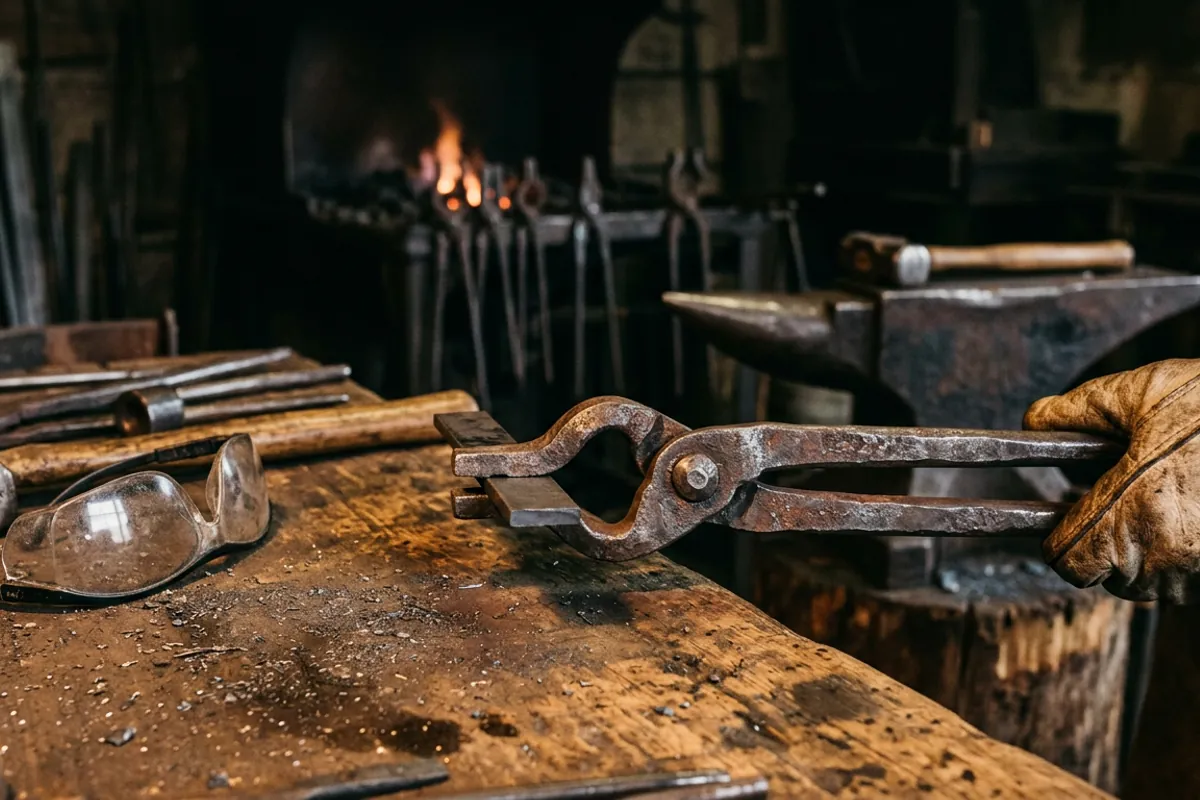
Jaw alignment. With the jaws closed on stock, the gripping faces should meet square, with contact along the whole bite and no daylight gap. Sight down the jaws for a twist. A tong that only touches at the tip, or that scissors off to one side, will let the work pivot. That is not just annoying. A bar that rolls in the jaws can swing a hot end toward your hand or your face.
Play at the rivet. Wiggle the reins side to side at the joint, which old-timers call the boss. A little lateral play is normal and can be snugged up by peening the rivet or a couple of taps at a red heat. A lot of slop, where the whole joint feels sloppy and the jaws wander, means the rivet hole or the boss faces are worn, and that is a harder fix.
Cracks at the boss. Look hard where the reins meet the jaws. A crack there can be forge-welded shut by a competent smith, and one experienced hand on The Garage Journal notes flatly that cracks "can be fixed" (The Garage Journal, "Blacksmith tongs"). But if you are a beginner, walk past a cracked pair. You are buying a tool to use, not a welding project.
The reins. Reins give you leverage and keep your hand off the heat. Short reins run hot, and a bent rein straightens in thirty seconds cold in the vise, so do not reject a good pair over a bend. Reject it over a jaw you cannot fix.
Fit to your stock. A tong is happiest holding one size and shape. A flat-bit or box jaw holds flat bar, a V-bit holds round and square, a wolf jaw does a bit of everything. Do not expect one old pair to do it all. If it grips the bar you actually forge, it is the right tong.
On safety, I do not soften this. I lost my eyebrows early on to a quench-oil flare-up because I stood too close in a cotton shirt with no face shield, and I kept my eyesight by luck. A tong that drops or rolls hot steel is the same class of hazard. Wear ANSI Z87.1 rated eye protection at the fire and the grinder, keep natural fibers next to your skin because synthetics melt, and do not run a tong that will not hold the work. If you want the full rundown, I keep it in blacksmith safety gear.
What old tongs cost, and where to find them
Prices are all over the place, which is exactly why you should never overpay. At farm auctions and flea markets, common unmarked tongs routinely move for 5 to 15 dollars a pair, and on Practical Machinist smiths describe picking them up anywhere from a dollar to ten (Practical Machinist, "Blacksmith tongs"). Named makers, unusual patterns, and matched sets can run more, and some old pieces are genuinely rare while others are worthless scrap. Most everyday tongs are unmarked because working smiths forged their own, which makes the maker impossible to identify (LoveToKnow, antique blacksmith tools).
The single most useful pricing trick is eBay's sold-listings filter. Ignore the asking prices, which are fantasy, and look at what pairs actually closed at. That tells you the real market. Beyond that, estate and farm auctions are where the deals live, blacksmith club meets and swaps are better than either because the seller can tell you what a tong holds, and general antique stores are the worst value because the tongs get priced as decor. The same logic that applies to hunting old blacksmith hammers applies here: buy the tool, not the patina.
New tongs worth owning when the old ones do not show up
Some weeks the auction table is bare, or every old pair has a jaw you cannot save. That is when a new tong earns its keep. Below are published specs for the ones I would actually consider, pulled from the makers and non-marketplace retailers, not from a marketplace product page. Where a figure is not published, I say so rather than invent it.
Scroll horizontally to see all columns.
| Tong | Jaw type | Overall length | Rein length | Steel | Price tier |
|---|---|---|---|---|---|
| Generic import wolf jaw (17 in) | Wolf jaw | 17 in (listed) | not published | not published | Budget |
| Simond Store set of 4 | Wolf, flat, round, mandrel | 16 in | 13 in | 5160 spring steel | Budget |
| Centaur box jaw, 1-1/2 x 3/8 | Box (flat) jaw | 17-1/8 in | 14 in | 8560 steel | Mid |
Simond publishes the set as 16 inch overall with 13 inch reins, forged from 5160 spring steel, sized to hold 1/4 inch flat, round, and square bar (Simond Store). Centaur lists its box jaw at 17-1/8 inches overall on a 14 inch rein with a 1-1/2 by 3/8 inch jaw in 8560 steel (Centaur Forge). Those are the numbers that matter: rein length for leverage and heat, and jaw size for the stock it actually fits.
The wolf jaw tong I would reach for first
If I could only hand a beginner one new tong, it would be a wolf jaw in the 16 to 17 inch range. The wolf jaw has stepped, interlocking notches that will hold flat, round, and square stock in a usable range, so a new smith is not stuck buying five tongs before the first project. It is the closest single tool to the general-purpose old pair everyone wishes they had found.
A representative one is a 17 inch wolf jaw sold as heavy-duty steel with a three-point grip. The listing states the 17 inch length; the steel grade is not published, which is worth knowing before you buy, because grade is exactly where the budget imports vary most. Owners generally report these hold work fine for light and medium stock, with the usual budget caveat that some arrive needing the jaws dressed to sit square. For a beginner heating quarter-inch and half-inch bar, that is a reasonable trade, and if the jaws need a tweak, adjusting them teaches you what a good tong feels like.
Check price on Amazon (paid link)
If you want the reasoning behind picking a first tong worked all the way out, I laid it out in the blacksmith tongs I would buy first.
A starter set that covers the common stock
When someone wants to skip the one-tong-at-a-time route, a small set makes sense. The Simond Store set of four gives you wolf, flat, round, and mandrel jaws at 16 inches overall on 13 inch reins, forged from 5160 spring steel, per the maker (Simond Store). 5160 is a real spring steel, the honest choice for a tong body, and 13 inch reins are long enough to keep your hand out of the heat.
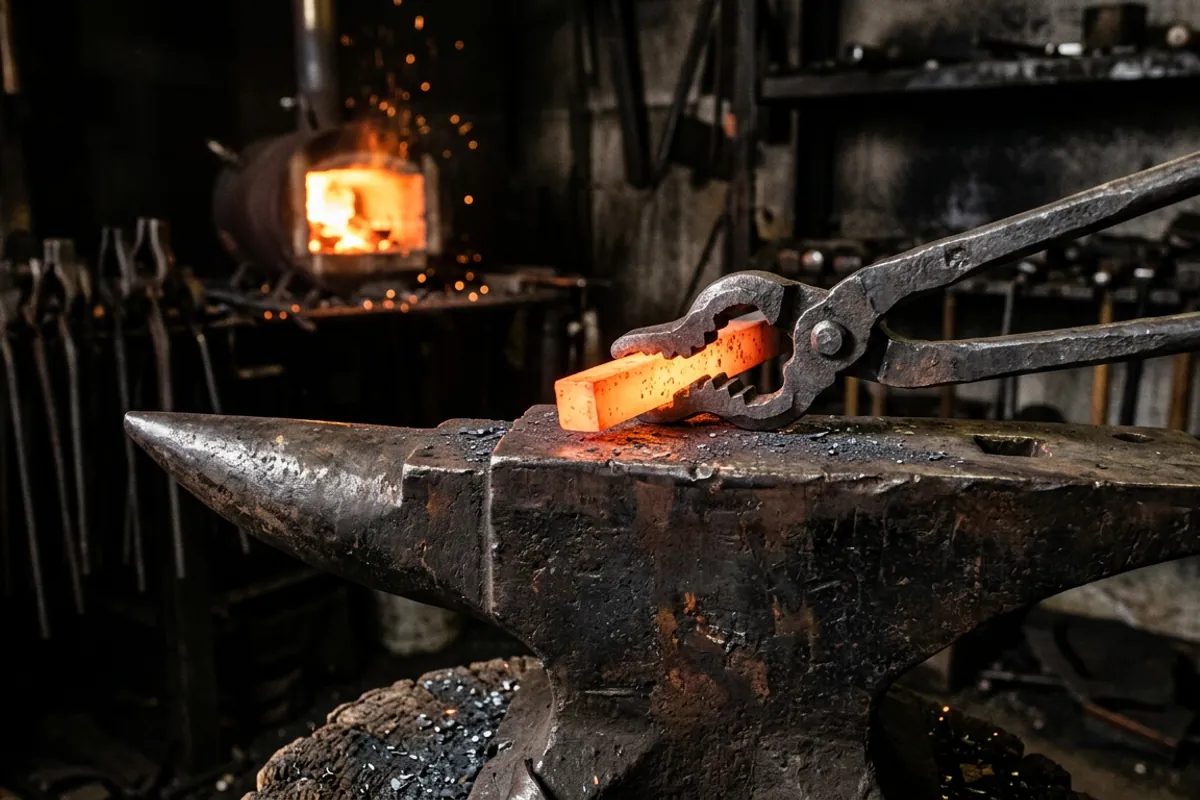
The set is sized around 1/4 inch stock. That is the honest read: it is a light-to-medium set, not a heavy-forging kit, and if you move up to inch-plus bar you will outgrow the smaller jaws. For a beginner working knife stock and small hardware, though, four tongs that each do one job well beats one tong fighting everything. Treat any set like this the way the forums treat all budget tongs: check each pair closes square out of the box, and be ready to dress a jaw.
Check price on Amazon (paid link)
New box jaw, and the buy-versus-make question
For flat bar specifically, a box jaw is hard to beat, because the jaw wraps the bar on three sides and will not let it twist. Centaur's box jaw is a known-good new-production tool at a real spec: 17-1/8 inches overall, 14 inch rein, 1-1/2 by 3/8 inch jaw, 8560 steel (Centaur Forge). It costs more than the imports, and it is worth it if you forge a lot of flat stock and want a tong you do not have to fix first.
Which brings up the oldest argument in the shop: buy tongs or make them. Full-time smiths on I Forge Iron say plainly they do not have time to forge their own and just buy good ones. Hobby smiths often go the other way, because forging a pair of tongs is one of the projects that genuinely teaches your hands to draw out, punch, and rivet. My honest take: buy one or two decent tongs so you can forge today, hunt old pairs at every auction you pass, and make your own once you have a tong to hold the hot work while you build the next one. If you want a specialty pair that teaches you and costs almost nothing in steel, railroad spike tongs are a good first make.
What owners say
For the new-production tongs here, I have not run each model down in my own shop, so this is owner consensus, attributed and weighed against general experience, not a bench test.
On the budget imports, the recurring forum theme is "usable, but check them." Smiths on I Forge Iron treat cheap tongs as a fine place to start and a good thing to study, with the expectation that some arrive with jaws that need dressing to close square, and that a beginner is better served fixing a jaw than waiting to forge (I Forge Iron, "Buying tongs"; I Forge Iron, "What tongs should I buy"). Nobody on the forums calls the imports shop-grade heirlooms, and neither do I.
On old tongs, the consensus is warmer and more cautious at once: the good ones are excellent and cheap, the market is wildly uneven, and unmarked is the norm because working smiths made their own (Practical Machinist; LoveToKnow). The signal from every thread is the same one I gave you above: judge the tool, not the age.
What I would tell a friend
If a sound old pair is on the table and the jaws close square with a tight joint, buy it, especially at 5 to 15 dollars. That is the best tong value in this whole trade, and it is why I keep checking every farm auction. Walk past cracked bosses and sloppy joints unless you are ready to weld. When the old ones do not show, a 16 to 17 inch wolf jaw gets a beginner forging that day, and a small 5160 set covers the common stock without buying tongs one at a time; step up to a Centaur box jaw when you forge enough flat bar to want a tong that grips it perfectly out of the box.
The note that matters most is the one that took my eyebrows: a tong that will not hold the work square is a safety problem before it is an annoyance. Fix it or set it down, wear your Z87.1 eye protection and natural fibers at the fire, and keep the rest of your kit sorted from the hammers and tongs hub. Old or new, the only tong worth owning is the one that grips.