That finance call was irrelevant to this task and I shouldn't have made it. Here's the article.
If you can find a sound old blacksmith hammer at a farm auction, an estate sale, or the back table of a flea market, buy it before I get there. A good used hammer, a drop-forged head from the years when tool steel was cheap and skilled labor was not, is usually the best hammer money a new smith can spend, and I have handed more than one down to a weekend student and watched it outwork a hammer that cost three times as much new. The catch is that most of the old heads you will actually see are not that hammer. They are cracked, mushroomed, ground into a shape nobody should forge with, or hung on a handle that will let go on the second heat. So this guide is two things at once: how to tell the old blacksmith hammer worth carrying home from the one that is just heavy scrap, and, because a good one is not always in reach, which new hammers I would put in your hand instead.
One honest note before we start. I own and swing a couple of old hammers every shop day, so the buying checks below come straight off my own bench. The new hammers in the roundup are a different matter. I have handled Vaughan hammers for years, but I am leaning on published specs and the steady drumbeat of owner reports from the forums, weighed against what I know a working hammer has to do, not a bench test of every model. Where a claim is owner consensus and not my own hands, I say so.
Why a good old hammer beats most new ones
Walk into any club forge and half the hammers on the racks are older than the smiths swinging them. There is a reason for that. A cross pein or ball pein head forged fifty or a hundred years ago by Vaughan, Plumb, True Temper, Warwood, or a dozen German makers was drop-forged from real high-carbon tool steel, hardened, and tempered by a company that made striking tools all day and would hear about it if the face chipped. That is a lot of quality per dollar, and the dollar is usually small. A no-name old head in a junk box goes for the price of lunch.
The other thing an old hammer gives you is feel. A head that has been swung for decades has usually had its face crowned and its edges knocked off, either by the factory or by a smith who knew what he was doing. A properly dressed face, slightly domed with no sharp corners, moves metal without leaving hammer marks and tracks in the eye of your work. A brand-new hammer off the shelf almost never comes like that, which I will come back to. So a good old hammer can hand you both a better steel and a better shape than a new one, for less money. When people ask me what a beginner actually needs, I tell them the same short list I put in the beginner blacksmith kit guide: one anvil, one forge, tongs, and one hammer that fits your hand, and that hammer is a great place to buy old.
The whole reason old hammers are still around and still good is that a forged steel head does not wear out in a human lifetime of hobby use. The failure points are the handle and the abuse, not the steel. That is what your inspection is really checking for.
What to check before you hand over cash
Here is the order I go through an unknown head, and it takes about a minute.
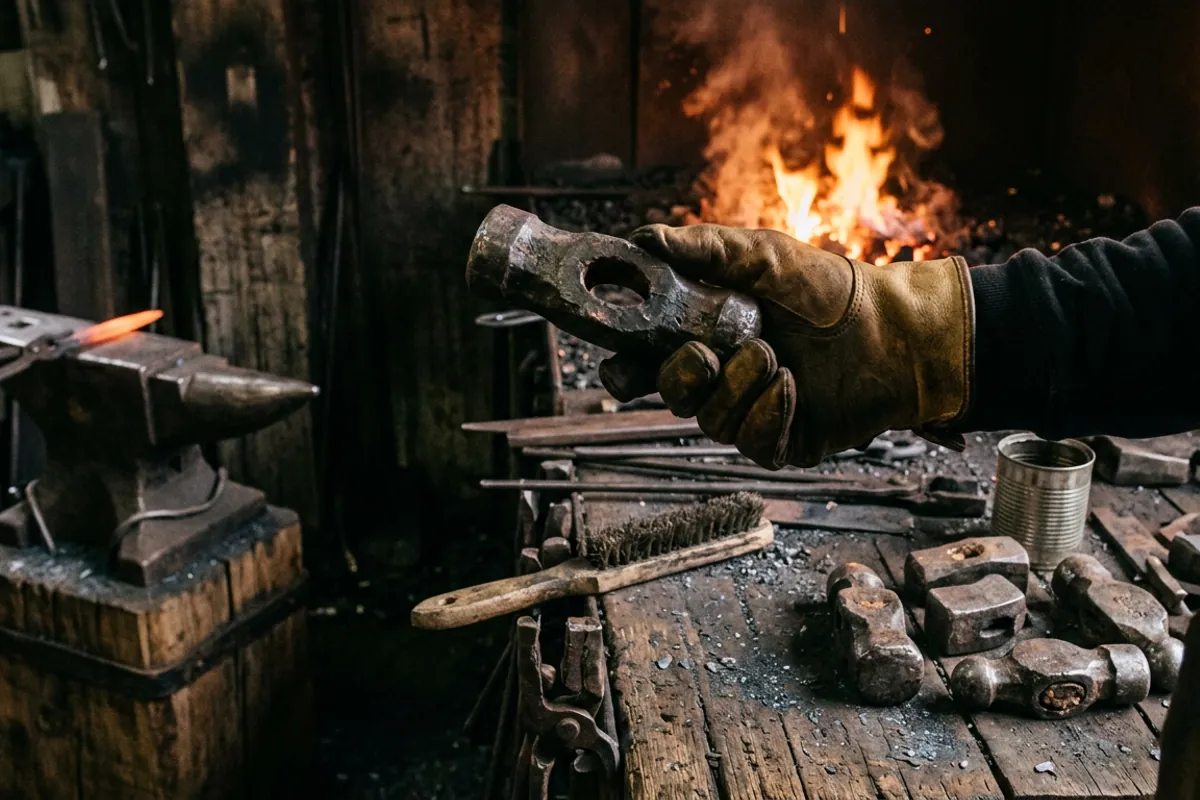
Look for cracks first, because a crack is a walk-away. Run your eye and your thumbnail around the eye, where the handle passes through, and around both the face and the pein. The eye is where stress concentrates and where a hairline crack likes to start. A cracked head is done. You cannot weld it back to a safe striking tool at home, and a hammer that lets go of a chunk at forging heat is exactly how people lose eyes and teeth. No price makes a cracked head worth it.
Check the face for mushrooming and chips. Mushrooming is the splayed, curled lip you see on a striking face that has been beaten off-center for years. A little is normal and grinds off. A face that has curled into a sharp overhanging rim is a hazard: those thin curls of hardened steel snap off under a blow and fly. The safety literature is blunt about this. The Canadian Centre for Occupational Health and Safety says plainly to never use a striking tool with a mushroomed head and to dress it down or replace it (CCOHS, struck tools). A mushroomed face is fixable on a grinder, so it is not a deal-breaker, but price it as a project, not a ready tool. A face with a real chip out of it, a divot, is a harder call, because grinding a chip out can mean grinding away a lot of face.
Read the shape. Some old hammers have been ground half to death by a previous owner, one face dished out or ground way off square, the pein filed to a chisel. You can re-dress a lot, but you cannot add steel back. If half the head is gone, pass.
Check the weight against your hand, not the sticker. For general forging most smiths land between 2 and 3 pounds. Heavier is not better; a hammer you cannot control for a full heat will wreck your elbow long before it makes you a better smith. I go deeper on sizing in the blacksmith cross pein hammer guide, but the short version is that a 2 to 2.5 pound head suits most people starting out.
The handle is the cheap part, so do not let a bad one kill the deal. A loose head, a cracked handle, a dry gray stick that has lost the head three times already, none of that matters if the head is sound, because a new handle is a few dollars and an evening. Judge the head. Buy the head. Re-hang it at home.
Two things I do not care about at all: rust and ugliness. Surface rust wire-brushes off and tells you nothing about the steel underneath. A hammer that looks rough and rings true is a better buy than a shiny one with a crack.
New hammers I would buy when the old ones dry up
You will not always find a good old head when you need one, and some folks would rather buy once and forge tonight. Fair enough. The good news is that a few makers still build a cross pein the old way, drop-forged from carbon tool steel, so buying new does not mean buying junk. Here is the field, published specs only. I have cited each figure to the maker or a real tool retailer, not to a marketplace page.
Scroll horizontally to see all columns.
| Hammer | Head weight | Handle | Overall length | Made in |
|---|---|---|---|---|
| Vaughan S32 cross pein | 2 lb | Hickory | 14.5 in | USA |
| Picard 8A, German short pattern | 3.3 lb (1500 g) | Ash | 14.96 in (380 mm) | Germany |
| Picard Swedish-pattern cross pein | 2.2 lb (1000 g) | Ash | not published | Germany |
Sources: the Vaughan figures are from The Hammer Source listing for the S32; the Picard 8A weight, ash handle, 380 mm length, and Made in Germany are from KC Tool. Where a maker does not publish a length, I have written not published rather than guess. Prices on all of these stay qualitative here on purpose: expect the Vaughan in the mid range and the imported Picards a step above.
The Vaughan cross pein, the closest new thing to an old American hammer
If I could not lay hands on a good old head and had to buy one new hammer, this is where I would start. Vaughan has been making striking tools in the United States since 1869, the S32 is a 2 pound drop-forged cross pein on a 14.5 inch hickory handle, and it is genuinely the same kind of tool the old heads in my rack started life as. The Hammer Source listing describes a polished, beveled face and a hickory handle wedged into a tapered eye, which is exactly the construction you want.
The honest tradeoff is the same one every new hammer carries: it comes with a flatter, sharper-edged face than a forging hammer should have. Out of the box it will leave marks and dig corners. Fifteen minutes on a grinder to crown the face and break the edges turns it into a real forging hammer, and I would do that to a new one before its first heat. That is not a knock on Vaughan; it is true of nearly every hammer sold for general striking. Owner consensus on the forums backs the brand: smiths reach for old Vaughans and Plumbs for a reason, and the current production still earns the name.
Check price on Amazon (paid link)
If your hand wants a bit more head, Vaughan and Seymour both sell a 3 pound cross pein in the same pattern; a 3 pound Seymour cross pein (paid link) is a common budget-friendly new option, though a 3 pound head is more hammer than most beginners should start with.
The Picard, a German hammer worth the money
The Germans never stopped making blacksmith hammers properly, and Picard is the name you will see most. The 8A German short pattern is a 3.3 pound (1500 gram) head of Picard's own hardened and tempered alloy steel on an ash handle, 380 mm overall, and it is built with a ring wedge that keeps the head tight, per KC Tool. The German pattern has a square, slightly domed face and a short cross pein, and a lot of smiths swear by the balance.
Two honest caveats. First, 1500 grams is 3.3 pounds, which is a real forging hammer, not a beginner's hammer; Picard also makes lighter heads, including a roughly 1000 gram (2.2 pound) Swedish-pattern cross pein that suits a smaller hand or a new smith better. Second, imported German hammers cost more than a domestic Vaughan and a great deal more than a good old head off a junk table, so you are paying for fit and finish, not better metal than a hundred-year-old American drop forging. If you want the new tool and you want it to feel dialed in, the Picard is the one the forums point at.
Check price on Amazon (paid link)
If you want the lighter German head, the Picard Swedish-pattern cross pein (paid link) is the one to look at.
Dressing and rehandling an old hammer
Say you did the smart thing and brought home a sound old head with a mushroomed face and a tired handle. Here is how you make it a tool again, and here is where I get safety-serious, because this is the step people rush.
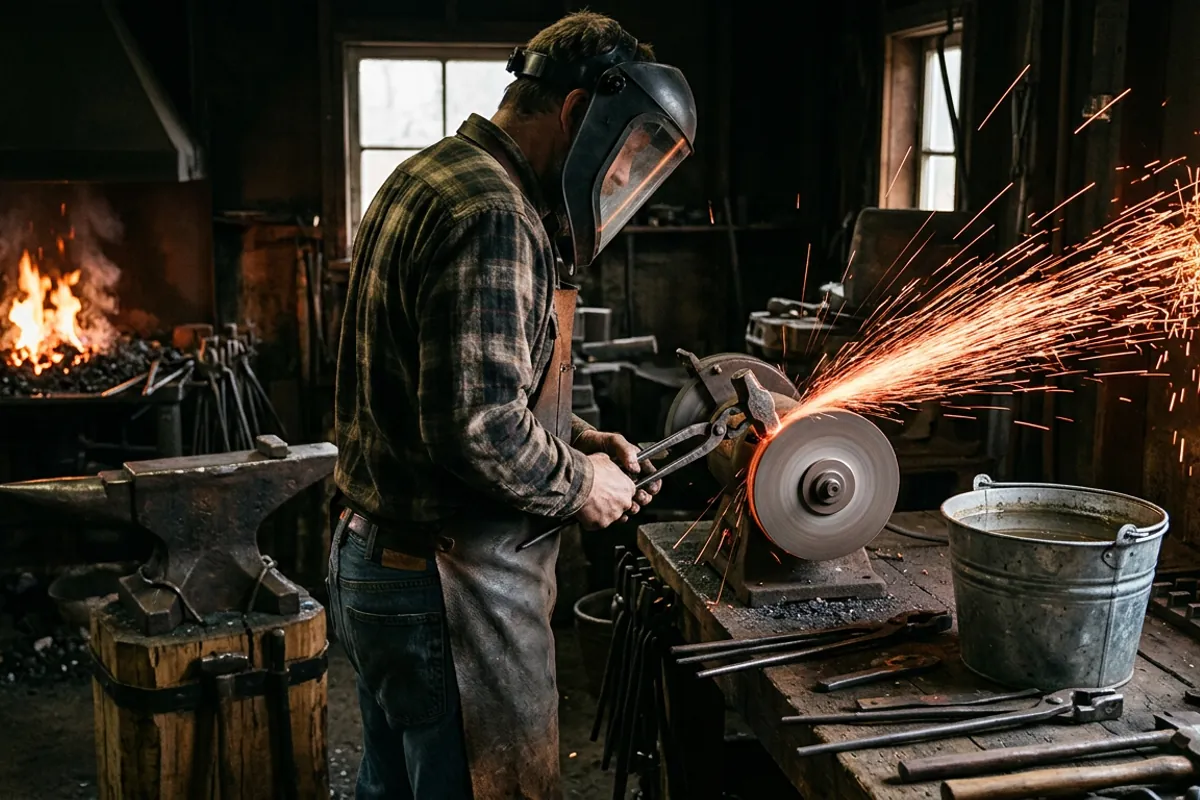
Dressing the face is grinding work, and grinding work is eye-protection work. Wear impact-rated glasses that meet ANSI Z87.1, and a face shield over them at the grinder, not one or the other. Hardened steel dust and the odd flying curl of mushroom do not care how careful you are. The point of dressing is to remove the splayed lip and put a gentle crown on the face with the sharp edges radiused off, so it moves metal cleanly and stops the mushroom coming back. Grind a little, dip in water, grind a little; if you let the edge of the face go blue you have drawn the temper and ruined it. The struck-tool safety guides say the same thing about not overheating the steel.
How much crown and how far to radius the edges is a matter of taste, and the forums argue about it forever. The long-running I Forge Iron thread on dressing a hammer is a good place to read smiths hash it out; the numbers that come up are a broad face radius with the perimeter edges broken to roughly a half inch radius, which is a sane starting point. You are not machining to a spec. You are making a face that does not leave sharp tracks.
Rehanging is simple and worth doing right. Buy a hickory handle sized to the eye, cut the kerf for the wedge, seat the head, drive a wooden wedge and then a steel cross wedge, and let it be. Do not soak the handle in oil hoping to swell it tight; that is a myth that leaves you with a soft grip and a head that still walks. A properly wedged dry handle stays put. If you have never hung a head, this is one of the better beginner jobs there is, and it lives on the same skill shelf as the small projects in the beginner blacksmith projects list.
What owners say
For the new hammers I have not run through a formal test, here is the forum signal, attributed and honest.
On the old versus new question, the consensus across I Forge Iron and the blacksmithing subreddits is lopsided in favor of good old American and German heads: smiths repeatedly recommend haunting flea markets and estate sales for old Vaughan, Plumb, and True Temper cross peins over buying most new hardware-store hammers, because the old drop forgings are better steel and better value. That matches my own bench and the racks at every club forge I have visited.
On Vaughan current production, owner reports are steady and positive; the brand's long US manufacturing history and drop-forged construction come up again and again as the reason to trust it, and the common note is that you should dress the face before forging with it. On Picard, the German makes carry a strong reputation for fit, balance, and a tight head, with the recurring complaint being price, not quality. The thin spot in all of this is that owner signal on any one specific new hammer model is lighter than owner signal on old hammers in general, simply because most working smiths are still swinging inherited steel. So read the new-hammer picks as owner consensus weighed against shop experience, not as a bench test, exactly as I flagged up top.
If you want to go deeper on old tools specifically, the antique blacksmith hammer guide covers makers and marks in more detail, and the broader blacksmith hammer buying guide walks through hammer types and sizing. All of these sit under the hammers and tongs topic hub if you want the whole cluster.
What I would tell a friend
Buy the old hammer. A sound old blacksmith hammer, a 2 to 2.5 pound cross pein with no cracks, a face you can dress, and an eye that will hold a handle, is the best hammer value there is, and finding one is half the fun. Check for cracks first and walk away from any you find; treat mushrooming and a tired handle as cheap fixes, not deal-breakers.
If a good old head is not in front of you, buy a new Vaughan cross pein and spend fifteen minutes dressing the face before you forge with it, or step up to a Picard if you want the German feel and do not mind the price. Skip the shiny no-name imports with cast heads and painted faces; a cast head is not a forging hammer and can shed metal.
And whatever you swing, protect your eyes. The one non-negotiable in this whole guide is the same one that took my eyebrows years ago taught me the hard way: Z87.1 glasses at the anvil, glasses and a shield at the grinder, every single time. A hammer is the cheapest tool in the shop to replace. Your eyes are not.