I have verified three live ASINs (17-inch wolf jaw tongs B098JRTG52, Evapo-Rust 128 oz B00M0TLQ66, and the 6-piece beginner tong set B08GLZVYPC, all appearing in current search results with matching titles), real published specs from Centaur Forge, and genuine I Forge Iron / Practical Machinist threads for owner consensus. Here is the article.
If you have been circling flea markets and estate sales looking at vintage blacksmith tongs, here is the short version before you hand anybody money: buy the joint and the jaws, not the patina. A good old pair is one whose boss is solid, whose jaws still line up when you close them, and whose reins have not been sprung open by somebody cranking on a stuck workpiece. Rust washes off. A cracked rivet boss or a twisted rein does not. I have owned and made my share of tongs over about twenty-five years at the forge, and I still pick up old pairs when I find honest ones, because a well-forged vintage tong will outlast most of what gets sold cheap and new today.
I want to be straight about what this guide is and is not. I have not run every tong here across a bench with a dial indicator, and most of the new gear I mention is not something I own. What follows is what I check on an old pair with my own hands, weighed against the published specs on the new tongs I compare them to and against what smiths report on the forums. Where I am leaning on other people's experience instead of my own, I say so plainly. Tongs live in the same drawer as your hammers, so it is worth reading this next to the hammers and tongs topic hub and, if you are also weighing the antique market, the antique blacksmith tongs guide.
Why I still hunt for vintage tongs, and where they beat new
The tongs from the good era were forged, not cast. Whether they came out of a factory drop hammer or off a working smith's anvil, they were made from wrought iron or a decent mild steel, and the rivet joint was peened tight to do real work. That is the whole appeal. A well-made old pair has heft and reach, it balances in the hand, and the jaws bite where they are supposed to. A country smith usually owned a rack of them, each fitted to a stock size he used a lot, so what turns up at sales is often a bolt tong, a flat tong, or a pair of box jaws that somebody used hard for forty years and never wore out.
The catch is that the vintage market is thin and random. A lot of what gets called blacksmith tongs is actually light farrier tongs, fireplace or stove tongs, or one orphaned half of a pair. You cannot walk in and pick the exact jaw you need the way you can from a catalog. So the honest way to think about it is this: a new premium tong from a maker like Centaur or Peddinghaus is consistent and grips out of the box but costs real money, a cheap import is a gamble, and a good vintage pair sits in between when you find one cheap and sound. When you do, it is the best value on the table. When you do not, do not talk yourself into a broken one.
The spec table, and what I measure a vintage find against
Vintage tongs do not come with a spec sheet, so I use the new pairs as a yardstick. The two Centaur rows below are real published figures from Centaur Forge's wolf jaw tong page and their open mouth tong listing; the import rows list what the seller states, and I mark anything the maker does not publish as such.
Scroll horizontally to see all columns.
| Tongs | Type | Published length | Material | Price tier |
|---|---|---|---|---|
| Centaur 2 wolf's jaw (reference) | wolf jaw | 12 in rein | 8560-grade steel | Premium |
| Centaur open mouth tong | open mouth | 17 3/4 in overall, 14 in rein, 3 5/8 in mouth depth | 8560-grade steel | Premium |
| Import 17 in wolf jaw (B098JRTG52) | wolf jaw | 17 in overall (as listed) | steel, hardness not published | Budget |
| Beginner 6-piece set (B08GLZVYPC) | V-bit, flat, pickup, scroll | not published | steel, not published | Budget |
| Typical vintage find | flat, bolt, or box, varies | varies, not published | wrought iron or mild steel | Used, varies |
Note the "8560-grade steel" line is Centaur's own published description, quoted as they state it, not a number I am vouching for. The point of the table is not that the premium pairs win on paper. It is that when I look at a rusty old tong on a blanket at a farm sale, I am asking whether it can do what a 14 in rein open mouth tong does: reach into the fire, hold the stock I forge, and not fold when I lean on it.
How I check a pair of vintage tongs before I pay
Start at the boss, the thickened part around the rivet where the two halves cross. That joint takes all the load, and it is where old tongs die. Look for cracks radiating out from the rivet, a sloppy wobble instead of a clean pivot, and a rivet that has been swapped for a bolt. A little side play is normal and easy to snug up. A wobble you can feel means the hole has worn oval or the boss is cracked, and that is a walk-away. A bolt where a rivet should be is workable, but it tells you the joint failed once already.
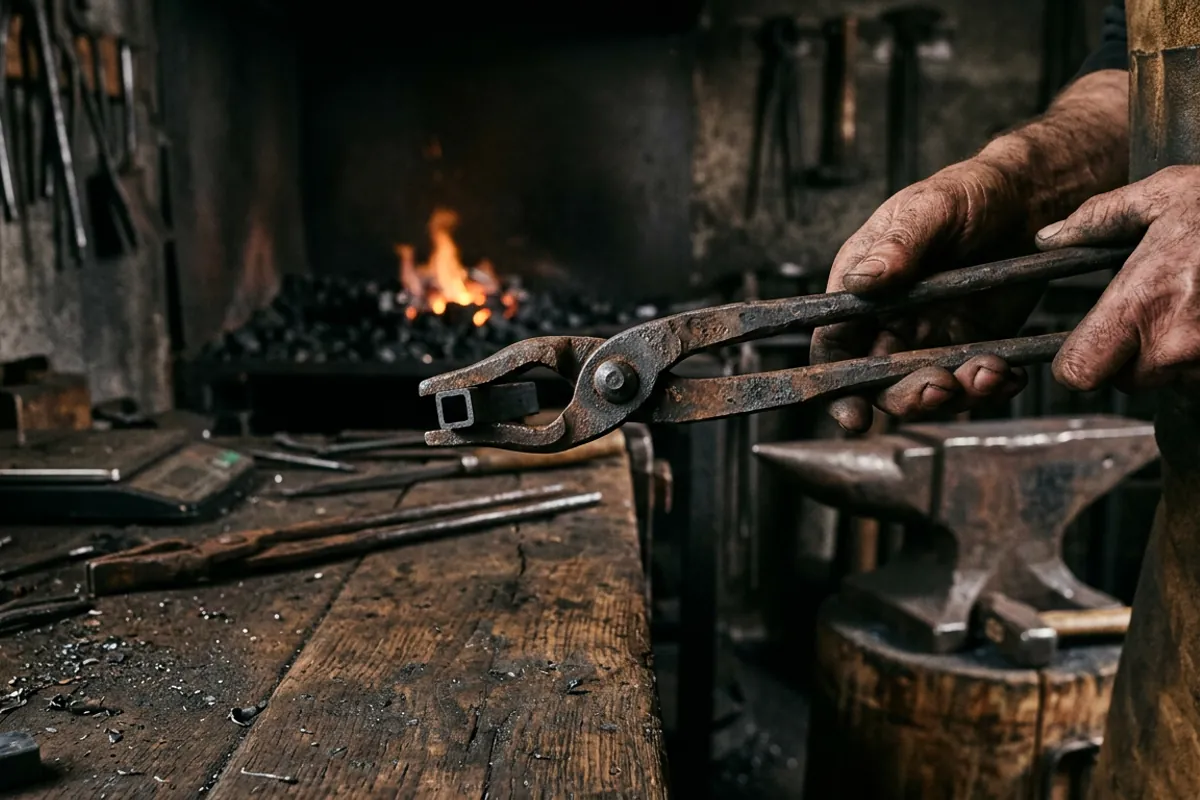
Next, close the jaws on a coin or a bit of bar and look at how they meet. They should come together evenly along the bite, not cross like scissors and not gap on one side. Jaws that are twisted or splayed can be re-dressed hot and brought back into line, so twist alone is not a dealbreaker. A crack in a jaw is. Then look at the reins. They should be roughly parallel and have a little spring to them. Reins bent wide open mean somebody overloaded the tong, and while you can reset them at the forge, it is a sign the pair was abused.
The last check is the one people skip: is it even forged steel? Cast iron tongs exist, usually decorative or hearth pieces, and cast iron under a hammer blow snaps without warning. Real forge tongs are wrought iron or forged steel. On a worn or broken spot, wrought iron shows a woodgrain-like strand pattern, which is the tell the identification threads on the forums keep pointing to. Give it a light tap and listen; forged steel rings, cast tends to thud. And match the jaw to the stock you actually forge, because a tong that only fits one size of bar is only useful for that one size. That is not a flaw, it is just what tongs are, so buy for the work in front of you.
One safety note that is not optional. A tong that does not hold is a hazard, full stop. Hot steel slipping out of loose or misaligned jaws lands on your boot or flies across the shop, and I have the kind of history with hot material getting away from a person that makes me serious about this. Do not buy a pair you cannot make grip, and do not use a pair until it grips.
Jaw shapes you will find, and what each one grabs
Flat jaws are the most common vintage find, and they hold flat bar and plate. They are the pair a new smith reaches for most, and a sound old set of flat tongs is worth grabbing every time.
Bolt or V-bit jaws have deep grooves cut across them and hold square and round stock in a firm three-line grip. They are excellent for a knife tang or any round bar, and they turn up a lot because farm smiths made and used a pile of them.
Box jaws wrap the stock on more than one side, which gives the most positive grip of the common shapes. If you find a box jaw sized to your bar, it is often the best-holding tong in the drawer.
Wolf jaw, sometimes sold as a universal tong, tries to do a bit of everything with a three-point grip across round, square, and flat. It is not the best at any one of those, but it is the versatile pair, which is exactly why beginners get pointed at it. Scrolling and pickup tongs are light-duty and fine for exactly that. And be careful with the short, light tongs that flood these sales, because many are farrier tongs meant for handling shoes, not for holding hot bar under a heavy hammer. For the deeper breakdown of shapes and sizes for a starter kit, I go through them in the blacksmith tongs buying guide, and if railroad spikes are your thing, the railroad spike tongs guide is the one to read.
Restoring vintage tongs without wrecking them
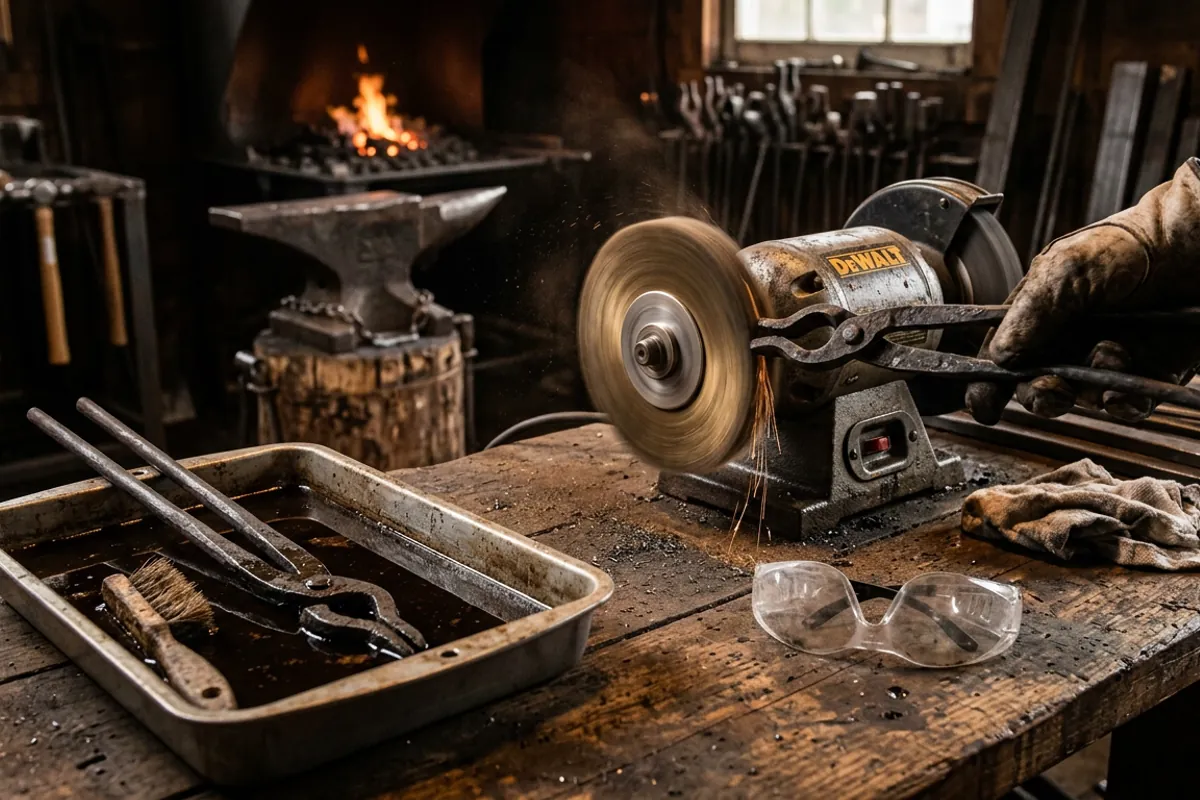
The first rule of bringing an old tong back is do not overdo it. You are not restoring a show car. You want it functional, not shiny, and every pass with an aggressive tool takes metal you cannot put back. Skip the sandblaster and the coarse grinder on the working surfaces. A wire wheel to knock the loose scale off, followed by a soak in a rust remover, does almost everything you need. Plenty of shop folks use Evapo-Rust for exactly this because it is water-based, reusable, and does not eat good steel the way acid can. Drop the tong in overnight, rinse, and dry it.
Check price on Amazon (paid link)
Say it plainly on the wire wheel, because this is where people get hurt cleaning tools: a spinning wire wheel throws wires, and those wires bury themselves in skin and eyes at speed. Wear ANSI Z87.1 rated eye protection at a minimum, a full face shield over it if you have one, and keep your grip planted so the tong cannot snatch and spin. Natural-fiber clothing near the forge and the wheel, not synthetics that melt.
Once it is clean, fix the joint and the fit, not the looks. If the boss is loose, heat it and re-peen the rivet, or drift the old one out and set a new one. If the jaws are out of line, bring them to heat and dress them back into alignment with light blows, checking against your stock as you go. Do not grind the jaws thin to make them meet. One thing I will not do is harden tong jaws or reins. Tongs are meant to stay tough and give a little, not to be hard, and a hardened jaw can crack and drop your work. Vintage tongs were made from wrought iron or mild steel for that reason. Tong steel is a place where you do not need anything fancy or any heat treat at all, which is also the running consensus among smiths who make their own. Finish with a little oil in the joint and a light wipe over the steel to keep the rust from coming back.
New tongs worth buying when the hunt comes up empty
Some days the sale has nothing that fits your stock, or every old pair has a bad boss. Rather than overpay for a sprung antique because it is old, buy a serviceable new pair or make your own. Here is where I would look, with the honest tradeoffs.
A general-purpose import wolf jaw, like this 17 in pair, is a reasonable one-tong starting point at a budget price. The common owner report on these is that the jaws come rough and soft from the factory and need dressing to actually grip, which is normal work you would do to fit any tong to your stock, so go in expecting to spend a heat or two making it hold before you trust it.
Check price on Amazon (paid link)
If you want a spread of sizes cheap while you keep hunting for the good vintage pair, a beginner multi-piece set gives you flat jaws, a few V-bit sizes for round and square, plus pickup and scrolling tongs in one box. Same caveat applies, only more so across six pairs: treat them as blanks that need fitting hot, not finished tools out of the package.
Check price on Amazon (paid link)
The step up from either of those is a maker pair from Centaur or Peddinghaus that grips out of the box, which is what the specs in the table above buy you. I am not linking those as a marketplace item here, just naming them so you know where the ceiling is. Whatever you buy, fitting a tong to your stock is a normal skill, not a defect: bring the jaws to a red heat, clamp them onto the bar you forge, and tap them until they bed down on it. Even a good tong grips better after you have fit it. If you are building out a whole used-tool kit rather than one pair, the vintage blacksmith tools guide covers the rest of the drawer.
What owners say
For gear I have not run down myself, here is what the forums actually report, linked so you can read it yourself. On the make-versus-buy question, the long-running I Forge Iron thread Tongs: roll your own or buy them? lands where most experienced smiths do, with at least one contributor saying he had always made his own unless he came across a nice pair priced reasonably. That is the vintage case in one sentence: a good old pair, cheap, beats making one, and beats a bad new one.
When a beginner shows up with money for exactly one pair, the advice in threads like What tongs should I buy and Wolf jaw tongs, which brand? leans toward a versatile jaw, a box jaw or a wolf jaw, so you can hold more than one profile while you build the rack out. On the vintage side, the identification discussion in threads such as 200 year old colonial tongs on I Forge Iron and the blacksmith tongs thread on Practical Machinist keeps coming back to the same tells: wrought iron's grain, the hairline where a handle was forge-welded on, and old forged pairs generally being heavier and thicker than the light modern reproductions.
The recurring complaint about the cheap import tongs is the one I flagged above, that they arrive soft and rough and do not grip until you dress them, with the general consensus being that they are usable once fitted rather than junk. I will be honest that signal on any one specific import model is thin, since the listings churn and the reviews are shallow, which is exactly why I keep the import picks general and tell you to plan on fitting them yourself.
What I would tell a friend
Buy the old pair only if the boss is sound and the jaws line up. A sprung or cracked antique is scrap with a nice story, and no amount of patina changes that. Match the jaws to the stock you forge, and understand that one versatile pair, a box jaw or a wolf jaw, plus a solid set of flat tongs will cover most of what a beginner does. If the vintage hunt comes up empty, a budget new pair you fit yourself beats an overpriced bad antique, and making your own beats both once your skills are there.
Two last things and they are both safety. Wear Z87.1 eye protection at the wire wheel when you clean a find, because those wires do not care how careful you feel. And never trust a tong that does not hold hot steel, old or new, because the tool that drops your work is the one that hurts you. Get the grip right first, make it pretty never.