If you are going to buy one pair of smithing tongs and nothing else, buy a wolf jaw in a 16 inch length, sized to the stock you actually forge. That single pattern will carry round, square, and flat bar through most of what a beginner does, and the longer reins keep your knuckles out of the fire. The pair I would point most people at first is the Simond Store 16 inch wolf jaw (paid link), because it costs about what a takeout dinner costs and it is close enough to right that fifteen minutes of adjustment makes it good. The pair I would buy once and stop thinking about is the Picard 04900-400 wolf's jaw (paid link), which is a German-made tong with published specs and a lifetime warranty against defects.
Now the honest framing. I have been at this about twenty-five years, most of it on Bessie, my 148 lb Trenton, with a coal forge for heavy stock and a propane forge for everything else. I have not personally run down every pair in this guide. Nobody who writes a roundup has. What follows is published specs from makers and tool retailers, owner reports from forums where smiths argue about this stuff, and my own shop experience about what a tong has to do to be worth owning. Where I am telling you what owners report rather than what I have felt in my hand, I say so.
How smithing tongs are sized, and why it matters more than the brand
A tong is not a general-purpose gripper. It is a fixture for one size and shape of stock, and the closer the jaw matches the bar, the better it holds. A wolf jaw is the compromise pattern: it has notches cut so it will take round, square, and flat in the same jaw. That is why it is the standard first recommendation, and it is also why a wolf jaw is never quite as secure as a dedicated V-bit on round stock or a flat bit on a blade blank.
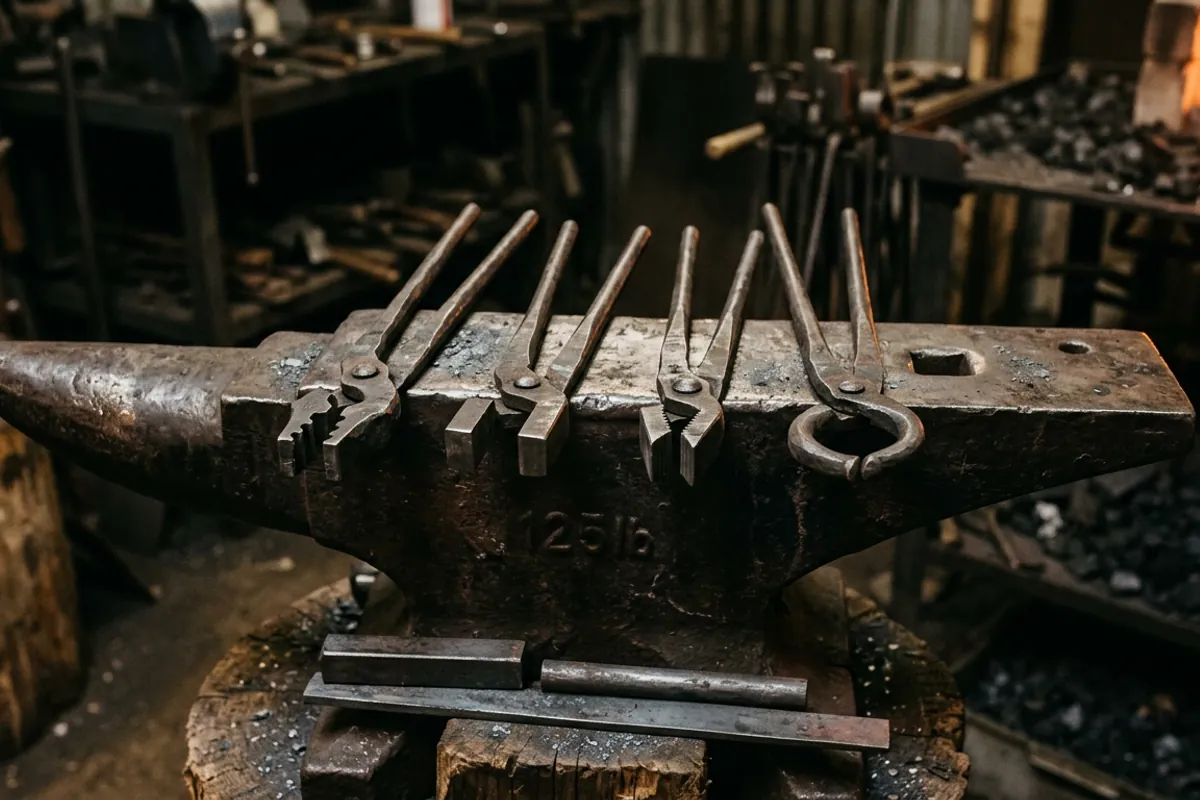
Two numbers matter when you shop. The first is the stock capacity the maker publishes. Picard states its 400 mm wolf's jaw is for material 3 to 12 mm, which in shop terms covers about 1/8 inch through 1/2 inch. If you are forging 3/4 inch square, that tong is the wrong tool no matter how well it is made. The second is overall length, which sets how far your hand sits from the heat. A 12 inch tong is fine at a small propane forge with the work sticking well out. A 16 inch tong is the safer default, and 18 inch reins give you leverage at the cost of a little precision.
The third thing, which nobody publishes, is fit. A tong that does not clamp the bar in three places, both jaw faces plus the pivot geometry pulling them together, will let the work rotate under the hammer. That is the single most common complaint about budget tongs, and it is fixable. More on that below. If you are still assembling the rest of the bench, the short list in blacksmithing tools: the short list that actually matters covers what goes with them, and the wider hammers and tongs hub collects the rest of the striking and holding gear.
The field at a glance
Published figures only. Where a maker does not state a number, it says so rather than my guessing one. Every figure is sourced in the section that follows.
Scroll horizontally to see all columns.
| Tongs | Pattern | Overall length | Weight | Steel | Stock capacity stated | Price tier |
|---|---|---|---|---|---|---|
| Simond Store 16 inch wolf jaw | Wolf jaw | 16 in | Not published | Not published | Not published | Budget |
| Simond Store 16 inch V-bit slot jaw | V-bit slot | 16 in, 2.5 in jaw | Not published | "High quality forged steel", grade not published | Square and flat stock, figure not published | Budget |
| Simond Store 16 inch set of four | Wolf, flat, round, mandrel | 16 in each | Not published | Not published | Not published | Budget |
| VEVOR 18 inch four piece set | V-bit bolt, wolf jaw, Z V-bit, gripping | 18 in | Not published | Carbon steel body, A3 steel rivets | Not published | Budget |
| Picard 04900-400 wolf's jaw | Wolf's jaw | 400 mm (15.75 in) | 850 g (1.87 lb) | C35 | 3 to 12 mm | Premium |
| Picard 04930-400 mandrel | Mandrel | 400 mm (16 in) | 2 lb (0.9 kg) | C35 | 19 to 20 mm | Premium |
The pattern in that table is the whole story of this market. The budget makers publish a length and a photograph. The German maker publishes a length, a weight, a steel grade, and a capacity. You are not only paying for better steel, you are paying for knowing what you bought.
Simond Store 16 inch wolf jaw tongs
This is the pair I would put in a beginner's hand, with the caveat attached. It is a 16 inch wolf jaw in the standard imported pattern, sold as a single tong rather than a set, and it is priced where losing the gamble costs you very little. Simond Store does not publish a steel grade or a stock capacity for it, which is the honest state of the listing.
What you get is a serviceable general-purpose tong that will need fitting. Owner reports across the forums are consistent that imported tongs in this class arrive with jaws that do not close square on the bar and reins that are heavier than a hand-forged pair. That is not a defect so much as the price point: nobody is hand-fitting a tong to your 3/8 inch square at that money. Heat the jaws to orange, clamp a piece of your working stock in them, and set the jaws to that bar with a hammer. Fifteen minutes and you have a tong that holds.
For a first pair on 1/4 inch to 1/2 inch stock, that is a fair trade. Check price on Amazon (paid link).
Simond Store 16 inch V-bit slot jaw tongs
If you are forging knives rather than hooks and hardware, this is the more useful shape. Simond Store publishes 16 inch overall length with a 2.5 inch jaw, and describes the material as forged steel without naming a grade, per their own product page. The V-bit slot pattern grips square and flat stock down the length of the jaw, which is what you want when you are drawing out a blade and the bar keeps trying to twist.
The tradeoff is the same as every specialist: it is excellent on the shape it was cut for and mediocre on everything else. It will not hold round bar securely. If your work is bladesmithing first, buy this one before the wolf jaw. If your work is general smithing, buy it second.
Check price on Amazon (paid link).
Simond Store 16 inch four piece set
The set is wolf jaw, flat jaw, round jaw, and mandrel jaw, all at 16 inch. Simond Store does not publish steel grade or per-tong capacity for the set. Sets like this are how most people actually buy their first tongs, and I understand the appeal: four patterns for less than one German tong.
Here is the honest read. You will use two of the four. The wolf jaw and the flat jaw will live on the rack by the forge, and the mandrel will sit in a drawer until the day you make a ring. That is not wasted money if the set costs less than two singles, but do not buy it thinking you now own a complete set of smithing tongs. You own two working tongs and two future projects. And every one of them needs the same jaw fitting the single does.
Check price on Amazon (paid link).
VEVOR 18 inch four piece set
VEVOR's four piece set is V-bit bolt, wolf jaw, Z V-bit, and gripping tongs at 18 inch. The maker publishes carbon steel construction with A3 steel rivets on its own product page, and states plainly that if the jaws become misaligned over time you adjust the rivets to realign them. I appreciate a maker who says that out loud instead of pretending it does not happen.
The Z V-bit is the interesting inclusion. It is a blade tong pattern, offset so the reins clear the work, and it is the shape bladesmiths on the forums keep naming when they talk about holding a blank without cramping. The extra two inches of rein length over the Simond Store tongs is real leverage, and it costs you a little control on small work.
Treat the rivets as the wear point. On any tong in this price class, check that the rivet is tight and peened, not just a bolt through a hole, and do not hang your whole hand weight on a loose joint over a hot bar.
Check price on Amazon (paid link).
Picard 04900-400 wolf's jaw tongs
This is the one to buy if you would rather buy once. KC Tool publishes the Picard 49 wolf's jaw at 400 mm, 850 g, C35 steel, made in Germany, with Picard guaranteeing the tool for its lifetime against defects in materials or workmanship. The Hammer Source lists the same 400 mm wolf's jaw as for material 3 to 12 mm.
Those numbers matter in a way the marketing does not. C35 is a medium carbon steel with published properties, so the reins have some spring and the jaws will take heat and hammering without deforming into uselessness. 850 g in a 400 mm tong is light in the hand for the length, and light tongs are why your forearm still works in hour three.
It is a real chunk of money next to the imported singles, and it will still benefit from being fitted to your specific bar. The difference is that you are fitting a good tong rather than rescuing a rough one. For comparison, Centaur Forge builds its own wolf's jaw tongs from 8560 grade steel with balls at the rein ends, which is the same idea from an American maker.
Check price on Amazon (paid link).
Picard 04930-400 mandrel tongs, and when a specialist earns shelf space
Worth knowing what is on the shelf next to the wolf's jaw. The Picard mandrel pattern in 400 mm is published by The Hammer Source at 2 lb, for 19 to 20 mm material, with a 3 1/4 inch mouth. That is roughly 3/4 inch stock, and the mandrel jaw is built for gripping the end of heavy material while you work the other end.
I am naming it because it is easy to buy the wrong Picard. If you search the brand and grab the first result, you can end up with a specialist tong for 3/4 inch bar when what you needed was the wolf's jaw for 1/2 inch. Buy the pattern and the capacity, then buy the brand. The mandrel is a good tong; it is just not your first one. Check price on Amazon (paid link).
Fitting tongs so they actually grip
This is the section that will save you more grief than any purchase decision. Almost no tong, at any price, arrives fitted to your stock. Fitting it is a twenty minute job and it is good practice besides.
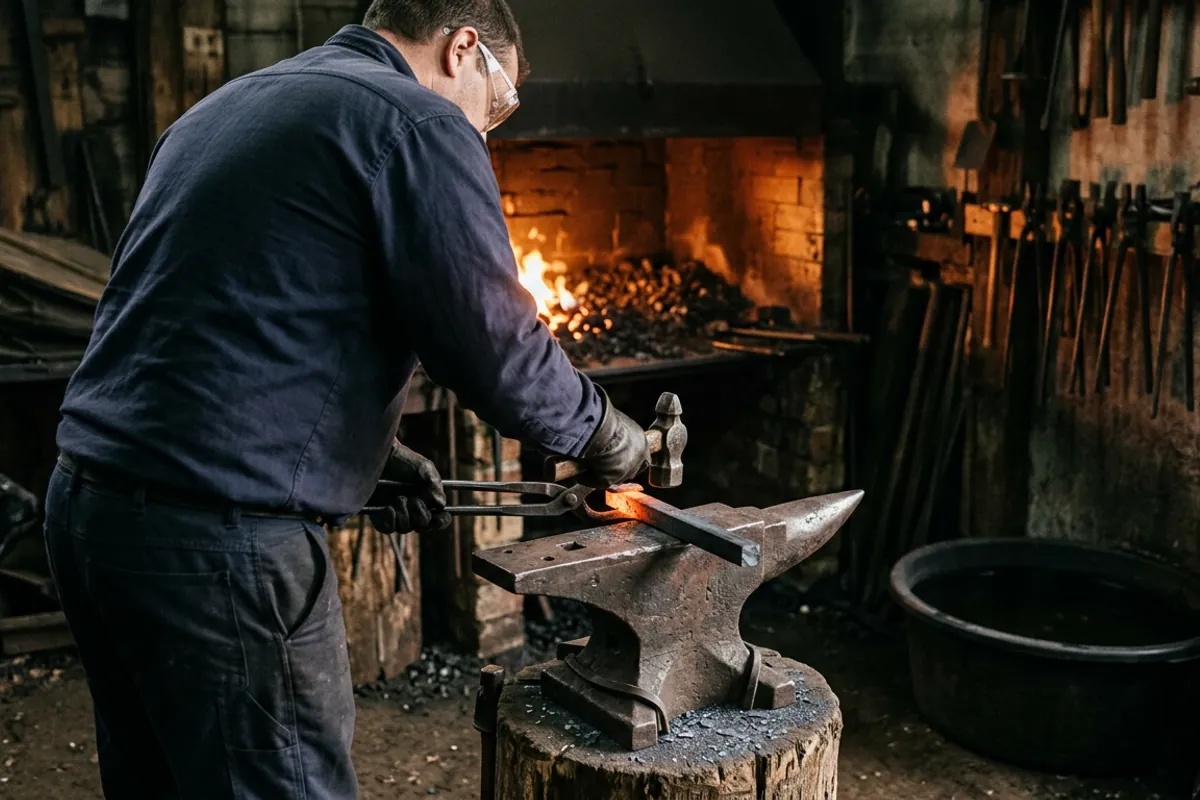
Bring the jaws to an even orange in the forge, both of them. Take a piece of the stock you actually forge, cold, and clamp it in the hot jaws. Squeeze the reins so the jaws take the bar's shape, then set it on the anvil face and tap the jaws down onto the bar with a hammer until the faces sit flat along the whole grip, not just at the tips. Check that the bar is held in line with the reins and does not rock. Let it cool in air; you are not hardening anything, and you do not want to quench-harden a tong jaw.
While you are at it, check the rivet. It should be snug enough that the reins stay where you put them and loose enough to open freely. Too tight and you fight it all day; too loose and the jaws wander off the bar mid-blow. And make yourself a tong clip, a simple ring of round bar that slides up the reins to lock them closed. A tong ring turns a two-hand hold into a one-hand hold, and it is the cheapest safety upgrade in the shop.
If you want the longer version of the tong argument, including the case for forging your own from blanks, I wrote it up in the blacksmith tongs I would buy first, and the ones I would skip. Pair whichever tongs you buy with a hammer that suits your arm; the reasoning is in the blacksmith hammer I would hand a beginner.
What owners say
I have not put these specific pairs through my own forge, so here is what smiths who own tongs in these classes report, attributed.
On sizing, a BladeForums thread on right size tongs for smaller knives has Stacy E. Apelt telling a beginner that a simple 300 mm wolf jaw tong will do most any small task, with others in the thread pushing Z-box and blade tongs as the versatile option for flat stock. That matches the pattern advice above: one wolf jaw plus one blade pattern covers a beginner's work.
On what separates a good tong from a bad one, the BladeForums thread what kind of tongs y'all using is the useful read. Members repeatedly name Kayne and Son Blacksmith Depot and Off Center Products as the quality sources. VaughnT describes offset blade box tongs as giving a very solid hold with light reins that have a bit of spring, which is exactly the property that heavy imported reins lack. In the same thread, Cajun Kamikaze reports that modified farrier tongs caused forearm cramping after about twenty minutes of forging, and another member makes the blunt point that quality commercial tongs eliminate the cramps and fatigue that homemade pairs cause. Will52100 is honest that a first attempt at forging his own turned out horrible and improved with practice.
Owner signal specifically on the budget four piece sets is thin and noisy, which I would rather say than dress up. The recurring themes across those threads are jaw alignment out of the box and rein weight, not catastrophic failure. Nobody in the threads I read reported a tong coming apart in use. Treat that as "needs fitting," not "unsafe," and check your own rivet before you trust it with hot steel.
Safety that is not optional with tongs
A tong is a safety device. Its whole job is keeping your hand off a bar at 2000 degrees, and a tong that drops the work is a burn or worse waiting to happen. Test the grip cold before every heat on new stock: clamp it, and try to twist and pull the bar out. If it moves, fit the jaws before you forge, not after.
Wear ANSI Z87.1 rated eye protection at the forge and the anvil, every heat, no exceptions. Wear natural fibers, cotton or wool or leather, never synthetics near heat. Synthetics melt onto skin and turn a small burn into a graft. I learned the cost of getting relaxed about this the hard way: early on I quenched a blade in oil that was too cold, standing too close in a cotton shirt with no face shield, and the flare took my eyebrows. I kept my eyesight by luck, and luck is not a safety plan. The full rundown of what is worth buying and what is theater is in blacksmith safety gear: what matters and what to skip.
One more tong-specific hazard: do not hold a workpiece with pliers or vise grips because your tongs do not fit. The forums are full of that suggestion for small work, and it is fine for a cold pickup, but a plier jaw on a hot bar is a point contact that rolls. Get the right tong.
What I would tell a friend
Buy one 16 inch wolf jaw and fit it to the stock you actually use. If you are making knives, buy a V-bit or blade pattern instead and add the wolf jaw second. Skip the temptation to buy the four piece set as your entry point unless the math genuinely beats two singles, because you will use half of it.
The pair I would put in a new smith's hand today is the Simond Store 16 inch wolf jaw (paid link) with an afternoon of jaw fitting behind it. The pair I would buy if I never wanted to think about tongs again is the Picard 04900-400 wolf's jaw (paid link), 400 mm, 850 g, C35 steel, for 3 to 12 mm material, with the maker's numbers published where you can check them.
And the note that matters most: a tong you have not fitted is a tong you cannot trust. Fit it cold, test it cold, put a tong ring on the reins, and keep your Z87.1 glasses on your face. The steel does not care how much you paid.