railroad spike tongs are one of those tools you can absolutely live without, right up until you have a cherry-red spike skating around your anvil face and no clean way to hold it. If you only ever forge one or two spike knives, skip the dedicated pair and use what you have. If you have caught the spike bug and you are running a dozen through the fire on a Saturday, the tongs to buy are the forked "spike head" style that grabs the spike by its own head, and the honest budget runner-up is a plain V-bit bolt tong that clamps the 5/8 inch shank. That is the whole verdict, and I will walk through why below.
Fair warning on how I write these: I have forged spikes and I have made my own tongs, but I have not run every import pair on Amazon across my own anvil. So the picks here lean on published maker specs, what owners report on the forums, and general shop experience with how tongs actually behave under a hammer, not on a bench test I did not do. Where the owner signal is thin, I will say so, because on this particular tool it is thin.
What railroad spike tongs actually are
A railroad spike is an awkward little thing to hold. The head is a flat, offset mushroom, the shank is roughly 5/8 inch square tapering to a chisel point, and the whole thing is short. Regular flat-jaw tongs want to slide right off the tapered shank, and they cannot get a real bite on that offset head. So "railroad spike tongs" ended up meaning one of two solutions to that problem.
The first is a forked or box-style jaw that cups the head of the spike, pressing on the back of the head and trapping the two edges so the spike hangs off the front of the tongs like it grew there. This is the purpose-built answer, and it is what most listings mean when they say "spike head tongs." The second is a V-bit or bolt tong: the jaws close into a V that grips 5/8 inch square or round stock, with a throat wide enough to clear the head. That one holds the spike by its shank instead of its head.
Which you want depends entirely on what you are forging. If you are making a railroad spike knife and keeping the head as the pommel, you often forge the blade out of the shank while holding the head, so a head-gripping tong is gold. If you are forging the head down into something else, or drawing the whole spike out, you need to hold the shank, and the V-bit tong is your friend. If you are new to the whole idea, the railroad spike knife guide walks through what these spikes are and are not before you spend a dime on tongs. And for the broader picture of grip styles, the Hammers and tongs hub is the place to start.
The specs, side by side
Here is the field at a glance. I only list a figure where a maker actually publishes it. The mass-market import tongs do not come with a spec sheet, only a marketplace listing, and I will not cite a marketplace page for a dimension, so those rows honestly read "not published."
Scroll horizontally to see all columns.
| Tongs | Jaw style | Overall length | Material | Holds | Price tier |
|---|---|---|---|---|---|
| FieryFurnaceForge forked spike tongs | Forked, grips the head | 18 in | 5160 spring steel | Spike by the head | Premium (maker-forged) |
| Import spike head tongs | Forked, grips the head | not published | not published | Spike by the head | Budget |
| V-bit / bolt tongs | V-bit | not published | not published | 5/8 in square or round | Budget |
The one line worth staring at is the material and length on that maker-forged pair: 5160 spring steel, 18 inches overall, forged specifically to hold a spike by the head, per the maker's own listing at FieryFurnaceForge. That tells you what a "real" version of this tool looks like, and it gives you a yardstick for judging the cheaper ones.
The dedicated forked spike-head tongs
This is the pick if you forge spikes in any volume. The forked jaw does one job and does it well: it cups the offset head, presses on the back of it, and pins the edges so the spike does not rotate or walk while you hammer the shank. When the head-grip is right, you can forge a blade out of the shank one-handed on the tongs and never fight the thing. That is the whole reason this specialized shape exists.
On Amazon, the common import version is sold under a dozen near-identical names, all landing around 15 inches long with a forked head jaw. This one (paid link) is the representative listing, marketed straight at making spike knives. A shorter-reined variant shows up as a roughly 15-inch pair (paid link) as well. I have not run either across Bessie, my own anvil, so I will not pretend to rate their heat treat. What I can tell you from general tong experience is what to check the day it arrives: put a cold spike in the jaws and see whether the fork actually seats on the head or just perches on it. A jaw that only kisses the head will let the spike pivot under the first real blow, and a pivoting spike is a spike about to leave the tongs.
The maker-forged option, at 18 inches of 5160, is the one to buy if you would rather pay once. Spring steel reins that long give you leverage and a bit of forgiveness, and a real smith forged the jaw to the head instead of stamping it. That is a genuine difference in a tool you are trusting to hold hot metal. It costs more than triple the imports, and for a once-a-year spike knife that is not worth it. For a shop that forges spikes regularly, it is.
V-bit and bolt tongs: the honest alternative
Here is the thing dedicated-tong sellers will not tell you: for a lot of spike work you do not need a spike tong at all. You need a tong that grips 5/8 inch square stock, because that is what the shank is. A V-bit bolt tong does exactly that, and it is a far more useful tool in the long run because it will hold every other piece of 1/2 to 5/8 inch bar you ever forge, not just spikes.
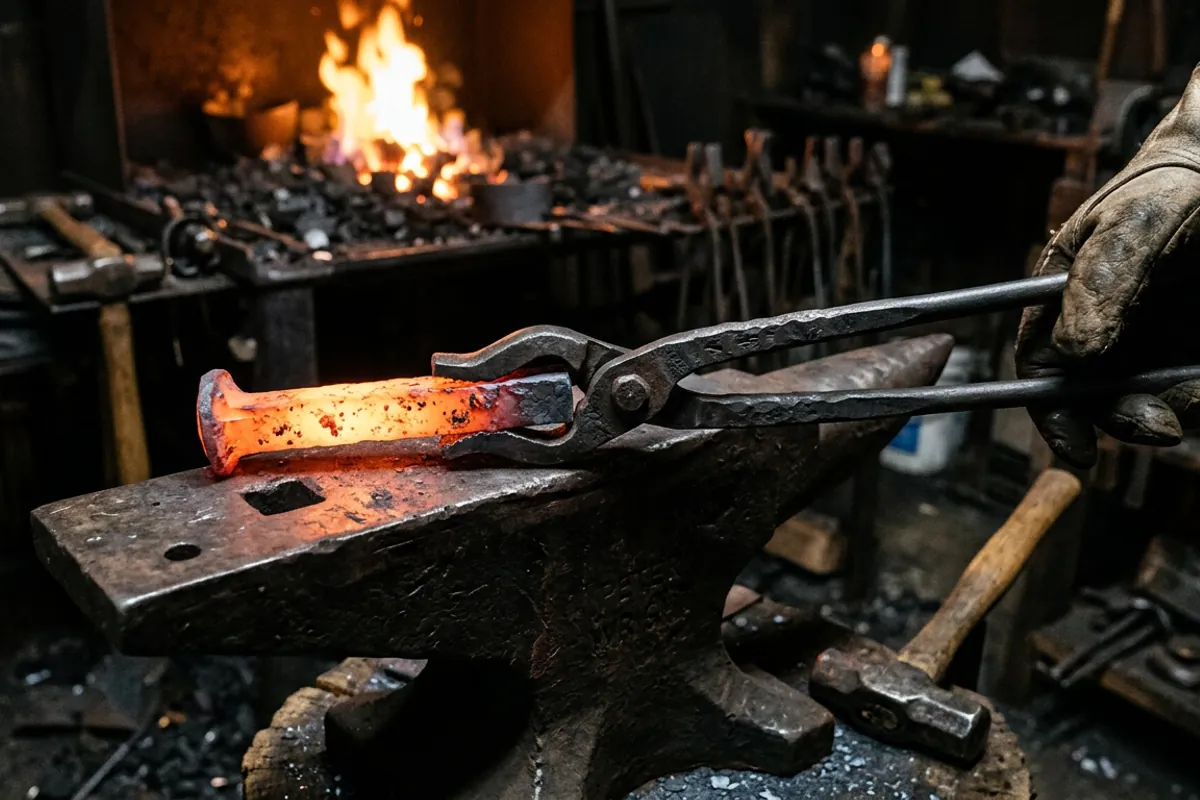
The 5/8 inch V-bit bolt tong (paid link) is the pattern to look for: jaws that close into a V on square or round stock, with a throat wide enough to clear the spike head so you can hold the shank right up near the work. If I could own only one tong for spike knives and general small-stock work, it would be a good V-bit before a single-purpose spike tong, because the spike tong holds spikes and nothing else. This is the same logic I lean on in the broader blacksmith tongs buying guide: buy the tong that fits your stock, not the tong with your project's name printed on it.
The tradeoff is real, though. Holding the shank means the head is out at the far end of the work, which is fine when you are forging the point and the middle, and less fine when you want to work right at the head. That is the case where the forked head-grip tong earns its keep. Most spike smiths I know end up with both eventually, and reach for whichever end of the spike they are not currently beating on.
The budget import spike tongs
Below the maker-forged tier, the import spike tongs are all cut from the same cloth, and the Caliburn-branded pair (paid link) is one of the more visible names. They are cheap, they are forged from some unspecified steel the seller does not name, and they will hold a spike well enough to get you through a knife. For a beginner who wants to try one spike knife without committing, that is a reasonable place to spend a little money.
What you are giving up is consistency and, sometimes, jaw fit. The reason I keep saying "check the fit cold" is that these no-name pairs vary unit to unit. One arrives with a jaw that cups the head perfectly and one arrives with a jaw that needs a few minutes at forging heat and a light adjustment to close square. That adjustability is actually the upside of a cheap tong: mild steel reins bend to fit, and tuning a tong jaw to your exact stock is a normal, expected part of owning tongs. If you are willing to heat and tweak, a budget import becomes a tong that fits your spikes better than it did out of the box. If you want it perfect on arrival, pay for the forged pair.
One thing I will not do is quote you a hardness or a steel spec for these imports, because the sellers do not publish one and I have not tested one. "Heavy-duty steel" on a listing is marketing, not a number. Treat it that way.
What owners say
Owner signal on dedicated spike tongs specifically is thin, and that thinness is itself the honest headline. When you dig through the blacksmithing forums, the loudest recurring advice about spike tongs is not which brand to buy, it is that a lot of smiths just make their own.
On BladeForums, a thread on picking tongs runs heavily toward DIY: members point newcomers at kits from Ken's Custom Iron as "inexpensive and allow you to customize on the cheap," and at AnvilFire's "Easy Tongs by Sean Connor" as about the simplest tong to forge yourself, with mild steel being the right material for the job (BladeForums, Recommendations for tongs). The same thread praises box-jaw and wolf-jaw patterns as the general-purpose grips worth owning, which lines up with the idea that a good V-bit or box tong beats a single-purpose spike tong for most people.
Over on I Forge Iron, the spike-tong conversation is mostly about improvised and shop-made solutions rather than product reviews. Threads like "Tongs for RR spikes" and "Improvised Railroad Spike Tongs" exist precisely because smiths keep working out their own way to grip that awkward head instead of buying a dedicated pair (I Forge Iron, Tongs for RR spikes; I Forge Iron, Improvised Railroad Spike Tongs). Read that as the community's real verdict: the tool is useful, but plenty of experienced smiths do not think it is worth buying when a bolt tong or a hand-forged jaw does the same work.
So if you see thin owner reviews on a given import pair and it makes you nervous, that is not you missing something. There genuinely is not a deep bench of long-term reviews on these no-name tongs. Judge them on fit in your own hand, not on a star rating.
While we are on steel, do not carry any myths about railroad spike steel into this. Spikes are low to medium carbon and marked "HC" at best, and whether they harden usefully is a real testing question, not a campfire story. Send that one to real metallurgy at Knife Steel Nerds rather than trusting a forum guess or a seller's blurb.
The safety part nobody wants to hear
A tong that does not fit is not a minor annoyance, it is a hazard. When a jaw only perches on the spike head instead of seating on it, the first solid hammer blow can pop the spike out of the tongs and launch a piece of hot steel across your shop. I have had cold work slip; I have never wanted to feel a 1500 degree spike do it. This is the single most important reason to buy or tune a tong that actually grips: the grip is the safety feature.
That means the usual rules are not optional here. Wear eye protection rated to ANSI Z87.1 every time the hammer is moving, because the failure mode of a bad tong is fast and aimed at your face. Wear natural fibers, cotton or wool or leather, never synthetics, near that heat; melted polyester on skin is a burn that keeps burning. I learned the PPE lesson the hard way years ago with a quench-oil flare that took my eyebrows and nearly my eyesight, and I have never treated it as optional since. If your PPE is not sorted, the blacksmith safety gear guide covers what actually matters before you start throwing hot spikes around.
And keep the reins long enough that your hand is well clear of the fire. The 15 to 18 inch overall lengths on these tongs are not an accident; that reach is what keeps your knuckles off the spike head while it soaks. If a cheap pair has short reins, that is a real strike against it, not a nitpick.
What I would tell a friend
Buy the V-bit bolt tong first. It holds the 5/8 inch spike shank, it holds every other small bar you will ever forge, and it costs the same as a single-purpose spike tong that only earns its keep on spikes. If you forge spikes by the dozen and want to hold them by the head, add a forked spike-head tong, and if you would rather buy once and stop thinking about it, the maker-forged 5160 pair at 18 inches is the one worth the extra money. The cheap import spike tongs are fine for a first spike knife as long as you check the jaw fit cold and are willing to heat and tune it.
The one to skip is any tong, at any price, whose jaw will not actually seat on your stock, because that is the one that throws hot steel. Fit first, brand second, price last. For the wider view on grips and how to size your first pairs, the forging tongs buying guide is worth a read before you check out.