Verified live: B098F2Q1N7 (16-inch wolf jaw), B098JRTG52 (17-inch wolf jaw), B09BQHJXQS (5-piece tong set). Now writing.
I have enough to write. Producing the article.
Most days in my shop, the tool that decides whether a session is fun or miserable is not the anvil and not the hammer. It is the pair of forging tongs holding the hot bar. Grab the wrong pair, or a cheap pair with sloppy jaws, and the work squirts sideways every time you set the hammer to it, which is how a bar of orange steel ends up on the floor near your boots. Get the right pair and you forget the tongs are even there. So if you are buying your first set, here is the short version: start with a wolf jaw pattern in the 15 to 17 inch range, because it grips round, square, and flat stock well enough to get you through your first year without owning a wall of tongs. I will walk through the specific pairs below.
One honest note before we go further. I have run tongs for about twenty-five years, and I know what a good pair feels like versus a sloppy one. But most of the imported tongs sold on Amazon under a dozen near-identical listings are not gear I have personally run down on my own anvil. So the picks below lean on published lengths and jaw patterns, on owner reports from the forums, and on general shop experience about what makes tongs worth owning. Where I am reading the forums instead of the steel, I say so.
What forging tongs actually do, and why the wrong pair fights you
Forging tongs are the extension of your hand into a heat you cannot touch. That sounds obvious until you understand what a bad pair costs you. Tongs have three parts that matter: the jaws that grip the stock, the reins (the long handles) that give you leverage and reach, and the boss and rivet where they pivot. A good pair holds the workpiece so the axis of the bar lines up with the reins, so when you hammer the steel, the force runs down the bar and not into a twist that pops the piece loose.
The classic beginner mistake is thinking any tongs hold any steel. They do not. Tongs are matched to stock. A flat jaw pair that grips 1/4 inch flat bar beautifully will barely close on a 1/2 inch square, and a pair sized for 1/2 inch round will roll a thin flat bar like a pencil. This is why experienced smiths on every forum say the same thing: you will end up owning several pairs. That is true, and I will not pretend otherwise. But you do not start there. You start with one versatile pattern and add as your work tells you what you are missing.
How I would choose your first forging tongs
Three things decide it: jaw pattern, length, and grip quality.
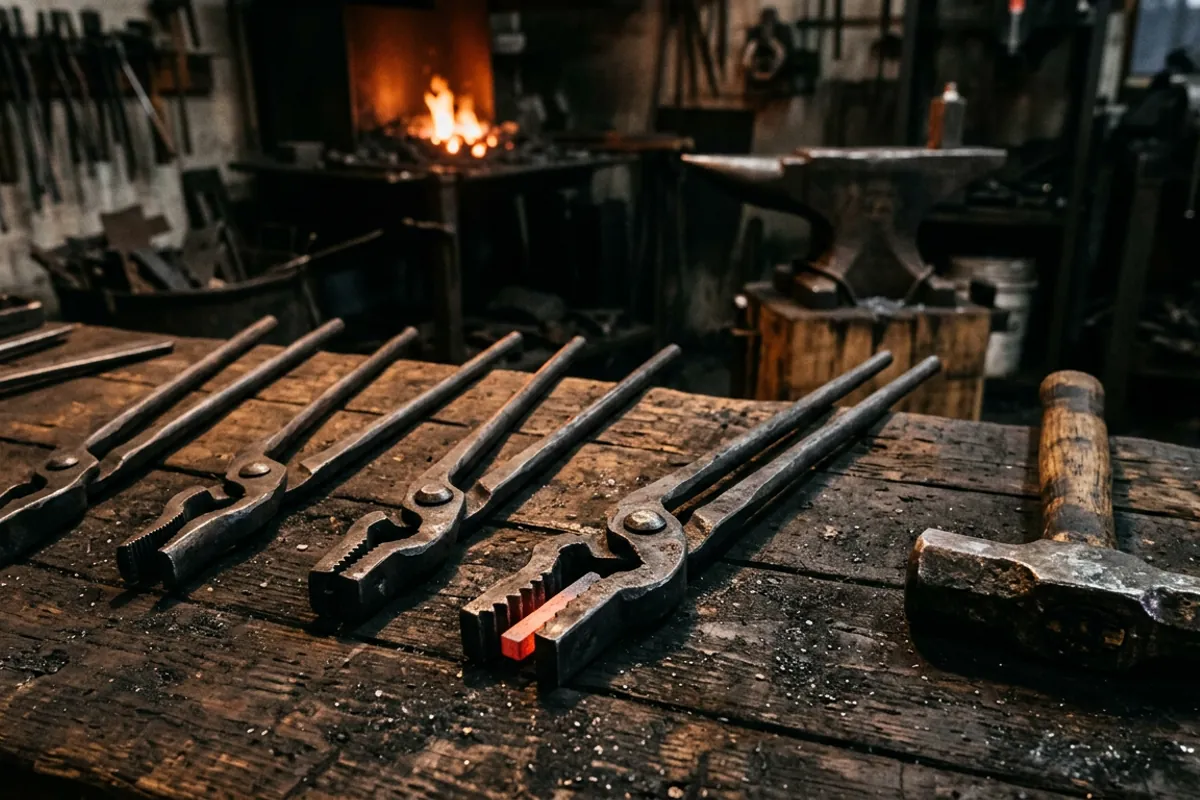
For pattern, the wolf jaw (sometimes called wolf's jaw) wins for a first pair. The jaws have a wavy, toothed profile with grooves that let it bite round, square, and flat stock across a range of sizes rather than one exact dimension. Working the Flame's tong guide puts wolf jaw at the top of its beginner list for exactly this reason, calling it adaptable to different stock shapes and sizes while staying relatively light (Working the Flame). It is not the strongest grip on any one shape, but it is the most forgiving across many, which is what a beginner needs.
For length, I like 15 to 18 inches for general bench work. Working the Flame recommends roughly 18 to 22 inches for multi-purpose tongs, and that is a fine range too, especially if you run a hotter forge and want your hands further from the heat. Shorter reins give finer control up close; longer reins keep your knuckles cooler and let you choke up when you need. If you only buy one, land in the middle.
For grip quality, this is where cheap tongs earn their reputation. The jaws should meet cleanly along their whole gripping surface with the reins parallel and close, not gapped open like a wishbone. If the jaws only touch at the tips, or the reins sit four inches apart when the jaws are closed on your stock, the pair will never hold well and you will fight it forever. The good news is this is fixable on any pair of real steel tongs: heat the jaws and adjust them to your stock. More on that below.
The field at a glance
These are the pairs I would actually consider for a first purchase, with the specs the makers publish. Reins spacing, weight, and hardness are not published on these imported listings, so I have marked them not published rather than invent a figure. Lengths are as stated in each product name.
Scroll horizontally to see all columns.
| Tongs | Jaw pattern | Length | Material | Weight / hardness | Price tier |
|---|---|---|---|---|---|
| Wolf jaw 16 inch | Wolf jaw, 3-point grip | 16 in | Steel | Not published | Budget |
| Wolf jaw 17 inch | Wolf jaw, 3-point grip | 17 in | Steel | Not published | Budget |
| 5-piece tong set | Flat, square jaw, bolt, blade, wolf jaw | Not published | Steel | Not published | Budget to mid |
Every figure that is not in the maker's listing is marked not published on purpose. Do not trust a spec sheet that fills in a hardness number for a nameless import; nobody heat-treated and tested those jaws to a published Rockwell.
The 16 inch wolf jaw I would start with
If you buy exactly one pair, this is the size I would point a weekend beginner at. A 16 inch wolf jaw sits right in the sweet spot: long enough in the reins to keep your hand off the heat when you are working a piece near the fire, short enough to feel precise on the anvil. The wolf jaw profile means it will take the 1/4 inch to 1/2 inch flat, square, and round stock that most beginner projects (hooks, bottle openers, small blades, leaves) start from.
The listing calls it a heavy-duty steel wolf jaw with a 3-point grip, 16 inches long. That 3-point grip is marketing language for the toothed jaw contact, and it is genuinely the useful feature here.
Check price on Amazon (paid link)
The honest read: this is a budget import, and it will almost certainly need fitting to your stock out of the box. That is not a defect unique to this pair, it is the nature of cheap tongs, and it is a ten minute fix (heat the jaws to orange, close them on the actual bar you will forge, tap the reins to line up). What you are buying is real steel in the right pattern at a price that lets you start. Spend your money on the anvil and forge first; the tongs you can upgrade or forge yourself later.
A 17 inch wolf jaw for a little more reach
Same pattern, one inch more rein. If you run a hotter setup, have larger hands, or just want your knuckles a touch further from the fire, the 17 inch version of the same wolf jaw is the one I would grab. The extra length costs you a hair of close-up control and buys you reach and leverage. For most people the difference between 16 and 17 inches is not worth agonizing over; pick whichever the budget likes on the day.
Check price on Amazon (paid link)
Same honest read as the shorter pair: budget import, fit the jaws before you trust them, and do not expect a published hardness because there is not one. If you can only stomach one purchase, either length of wolf jaw does the job. I would not buy both to start.
The multi-piece tong set, and when a kit makes sense
There is a temptation, when you realize you will eventually own several pairs, to skip ahead and buy a set. There is a 5-piece kit that bundles flat, square jaw, bolt, blade, and wolf jaw tongs. On paper that covers a lot of ground, and if you already know you are going to be forging blades (the blade and box-style jaws matter for stock you do not want the jaws marking) a kit can be reasonable value.
Check price on Amazon (paid link)
I am cooler on kits than the marketing wants me to be, for two reasons. First, a five pair set at a budget price means five budget pairs, and every one of them will want fitting. Second, a beginner rarely knows yet which patterns their work actually needs, so half the set sits in a drawer while you use the wolf jaw for everything anyway. If you are certain of your path (bladesmithing, say), a kit gets you there faster. If you are still finding out what you like to forge, buy one wolf jaw and let your projects tell you what to add. For more on how the tong field breaks down by pattern, I went deeper in the blacksmith tongs buying guide and in smithing tongs that actually grip.
Making your own tongs, the real long game
Here is the thing no listing will tell you: tongs are one of the classic projects a smith forges rather than buys. A pair of tongs is two identical halves, and forging them teaches drawing out, punching or drifting the rivet hole, and fitting a joint. Once you can make a serviceable pair, you can make tongs sized to any stock you own, which solves the whole one-pair-per-size problem for the cost of bar stock. The BladeForums crowd points beginners toward tong kits, like the DIY kits from Ken's Custom Iron, and toward Sean Conner's easy tongs design as a beginner-friendly first pair to forge (BladeForums).
I am not saying forge your first pair before you have anything to hold hot steel with, that is a chicken and egg problem. Buy one wolf jaw so you can safely work, then make your second and third pairs. If you want a project that genuinely levels you up, tongs are near the top of the list, right there with a good beginner hammer and a forging project that teaches you something.
What owners say
For gear I have not run down myself, here is what the forums actually report, patterns not hype.
On the imported wolf jaw tongs generally, owner consensus is that they are usable but need fitting. The recurring theme across blacksmithing forums is that budget tongs arrive with jaws that do not close cleanly on the stock they claim to hold, and that a few minutes at the forge to reset the jaws turns a frustrating pair into a fine one. Nobody reports them as heirloom tools; they report them as a working starting point at a price that lets a beginner get going.
On tong strategy overall, the BladeForums thread on tong recommendations is blunt and correct: you really need more than one set, sized to the different stock you work, and mild steel is the material to want in a tong, not high carbon (BladeForums). Members there also flag the real limitation of box and blade jaws, that they are very dependent on matching the exact width of the stock, which is precisely why a forgiving wolf jaw is the better first pair. Working the Flame makes the same point about box jaws being width-dependent while wolf jaws adapt across sizes (Working the Flame).
Where owner signal is genuinely thin is on any specific import listing by ASIN, because they turn over and rebrand constantly. So I am not going to pretend a particular seller's 16 inch pair has a track record it does not have. Judge these on the pattern and the price, fit them yourself, and do not expect a name-brand life out of a no-name tool.
Safety at the tongs, and the one habit that matters
Tongs are a safety tool before they are a convenience. A pair that does not hold is not just annoying, it is how hot steel ends up where your feet are. Two things I will not soften.
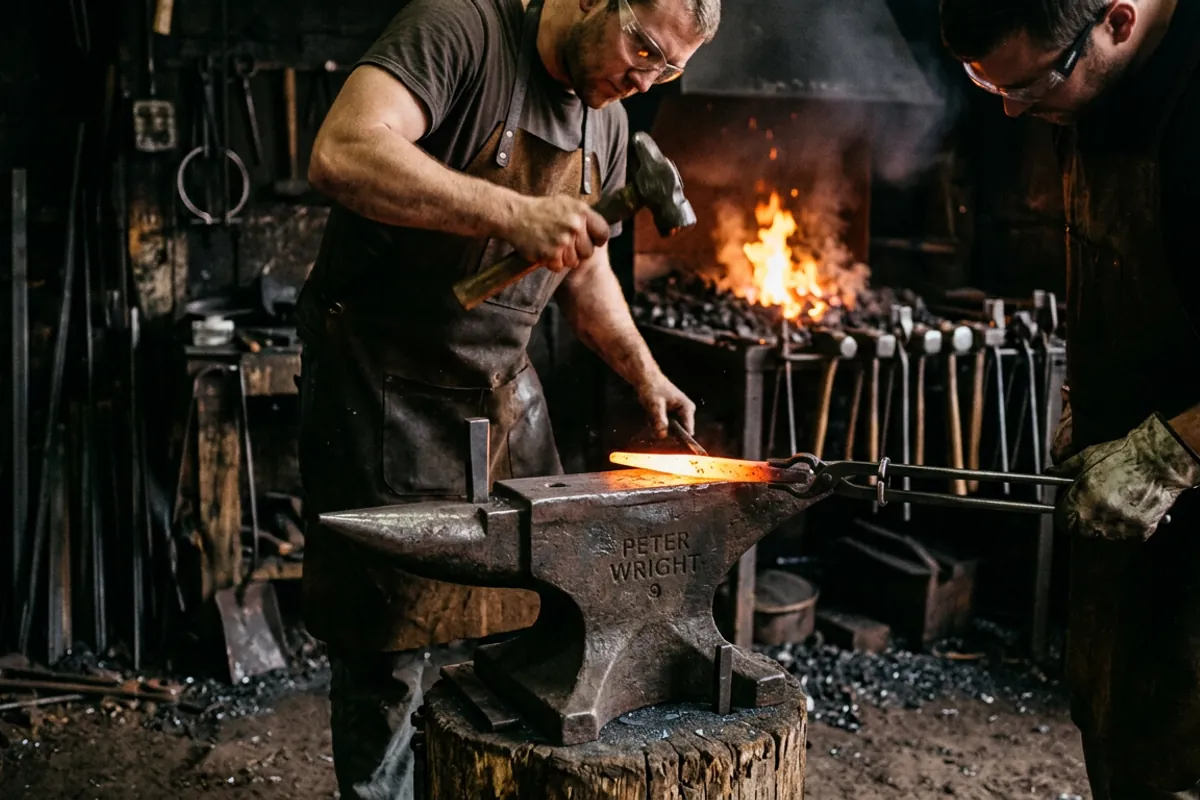
First, fit the jaws to the stock. Loose tongs throw work. Heat the jaws, close them on the exact bar you are forging, and tap the reins until the pair grips that bar with the reins nearly parallel. Do this before you trust any new pair, budget or not.
Second, for anything you are hammering hard or moving between forge and anvil, use a tong ring (a loop of round bar you slide up the reins to clamp them shut). It keeps the jaws from springing open under a hard blow. And keep your eyes protected the whole time, ANSI Z87.1 rated at minimum, because scale flies off hot steel and a slipped bar is exactly when you least want to be blinking grit out. I lost my eyebrows early on to a quench flare I stood too close to in a cotton shirt, and the lesson generalized: the shop does not care that you were only going to be a second. The rest of what belongs on your body is in the blacksmith safety gear guide.
What I would tell a friend
Buy one wolf jaw pair in the 15 to 17 inch range, fit the jaws to your stock the first day, and go forge. That single versatile pair carries a beginner through the projects that teach the craft, and the 16 inch wolf jaw (paid link) is the size I would point most people at first. Skip the five pair kit unless you already know you are chasing bladework, because a beginner uses the wolf jaw for everything anyway and the rest sit in a drawer. Then, once you can hold hot steel safely, forge your second pair rather than buy it, because tongs are the project that pays you back. Put the rest of your money in the anvil, the forge, and a hammer that fits your hand. For the whole tool picture, the hammers and tongs hub ties the pieces together.