If you want one forge hammer and you want to stop thinking about it, buy a 2 to 2.5 pound cross pein with a hickory handle and spend the money you saved on tongs. That is the whole verdict. The Vaughan S32 at 32 ounces is the one I would hand a beginner first, the Vaughan S40 at 40 ounces if you are a bigger person or you already know you swing heavy, and the Picard Swedish pattern if you want a hammer that will outlive you and you do not mind paying for German steel.
Before you read another word: these are not bench tests. I have swung cross peins for about twenty five years and I know what a hammer of a given weight and geometry feels like after an hour of drawing out, but I have not run every model below down in my own shop. What follows is published specs from the makers and their non-marketplace retailers, plus what smiths actually report on the forums, weighed against what I know from the floor. Where owner signal is thin I say so, because that is the useful part.
What a forge hammer has to do all day
A forge hammer is a simple tool with three jobs. It moves hot steel, it does that job hundreds of times an hour without tearing your elbow apart, and it leaves a surface you do not have to spend twenty minutes cleaning up afterward. Everything on the spec sheet feeds one of those three.
Weight is the one everyone fixates on and the one that matters least past a point. A 2 pound head with good technique moves more metal in a session than a 4 pound head swung by somebody who is fighting it. The people who tell you to go heavy are usually strong, experienced, and forging bigger stock than you are.
Pattern matters more than most beginners think. A cross pein has a flat face for planishing and general work, and a wedge shaped pein across the handle axis for spreading steel in one direction. A rounding hammer has a flat face and a domed face, and the dome moves metal faster with less marking. Both work. The cross pein is more common, cheaper, and easier to find in a hardware store.
Handle length and shape are the parts you will actually change. Most factory handles are too long and too fat for hammer work, and every one of them is straight out of a machine with no thought given to how it sits in a hand that is holding it loosely at the end.
The published specs, side by side
Only figures the maker or a non-marketplace retailer publishes. Where nobody states a number, it says not published rather than a number I made up.
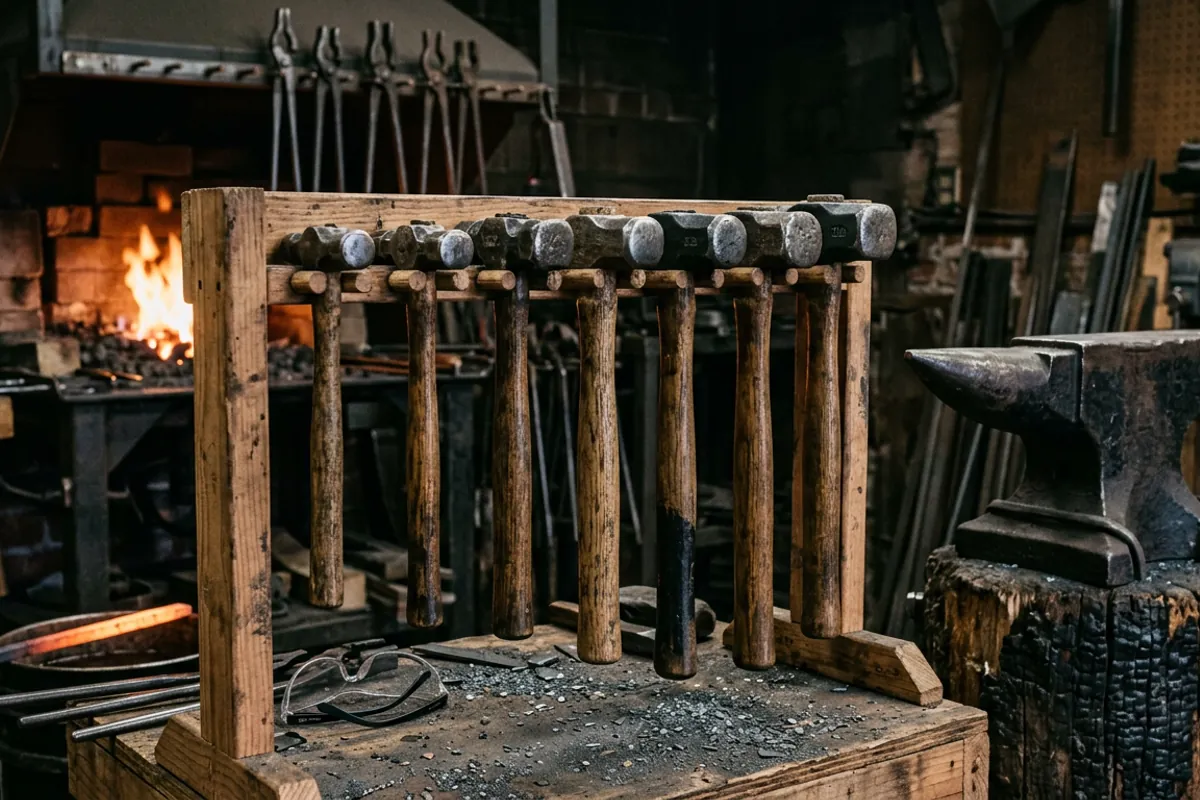
Scroll horizontally to see all columns.
| Hammer | Head weight | Pattern | Handle | Overall length | Price tier |
|---|---|---|---|---|---|
| Vaughan S32 (17030) | 32 oz (2 lb) | Cross pein | Hickory, 13-1/4 in | 14-1/2 in | Budget |
| Vaughan S40 (17130) | 40 oz (2.5 lb) | Cross pein | American hickory, Sure-Lock wedging | Not published | Budget |
| Picard 0000811-1000 | 1000 g (2.2 lb) | Swedish pattern cross peen | Dual curved ash | 14 in | Mid |
| Estwing MRF40BS | 40 oz (2.5 lb) | Blacksmith pattern, flat face and peen | Fiberglass, 12 in | Not published | Budget |
| Seymour 3 lb cross pein | 3 lb | Cross pein | Hickory, 15 in | Not published | Budget |
Sources for those figures are linked in each section below. One caution that applies to the whole table: marketplace listing photos for these hammers get swapped around constantly, and a cross pein is regularly pictured as a ball peen. Buy by model number, not by the picture.
Vaughan S32, 2 pounds of cross pein
This is the hammer I would put in a new smith's hand. Two pounds is enough mass to move 1/2 inch round stock at a working heat, and light enough that you can still control the last blow of a long session, which is when your work gets ruined.
Vaughan publishes it as a 32 ounce head on a 13-1/4 inch hickory handle, 14-1/2 inches overall, with a rust resistant powder coated head, made in the United States, per the S32 17030 listing at Jets Inc. Face diameter is published inconsistently across retailers, so I am not going to quote you one.
The honest tradeoff: this is a general trades hammer, not a smith's hammer. The face comes with sharp edges and a flat, unforgiving profile, and the handle is a stock handle. It arrives as a good head on a mediocre grip, and that is fine, because both of those are things you fix in twenty minutes with a file and a belt sander. If you want the full argument for why this weight and pattern is the right starting point, I laid it out in the blacksmith hammer buying guide.
Check price on Amazon (paid link)
Vaughan S40, the 2.5 pound version
Same family, same construction, 40 ounces instead of 32. JB Tools lists the 17130 as American hickory with Sure-Lock wedging, a polished striking face, beveled pein ends to reduce chipping, a rust resistant powder coat, and made in the USA (JB Tools product page).
Half a pound does not sound like anything until you have swung it for an hour. If you are a big person with a long reach, or you already do physical work for a living, 2.5 pounds will feel natural and you will draw out faster. If you are not sure which camp you are in, take the 32 ounce. You can always buy up. Nobody ever regretted starting lighter, and a lot of smiths on the forums report the opposite regret.
The beveled pein is worth a mention because it is the part most beginners chip. A pein with a sharp corner will bite the steel and leave a crease you then have to forge out. Vaughan bevels theirs from the factory, which puts them a step ahead of some import hammers in the same tier.
Check price on Amazon (paid link)
Picard 0000811-1000 Swedish pattern
This is the step up, and if you can only own one hammer forever, this is the one I would point at. The Hammer Source publishes the specs: 1000 gram head (2.2 pounds), 5-1/2 inch head length, square face at 1-1/2 by 1-5/8 inches, cross peen 1-1/2 by 1/2 inch rounded, 14 inch dual curved ash handle with a ring wedge, alloyed Picard special steel hardened and tempered, face and peen ground with chamfered edges (Hammer Source spec page).
Two things on that list are the reason for the price. The chamfered, ground face means the hammer arrives dressed, so it does not print a ring into your work on the first strike. The dual curved handle is shaped for a hammer swing rather than for a general purpose tool, and the ring wedge holds the head better than a plain wooden wedge over years of shock.
The tradeoff is simple: it costs several times what a hardware store cross pein costs, and a dressed hardware store hammer does the same work. What you are paying for is that you never have to touch it, and that a hard hammer face stays flat instead of slowly mushrooming. Worth it for someone who knows they are going to keep forging. Not worth it for someone still deciding.
Check price on Amazon (paid link)
Estwing Sure Strike 40 oz, the fiberglass one
Ace Hardware lists the MRF40BS as a 40 ounce steel head on a 12 inch fiberglass handle (Ace Hardware product page). Estwing makes the family in 32, 40, and 64 ounce head weights.
Fiberglass splits the room. The case for it: it does not dry out, it does not loosen in a shop that swings from humid summer to bone dry winter heat, and it will not fail from a missed blow the way a wooden handle does when you overstrike the far edge of the anvil. The case against it: you cannot reshape it, you cannot easily rehandle it, and most smiths I know find that it transmits more shock into the hand than hickory does.
I run wood, and I would tell a beginner to run wood, because reshaping the handle is one of the highest value things you can do to a cheap hammer. But if you are the sort of person who leaves tools outside, or you have already broken two wooden handles by overstriking, the fiberglass version is a reasonable answer rather than a wrong one. The 12 inch handle is short, which some people love for control and others find cramped.
Check price on Amazon (paid link)
Seymour 3 pound cross pein
Seymour Midwest publishes a 3 pound cross pein hammer with a 15 inch hickory handle (Seymour Midwest product page). The retail part numbers wander around between sellers, so match the description rather than the number.
Three pounds is more hammer than most beginners should start with, and the 15 inch handle is longer than most smiths end up using. Both of those are fixable and neither is a defect. This is the pick for somebody who already knows they want mass, or who is forging heavier stock than the usual beginner projects. If you buy it, expect to cut the handle down.
I would not make this a first hammer. The failure mode with a heavy hammer is not that you cannot lift it, it is that you unconsciously start muscling it instead of letting it fall, and muscling a hammer is how smiths end up with a bad elbow and a bad shoulder.
Check price on Amazon (paid link)
Rounding hammers and why I would not start there
A rounding hammer, with its flat face and domed face, is a genuinely better forging tool for most bar work than a cross pein. The dome moves steel with less marking and lets you plan out a surface with the flat face right after. Most smiths who have been at it a while end up with one on the rack.
I still would not start there, for two reasons. First, a good rounding hammer is a specialist item, usually hand forged, and it costs real money. The ones sold cheaply on marketplaces have thin owner signal in the smithing forums and I am not going to recommend a hammer I cannot find honest reports on. Second, the cross pein teaches you something the rounding hammer does not, which is directional spreading, and that skill transfers to every fuller and set tool you will ever use.
If you want one later, buy from a maker who forges them rather than off a marketplace listing. Centaur Forge carries them, and small shops like Fiery Furnace Forge sell hand forged ones directly. Those are not affiliate links and I do not earn anything if you buy there. For where a rounding hammer fits alongside the rest of your kit, see the hammers and tongs hub.
Dress the face before you swing it
Every budget hammer on this list should be dressed before it touches hot steel, and this is the single highest value thing you will do to it. A factory face has a sharp perimeter edge that stamps a crescent into your work every time you strike slightly off square, which is often.
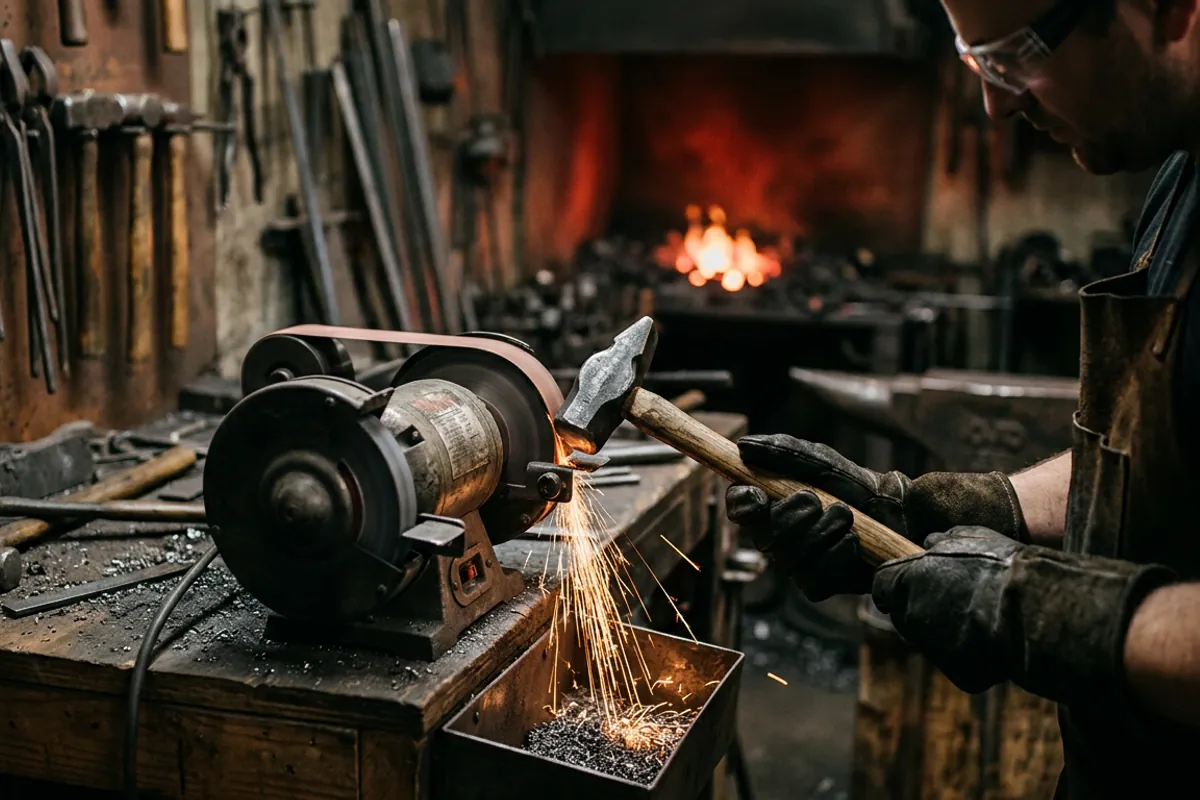
Dressing means rounding the perimeter of the flat face into a gentle radius and polishing the face itself so it leaves a clean surface. Take the corner off the pein too, so it spreads instead of cutting. A belt sander and a few minutes of care does it. This is common practice, not my invention: I Forge Iron has a standing thread on it in the hand hammers section (Hammer Dressing), and the advice there is that most hammers need dressing before use.
While you are at it, look at the handle. Most factory handles are too long and too thick. Cutting a couple inches off and thinning the grip so it sits loosely in a relaxed hand is standard practice among working smiths. If you have a belt grinder already for knife work, you have the tool for both jobs. Wear ANSI Z87.1 rated eye protection at the grinder, every time, no exceptions.
What owners say
For hammer weight, the forum consensus is consistent and it is lighter than beginners expect. On BladeForums, the thread Hammer weight for forging lands mostly on 2 to 2.5 pounds for blade work, with one poster arguing 2.5 pounds is about the ceiling for a hand hammer and heavier work belongs to a striker or a sledge. A poster recovering from shoulder surgery with nerve damage reports working the range from 3.5 pounds down to 1.5 pounds and never heavier, and notes he cut a handle down by a third to fit his hand better. Another experienced poster in that thread makes the opposite case, preferring 4 pounds to cut down reheat cycles on heavier stock. Both positions are real. Control is what decides it.
I Forge Iron's What Size Hammer?? runs the same argument from the general smithing side. A member forging nails and hooks with 2 and 2.5 pound hammers was told by an experienced smith that a 3 pounder was the minimum, while another poster in the same thread said he uses 2.5 pounds for normal work and only reaches for the 3 pound when drawing out larger pieces, adding that the real question is what you can control, since a lighter hammer takes longer but does not leave deep dings. The debate is old enough that IFI has a thread titled Which is faster to move metal; 4 lbs hammer or 2 lbs hammer with 2x the blows.
On injury, the I Forge Iron threads on blacksmith's elbow (one here) trace the problem to technique and grip more than to weight. The recurring report is gripping the handle too tightly, often because the handle is too small for the hand.
Now the thin spot, and I would rather say it than paper over it: I did not find substantial blacksmithing forum discussion of these specific hardware store models by part number. Smiths talk about hammer weight, handle shape, and dressing constantly, and they talk about Picard by name because it is a smithing brand. Vaughan, Estwing, and Seymour come up mostly as generic hardware store cross peins that work fine once dressed. That is a real signal, but it is a weaker one than a hundred owners reporting on the same model, and you should weigh it accordingly.
The safety part I do not skip
Eye protection rated to ANSI Z87.1, on your face, every time the hammer moves. Hot scale flies off the work on the first blow and it flies toward whoever is swinging. That standard is not a suggestion and a pair of fashion sunglasses is not a substitute.
Natural fibers only. Cotton, wool, leather. Synthetic clothing melts into skin instead of burning away, and near a forge that is the difference between a scar and a graft. I learned the safety lesson on this site the hard way years ago: I quenched a blade in oil that was too cold, standing too close in a cotton shirt with no face shield, and the oil flared and took my eyebrows. I kept my eyesight by luck. Luck is not a plan, which is why I will not soften any of this.
For hammer work specifically, the other hazard is the one that builds slowly. A loose head is a projectile. Check the wedge on a wooden handle regularly, and if the head moves at all, stop and rehandle it. Do not swing a hammer with a cracked handle because you want to finish the piece. The rest of the kit is covered in blacksmith safety gear.
What I would tell a friend
Buy the 2 pound Vaughan cross pein, dress the face and the pein, cut the handle back until it sits right, and go forge for six months. That hammer plus a decent anvil and one pair of tongs will take you through every beginner project there is. If after those six months you know you want mass, buy the 2.5 pound. If you know you want a hammer for the next thirty years, buy the Picard.
The one I would skip for a first hammer is the 3 pound. Not because it is a bad tool, but because starting heavy teaches you to muscle the swing, and that habit is expensive to unlearn and hard on your joints.
The buying note that matters most: your hammer is the cheapest part of this. A poor hammer costs you twenty minutes with a file. A poor anvil costs you every blow you ever strike on it, which is why I would put spare money there first, not into the hammer. Start with the anvil weight guide and the short list in blacksmithing tools that actually matter, then come back for tongs in the tongs buying guide.