If you want a blacksmith power hammer in a home shop and you want the short answer first: buy a used mechanical hammer in the 25 to 50 pound ram class with parts support behind it, or build a tire hammer at a workshop, and only step up to a new self-contained air hammer like an Anyang ST or a Big BLU once you know what you are asking a machine to do all day. I have been forging about twenty-five years and I do most of my work by hand on Bessie, my 148 lb Trenton, so let me be straight about what follows: these are not bench tests. I do not own six power hammers and I am not going to pretend I do. What you are getting is published maker specs, owner reports from the forums with the link so you can read them yourself, and the shop judgment I do have about what a machine like this costs you in floor, power, and attention.
The other thing worth saying in the first breath: most of what sells online under the words "power hammer" is not a forging hammer at all. It is a pneumatic planishing hammer for sheet metal. That is a real tool, it just will not draw out a bar of 1 inch square. More on that below, because a lot of people spend money on the wrong machine.
What a power hammer actually buys you
A power hammer is a mechanical striker. It replaces the second person swinging a sledge, which is exactly the job it was invented for. It draws out stock, spreads, tapers, sets down shoulders, and flattens forge welds faster and more consistently than your arm can, and it keeps doing it after your elbow has quit for the day.
What it does not do is make you a smith. If you cannot move steel accurately with a 2 lb cross peen, a machine that swings 250 times a minute will only produce mistakes faster. I tell the weekend beginners the same thing every time: the hammer in your hand comes first, then the anvil, then the forge, then tongs that actually grip, and a power hammer is somewhere past all of that. If you are still sorting out the basics, start with the blacksmith hammer I would hand a beginner and tongs that actually hold the work, and come back to this page when your shop is running.
The honest trigger for buying one is volume and stock size. If you are making a lot of anything, or you are working 1 inch and up, or you are drawing damascus billets, a power hammer stops being a luxury. If you make a hook or two on a Saturday, it is a very heavy way to store money.
The field at a glance
Published specs only. Where a maker does not publish a figure, it says so.
Scroll horizontally to see all columns.
| Machine | Type | Ram weight | Blows per minute | Power needed | Machine weight |
|---|---|---|---|---|---|
| Anyang STH-15 | Self-contained air | 15 kg / 33 lb | 300 per minute | 2.2 kW motor | 540 kg / 1188 lb with base |
| Anyang STH-25 | Self-contained air | 25 kg / 55 lb | 250 per minute | 3 kW motor | 1100 kg / 2420 lb with base |
| Anyang STH-40 | Self-contained air | 40 kg / 88 lb | 245 per minute | 4 kW motor | 1350 kg / 2970 lb with base |
| Big BLU MAX 65 | Air, shop compressor | 65 lb (30 kg), 500 lb anvil | Not published | 14 to 16 CFM, 3.5 to 5 HP compressor with 80 gallon tank | Not published |
| Big BLU MAX 110 | Air, shop compressor | 110 lb (50 kg), 700 lb anvil | Not published | 16 to 18 CFM, 5 HP compressor with 60 to 80 gallon tank | Not published |
| Clay Spencer tire hammer | Mechanical, home built | 50 lb | Up to 270 per minute | 1 hp, 1750 rpm, 120/240 volt | Not published |
| Little Giant 25 lb | Mechanical, used | 25 lb | Not published | Varies by motor fitted | Varies, used market |
Anyang ST figures are from the Blacksmith Source specification table. Big BLU figures are from the maker's own model page, which also states the hammers are made in the USA. The tire hammer numbers are from Farm Show's writeup of Clay Spencer's design.
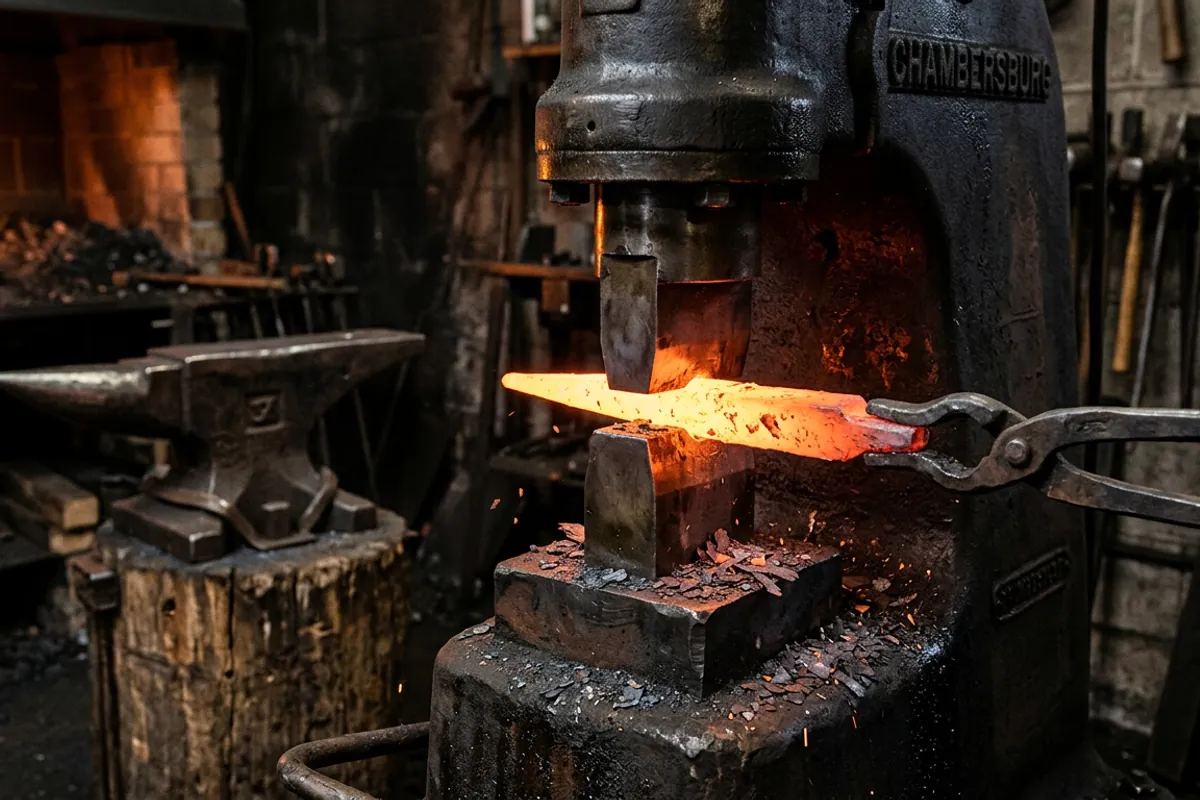
Notice what the table tells you before any brand argument starts. A 33 lb ram arrives as roughly 1188 pounds of machine. That is the real spec. Ram weight is what hits the steel; machine weight is what your floor, your trailer, and your back have to deal with.
Anyang ST: the cheapest way into a new self-contained air hammer
Self-contained means the compressor is built into the machine. You plug it in, you do not need a shop compressor and an air line, and there is no external tank to size. For a one person shop that is genuinely convenient, and it is why the small Anyangs show up in so many hobby shops.
The published ST range starts at the STH-15 with a 15 kg (33 lb) ram at 300 blows per minute on a 2.2 kW motor, and steps up through 25, 40, 55, 75, and 110 kg rams. The frames are cast, and the importers push that as an advantage over fabricated frames.
Two things to check before you get excited about the entry model. First, the maker publishes motor power but the supply matters just as much: ask the dealer what voltage and phase the specific machine wants before you buy, because "I need a rotary phase converter" is an expensive surprise after delivery. Second, the small one is small. The consistent advice on the forums is not to buy the 33 lb model if you can stretch to the next size, because people outgrow it. I have not run one, so I am reporting that, not testing it.
Big BLU: US made, and the compressor it needs
Big BLU builds in North Carolina and sells three families, the Mini, the Max, and the Super. The MAX 65 runs a 65 lb ram over a 500 lb anvil with a 7.5 inch adjustable stroke and an 18 inch throat; the MAX 110 goes to a 110 lb ram over a 700 lb anvil; the MAX 155 is a 155 lb ram over an 800 lb anvil. The company does not publish blows per minute on that page, so I am not going to guess at one.
The number people miss is air. Big BLU publishes 14 to 16 CFM during hot forging for the 65, 16 to 18 CFM for the 110, and 21 to 24 CFM for the 155, with a 3.5 to 5 HP compressor and an 80 gallon tank recommended for the smallest of the three. A shop compressor that size is its own purchase, its own circuit, and its own noise. Budget it as part of the hammer, not as an accessory, or you will end up with a machine that cycles a struggling compressor all afternoon and never gives you full power.
Against the imported self-contained hammers, you are paying for domestic manufacture, a quick change die system, and a phone number that answers. Whether that is worth the difference is your call, but it is a real difference and not a marketing one.
Used mechanical hammers and the Little Giant question
The classic American hobby answer is still a used Little Giant in the 25 to 50 lb class. They were made by the tens of thousands, they are simple enough to rebuild on a shop floor, and parts are genuinely available: the current company stocks parts for 25, 50, 100, and 250 lb hammers, plus babbitting supplies and a rebuilding DVD set. That is a real ownership advantage over an orphan machine of unknown make sitting in a barn.
Buying used is buying condition, not brand. Look at the same things you would look at on an old anvil, with more moving parts: play in the ram guides, condition of the toggle arms and pins, whether the babbitt bearings are shot, whether the clutch grabs, whether the dies are dressed or beaten to a mushroom. A hammer that needs a full rebuild is a project measured in months, and rebuild work is not cheap if you farm it out. The same buy-it-with-your-eyes-open thinking I use on used anvils applies here, only the downside is bigger, because a bad anvil is a doorstop and a bad hammer is a doorstop you cannot lift.
If a seller will not run the machine for you, treat the price as a parts price.
Building a tire hammer
The most common home built power hammer in North America is Clay Spencer's tire hammer, developed from Ray Clontz's design. It uses a spare tire and rim on a trailer axle as the clutch, driving a spring toggle linkage like a Little Giant. Farm Show published the specifics: a 50 lb hammer running a 1 hp, 1750 rpm, 120/240 volt motor, delivering up to 270 blows a minute, and Spencer's own estimate of about $1,000 in materials and 100 hours of gathering and building.
Owner reaction on the forums is warm. In a KnifeDogs thread on the plans, Wayne Coe calls it a very good mechanical hammer, similar to a Little Giant, with very good control, and says that for the money you cannot do better. The criticism in the same thread is die size, with a preference for dies larger than the stock 2 by 3 inch, which he notes rarely matters for knife work. Members there consistently point people at a group build workshop rather than a solo build, and quote workshop cost around $1,000 with prebuilt hammers around $2,500. Those are published figures from that discussion and prices move, so treat them as direction rather than a quote.
Honest caveat: this route needs a welder, a drill press or mill access, and the patience to read drawings. If that is not your shop, buy a hammer.
What Amazon sells as a blacksmith power hammer
Search the big marketplace for "power hammer blacksmithing" and you will get pneumatic planishing hammers: a foot pedal, a C frame with a throat, a small round anvil cap, and a rated capacity in sheet gauge. These are metal shaping tools. They smooth welds and crown panels for bodywork, and they are good at that. They are not forging hammers, they will not draw hot bar stock, and no amount of listing text calling something a black smith power hammer changes what the machine can do.
If sheet metal shaping is what you actually wanted, the deep throat version is the one to look at, because throat depth is what limits panel size: Check price on Amazon (paid link). If you wanted to move hot bar, close the tab. Nothing in that category will do it, and the money is better spent on a used mechanical hammer or on the rest of the shop. For where that money goes instead, see the blacksmithing supplies I would actually buy first.
What the hammer needs from your shop
Before you buy anything on this page, walk your shop with a tape measure.
Floor. The factory answer for a Little Giant was footings about 2 feet deep, and most hobby smiths never do it. The practical accounts collected at spaco.org describe hammers bolted to existing slabs, set on railroad ties, or bedded on half inch conveyor belting glued to the floor and the hammer base, with that last setup still in place decades later. A thin slab plus a heavy hammer is how slabs crack, so know what you are standing on and give the machine mass and some isolation from the rest of the floor.
Ceiling and access. Machines in this class arrive on a pallet weighing half a ton or more. Plan the unload, the door width, and the path before delivery day.
Power. Read the motor spec, then read your panel.
Neighbors. A power hammer is loud in a way a hand hammer is not, and it puts impact into the ground. If your shop shares a wall or a property line with someone's bedroom, that conversation happens before the purchase, not after.
Safety under a power hammer
This is the part I will not soften. A power hammer does not care what is between the dies.
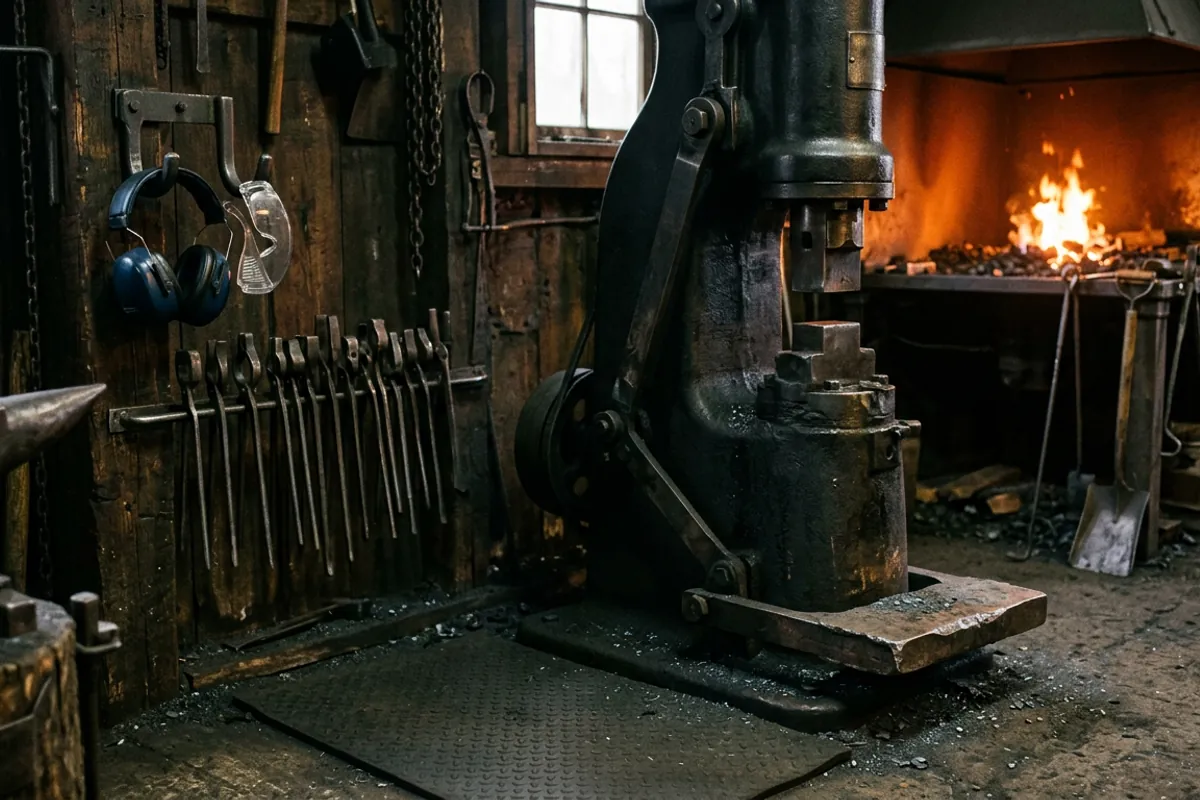
Hot steel goes in with tongs that fit the stock, never with fingers near the die line, and never with short stock you are pinching to hold. Keep your hands out of the strike zone as a habit, not as a decision you make each time. On a mechanical hammer, the belt, flywheel, and clutch are all things that grab sleeves; keep guards on and keep loose clothing away.
Before you change dies or reach into the mechanism, kill the power and, on an air hammer, bleed the pressure. A machine that is off but still charged can still cycle.
Eyes and ears are not optional. Scale comes off hot work under the dies with real speed, so wear eye protection rated to ANSI Z87.1: the 3M SecureFit 400 series meets the impact-rated protector requirement of that standard and is cheap enough to keep several pairs in the shop (Check price on Amazon (paid link)). For hearing, the 3M Peltor X5A is published at NRR 31 dB, the highest NRR 3M lists for a passive earmuff, and it is the kind of muff worth owning if you run a hammer regularly (Check price on Amazon (paid link)); the published attenuation figures are here.
Wear natural fibers. Early on I quenched a blade in oil that was too cold, standing too close in a cotton shirt with no face shield, and the flare took my eyebrows. Cotton scorched. A synthetic shirt would have melted onto me. The rest of the kit is covered in blacksmith safety gear: what matters and what to skip.
What owners say
For the imported self-contained hammers, the signal is mixed and worth reading in full. In a BladeForums thread on Anyang hammer owners, one experienced poster reports that the front of the hammer, where the front piston sits, would get hot enough to burn you after heavy or prolonged use, and describes replacing front seals roughly every six months. Parts and support were a historical complaint, though the thread notes improvement under the US representative. The size advice in that same discussion is blunt: buy the largest and best hammer you can afford rather than a 33 lb model, because owners grow into a bigger hammer. Say-Mak, Iron Kiss, and Little Giant come up repeatedly as the alternatives people preferred.
For the tire hammer, the owner signal is consistently positive on control and value, with die size the only recurring gripe, as in the KnifeDogs thread above.
For Big BLU, owner chatter is thinner in public threads than the brand's presence suggests, and I am not going to manufacture a consensus that I did not find. What is verifiable is the published spec sheet and the domestic manufacture. Talk to someone at a club or a hammer-in who runs one before you spend that kind of money.
What I would tell a friend
Buy the hammer that matches the work you are actually doing, and buy it once. For most home shops that means a used mechanical hammer in the 25 to 50 lb ram class with parts support behind it, or a tire hammer built at a workshop, both of which put a real striker on your floor for a fraction of a new machine. If you want new and self-contained, do not buy the smallest one in the catalog. If you want US built and you already have or will buy a compressor sized to the published CFM, Big BLU is the straightforward answer.
Skip anything sold as a power hammer that is really a planishing hammer, unless sheet metal is the work you want to do.
And keep the order of operations straight: hammer, anvil, forge, tongs, then a machine. More on the whole picture at the hammers and tongs hub and in what size anvil you actually need.