Body
I would put a 2 lb cross pein in a new smith's hand nine times out of ten, and the specific one I would hand over is the Vaughan S32. It is a plain American blacksmith hammer, hickory handled, cheap enough that nobody agonizes over it, heavy enough to move quarter inch stock, and light enough that a beginner still has an elbow at the end of a Saturday. Before you read another word: I have not run every hammer below in my own shop. What follows is published maker and retailer specs, owner reports from the forums, and about twenty-five years of my own hammer time weighed against both. Where a figure is not published, I say so instead of making one up.
People search for this tool as a blacksmith hammer, a blacksmiths hammer, and even a black smiths hammer, and they all mean the same thing: the striking tool you will hold for every heat you ever take. It is the cheapest tool in the shop that has the biggest effect on your work and on your joints, which is exactly why it deserves more thought than most beginners give it.
What a blacksmith hammer actually has to do
A forging hammer has one job, which is delivering a controlled blow to hot steel over an anvil face, thousands of times, without hurting you. Everything worth judging comes out of that.
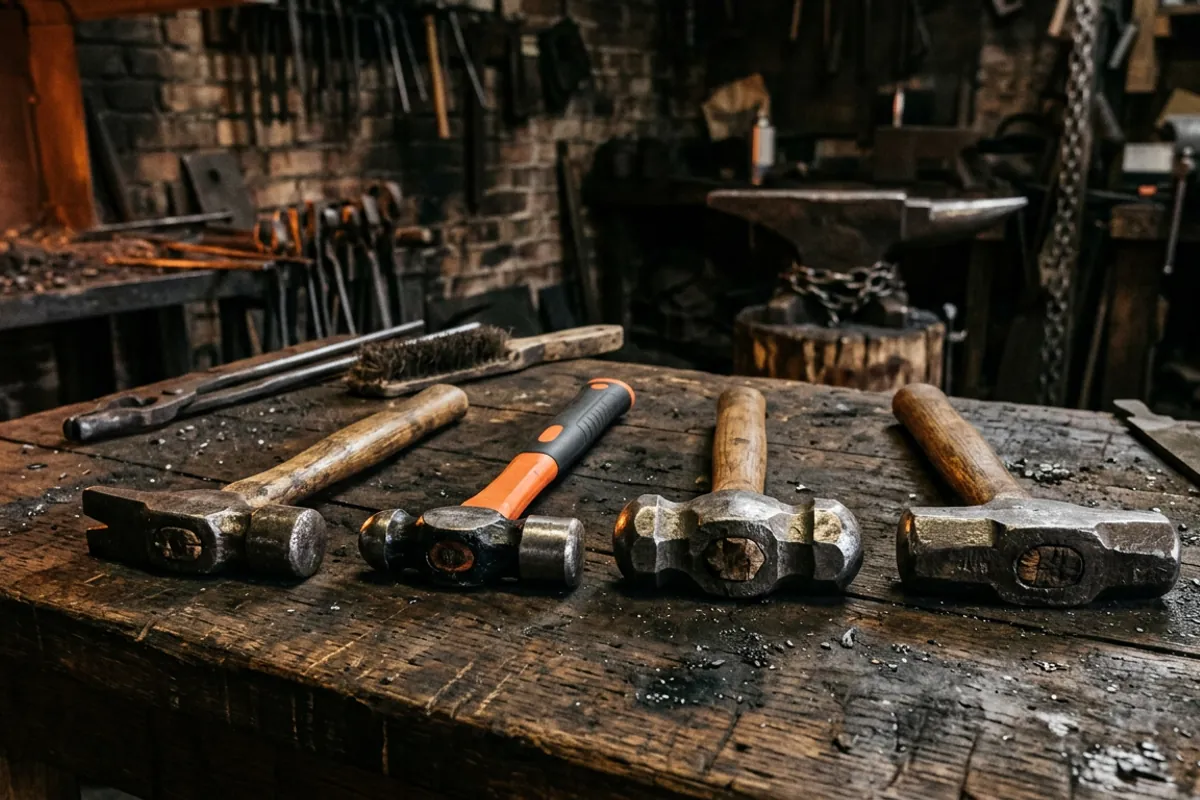
Weight is a control decision, not a power decision. The honest answer to "what weight" is the heaviest hammer you can still swing accurately on your hundredth heat, not your first. For most adults starting out that is somewhere from 2 to 2.5 pounds. Heavier hammers do move more metal per blow, and experienced smiths will tell you so, but a 4 lb hammer in an untrained arm produces bad blows, bad marks, and eventually a bad elbow. You can always buy up later. Nobody has ever regretted learning technique on a lighter hammer.
Face geometry matters more than brand. A forging face wants a very slight crown and softly radiused edges. A dead flat face with a sharp corner leaves a half moon dent in your work every time you tip the hammer even a degree, and you will tip it. Most factory hammers ship flatter and sharper than a smith wants, which is why dressing is a normal part of owning one.
The peen is the second tool. A cross pein drives metal perpendicular to its edge, which is how you spread and draw out. A ball peen does not draw well but is fine for riveting and for striking punches and chisels. A rounding hammer gives you a flat face for finishing and a crowned face for moving material fast, which is why farriers and a lot of production smiths live on them.
The handle is a consumable. Wood handles break. That is not a defect, that is the handle doing its job instead of your wrist. Hickory and ash are the traditional choices because they take shock well and because you can replace them for a few dollars. What you must not tolerate is a loose head, ever.
If you are still assembling the rest of the shop, the short list of tools that actually matter and the starter kit guide cover what goes with the hammer, and everything in this cluster lives on the hammers and tongs hub.
The field at a glance
Published figures only, cited to the maker or a non marketplace retailer. Where a spec is not published I have written that rather than guessing.
Scroll horizontally to see all columns.
| Hammer | Head weight | Pattern | Face and peen | Handle | Price tier |
|---|---|---|---|---|---|
| Estwing Sure Strike MRW24BP | 24 oz | Ball peen | Fully polished face, ball peen; face size not published | Hickory, triple wedge, 444 mm overall (about 17.5 in) | Budget |
| Vaughan S32 | 32 oz (2 lb) | Cross pein blacksmith | 1-1/8 in diameter face, beveled pein | Hickory, Sure-Lock wedged, 14-1/2 in overall | Budget |
| Vaughan S40F (171-20) | 40 oz (2.5 lb) | Cross pein blacksmith | Face diameter not published | Fiberglass, 15 in overall | Mid |
| Picard 0000811-1000 | 1000 g (2.2 lb) | Swedish pattern | Square face 1-1/2 by 1-5/8 in, cross pein 1-1/2 by 1/2 in rounded | Ash, ring wedge | Mid to premium |
| Nordic Forge 2 lb rounding | 2 lb | Rounding (farrier pattern) | 1-1/2 in faces, one rounded and one flat | Hickory, 15-1/2 in | Mid to premium |
Sources for the figures above: Hardwick and Sons on the Vaughan S32, HomElectrical on the Vaughan S40F, The Hammer Source on the Picard 811-1000, The Hammer Source on the Nordic Forge 2 lb rounding hammer, and Haus of Tools on the Estwing MRW24BP.
Estwing Sure Strike 24 oz ball peen
This is the hammer most people already own or can buy on the way home, and it is the honest answer to "can I start tonight with what I can get." A 24 oz ball peen will forge a hook, upset a rivet, and drive a punch. It is not a drawing hammer, and you will feel that the first time you try to spread stock with the ball: it dishes metal instead of moving it in a line.
Published: 24 oz head, forged solid steel with a fully polished face, hickory handle with triple wedge construction, listed at 444 mm overall by Haus of Tools. Estwing does not publish a face diameter for the wood handled Sure Strike line, so I am not going to invent one.
The tradeoff is honest: it is light for hot work at 1.5 pounds, and the ball is the wrong peen for most forging. But it is the cheapest way to find out whether you actually like standing in front of a fire, and it will stay useful for punch and chisel work forever after you upgrade. If money is tight, buy this and put the difference toward the anvil, which is the purchase that really decides how your work goes. Check price on Amazon (paid link)
Vaughan S32 two pound cross pein
This is my pick for a first real blacksmith hammer. Published specs: 32 oz head, 14-1/2 in overall length, 1-1/8 in diameter face, Vaughan Supersteel head with a rust resistant powder coat, and a flame treated hickory handle wedged in a tapered eye, per Hardwick and Sons. Vaughan states the pein ends are generously beveled to minimize chipping, which is a real design detail and not marketing fluff: a sharp peen edge is exactly what chips.
Why this one. Two pounds is the weight most beginners can actually control for an hour. The cross pein is the peen you will use for real work. The handle is replaceable at any hardware store. And the price puts it in the range where you can buy it, dress it, learn on it, and not feel precious about grinding the face the way you want it.
What you give up: the face is small at 1-1/8 in, which is fine for small stock and less forgiving on wide flat work than a bigger faced hammer. The factory handle is thicker and more varnished than most smiths like, and the face will want dressing out of the box. Both are ten minute problems. Check price on Amazon (paid link)
Vaughan S40F two and a half pound with a fiberglass handle
Same pattern, more mass, different handle. Published: 2-1/2 lb forged steel head, 15 in overall, fiberglass handle with a rubber overstrike shield at the neck and a cushioned PVC grip, per HomElectrical. Vaughan does not publish a face diameter for this model that I could find on a maker or retailer page, so treat the face as unknown until you have it in hand.
Fiberglass is a real argument, not a compromise. It survives an overstrike that would break a wood handle, and the shield at the neck is there because overstrikes happen. The counterargument from the traditional side is that you cannot reshape a fiberglass handle, and a lot of smiths thin and reshape a wood handle to fit their grip. I run wood, because I like being able to make the handle mine and replace it for the cost of lunch. If you know you are hard on handles, this is a fair choice at 2.5 pounds. If your hands or elbows already give you trouble, stay at 2 pounds. Check price on Amazon (paid link)
Picard 0000811-1000 Swedish pattern
The German made Picard is the step up that owners talk about most. Published: 1000 g (2.2 lb) head of alloyed Picard special steel, hardened and tempered, black powder coat, square face measuring 1-1/2 by 1-5/8 in, cross pein 1-1/2 by 1/2 in and rounded, dual curved ash handle secured with a ring wedge, per The Hammer Source.
What you are paying for is the face. A 1-1/2 by 1-5/8 in face is substantially larger than the Vaughan's 1-1/8 in circle, and a bigger face means fewer marks to planish out and better control on flat work. The Swedish pattern's curved handle also fits the way most people naturally swing.
The tradeoff is money and expectations. It is several times the price of the Vaughan, and it still may want dressing to your taste. It will not make a beginner forge better; it will make a smith who already has technique work a little cleaner. Buy it as your second hammer, not your first. Check price on Amazon (paid link)
Nordic Forge two pound rounding hammer
Rounding hammers come out of the farrier world and have crossed over hard into blacksmithing, because one hammer gives you a crowned face to move metal fast and a flat face to finish. This one is published at 2 lb with 1-1/2 in faces, one rounded and one flat, on a 15-1/2 in hickory handle, per The Hammer Source. Centaur Forge states the heads are forged from tool steel, machined, heat treated, and given a process that rounds the chamfers to help prevent chipping, and that the handles are Arkansas hickory.
Who it suits: someone who already knows they want to forge, not someone testing the hobby. The crowned face is less intuitive than a flat face for a first week, and the price sits well above the Vaughan. What you get is a hammer that does both jobs and a maker that dresses chamfers at the factory instead of leaving it to you. Check price on Amazon (paid link)
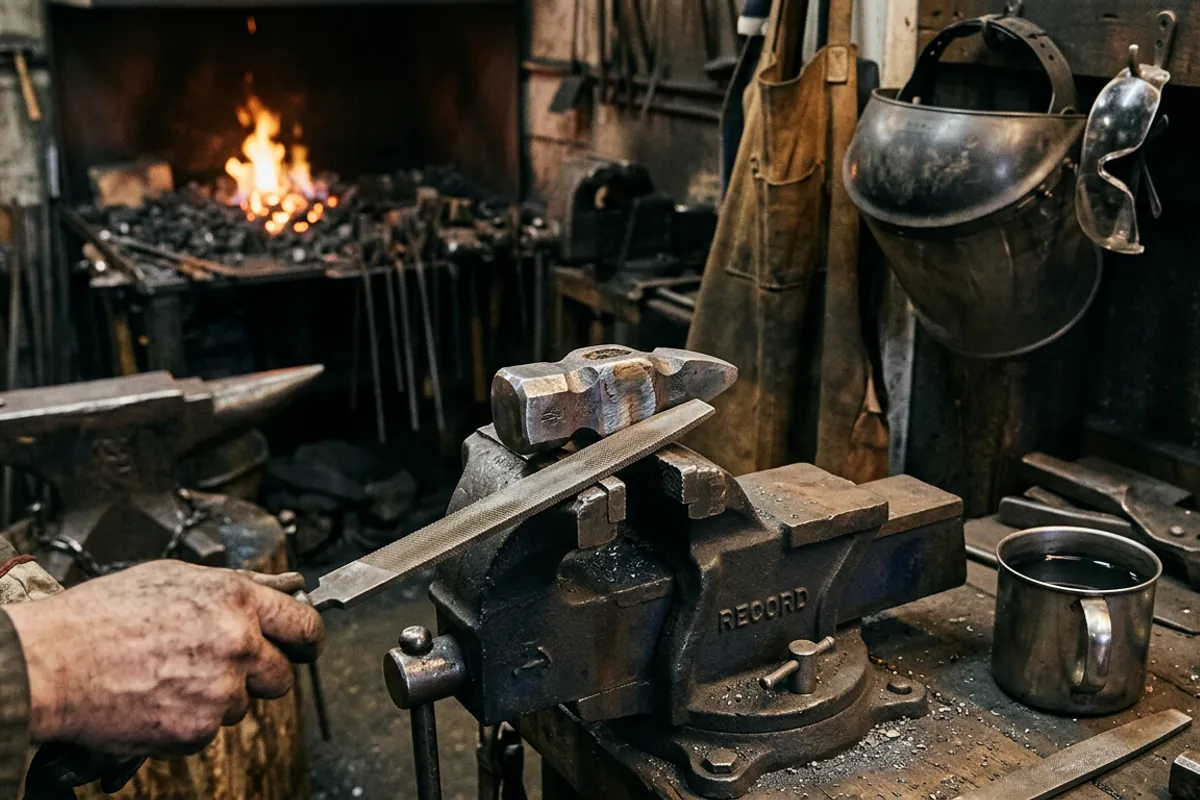
Dress the hammer before you work with it
Almost every factory hammer arrives sharper edged and flatter faced than a forging hammer should be, and the coating is not there for you. Smiths on The Garage Journal describe new hammers arriving rough ground with an uneven finish and coated in lacquer that has to come off to bare metal, and the same thread runs the long standing argument about how much crown a face should carry and where. The consensus that matters for a beginner: take the sharpness off the edges, get the face smooth, and keep the crown slight.
How I do it, in plain terms. Take the coating off the face. Break the edge to a small radius all the way around, then blend it so there is no step you can catch a fingernail on. Leave the face nearly flat with only a whisper of crown. Go slowly on a belt sander or with a file and quench the head in water often. That last part is not optional: a hardened hammer face heated blue on a grinder is a softened hammer face, and you cannot undo it in a home shop.
Wear a face shield over safety glasses at the grinder. Grinding wheels and belts throw hot particles and hammer faces are hard, and I would rather you look silly than lose an eye. The full rundown of what to wear and what is a waste of money is in the safety gear guide.
What owners say
I have not personally run every hammer above, so here is what the forums report, attributed.
On weight, the BladeForums thread on hammer weight for forging lands where I do: members mostly work in the 2 to 2.5 lb range, with heavier hammers reserved for specific tasks. One member puts it bluntly as a question of what size hammer you can control well, while another argues a heavier hammer saves reheats by penetrating deeper. The same thread carries a member's account of rotator cuff surgery and permanent weight restrictions afterward, and another member's advice to round the faces so there are no sharp edges, learned the hard way. That is the whole debate in one place, and it is worth reading before you buy up in weight.
The I Forge Iron threads titled What Size Hammer?? and Which is faster to move metal; 4 lbs hammer or 2 lbs hammer with 2x the blows run the same argument at length, with experienced smiths split between recommending more mass and recommending the lightest hammer you can drive accurately. There is no forum consensus on a single correct weight, and anyone who tells you there is has not read the threads.
On the specific models, the signal is uneven and I will say so. Vaughan is widely owned and rarely discussed as a problem, which is the kind of quiet reputation a cheap hammer earns by working. Picard comes up often as the step up worth paying for. Owner signal on the Nordic Forge hammer is thinner in blacksmithing circles than in farrier circles, which makes sense given where it comes from. I did not find a body of complaints worth reporting on any of the five, but absence of complaints in threads I read is not the same as a durability test, and I am not going to pretend otherwise.
The safety part I will not soften
Hammer faces are hardened. So are anvil faces, punches, chisels, and other hammers. Striking hardened against hardened is how chips come off at speed, and a steel chip in an eye does not heal. Never strike your hammer face directly on a bare anvil face, never hit one hammer with another, and never strike a struck tool whose head has mushroomed. Grind mushroomed heads back before you use them.
Eye protection is the floor, not the ceiling: ANSI Z87.1 rated safety glasses at minimum, and a face shield over them for grinding. Wear natural fibers near the forge, cotton or wool or leather. Synthetics melt onto skin, and a burn under melted polyester is a much worse injury than a burn. I learned the heat side of this the expensive way, quenching a blade in oil that was too cold while standing too close in a cotton shirt with no face shield. The oil flared and took my eyebrows. I kept my eyesight by luck, not by judgment, and I have not made a "just this once" exception since.
Check the head every session. Grab the handle and try to twist and rock the head; if it moves at all, stop and rehang it. A head that leaves the handle mid swing goes wherever it wants. And keep your grip loose, near the end of the handle, letting the hammer's weight do the work. A death grip is how you end up with tennis elbow and a hobby you cannot do anymore.
What I would tell a friend
Buy the Vaughan S32, spend twenty minutes dressing the face and knocking the varnish off the handle, and put the money you saved into the anvil. That is the real order of priorities: hammers are cheap and swappable, and the anvil under the work is the thing you live with. If you are still choosing one, start with what size anvil you actually need and then how to buy an anvil without wasting your money.
If you already own a decent ball peen, forge with it for a month first. You will learn what you actually want in a hammer, and a 24 oz Estwing is never wasted money because it becomes your punch and rivet hammer.
If you have a year of hammer time and want a better tool, the Picard is where I would spend, mostly for the bigger face. The Nordic rounding hammer is the pick if you want one hammer that both moves and finishes and you already know you are staying with this.
The one to skip: the no name two pack blacksmith hammers that show up cheap with no maker, no published steel, and no stated hardness. You cannot verify the heat treat, and an unknown heat treat on a face you are going to strike hard is not a bargain. Buy a hammer whose maker will tell you what it is.