Research done. Writing the article.
A smithing power hammer is the first machine that changes what you can make, not just how fast you make it. If you want the short answer: for most home shops, a self-contained air hammer in the 33 to 55 pound ram class, bought through a US dealer who actually stocks parts, is the sane buy. If you can weld and would rather spend a hundred hours than a pile of money, build a Clay Spencer tire hammer. If you already own a serious air compressor and want the most controllable machine on the list, a Big BLU utility hammer earns its keep. And if you find a rebuilt Little Giant local, cheap, and running, that is a fine hammer too, with a maintenance bill attached.
Now the honest part. I do not own a power hammer. I have Bessie, my 148 pound Trenton, two forges, and twenty-five years of hand hammer work, and I have watched a lot of club members buy these machines and either fall in love with them or list them for sale inside a year. Everything below is published maker specs, owner reports from forums I read and link, and shop judgment about what actually matters when a 700 to 3700 pound machine lands on your floor. None of it is a bench test, and I am not going to dress it up as one.
If you are still shopping hand tools, start at the hammers and tongs hub instead. A power hammer is not an early purchase.
The short version of my picks
Best all-around for a home shop: a self-contained air hammer, Anyang ST class, 33 pound ram if your shop is small and your work is knives and small scrolls, 55 pound if you want to move 1 inch and larger stock. Self-contained means the compressor is built into the machine. No compressor room, no CFM math, no waiting for a tank to catch up.
Best if you already have big air: Big BLU MAX 65 or 110. Owners consistently describe the treadle control as the best part of the machine. The catch is that it is only as good as the compressor behind it.
Best value if you can weld: Clay Spencer tire hammer, built from plans. Hundreds have been built. It is a real hammer, and it is also a mechanical hammer, which means adjusting and lubricating it is part of owning it.
Best used gamble: a rebuilt Little Giant. Old iron with living parts support, which is rarer than it sounds.
The one I would skip: any imported hammer, at any price, from a seller with no US parts presence. A hammer you cannot get seals for is a large paperweight.
How the common hammers compare on paper
Scroll horizontally to see all columns.
| Hammer | Ram weight | Blows per minute | Anvil or machine weight | Power and air needs |
|---|---|---|---|---|
| Anyang STH-15 | 33 lb | 300 | 1188 lb machine | 2.2 kW motor, self-contained |
| Anyang STH-25 | 55 lb | 250 | 2420 lb machine | 3 kW motor, self-contained |
| Anyang STH-40 | 88 lb | 245 | 2970 lb machine | 4 kW motor, self-contained |
| Big BLU MAX 65 | 65 lb | 0 to 220 | 500 lb anvil | 14 to 16 CFM at 90 psi, 3.5 to 5 HP compressor, 80 gal tank |
| Big BLU MAX 110 | 110 lb | 0 to 275 | 700 lb anvil | 16 to 18 CFM at 125 psi, 5 HP compressor, 60 to 80 gal tank |
| Big BLU MAX 155 | 155 lb | 0 to 210 | 800 lb anvil | 21 to 24 CFM at 140 psi, 7.5 to 10 HP compressor, 80 gal tank |
| Clay Spencer tire hammer (50 lb plans) | 50 lb | about 250 | 300 lb anvil, about 700 lb total | 1 HP, 1750 rpm, 120 or 240 volt |
| Clay Spencer tire hammer (70 lb version) | 70 lb | not published | 500 lb anvil, over 1000 lb total | 1.5 HP |
| Little Giant, vintage | 25, 50, 100, 250 lb | varies by vintage | not published | varies by vintage |
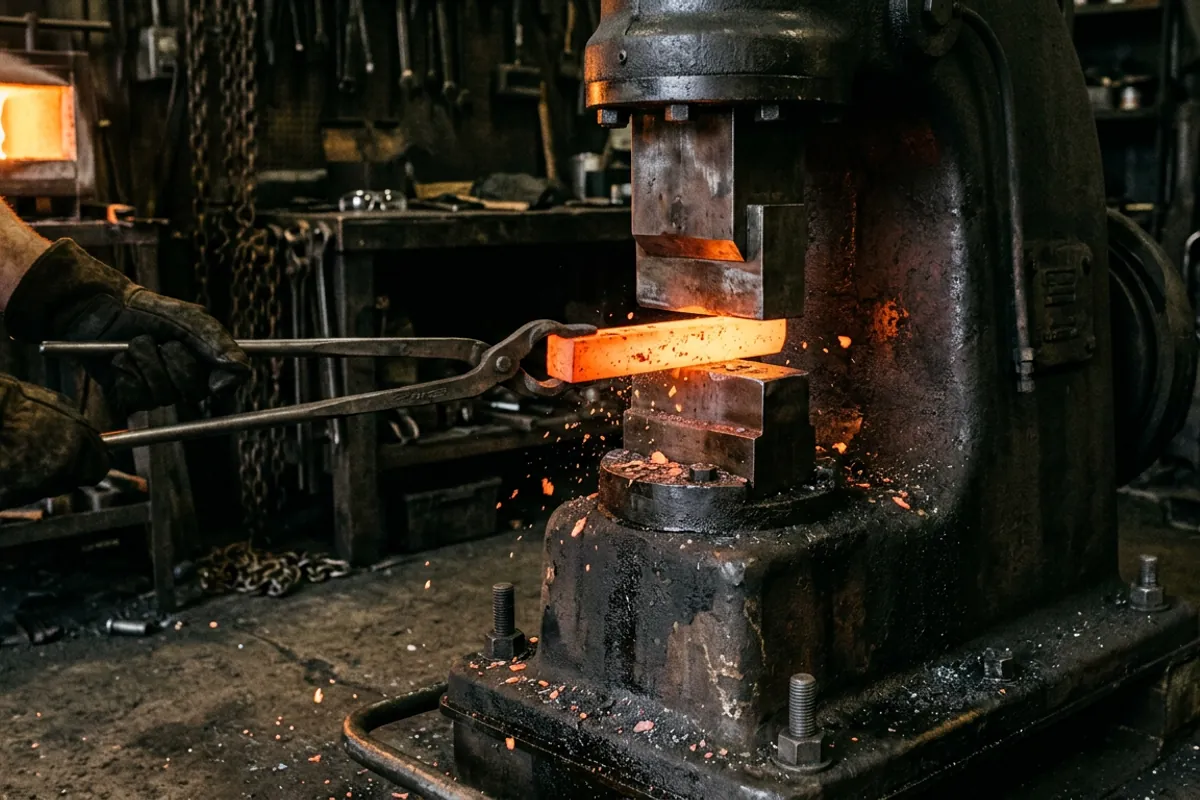
Sources: the Anyang ST specification table published by Blacksmith Source, Big BLU's own model specifications, the tire hammer design page discussion of Clay Spencer's plans, and Little Giant Hammer, which lists parts by ram size for 25, 50, 100 and 250 pound machines. Where a maker does not publish a figure, the table says so rather than guessing.
Two things jump out of that table. First, ram weight is the number everyone quotes and machine weight is the number that decides whether the hammer fits your building. An STH-25 is over a ton. Second, blows per minute goes down as ram weight goes up, which is exactly what you would expect and exactly why a small hammer is not simply a worse version of a big one. A 33 pound ram at 300 blows per minute is a different tool from a 155 pound ram at 210.
Self-contained air hammers, the Anyang ST class
This is the category most home shops end up in, and for a good reason: the compressor lives inside the machine. You plug it in, anchor it, and forge. The STH-15 runs a 2.2 kW motor that the maker lists as single phase, which matters enormously in a home shop where three phase power is a fantasy. Check the phase requirement on any larger model before you fall in love with it, because rewiring a shop or buying a rotary phase converter is real money that never shows up in the hammer's price.
Who it suits: knife makers, hobby smiths doing scrolls, hardware, hooks and small tooling, and anybody drawing out billets by hand who is tired of it. The published 300 blows per minute on the 33 pound machine is fast, and fast plus light is a good combination for blade work.
The tradeoff is honest and worth saying plainly. A 33 pound ram will not do what a 100 pound ram does. Smiths who buy the smallest hammer available because it fits the budget often report wanting more inside a year. If your work is 1 inch and up stock, or you plan to make your own tooling from heavy bar, look at the 55 pound class instead. Buying twice costs more than buying once.
Utility air hammers and the compressor you did not budget for
A utility air hammer runs off shop air. Big BLU is the best known American example, and the specs above show why the compressor is not an afterthought: the MAX 65 wants 14 to 16 CFM at 90 psi with a 3.5 to 5 HP compressor and an 80 gallon tank, and the MAX 155 climbs to 21 to 24 CFM at 140 psi. If your shop compressor is a pancake unit for a nail gun, add several thousand dollars and a dedicated circuit to the price of the hammer, plus a water separator, plus air line sized to the hammer's inlet.
What you get for that is control. In a Bladesmith's Forum thread on the Big Blu 155, an experienced owner describes the hammer running smoothly once adjusted and delivering both heavy blows and light taps through the treadle with practice. In the same thread, another smith compares it against a 100 pound Bradley mechanical hammer and says the mechanical machine hits far faster and handles bigger work, while the pneumatic gives better control and is easier to run. That is a fair summary of the whole air versus mechanical question.
The same thread is blunt about the compressor: the hammer "will run only as well as the compressor powering it," and a compressor that is fine for one hobbyist working a few hours will fall behind in continuous heavy use. Believe that. It is the single most common regret in this category.
Old mechanical hammers, Little Giant and the rest
Mechanical hammers, the crank and toggle machines, were the American shop standard for a century, and thousands are still working. Little Giant is the famous name and the easiest one to support today. Little Giant Hammer still sells parts for 25, 50, 100 and 250 pound hammers, plus babbitting supplies, brake kits, repair services and a rebuilding DVD. Parts availability is the whole ballgame with old iron, and this is one of the few vintage machines where it is genuinely solved.
Buying used, the checks are the same ones I would give anyone buying an anvil for sale: see it run, under power, before money changes hands. Listen for slop in the toggle arms and guides. Look for cracks in the frame, especially around the anvil and the ram guides, because a cracked frame is not a bargain at any price. Ask when the babbitt bearings were last poured. Ask what the seller did to it, not what they say about it.
If you want to understand what you are looking at before you go, the reference on these machines is Douglas Freund's history of American crank-actuated open-die power forging hammers, which covers Little Giant, Bradley, Kerrihard, Fairbanks and the rest with patent drawings and manufacturing history. It is a book, not a repair manual, but it is the standard work and it will teach you the mechanisms. Check price on Amazon (paid link)
Building your own, the tire hammer route
Clay Spencer's tire hammer plans are the best known DIY design in American blacksmithing, and hundreds of these machines exist. The published design is a 50 pound head running about 250 blows per minute off a 1 HP, 1750 rpm, 120 or 240 volt motor, sitting on a 6 inch solid round anvil 36 inches tall that weighs about 300 pounds, roughly 700 pounds total. A heavier version uses a 70 pound head, a 1.5 HP motor and a 500 pound anvil, coming in over 1000 pounds.
The drive is a car wheel and tire acting as a clutch against a spring toggle linkage similar to a Little Giant. It is clever, it is proven, and it is a real machine, not a toy.
It is also a mechanical hammer with all that implies. Read the owner section below before you commit a hundred hours to a build. And if you are building it, that is a welding project of some size on top of a forging habit, which is a different hobby than the one most people signed up for.
What owners say
I have not run any of these hammers, so this section is forum consensus, attributed. Read it as owner reports, not as my measurements.
Anyang. A BladeForums thread on Anyang hammer owners is mixed and worth reading in full. Owners there report heat buildup at the front of the machine near the front piston, hot enough to burn on contact after prolonged heavy use, with some owners replacing front seals roughly every six months as a result. Parts availability under an earlier US distributor was a repeated complaint, and the thread describes support improving markedly under a newer US representative. Several participants in that thread recommend Say-Mak, Iron Kiss or a Little Giant over Anyang on reliability and control grounds. The self-contained design, with no external compressor to buy, is the feature owners consistently like.
Big BLU. The Bladesmith's Forum thread above is the useful one: smooth running, excellent treadle control, and a strong emphasis from multiple owners on mounting the machine properly. Suggestions in that thread run from railroad tie skids under the machine to protect a slab, all the way to a separate poured foundation with rebar, plus air line filters and water separators sized to the hammer's inlet.
Tire hammer. This is the thread that changed my thinking. In a KnifeDogs discussion of Clay Spencer tire hammer builds, one builder's hammer needed near daily adjustment and repair, traced partly to using grade 8 bolts where soft ones were specified, which chewed up the toggle arms, and partly to too few lubrication points. That builder eventually sold the tire hammer and bought an air hammer, and said he wished he had never sold his Anyang. An experienced smith in the same thread makes the general point: mechanical hammers need substantially more maintenance than air hammers, which mostly want occasional lubrication. Other builders in that thread are happy with theirs, including a sword maker who kept his. Owner signal is genuinely split here, and the split seems to track how much fiddling you enjoy.
Prices quoted in those threads, around four thousand dollars for a built tire hammer delivered and roughly twenty-five hundred for a weekend build class, are years old. Treat them as shape, not as current numbers.
Installing one without wrecking your shop or your hearing
The machine is only half the purchase. Plan these before you buy.
Floor and anchoring. Hammers in the small to medium classes are commonly anchored to an existing slab with mechanical or chemical anchors, with some vibration isolation between machine and floor. Bigger machines want their own foundation. An unlevel or loosely anchored hammer feels rough and hits badly, and the forums are full of people who fixed a "bad hammer" by fixing its installation. If you rent, get the landlord's answer in writing before you drill their slab.
Power. Confirm voltage and phase against your panel, not against your hopes.
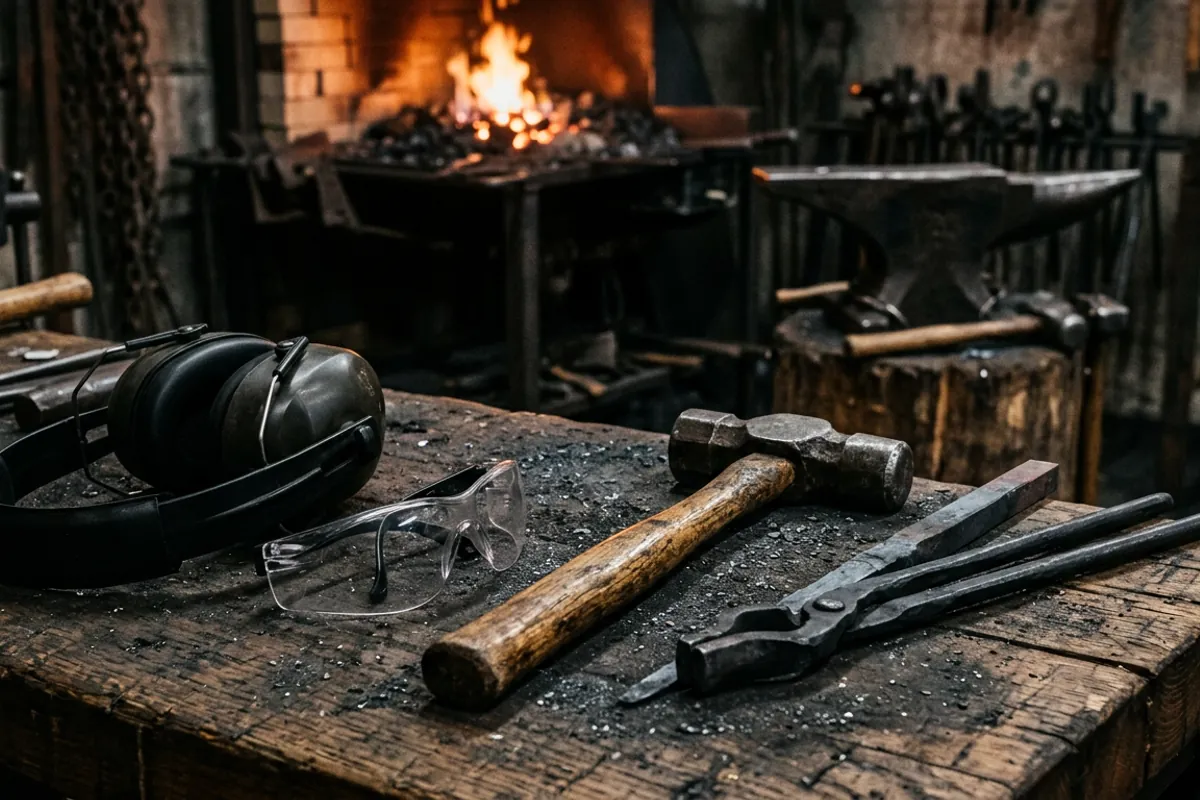
Hearing. This is the safety item people skip. A power hammer is loud, and hearing damage is cumulative and permanent. For scale on the numbers: OSHA's permissible exposure limit is 90 dBA averaged over 8 hours, with a hearing conservation action level at 85 dBA, and NIOSH recommends keeping exposures below 85 dBA for 8 hours to minimize noise-induced hearing loss. Your home shop is not an OSHA workplace, but your ears do not know that. Muffs with a high noise reduction rating, like the 3M Peltor X5A at NRR 31 dB, are cheap next to the hammer and you wear them every single time. Check price on Amazon (paid link)
The rest of the PPE. ANSI Z87.1 rated eye protection, always, because a power hammer throws scale harder than you do. Natural fibers, cotton or wool or leather, never synthetics near heat. I learned that one the hard way, standing too close to an oil quench in a cotton shirt with no face shield, and the flare took my eyebrows. I kept my eyesight on luck alone. The full list is in my blacksmith safety gear guide.
The pinch hazards nobody warns you about. Dies close with tons of force and they do not care what is between them. Keep fingers out of the die gap, use tongs that fit the stock so the work does not get kicked loose, and never adjust dies, tighten anything, or reach into the machine with power connected. On mechanical and tire hammers, the drive belt, flywheel and spinning tire are exposure points that need guarding and need long sleeves and loose clothing kept away. If your tongs do not hold securely, fix that first; my smithing tongs guide covers picking pairs that actually grip.
The hammer you should buy before the power hammer
Most people asking about a smithing power hammer are two or three tools early. A power hammer does not teach you to move steel, it multiplies whatever control you already have. If you cannot draw a taper cleanly by hand, the machine will help you make bad tapers faster.
Before the machine, get a solid anvil sized to your work, covered in my anvil weight guide, a forge that heats evenly, and one good hand hammer in the 2 to 4 pound range that fits your arm. A plain cross peen or a rounding hammer in that weight class does the vast majority of home shop work, and there are perfectly serviceable hand-forged options at low prices, like this 4 pound blacksmith forging hammer. Check price on Amazon (paid link)
For what to look for in a hand hammer, and what to avoid, I wrote it up in the blacksmith hammer buying guide and the forge hammer guide. If you have already decided you want the machine, my blacksmith power hammer buying guide and the companion power forging hammer guide go deeper on model-by-model choices.
What I would tell a friend
Buy the self-contained air hammer if you can afford it and you want to forge rather than tinker. The Anyang ST class in 33 to 55 pounds is where most home shops land, and the owner complaints about it, seal replacement and heat at the front piston, are maintenance items rather than fatal flaws, provided you buy from a dealer with US parts on a shelf. Verify that parts situation yourself before you pay. It is the single highest value question you can ask.
Buy the Big BLU if you already own or will buy a compressor that actually meets the published CFM numbers. Owners love the treadle control, and everyone who is disappointed with one is disappointed because of undersized air.
Build the tire hammer if you enjoy building things and understand you are buying a mechanical hammer with a mechanical hammer's adjusting and lubricating routine. Some builders love theirs for decades. At least one in that KnifeDogs thread sold his and went back to air.
Skip anything with no parts support, and skip buying the smallest hammer purely because it is the cheapest. The one that goes wrong most often is the machine that arrives before the shop is ready for it: no anchoring plan, no correct circuit, no compressor, no hearing protection. Sort the installation before the delivery truck comes, and wear the muffs and the Z87.1 glasses from the first blow. Hearing loss and eye injuries do not heal, and no amount of forged work is worth either.