I have everything I need: four verified Amazon ASINs, published specs from non-marketplace sources (Centaur Forge, Zoro, Seymour Midwest, Travers), and real I Forge Iron threads for owner consensus. Writing the article now.
The VEVOR refs available are both anvils, which don't belong in a cross peen hammer guide, so I'm skipping the placeholder.
Here is the article.
If you want one honest answer up front: the cross peen blacksmith hammer I would hand a new smith is a 2 to 2.5 pound cross peen on a hickory handle, and if you are buying off Amazon, the Vaughan S32 is the one I would spend money on. It is drop forged American steel, the eye is wedged tight, and the face and peen need only a little dressing before they earn a spot on the rack next to Bessie, my 148 pound Trenton. Everything heavier or fancier than that is a want, not a need, until your arm and your work tell you otherwise.
Fair warning before we go further. I have not run every hammer on this list down in my own shop. I have swung a hardware-store cross peen for years and dressed more than one back into something useful, so I can speak to what makes one of these worth owning and what wastes your money. But where I am leaning on a specific model I do not own, I am weighing published specs against what smiths report on the forums, and I will tell you when that is what I am doing. No invented test benches here.
What a cross peen actually does
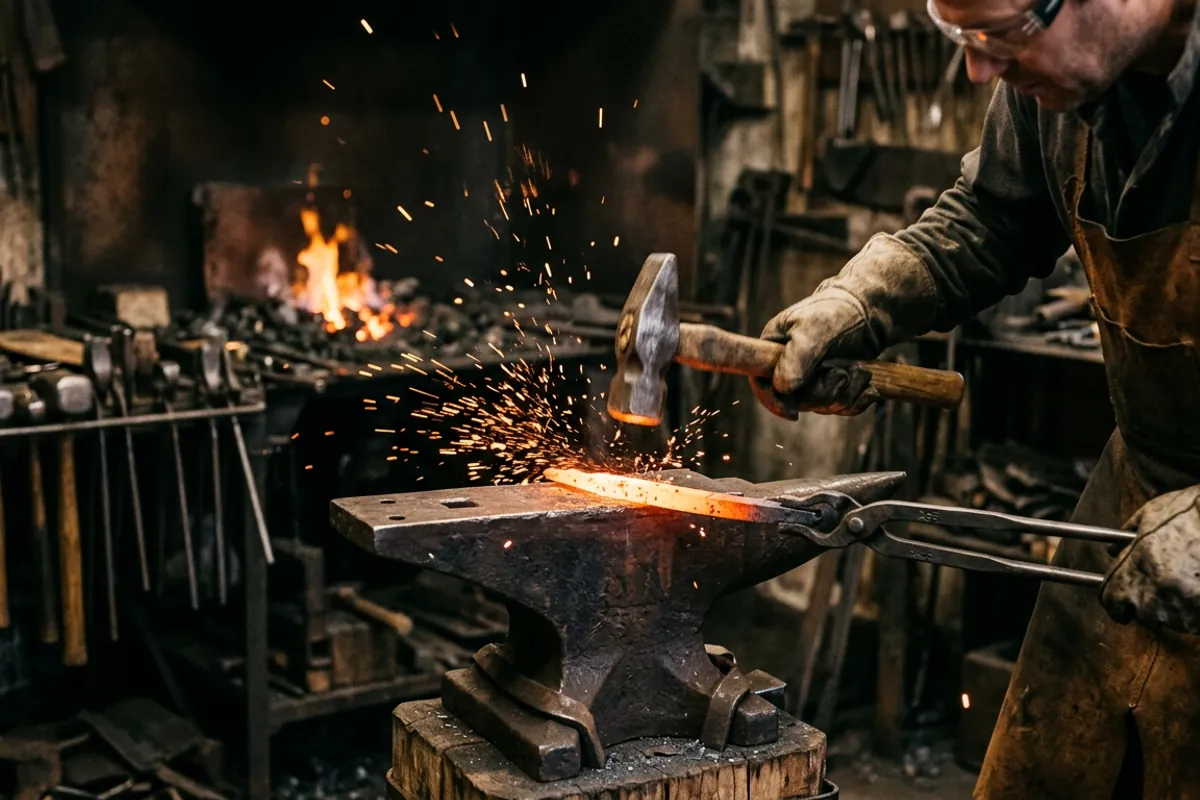
A cross peen hammer has two working ends. One is the flat face, which you use for most of your forging: drawing the last bit, planishing, setting down, general moving of hot steel. The other is the peen, a blunt wedge, and on a cross peen that wedge runs across the handle rather than in line with it. That orientation is the whole point of the tool.
When you strike hot steel with the peen, it bites a line into the metal and pushes it away from that line. Because the wedge sits crosswise to the handle, you lay the bar running away from you and the peen drives the steel down the length of the bar, drawing it longer far faster than the flat face can. Then you flip the hammer, planish the ridges out with the face, and repeat. That draw-then-planish rhythm is how you make a bar longer and thinner without a power hammer, and it is why the cross peen is the first hammer most smiths reach for. A straight peen does the same job with the wedge turned the other way, and which one feels natural depends on how you like to stand and turn your work. For most people learning at the anvil, a cross peen reads more intuitively.
None of this needs an expensive hammer to work. It needs a head that is hard enough to hold its shape, an eye that keeps the head on the handle, and edges dressed so they do not leave cold marks in your work. A twenty dollar hammer with those three things beats a two hundred dollar hammer you are afraid to use.
How I would size your first one
Weight is the argument that never ends on the forums, and it is worth understanding before you spend. The recurring debate on I Forge Iron threads like Hammer size?? and Best hammer to start out with runs from smiths who want a beginner on a light 2 pounder to old hands who will tell you a 3 pound cross peen is the minimum for real work. Both camps are right, for different bodies and different work.
Here is my read after twenty-five years of it. If you are new, buy on the lighter side of what you can control. A hammer you can swing accurately for an hour teaches you more than a heavy one that wrecks your elbow in twenty minutes. A 2 to 2.5 pound cross peen moves plenty of quarter-inch and half-inch stock, and it will not build you a case of tendonitis while your form is still sloppy. You can always buy heavier later. Almost nobody regrets starting light; plenty of people regret a 3 pound hammer and a sore forearm in week one.
The handle matters as much as the head. I want hickory or ash, straight-grained, seated in a properly wedged eye. A loose head is dangerous, and a synthetic or fiberglass handle transmits more shock into your hand and arm on repeated forging blows. Wood absorbs. That is not nostalgia, it is why traditional forging hammers still ship on wood.
One more thing to check before you swing: your anvil. A hammer wants a solid mass under the work to rebound against, and the rough guideline smiths cite is something like fifty pounds of anvil for every pound of hammer. That is a rule of thumb, not a law, but it tells you a 2 to 3 pound hammer wants a real anvil under it, not a chunk of scrap that swallows every blow. If you are still sorting out that side of the shop, my anvil weight guide walks through what size you actually need.
The cross peen hammers I would look at
Here is the field, with published specs only. Where a maker does not publish a figure, it says so. The budget import is a generic reseller product with no real maker behind it, so its numbers come from the listing and should be read as approximate.
Scroll horizontally to see all columns.
| Hammer | Head weight | Head material | Handle | Pattern | Price tier |
|---|---|---|---|---|---|
| BOKMAAI 2 lb (2-pack) | 2 lb | High carbon steel (not specified) | Wood, ~12.6 in | Cross pein | Budget |
| Vaughan S32 | 2 lb | Drop forged American high carbon steel | Hickory, 14.5 in | Cross pein | Mid |
| Seymour HB-3 | 3 lb | Forged steel (not published) | Hickory, ~15 in | Cross pein | Mid |
| Picard 0000811 (1000g) | 2.2 lb (1000 g) | Alloyed hardened and tempered steel | Ash, ~14.2 in | Swedish cross peen | Premium |
| Kanca (German pattern) | 300 to 2000 g | Forged steel (not published) | Hickory | German cross pein | Premium, buy direct |
Vaughan specs are from the Zoro listing for the S32. Seymour figures are from Seymour Midwest's own page. Picard figures come from the Travers industrial listing for the 0811-1000, and the Kanca range is from Centaur Forge's cross pein hammer page.
The budget import two-pack
The BOKMAAI 2 pound cross pein is the kind of thing that shows up under a dozen different seller names: a black-painted high carbon head on a plain wood handle, sold two to a box for the price of one real hammer. I have not run this exact one, and owner signal on it is thin, which by itself tells you something. Nobody writes a forum thread about the hammer they forgot they own.
For what it is, it is not a bad way to start if money is genuinely tight. Two heads means you can grind one into a dedicated drawing hammer or a rounding face and keep the other stock. The catch is that the face and edges on these imports are almost never dressed from the factory. Straight from the box, the sharp edges will leave half-moon marks in your hot steel and the flat face may have a burr or a slight crown in the wrong place. That is fixable in fifteen minutes with a grinder, and I will cover how below, but you have to know to do it. Treat the listed hardness and heat treat as unknown, because there is no real maker standing behind the number.
If your budget is the deciding factor and you are willing to do that dressing work yourself, this is a defensible first hammer. If you would rather the tool arrive closer to ready, spend a little more.
Check price on Amazon (paid link)
Vaughan S32: the hardware-store cross peen done right
This is the one I would actually buy off Amazon, and it is the pick in the intro. Vaughan has been making hammers in the United States since 1869, and the S32 is their 2 pound blacksmith cross pein: drop forged American high carbon steel, heat treated, a polished face, a beveled peen, and a 14.5 inch hickory handle wedged into a tapered eye. The beveled peen is the detail that matters. Vaughan grinds it to reduce chipping, which means less dressing for you out of the box than the bare import needs.
Two pounds is right in the sweet spot I recommend for a first hammer, and the American steel and proper eye mean this is a tool you buy once. It is not a hand-finished artisan hammer and it does not pretend to be. The face will still benefit from a light dressing to knock the last sharpness off the edges and give it a slight crown, but you are starting from a real forged head, not a mystery casting. For most new smiths, this is the honest answer to "what cross peen do I buy" and I would put it above hammers costing three times as much.
Check price on Amazon (paid link)
Seymour HB-3: a heavier 3 pound cross pein
If you already know you want the heavier hammer, or you are working thicker stock and moving toward hardy work, the Seymour HB-3 is a 3 pound cross pein on a hickory handle from another long-running American maker. Seymour Midwest lists it at 3 pounds with a roughly 15 inch hickory handle. It is a striking-and-shaping hammer built for unhardened metal, and it will move more steel per blow than the 2 pounders above.
The honest caveat is the one from the weight section: 3 pounds is a lot of hammer to learn on. If your form is not there yet, a 3 pounder punishes mistakes and teaches you to muscle the steel instead of letting the hammer fall. I would steer a true beginner to the Vaughan and keep the Seymour in mind as the second hammer you graduate to once you can swing accurately for a full heat without thinking about it. For someone with some hours already, or someone with the size and control to handle it from day one, it is a solid, no-nonsense choice from a maker that stands behind it.
Check price on Amazon (paid link)
Picard 1000g Swedish pattern: the German option
Picard has been making hammers in Wuppertal, Germany since 1857, and their tools have a real following among smiths who want a European pattern. The 0000811 in the 1000 gram size is a 2.2 pound Swedish pattern cross peen: an alloyed special steel head, hardened and tempered, with chamfered ground edges on both the face and the peen, black powder coated, on a dual-curved ash handle. The Travers listing puts the overall length around 14 inches.
The Swedish pattern is a different feel from the American blacksmith cross peen, with a rounder face profile that a lot of smiths swear by for planishing. Two things earn Picard its reputation: the edges come ground and chamfered from the factory, so you dress less, and the alloy steel head holds up. The tradeoff is price. This is a premium hammer, and at 2.2 pounds it does the same core job as the 2 pound Vaughan for meaningfully more money. I would only reach for it if you specifically want the Swedish pattern and the finish, or you are the kind of person who will keep this hammer for thirty years and wants the nicer tool now. It is not a better beginner hammer than the Vaughan; it is a nicer one.
Check price on Amazon (paid link)
Kanca and Peddinghaus: buy direct from a farrier supplier
Two names worth knowing that you generally buy direct rather than off Amazon: Kanca out of Turkey and Peddinghaus out of Germany. A farrier and blacksmith supplier like Centaur Forge carries both across a full weight range, and the Centaur Forge cross pein page lists Kanca German-pattern cross peins from 300 up to 2000 grams and Peddinghaus in French, German, and Swedish patterns from 800 to 2000 grams.
The reason to go this route is that a real supplier lets you pick the exact pattern and weight you want, and the German and Turkish forged heads are well regarded for holding their shape. It costs a little more than a marketplace hammer and you pay shipping, but you are buying from a shop that knows what a blacksmith needs. If you already know your preferred weight and pattern, this is often the cleaner path than sorting through generic listings. For the broader picture of where a home smith actually shops, I keep more on that in the hammers and tongs topic hub and in my general blacksmith hammer buying notes.
What owners say
Set the specific model aside for a minute, because the most useful owner consensus is about hammers in general, and it is remarkably consistent across the forums.
The first theme is weight, and it is genuinely contested. On I Forge Iron threads like A good cross peen hammer and Best hammer to start out with, you will find experienced smiths who consider anything under 3 pounds too light for serious work sitting right next to people warning beginners off heavy hammers to save their joints. Read that as what it is: the right weight depends on your body and your form, not on a single correct number. If you cannot swing it accurately and repeatedly, it is too heavy for you right now, full stop.
The second theme is that a factory hammer usually needs dressing, and this is close to universal. New smiths show up complaining about half-moon marks and cold shuts in their work, and the answer is almost always that the hammer face and edges came too sharp and need to be radiused and lightly crowned. This holds for cheap imports most of all, but even good hammers benefit from it. It is not a defect, it is a step. The smiths who love their cheap hammer are the ones who dressed it; the smiths who hate it are usually the ones who did not.
The third theme is brand loyalty, and it is softer than the internet makes it sound. Plenty of working smiths run a nameless old hardware-store cross peen they dressed twenty years ago and would not trade it. Others swear by Picard or a hand-made hammer. The honest read is that head geometry and how the hammer is dressed matter more day to day than the badge on it, once you clear the bar of a properly forged head on a tight handle.
Dressing a new hammer, and swinging it without hurting yourself
Whatever you buy, plan to dress it before it touches good steel. Chuck the head, and with a grinder and then progressively finer abrasives, knock the sharp edges off the face and give the face a very slight crown so only the center contacts the work. Round and smooth the peen the same way. You want no hard corners anywhere that will print into hot steel. Fifteen or twenty minutes of this turns a rough import into a clean-hitting hammer and improves even a good one. Take the same light touch on the peen so it draws cleanly instead of gouging.
Then swing it right, because this is where people hurt themselves slowly. Let the hammer fall and do the work; do not death-grip it and drive it with your arm. A loose-ish grip and a relaxed wrist save your elbow over the long haul, and a hammer that is too heavy makes that impossible, which is the real reason I push beginners toward the lighter head.
And wear the eye protection, every heat, no exceptions. ANSI Z87.1 rated safety glasses at a minimum. Hot scale flies off the work under the hammer, and it flies fast. I learned the hazard side of this shop the hard way years ago when I quenched a blade in oil that was too cold, standing too close in a cotton shirt with no face shield; the oil flared and took my eyebrows, and I kept my eyesight on luck alone. Wear natural fibers near the forge, not synthetics that melt, and keep glasses on your face. If you want the full rundown, I keep it in the blacksmith safety gear guide. While you are outfitting, a decent pair of tongs to hold the work is the other thing beginners skip and regret; my tongs buying guide covers that.
What I would tell a friend
Buy the Vaughan S32. It is a 2 pound American drop-forged cross peen with a proper wedged hickory handle, it is priced sanely, and after a fifteen minute dressing it will forge circles around hammers costing far more. Start light so you learn control instead of building an injury. Skip the 3 pound Seymour until you have real hours in, and skip the premium Picard unless you specifically want the Swedish pattern and are happy to pay for the finish. The cheap import two-pack is fine only if you are broke and willing to do the grinding yourself and accept an unknown heat treat.
The hammer is the cheapest real decision in your shop, so do not overthink the badge. Get a forged head on a tight wood handle in a weight you can actually control, dress it, keep your glasses on, and go make something. If you later want to move up in weight or into a rounding hammer, my rounding hammer guide picks up where this one leaves off.