A forging power hammer is the first machine that changes what you can make, not just how fast you make it. Everything up to that point (better tongs, a bigger anvil, a hotter forge) makes your existing work easier. A hammer under power lets you draw a 1 inch bar into a taper by yourself, forge a billet you would otherwise need a striker for, and still have a working elbow at sixty. That is the real argument for one, and it is a good argument. It is also why so many smiths buy one two or three years earlier than they should.
I have run Bessie, my 148 lb Trenton, for about twenty-five years, and most of what I make still comes off her face under a hand hammer. I do not own an Anyang or a Little Giant, so nothing below is a bench test. These picks come from published maker and dealer specs, which I have cited, weighed against what I know about shop power, floors, and what actually breaks on machines that hit things for a living. Where I lean on other owners, I say so and link the thread.
What a forging power hammer actually buys you
A power hammer is a ram that falls, driven by a motor, controlled by your foot. Mechanical hammers (Little Giant, Fairbanks, and the tire hammer clones) use a spring or a tire and toggle linkage to throw the ram. Self-contained air hammers (Anyang, Say-Mak, Striker) use a compressor built into the machine to drive the ram down a cylinder. Utility air hammers run off a shop compressor sitting somewhere else.
What it buys you is repeated, controlled force at a rate your arm cannot match. What it does not buy you is skill. A hammer moves steel wherever you hold it, faster, including in the wrong direction. Every smith I know who got one described the same first month: a pile of ruined stock and a new respect for how much a bad heat costs when the machine makes forty of them a minute.
It also does not replace a press. Those are different tools. On BladeForums, the recurring answer in the power hammer or press first threads is that a press is cheaper to build, safer to learn on, and better for squeezing pattern welded billets, while a hammer keeps your heat count down and shines on thin stock and tapers. If you forge Damascus and nothing else, look hard at a press first.
How to size a forging power hammer
Ram weight is the headline number and it is roughly the whole story. The old shop rule is that a hammer will comfortably draw mild steel about equal to its ram weight in square inches of cross section, which in practice means:
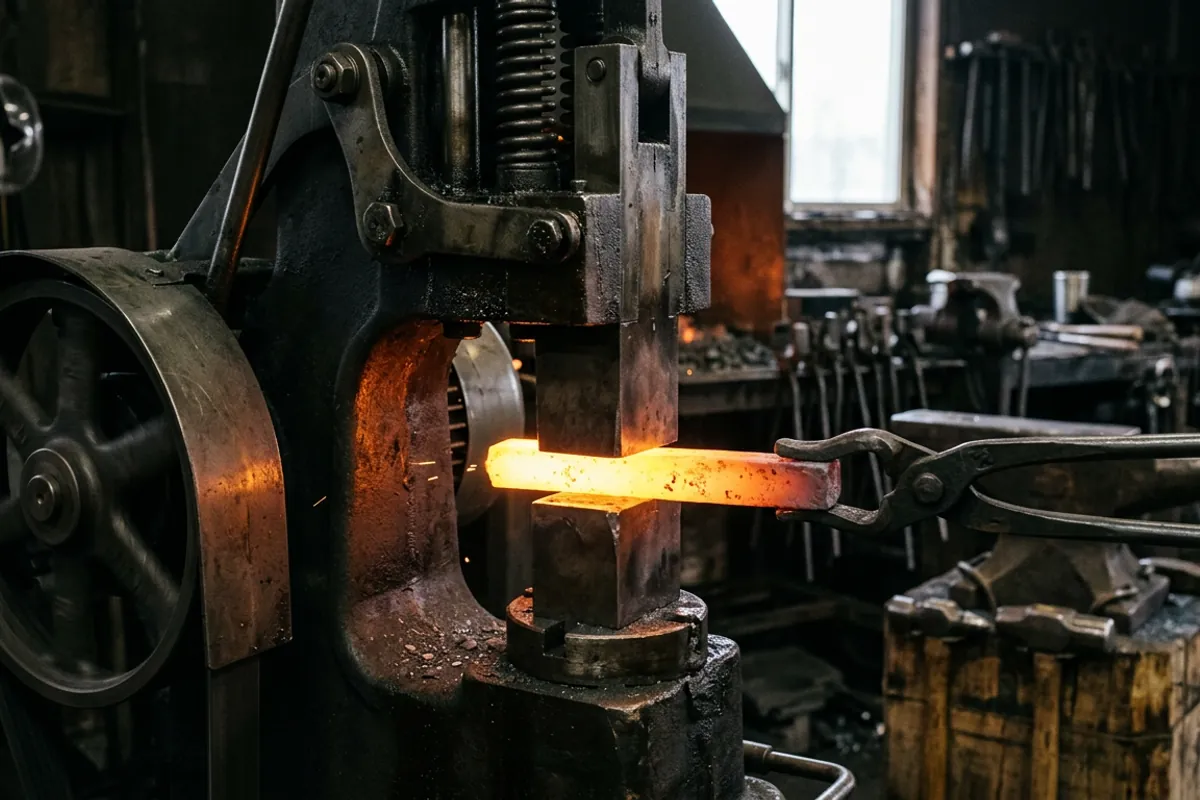
- 25 to 33 lb ram: knives, hardware, scrolls, tooling, stock up to about 1 inch square.
- 50 to 55 lb ram: the sweet spot for a general home shop, 1.5 inch stock all day.
- 75 lb and up: architectural work, big tooling, and a floor that has to be built for it.
The mistake almost nobody regrets is buying one size up. The mistake people regret constantly is buying a 25 lb hammer and outgrowing it in a year, then paying rigging costs twice. If you are choosing between the biggest hammer you can afford and the biggest hammer your shop floor and power supply can actually carry, pick the second one, because a machine you cannot install is not a machine.
Blows per minute matters less than people expect. More blows per minute means lighter individual blows for a given ram weight, and a hammer that is easier to feather but less able to move heavy sections. If you are new to this, read the hammers and tongs hub before you spend anything, and be honest about whether your hand hammer technique is good enough to be worth mechanizing.
The field at a glance
Published specs only. Where a maker or dealer does not publish a figure, it says so.
Scroll horizontally to see all columns.
| Hammer | Ram weight | Blows per minute | Motor | Machine weight | Max stock | Price tier |
|---|---|---|---|---|---|---|
| Anyang ST 15 | 33 lb (15 kg) | 245 | 2.2 kW single phase | 1188 lb | 30 mm square, 35 mm round | Mid |
| Anyang ST 25 | 55 lb (25 kg) | 250 | 3 kW | 2420 lb | 40 mm square, 48 mm round | Premium |
| Little Giant 25 lb (used) | 25 lb | 375 (per dealer listing) | 1 hp | Not published by the maker | 2 inch rounds (per dealer listing) | Used, varies |
| Clay Spencer tire hammer (built) | 50 lb | About 250 | 1 hp, 1750 rpm | About 700 lb | Not published | Build cost |
Sources: Blacksmith Source ST 15, Blacksmith Source ST 25, a used 25 lb Little Giant listing, and Clay Spencer's tire hammer page.
Anyang ST 15, the 33 lb air hammer I would buy new
This is the machine most one person shops end up looking at. Blacksmith Source publishes 33 lb of ram, 245 blows per minute, a 2.2 kW single phase motor, and a total machine weight of 1188 lb, with a rated capacity of 30 mm square or 35 mm round mild steel. Overall height is listed at 1780 mm, about 70 inches, so measure your ceiling and your garage door before you get excited.
Two things make it the sensible new-hammer pick. It is self contained, so you do not need a big shop compressor sitting in the corner cycling all day, and it runs on single phase, which is what most home shops actually have. That second point kills more used-hammer deals than anything else.
Worth flagging honestly: dealers do not agree on the blow rate. Blacksmith Source lists 245 blows per minute for the ST 15, while PowerHammers LLC lists 300 for the same machine. That is a real discrepancy in published specs, not a rounding difference, and I would ask the dealer you buy from to confirm it in writing rather than trust either number secondhand.
The tradeoff is size. At 33 lb of ram, this hammer is a knife, tool, and hardware machine. If your plan includes gate work or 1.5 inch square stock, you will be at its limit inside a year.
Anyang ST 25, the 55 lb step up
Same family, meaningfully more machine. Blacksmith Source publishes 55 lb of ram, 250 blows per minute, a 3 kW motor, a total weight of 2420 lb, and capacity of 40 mm square or 48 mm round.
Note what the weight jump tells you. Going from 33 lb to 55 lb of ram roughly doubles the mass of the machine, from 1188 lb to 2420 lb. That is not marketing, that is the anvil mass under the ram doing its job, and it is the single biggest reason a bigger hammer hits harder than the ram weight alone suggests. It is also 2420 lb that has to come off a truck, cross your floor, and sit on something that will not crack.
If you have three phase power or a rotary phase converter, the floor for it, and you genuinely forge heavy stock, this is the one I would buy and stop shopping. For most home shops it is more hammer than the building can take.
A used Little Giant 25 lb, the cheap route with strings attached
The old American mechanical hammers are still working in shops all over the country, and a 25 lb Little Giant is the classic small one. A recent used-machinery listing puts one at 375 strokes per minute, an 8 inch stroke, a 1 hp motor, and 2 inch round capacity.
The case for buying used is simple: a running mechanical hammer often costs a fraction of a new air hammer, and Little Giant still sells parts and runs a power hammer school, which is a rare thing for a machine this old. Dies, toggle arms, clutch parts, and ram guides are available, so a tired hammer is a rebuildable hammer rather than a boat anchor.
The case against is everything else. Worn ram guides and beaten toggle links turn a hammer into a machine that hits sideways. Babbitt bearings, brake and clutch adjustment, and die fitting are all skills you will be learning on your own machine. Buy one running if you possibly can, watch it hit under load, and bring somebody who has rebuilt one. If nobody local has, budget for the rebuild in the purchase price rather than pretending it will not need one.
The Clay Spencer tire hammer, the one I would build
If you have a welder and patience, this is the honest best value in the whole category. Clay Spencer's design uses a car hub and a spare tire as the clutch and a spring toggle linkage similar to a Little Giant. His page publishes a 50 lb ram, a 6 by 36 inch solid anvil, a machine that weighs about 700 lb and stands just under 7 feet, a 1 hp 1750 rpm motor, and a run rate of about 250 rpm depending on tire diameter. There is also a heavier version with a 70 lb head, a 500 lb anvil, and a 1.5 hp motor that goes over 1000 lb.
Farm Show, writing about the design, puts a self build at about $1,000 and 100 hours of gathering materials and building. That is a 50 lb hammer for the cost of a decent belt grinder, which is why these get built in group workshops all over the country. If you are not a confident welder, the group build route is the right one: you finish with a hammer and somebody experienced has checked your welds.
Power, floor, and foundation
This is the part that sinks installations. Before you buy anything:
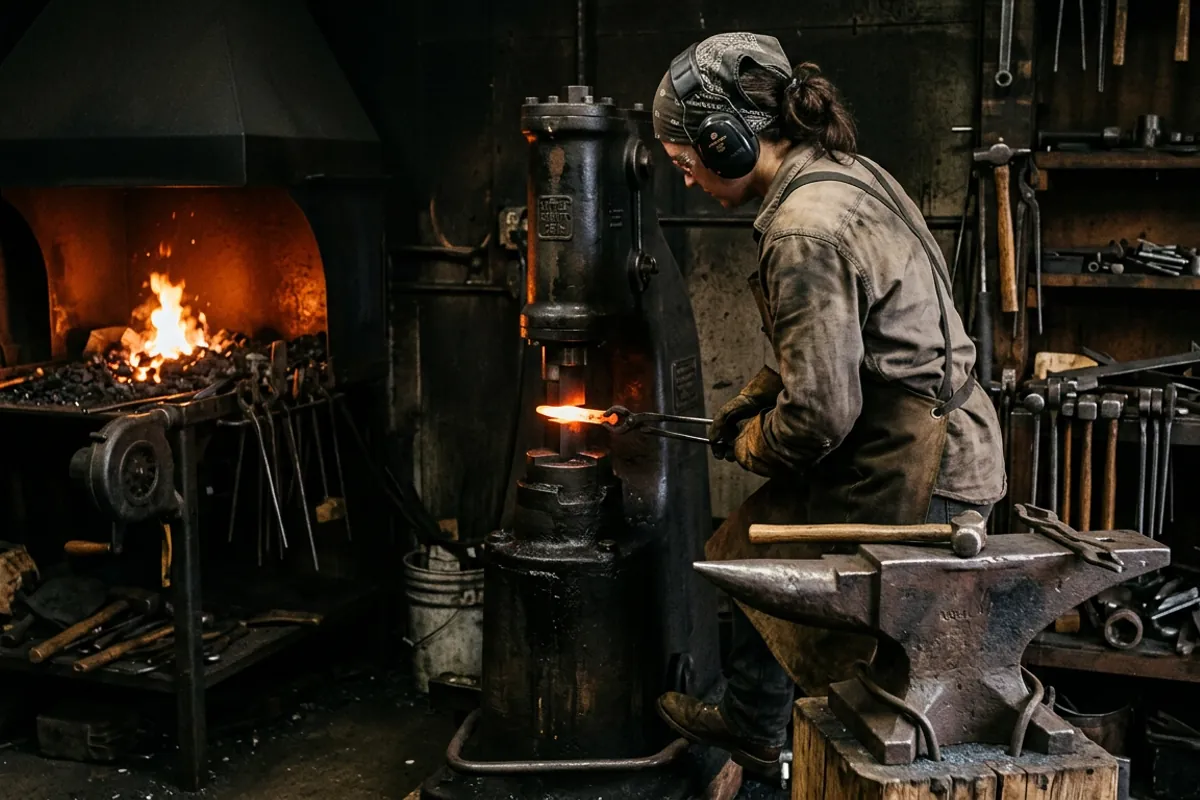
Check your power. A 2.2 kW single phase motor is a real load on a garage circuit, and most older American hammers came wired for three phase. A used 25 lb Little Giant with a 1 hp motor is easy. A 3 kW ST 25 is not.
Check your floor. A 1188 lb machine that hits 245 times a minute delivers its energy into whatever is under it. A four inch residential slab is thinner than what these machines were designed to sit on, and cracked slabs under power hammers are a standing topic on I Forge Iron, including the power hammer anvil requirements thread. Ask the maker or dealer for their foundation spec, in writing, and follow it.
Check your ceiling and your door. Seventy inches of machine goes through a standard door. Rigging it off a trailer without a forklift does not go anywhere.
Buy this before you buy a hammer
A power hammer is loud in a way a hand hammer is not, and it is continuous. Hearing protection is not optional around one. The 3M Peltor X5A is rated NRR 31 dB, the highest in 3M's earmuff range, and 3M's own product page says the rating may overestimate real world protection and recommends derating it by 50 percent when you estimate. Even derated, that is the difference between keeping your hearing and not. Check price on Amazon (paid link)
The other thing to buy first is a better hand hammer, because that is where your skill comes from and a power hammer will only amplify what you already do. A 2 to 3 lb cross peen covers most daily work: the Picard style Swedish pattern hammer with a round face and a wedge peen is a straightforward one at 2.2 lb. Check price on Amazon (paid link) If you want a heavier drawing hammer for the days you have no machine, a 4 lb forged head does the job. Check price on Amazon (paid link) There is more on picking one in my blacksmith hammer guide and the forge hammer guide.
And read the safety gear guide before the machine lands. I quenched a blade in oil that was too cold once, standing close in a cotton shirt with no face shield, and the flare took my eyebrows. I kept my eyesight by luck. Eye protection rated to ANSI Z87.1, natural fibers rather than synthetics near heat, and no gloves or loose sleeves near moving dies.
Working safely around a power hammer
The specific hazards are not the ones beginners expect.
Nothing goes between the dies except steel held in tongs. Not a finger, not a chisel you are holding by hand without a handle, not a die you are seating. The foot treadle is a live control, and hammers have cycled from a bumped treadle.
Guard the drive. On a tire hammer or a mechanical hammer, the belt, tire, and flywheel are exposed rotating mass at chest height. Loose clothing, long hair, and shop rags all get caught by them. Build or keep the guards.
Kill the power before you touch the dies. Unplug it or lock the disconnect, do not just switch it off, then change dies.
Wear the hearing protection every time, including for the two minute job. Hearing loss is cumulative and it does not come back.
Scale flies off hot stock at speed under a hammer. Z87.1 eye protection at minimum, and a face shield over it when you are drawing scaly stock.
What owners say
I have not run these machines, so here is what other owners report, with the threads.
On sizing, the I Forge Iron thread thoughts on small air hammers (Anyang 15kg/33lb) is the standard reference for whether a 33 lb hammer is enough, and the recurring answer across the small-hammer threads there is the same one I gave above: buy one size larger than the work you do today. Owner comment on the bigger Anyangs is generally positive on control, including the Anyang 120 thread, though the signal on any one model is thinner than you would like because there simply are not that many of these machines in home shops.
On hammer versus press, both BladeForums and I Forge Iron's power hammer vs hydraulic press thread land in the same place: a press is more capability per dollar at the low end and easier to build, a hammer takes fewer heats and does better on thin material.
On the tire hammer, the builds are well documented in public, including the KnifeDogs build thread and a Practical Machinist group build. What I have not found is a large body of complaints, which for a design with hundreds of copies out there is a decent sign.
What I would tell a friend
If you have a welder or access to a group build, build the tire hammer. Fifty pounds of ram for around a thousand dollars in materials is not close to any other option, and you finish knowing how the machine works, which matters the first time it stops working.
If you want to plug it in and forge, buy the Anyang ST 15 at 33 lb if your work is knives and hardware, and the ST 25 at 55 lb if you have the power, the floor, and heavier stock in your future. Confirm the blow rate with your dealer in writing, since the published figures disagree.
Buy a used Little Giant only if you can watch it run under load or you are genuinely willing to rebuild it. Parts exist, which is the good news, but a worn mechanical hammer is a project, not a purchase.
And if you have been forging less than a couple of years, put the money into your anvil, your forge, and your hand skills instead. A heavier anvil and a hammer you can actually control will do more for your work this year than a machine you are not ready to steer.