If you want a blacksmith power forging hammer and you have the floor, the power, and the money, the one I would buy is a self contained pneumatic in the 55 to 88 lb ram class: an Anyang ST 25 or ST 40 bought through a US dealer who stocks parts. If that number makes your eyes water, the honest second answer is to build a Clay Spencer tire hammer for roughly a thousand dollars in steel and scrap and about a hundred hours of your life. And if neither of those is happening this year, the third answer is the one nobody wants to hear: a hand hammer, a striker on the sledge, and better technique will move more steel than a machine you cannot afford to install correctly.
I should say plainly where I stand. I do not own a power hammer. Twenty five years in and my drawing out still happens with a hand hammer over Bessie, my 148 lb Trenton, because a home shop with a dirt floor corner and a 100 amp panel is a bad place to drop a 2,400 lb machine on a whim. So nothing below is a bench test. It is published maker and dealer specs, checked against what owners report on the forums, weighed against what I know about running a small shop and teaching beginners in it. Where the signal is thin, I will say so.
What a blacksmith power forging hammer actually buys you
A power hammer does one thing: it moves the mass of your arm out of the equation and replaces it with a ram that falls the same distance, at the same rate, until you take your foot off the treadle. What it buys you is drawing out, spreading, and fullering on stock heavier than you can reasonably move by hand, at a rate that lets you do it inside one heat instead of five.
What it does not buy you is skill. A power hammer under a smith who cannot control a taper by hand produces bad tapers faster. It is also indifferent to what goes under the dies, which includes fingers. The first thing a hammer teaches most people is respect, and it teaches it quickly.
The other thing worth being straight about: a power hammer is a production tool. If you make a knife a month and a set of hooks at Christmas, you do not have a hammer problem, you have a heat and technique problem, and the fix is cheaper. If you are drawing 1 in and larger stock regularly, forging out damascus billets, or making the same thing forty times, a hammer changes your week. The rest of the hammer question, including the one in your hand, lives on the hammers and tongs hub.
The four kinds of power hammer, and what the makers publish
There are four machine types a home smith realistically considers, plus one that is not a power hammer at all but keeps getting sold as if it were.
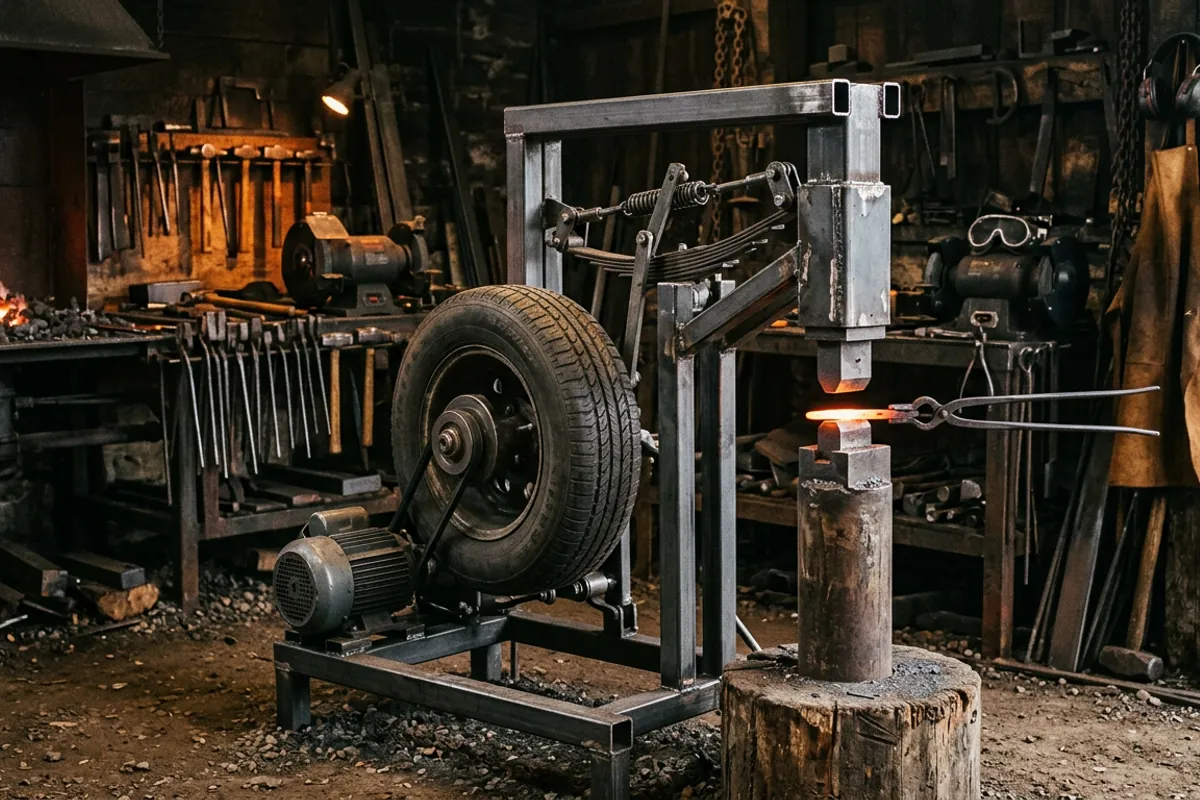
Mechanical (helve, spring, tire). A motor spins a shaft, a spring toggle or tire clutch converts that into ram travel. Little Giants are the classic American version; the Clay Spencer tire hammer is the modern shop built one. Simple, repairable, and forgiving of dirty shop power.
Self contained pneumatic. The machine has its own compressor cylinder built into the frame. No shop air, no hose, no 80 gallon tank in the corner. Anyang, Say Mak, and Sahinler are what most people are looking at.
Utility air hammer. A cylinder driven by shop air, controlled by a valve. Cheaper machine, but you buy the missing half of it in the form of a compressor.
Hydraulic press. Not a hammer. Slow, quiet, enormously useful for damascus and for squeezing, and it will not replace a hammer for drawing.
Here is the field, published figures only, cited where the maker or dealer states them.
Scroll horizontally to see all columns.
| Machine | Type | Ram | Blows per minute | Motor / air | Machine weight | Stock capacity |
|---|---|---|---|---|---|---|
| Anyang STH-15 | Self contained pneumatic | 15 kg / 33 lb | 245 in spec table, "up to 300" in the same listing | 2.2 kW / 3 hp, single phase | 540 kg / 1,188 lb with base | 30 x 30 mm square, 35 mm round |
| Anyang STH-25 | Self contained pneumatic | 25 kg / 55 lb | 250 | 3 kW / 4 hp, three phase (VFD offered) | 1,100 kg / 2,420 lb | 40 x 40 mm square, 45 mm round |
| Anyang STH-40 | Self contained pneumatic | 40 kg / 88 lb | 245 | 4 kW | 1,350 kg / 2,970 lb | 50 x 50 mm square, 65 mm round |
| Anyang STH-55 | Self contained pneumatic | 55 kg / 121 lb | 230 | 7.5 kW | 1,700 kg / 3,740 lb | 60 x 60 mm square, 75 mm round |
| Ken's Custom Iron MZ75 | Utility air hammer | Not published | Not published | Runs best 50 to 70 psi, needs shop compressor | Approx 1,000 lb, 81 in tall | 2.5 x 4 in flat dies standard |
| Clay Spencer tire hammer | Mechanical, shop built | 50 lb | About 250 | 1 hp, 1750 rpm, 120 or 240 V | About 700 lb | Dies about 2 x 3 in |
| Little Giant (vintage) | Mechanical | 25, 50, 100, 250 lb | Varies by hammer and pulley | Varies | Varies | Varies |
| Ingersoll Rand 121/Q | Pneumatic chisel, not a forging hammer | Not applicable | 3,000 | 3 CFM average, 0.401 in shank | 3.7 lb class hand tool | Texturing and chasing only |
Anyang figures come from the Blacksmith Source specification page for the ST hammers and their individual product listings; the MZ75 numbers from Ken's Custom Iron; the tire hammer figures from the FarmShow write up of Clay Spencer's plans; the Little Giant sizes from Little Giant's own parts page; the 121/Q specs from Acme Tools. Where a maker does not publish a number, I have written "not published" rather than filling in a guess.
Notice the ST 15 line. The same dealer page lists 245 blows per minute in the spec table and "up to 300 blows per minute" in the overview text. That is not a scandal, it is how marketing copy and engineering tables drift apart, but it is a good reminder to buy on ram weight and capacity, not on the headline number.
How much ram you actually need
The rule of thumb every experienced hammer owner repeats is: buy bigger than you think, because you will not outgrow the shop, you will outgrow the hammer. The capacity column above is the reason. A 33 lb ram is rated for 30 mm square, which is about 1.2 in. That covers most knife work and most light scroll and hook work. It does not cover 1.5 in round, and it does not cover welding up a big billet.
The step from 33 lb to 55 lb costs you more than money. It roughly doubles the machine weight, from about 1,188 lb to about 2,420 lb, and on the Anyang line it moves you from a single phase motor to a three phase one. That is the practical wall for a lot of home shops. Blacksmith Source offers a VFD to run the three phase ST 25 off single phase service, which is the normal fix, but it is another box, another cost, and another thing to wire correctly.
My read, and I want to be clear this is judgment rather than experience: if your work is knives and light architectural, a 33 lb self contained hammer is a real tool and not a toy. If you are forging tooling, axes, or anything over 1.25 in, the 55 lb class is the smallest that will not frustrate you. Think of it the way I think about anvil mass, which I laid out in what size anvil do you actually need: the machine has to be heavier than the work it does, by a lot, or the energy goes into moving the machine instead of the steel.
Self contained pneumatic: the Anyang ST hammers
This is the class most home smiths end up in, and the ST 25 is the one I would buy if the check cleared. Self contained means the compressor is part of the machine: you roll it in, wire it, bolt it down, and forge. No hose, no tank, no compressor duty cycle to think about. The frames are cast, in the pattern of the old Nazel and Massey hammers, and the ram design keeps the top die out of the cylinder.
The published capacity on the ST 25 is 40 x 40 mm square or 45 mm round at 250 blows per minute, with a 3 kW / 4 hp three phase motor. Machine weight with base is 1,100 kg, about 2,420 lb, which is a forklift problem and a foundation problem before it is a forging problem.
The honest tradeoff: these are made in China, and buyers who care about that should look at Say Mak or a used American machine instead. The other tradeoff is that you are buying into a dealer relationship as much as a machine. Parts, dies, and a phone number that gets answered matter more on a hammer than on almost anything else in the shop, because a hammer down is a shop down.
There is no marketplace link for this one on purpose. A 2,400 lb pneumatic hammer is bought from a specialist dealer with freight arranged, not clicked into a cart.
Utility air hammers and the compressor bill nobody budgets for
A utility air hammer is the cheaper way onto a treadle, and the reason it is cheaper is that half the machine is missing. Ken's Custom Iron publishes that the MZ75 runs best between 50 and 70 psi and lists what it takes to feed it: a 5 hp two stage compressor with an 80 gallon tank rated 17 CFM at 175 psi is their comfortable recommendation, with a 3.5 hp unit rated 11.6 CFM at 100 psi and a 20 gallon tank as a working option, and a 1.5 hp 20 gallon unit rated 7.3 CFM on 110 volts as the minimum they have tested.
That last figure is where people get hurt financially. A hammer that "runs" on a small compressor runs in the sense that it moves, not in the sense that you can forge continuously. Owners on the I Forge Iron CFM and PSI thread make the same point repeatedly: size the compressor for continuous duty, not for the maker's floor figure, because a compressor running at 100 percent duty in a hot shop is a compressor with a short future.
If you are going down this road, a 60 gallon stationary unit is about the smallest thing I would put behind a forging hammer. The Industrial Air ILA3606056 is the common one at that size: the maker lists 11.5 CFM at 90 psi, 155 psi max, a cast iron twin cylinder pump, and 240 volt single phase power. That last part is not a detail. It wants its own properly sized circuit run by someone who knows what they are doing, and so does the hammer.
Check price on Amazon (paid link)
Add the compressor, the wire, the breaker, and the plumbing to the hammer price before you compare it to a self contained machine. Do that math honestly and the utility hammer's advantage narrows a lot, unless you already own a real compressor for other work.
The tire hammer: what most home shops should build
If I were adding a hammer to my own shop tomorrow, this is the route I would take. Clay Spencer's tire hammer plans are a 30 page booklet with parts lists and diagrams, sold for 30 dollars including postage in the US and Canada. The hammer is a 50 lb ram machine using the rear hub and a compact spare from a front drive car as the clutch, a spring toggle linkage in the Little Giant pattern, a 1 hp 1750 rpm motor on 120 or 240 volts, about 250 blows per minute, an anvil of 6 in solid round minimum, and a total weight around 700 lb. FarmShow puts the build at roughly 1,000 dollars in materials and about 100 hours.
What makes this the sensible answer for a home shop is not just the price. It is 700 lb instead of 2,400 lb, it runs on ordinary house current, every part of it is something you welded and can therefore fix, and hundreds of them have been built in group workshops, which means the failure modes are known and the community that knows them is reachable.
You do need to be able to weld and cut reasonably well, and you need to be honest about whether you will finish it. A half built hammer in the corner is 700 lb of guilt. If you have never built shop equipment before, the workshops Clay runs with clubs are the shortcut: you leave with a working hammer instead of a pile of parts.
The air chisel is not a power hammer, but it earns bench space
Every so often someone shows up at the club forge with an air chisel and calls it a power hammer. It is not. A pneumatic chisel has no ram mass worth naming and no anvil under it; it cannot draw out stock and it will not replace a hand hammer, let alone a 50 lb machine.
What it does do, and does well, is texturing, chasing, repousse, and running shop made tools ground from blank bits. The Ingersoll Rand 121/Q is the one most shops end up with: Acme Tools publishes 3,000 blows per minute, a 2 9/32 in stroke, 0.401 in shank, and 3 CFM average air consumption. That 3 CFM figure is average, not continuous, so plan on more if you are working for minutes at a time rather than seconds.
Check price on Amazon (paid link)
If you do not already have chisels for it, the kit version bundles the tool with a chisel set and a case, and those chisels are useful mostly as blanks to reshape into your own texturing tools.
Check price on Amazon (paid link)
Sensible expectation setting: this is a hundred dollar class hand tool that does decorative work on cold and warm metal. Buying one because a real hammer is out of reach will disappoint you. Buying one because you want to texture panels and raise repousse is money well spent.
Foundation, wiring, and the safety that changes under a hammer
A power hammer changes the risk profile of your shop, and I do not say that to sound cautious. I say it because I got careless once with a quench tank, oil too cold, cotton shirt, no face shield, and it took my eyebrows and could easily have taken my eyes. Machines do not give you the warning a hand tool does.
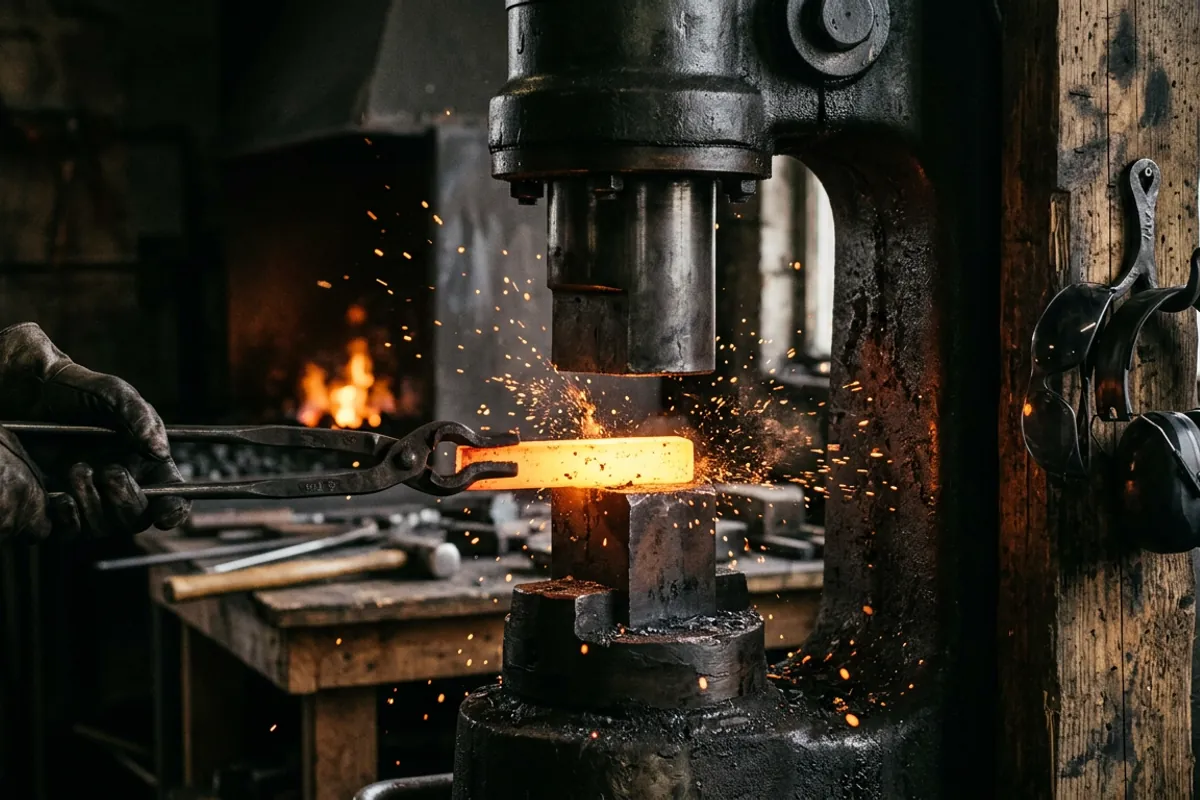
- Nothing loose above the dies. No gloves you cannot shed instantly on the hand near the work, no sleeves flapping, no shop rag in a back pocket. Natural fibers only near hot steel, because synthetics melt into skin.
- Eye protection rated to ANSI Z87.1, always. A hammer throws scale hard and continuously. This is the same standard I go through in the blacksmith safety gear guide, and it does not relax because the machine is doing the swinging.
- Hearing protection. A hammer under load is loud enough that you will not want to be in the shop without plugs or muffs. Hearing loss is cumulative and permanent.
- Foundation. These machines are heavy and they hammer. Follow the maker's mounting instructions, on a slab that can take it. A hammer that walks is a hammer that will eventually hurt someone.
- Wiring by someone competent. Three phase, VFDs, 240 volt circuits, and a shop with a forge in it are not the place to improvise. Get an electrician.
- Know where the stop is before you switch it on. Treadle up should mean stopped, every time, and if the linkage is sloppy you fix the linkage before you forge.
- Tongs, not fingers, and never a hand in the die gap. The rule is absolute. Tongs that actually grip make this easier, which is the whole argument in the tongs guide.
What owners say
I have not run these machines, so this section is forum consensus, attributed.
On the small Anyang, an I Forge Iron thread asking about the 15 kg / 33 lb hammer draws the answer you would expect from people who own hammers: for a hobby shop not exceeding 1 to 2 in stock the small hammer does the job, but the advice to buy bigger comes up over and over.
On Anyang ownership generally, the BladeForums Anyang owners thread is worth reading before you spend. Owners there report real heat buildup at the front cylinder under prolonged heavy use, with one describing seals needing replacement about every six months. Others push buyers toward Iron Kiss, Say Mak, or a rebuilt Little Giant instead. On the positive side, US dealer support was reported as much improved over the early years, which matters for parts.
On the tire hammer, the KnifeDogs thread on Clay Spencer's plans is unusually consistent: members report good control, performance in the neighborhood of a Little Giant, and value that is hard to match at the 1,000 to 2,500 dollar level. The complaints are honest ones about the design's limits, mainly the small die footprint and that 50 lb is underpowered next to a heavier pneumatic.
On Little Giants, the signal is not about the machine so much as the rebuild. Parts for 25, 50, 100, and 250 lb hammers are still supplied, along with rebuilding instruction, which is the reason these old machines are still working. An unrebuilt hammer with worn babbitt is a project, and everyone who has done one says so.
What I would tell a friend
Buy the Anyang ST 25 class if you have the money, the slab, and a dealer you can call. Build the Clay Spencer tire hammer if you can weld, because it is the best dollar per useful blow in this whole field and it runs on house current. Take the utility air hammer route only if you already own a serious compressor, and price the compressor into the comparison if you do not. Skip the 33 lb machine unless your work is genuinely small and you know it will stay small, because the people who bought one are the people telling you to buy bigger.
And skip all of it for now if what you actually need is a better hand hammer and more hours. That is not me being cheap on your behalf. Most of the smiths who ask me about power hammers are two years from needing one, and the money buys more shop as a forge, an anvil, and a hammer that fits your hand. A hammer you cannot install safely is worse than no hammer at all.