I have enough verified material. Two ASINs are confirmed live and name-matched (B098JRTG52, B098B2KTXQ); Centaur specs and forum/consensus sources are in hand. The VEVOR refs are both anvils, so they don't belong in a tongs guide and I'm leaving them out. Writing the article now.
If you are going to own exactly one pair of tongs before you own two, make it a wolf jaw. Wolf jaw tongs are the closest thing blacksmithing has to a do-everything grip: the stepped, tooth-like jaw holds round, square, flat, and hex stock across a usable band of sizes, which is exactly what a beginner needs when they own one bar of everything and nothing matches. My honest pick for a first pair is a mid-length wolf jaw somewhere around 15 to 18 inches overall, sized to the stock you actually forge most. Below I will tell you which cheap ones are worth the gamble, which forged pairs are worth the extra money, and the one thing that matters more than any brand stamped on the rein, which is fit.
Here is the framing this site runs on, up front. I have forged with wolf jaws for years and I can tell you exactly what the pattern does and does not do on the anvil. But the specific budget models below are not bench tests I ran in my own shop. Those picks lean on published specs and on what owners report on the forums, weighed against what I know about how a tong is supposed to sit in the hand and close on hot steel. Where a number is published, I cite it. Where it is not, I say "not published" instead of inventing one.
What a wolf jaw tong actually does
The wolf jaw gets its name from the jaw shape: a stepped set of grooves and ridges, like a row of teeth, cut into both jaws so they interlock when they close. That geometry is the whole trick. A flat-jaw tong grips flat bar and pretty much nothing else. A V-bit or box tong grips round and square beautifully and flat poorly. The wolf jaw splits the difference across all of them, because the stepped notches give the bar a couple of points of contact no matter which face you present to it. On the club-forge floor the standard line is that a wolf jaw is not the best tong for any single job, but it is the one tong that does every job well enough to get you through the day. That is why it is the pattern everyone points a beginner at.
What that means in practice: one good wolf jaw will pick up 1/4 inch round, 3/8 inch square, a piece of 1/8 by 1 inch flat, and a length of hex all afternoon, if it is the right size for that band of stock. The catch buried in that sentence is "the right size." A wolf jaw is versatile across the range it was made for, not across every size of steel in your rack. A big-jawed wolf jaw made for 1/2 inch and up will fumble a thin knife billet, and a small one made for 1/4 inch will not close on 3/4 inch square at all. Match the tong to the stock, not to the whole shop.
How I picked these, and what these picks are not
I sorted the field into three honest tiers: the cheap Amazon imports you can have on the bench this week, the mid-price domestic tongs from a real forge supplier, and the German forged tongs that cost the most and last the longest. For the imports, I am reading published listing specs and owner reports, not results from a tong I personally destructed. For the Centaur and German tongs I am citing the maker's or supplier's own published figures. No fabricated measurements, no invented weights. If you want the broader "which first tongs" conversation, I go through the full field in my blacksmith tongs buying guide and the more general smithing tongs guide; this one is about the wolf jaw specifically.
The wolf jaw tongs at a glance
Published specs only. A blank in the jaw depth or grade column means the maker or seller does not publish that figure, and I am not going to make one up.
Scroll horizontally to see all columns.
| Tongs | Overall length | Rein length | Jaw depth | Material (published) | Price tier |
|---|---|---|---|---|---|
| Generic import 17 inch wolf jaw (3-point grip) | 17 in | not published | not published | heavy-duty steel, grade not published | Budget |
| Camoo 17 inch wolf jaw | 17 in | not published | not published | steel, grade not published | Budget |
| Centaur 2 Wolf's Jaw | 15 in | 12 in | 2.5 in | 8560-grade steel | Mid |
| Centaur 3 Wolf's Jaw | 19 in | 15 in | 3.5 in | 8560-grade steel | Mid |
| Peddinghaus German wolf's jaw | 300 to 500 mm | not published | not published | forged steel, grade not published | Premium |
The Centaur figures come straight off Centaur Forge's own product pages, which list the Centaur 3 Wolf's Jaw at 19 inches overall, a 15 inch rein, a 3.5 inch mouth depth, and 8560-grade steel, and the Centaur 2 at a 12 inch rein in the same steel. The same page notes they also stock Peddinghaus German imports in 300, 400, and 500 mm. The two Amazon imports publish an overall length and little else, which tells you something on its own.
The budget import wolf jaw tongs
This is where most new smiths start, and honestly it is a defensible place to start. A 15 to 17 inch import wolf jaw is cheap enough that if you ruin it learning to fit tongs, you are out lunch money, not a week's pay.
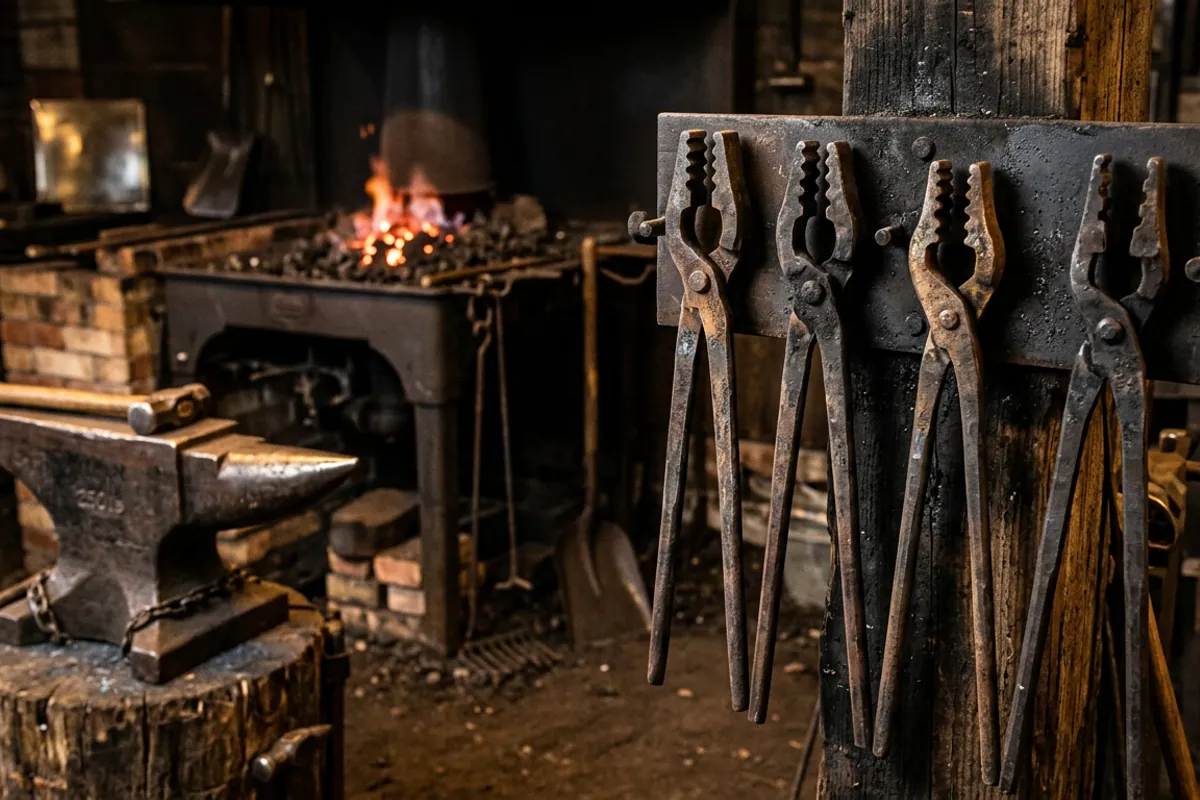
The one I would look at first is a plain 17 inch import sold under a generic "Blacksmith" label as wolf jaw tongs with a 3-point grip (paid link). The listing claims heavy-duty steel and a stepped jaw for round, flat, and square stock, which is the standard wolf jaw pitch. The 17 inch length is a sensible general size, long enough to keep your hand back from the fire and short enough to control. The Camoo 17 inch wolf jaw (paid link) is the same idea from a slightly more established seller, same length, same steel-of-unstated-grade.
Now the honest part. These are fabricated import tongs, and the recurring complaint on them is consistent: the jaws often do not meet square out of the box, the reins can be sprung or uneven, and the "grip" is only as good as the fit you put into it. None of the budget listings publishes a steel grade, a jaw depth, or a stock rating, so you are buying an overall length and a promise. That is fine, as long as you go in knowing you will almost certainly need to heat the jaws and fit them to your stock before they grip properly. Treat a cheap import as a tong kit, not a finished tong, and it will serve you well. Treat it as ready to use and it will drop hot steel on your boot.
If you want an adjustable jaw that copes with a wider size range without refitting, that is a different tool, and I cover those separately in my adjustable blacksmith tongs guide. A wolf jaw is not adjustable; it is fitted.
The step up: Centaur and German forged wolf jaw tongs
Spend a little more and you buy two things: a known steel and a jaw that was made to meet correctly.
Centaur Forge makes their own wolf jaw tongs from 8560-grade steel, with balls forged on the ends of the reins so the tong does not slip out of your hand. The Centaur 2 (12 inch rein, 15 inches overall, 2.5 inch mouth) is the compact one for lighter stock; the Centaur 3 (15 inch rein, 19 inches overall, 3.5 inch mouth) is the general-purpose size I would point most people at. These are not exotic tools and they are not expensive, but the jaws come closer to right from the start, and 8560 is a known tong steel that takes the abuse of being clamped on orange bar without spreading. Centaur's figures are published on their own site, linked in the table above.
Above that sit the German forged tongs, the Peddinghaus and Picard wolf's jaws. Centaur imports the Peddinghaus line in 300 to 500 mm sizes. The reason smiths pay for these is that they are forged rather than fabricated, from a maker that has been making tongs for a very long time, and the jaws and reins are true enough that fitting is a tune, not a rescue. On I Forge Iron, when the which-brand-of-wolf-jaw thread comes up, the German forged names are the ones that get named without an argument following. They cost the most of anything here and they are the last wolf jaw you will buy in that size.
I did not put an Amazon link on the Centaur or German tongs on purpose. Buy those from a real forge supplier where you can see the published specs and the return policy, not from a marketplace listing that publishes a length and a stock photo.
Fitting a wolf jaw tong to your stock is the whole game
Here is the thing nobody selling tongs wants to lead with: a wolf jaw tong grips well only when its jaws are fitted to the stock you are holding. Out of the box, even a decent tong will meet at a point or a line instead of across the notch, and a cheap one will be worse. A tong that grips on a line lets the bar pivot, and a bar that pivots in the fire is the accident waiting in your shop.
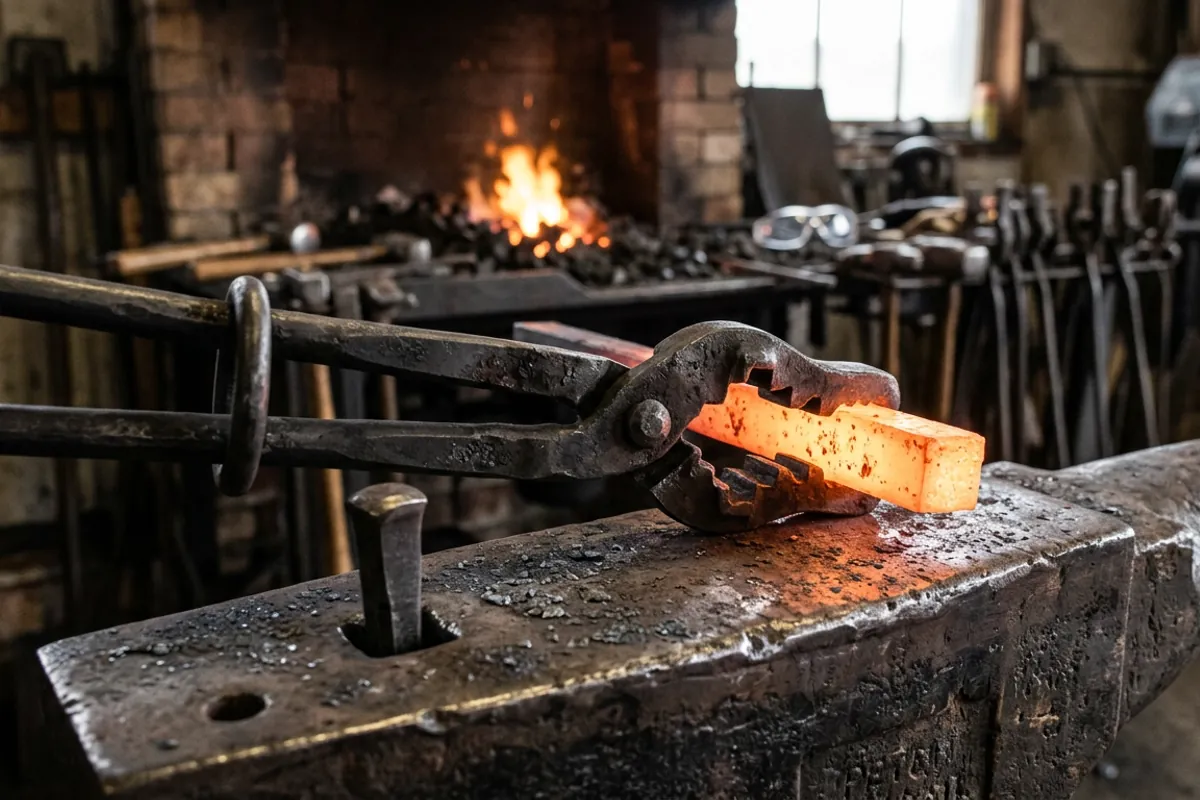
Fitting is simple and it is a rite of passage. You heat the jaws to a good orange, close them on a piece of the actual stock you plan to hold (or a bar the same size), and squeeze so the hot jaws take the shape of the steel. Do it in the vise or under a light hammer, keep the reins lined up, and let the jaws cool clamped on the bar. Now the notches sit on the stock across their whole width instead of pinching one edge. A wolf jaw fitted to 3/8 inch square will still grab 1/4 and 1/2 inch square well enough for general work, which is the versatility everyone praises, but it is at its best on the size you fit it to. This is exactly why buying "one wolf jaw for everything" is a beginner myth: you buy one wolf jaw for a band of sizes, fit it to the middle of that band, and buy a second when your work moves outside it.
Two more fitting notes. Keep the reins the right spread for your hand; if the tong forces your grip wide open, you will fatigue and lose control, and you can bend the reins closer cold or hot. And once the jaws are fitted, use a tong ring, also called a tong clip, a simple steel ring you slide up the reins to lock them closed on the work. It turns a hand grip into a mechanical clamp and is the cheapest safety upgrade in the shop. Your first forged wolf jaw and your first tong ring pair naturally with your first good blacksmith hammer as the core of a starter kit; I lay out the rest of that kit in the getting-started guide.
What owners say
For gear I have not run down in my own shop, here is what the forums actually report, not what the listings claim.
The consensus that everyone agrees on is versatility. Across I Forge Iron and the tong threads on BladeForums, the recurring description of the wolf jaw is the "Leatherman of tongs": not the best at any one grip, but able to hold rounds, squares, flats, and hex across a real range of thicknesses, which is why it gets recommended as a first pair over and over. The guide at Working the Flame lands in the same place, calling wolf jaws "great beginner tongs for multi-purpose application" and listing versatility as the main pro and cost as the main con on the quality end.
On the cheap imports the signal is thinner and more mixed, and I will not dress it up. The common complaint is exactly what you would expect from fabricated budget tongs: inconsistent fit out of the box, jaws that need regrinding or hot-fitting before they grip, and the occasional sprung rein. Nobody on the forums reports a cheap import that arrived ready to trust on a heavy piece without fitting first. The counterpoint, which is fair, is that a smith who is going to learn to fit tongs anyway loses nothing by learning on a $25 import instead of a $70 forged one. On the German forged tongs the signal is short and boring in the best way: people buy them, fit them once, and stop talking about them, which is the highest praise a tool gets on a forum.
Safety: a tong that slips is the hazard
The danger with tongs is not exotic. It is a piece of steel at a couple thousand degrees pivoting or dropping out of a jaw that does not really grip. That is a burn, a grass fire, or a hole in your boot, and it is the single most common way a wolf jaw hurts someone. Everything in the fitting section above is a safety section wearing work clothes: a fitted jaw and a tong ring are what keep the hot end where you put it.
The rest is the usual forge discipline, and I do not soften it, because I lost my eyebrows early on standing too close to a quench in a cotton shirt with no shield and got my eyesight back on luck alone. Wear eye protection rated to ANSI Z87.1 whenever you are at the fire or the grinder. Wear natural fibers, cotton, wool, or leather, near heat, never synthetics that melt onto skin. And do not extend your reach past a tong that is not gripping; if the bar is loose in the jaw, reset it before it is over the anvil. A longer rein keeps your hand back from the fire, which is one more reason the 15 to 18 inch sizes are the sweet spot for a first tong. The full rundown of shop protection lives in my blacksmith safety gear guide.
What I would tell a friend
Buy one wolf jaw first, in the 15 to 18 inch range, fitted to the stock you forge most. If money is tight or you just want to learn, start with a cheap import like the 17 inch 3-point grip wolf jaw (paid link) or the Camoo 17 inch (paid link), and go in knowing you will hot-fit the jaws before you trust them, because you will. If you would rather buy once, spend up to a Centaur 8560 wolf jaw or a German forged Peddinghaus and skip the fitting rescue. Either way, add a tong ring, wear your Z87.1 glasses and natural fibers, and remember that the tong is only as good as its fit to the steel. That is the whole guide: fit beats brand, size the tong to the stock, and never trust a jaw that grips on a line. For the rest of the pattern (hammers, other tong styles, and where the wolf jaw sits among them) start at the hammers and tongs hub.