You're right that the specific import complaints and the "commentary on BladeForums" were attributed as sourced consensus when I could only see search summaries, not the threads themselves. I re-searched and can substantiate the build-vs-buy consensus and the G2's reception (a smith noting you "could not make one as nice for the same price," praise for the open sides); I cannot substantiate specific import-owner complaints, so I've reframed those as my own read on budget import tooling and flagged the import owner signal as thin. Re-outputting the full corrected deliverable, cleanly (no preamble that could bleed into the parsed body).
If you asked me for the one tool that made my solo work look twice as clean, a blacksmith guillotine tool would be near the top of the list. It is the spring frame that drops into your anvil's hardy hole, holds a matched top and bottom die, and lets you set a clean shoulder, a fuller, or a tenon by yourself without a striker standing across the anvil. If you are set on buying one rather than building it, the tool I would point a friend at is the Yesteryear Forge G2, because it is a real design from a real maker with dies you can actually source. But I will be honest up front: most old hands will tell you this is the classic tool to build, not buy, and they are not wrong.
One more piece of honesty before the picks. I have run guillotine tools at my own anvil for years, so I can speak to how the class behaves under a hammer. I have not bench tested every model here. What follows leans on the makers' published specs, on what owners report on the forums, and on general shop experience with how these tools live and die. Where a number is not published, I say so rather than guess.
What a blacksmith guillotine tool actually does
Picture the old way of setting a shoulder: you hold the hot bar on the anvil, a striker swings a top fuller down onto it, and you both try to hit the same spot every time. A guillotine replaces the striker and the loose top tool with a frame. The frame stands in the hardy hole. Two dies, top and bottom, ride in that frame and are held apart by a spring, usually a leaf. You slide the hot steel between the dies, strike the top of the tool with your hand hammer, and the two dies close on the work in perfect register. Let up, the spring opens them, you move the bar, and you hit again.
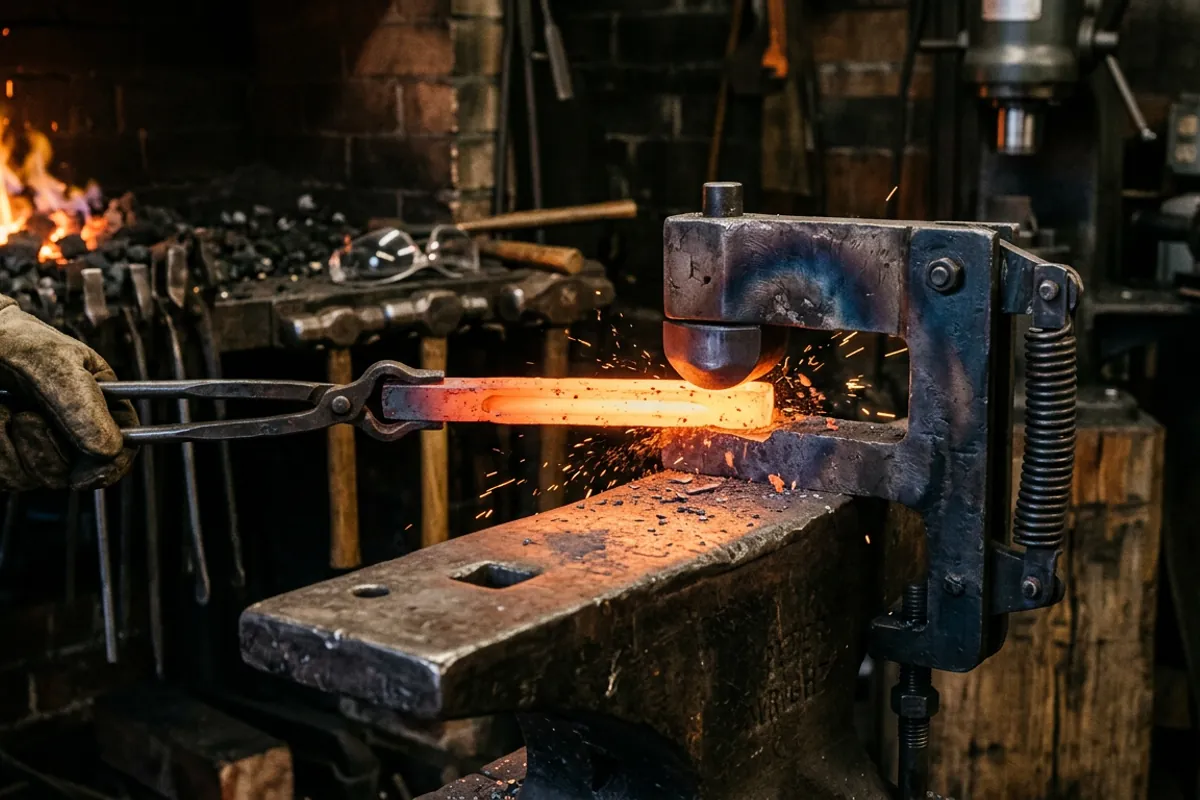
That register is the whole point. Every isolation, every fuller, every neck comes out in the same plane because the dies cannot wander. For a smith working alone it does the job of a second set of hands. Swap the dies and the same frame draws round or square tenons, sets butcher shoulders for leaf and animal head work, or cuts stock with a hot cut die. If you already understand hand fullers, a guillotine is the same geometry made repeatable and hands free.
Because it lives in the hardy hole, a guillotine is only as good as the anvil under it. You want real mass and a clean, tight hardy hole so the tool sits square and does not kick when you strike. Bessie, my 148 lb Trenton, has the mass to soak that up; a light stand anvil will bounce and rob your blows. This is one more reason a beginner is better served putting money into a solid anvil first, and adding the guillotine once the anvil and the basics are settled.
How I picked these, and what I did not test
I did not line up five guillotines on the bench and run comparison cuts. Nobody should tell you they did unless they show you the tools. What I did is read the maker pages for the published specs, read the forum threads where smiths who own these tools talk about them, and weigh both against how guillotines behave in my own shop. The picks below are grouped by what they are: the genuine commercial G2, the budget imports, the heavier commercial fuller dies, and the one you build. Every spec in the table is a published figure with a source, or it is marked not published.
The tools at a glance
Scroll horizontally to see all columns.
| Tool | What it is | Hardy shank | Die material (published) | Die size | Tier |
|---|---|---|---|---|---|
| Yesteryear Forge G2 | Open sided guillotine | 3/4 to 1 1/4 in, your choice | 1018 carbon steel | 1/2 in thick x 2 1/2 in wide | Premium |
| Commercial guillotine fuller dies (Smithing Magician style) | Guillotine with heavy dies | Varies, not published | 4140 at 50 to 52 HRC, untempered | Not published | Mid to premium |
| Forge Wizard heavy duty (import) | Budget guillotine, 2 die sets | Not published | Seller stated 4140 annealed | Seller stated 1/2 x 2 and 3/4 x 2 in | Budget |
| Bonbo 7 piece (import) | Budget guillotine, 3 die sets | Not published | Seller stated hot rolled steel | Seller stated about 2 in wide | Budget |
| Shop built spring fuller | DIY frame and dies | Cut to your hardy | Your choice of plate and spring | Your choice | DIY |
Sources for the published rows are linked in each tool's section below. The rows marked seller stated come only from the import listing and are not independently published, so treat them as a claim, not a tested fact.
The genuine G2 guillotine
The G2 from Yesteryear Forge is the one I would buy if I were buying. It is laser cut and bolted together with socket head cap screws, the sides are open so you can run a fuller the full length of a piece like a knife blade, and the bottom slot has exit points so scale and grime do not pack in and jam the dies. Yesteryear publishes the dies as 1/2 inch thick by 2 1/2 inch wide in 1018 carbon steel, and the tool comes with a radius set and a flat set. You pick the hardy shank when you order, anywhere from 3/4 inch up to 1 1/4 inch, so it fits your anvil rather than the other way around, per Yesteryear Forge.
Two honest notes. The dies are 1018, which is a mild carbon steel. That keeps replacement dies cheap and easy to source or cut yourself, but it also means the die faces will move over time if you hammer hardened stock hot and heavy. For most fullering and shouldering on bar stock that is a fair trade. The other note is that the open sided design is a feature and a limitation at once: it is what lets you fuller a long blade, but it also means the dies are not boxed in on every face, so keep them seated and square as you work.
Check price on Amazon (paid link)
The budget import guillotines
Search "blacksmith guillotine tool" and you will drown in near identical imports sold under names like Forge Wizard and a dozen others. They are welded steel frames with a leaf spring return and a couple of die sets. I do not own these, so I am reporting what the listings claim and giving you my read on tooling of this type, not a hands on test.
The heavier Forge Wizard listings state a 3/8 inch thick steel frame and dies of 4140 annealed steel, with two guide and die sets around 1/2 by 2 inch and 3/4 by 2 inch. That is a reasonable spec on paper, but it is the seller's own claim, not a published or tested figure. The Bonbo 7 piece (paid link) leans the other way, giving you three die sets, flat, fullering, and unground blanks you can grind to your own profile, but the frame and dies are described only as hot rolled steel with no hardness given. Blanks are actually the sleeper feature here: an unground blank lets you make the exact die your job needs, which is most of the reason to own a guillotine in the first place.
What to expect from this class, and I will flag this plainly as my own judgment on budget import tooling rather than a sourced test: the frames are usable, the leaf spring is the part most likely to fatigue, and the die to frame fit at this price often wants a file before the dies track cleanly. Take the "4140 annealed" as soft until you heat treat it yourself. If you go in knowing you are buying a frame and a starter die set to fettle, not a finished precision tool, a budget guillotine is a fair way to get going cheap.
Check price on Amazon (paid link)
The commercial fuller dies and the Smithing Magician
A step up from the imports and below a full custom tool sit the commercial guillotines built around heavier hardened dies, the Smithing Magician and the guillotine fuller die sets sold by shops like Blacksmiths Depot. The dies here are cut from 4140 tool steel and run about 50 to 52 HRC, and the seller is upfront that they ship not tempered, with tempering suggested if you are going to lean on them hard, per Blacksmiths Depot. That is the honest spec you want to see: real material, real hardness, and a clear note on heat treat rather than a vague "hardened steel."
This is the tier where you are paying for die steel that will hold its profile through real production, and for a frame that will not flex. The forum consensus is that commercial guillotines run somewhere in the range of a few hundred dollars, and I have seen 150 to 300 dollars quoted for the frame with one to three die sets on the I Forge Iron boards. Whether that is worth it over building depends entirely on whether you value your weekend more than the money, which is the same question that hangs over every bought versus built tool in the shop. If you want the die steel and hardness question settled, this is a good middle path, and the dies drop into the same kind of frame you could also cut yourself later.
The one most old hands will tell you to build
Here is the part the vendors will not lead with. The guillotine, or a simpler spring fuller, is one of the most built tools in the craft, and for good reason. The design is forgiving, the materials are scrap you already have, and building one teaches you exactly how the dies register, which makes you better at using it. There is a long running thread on I Forge Iron titled, plainly, that you should have a guillotine tool and can build one for under thirty dollars, and the consensus in the thread is that every beginner should build one as soon as they can, I Forge Iron.
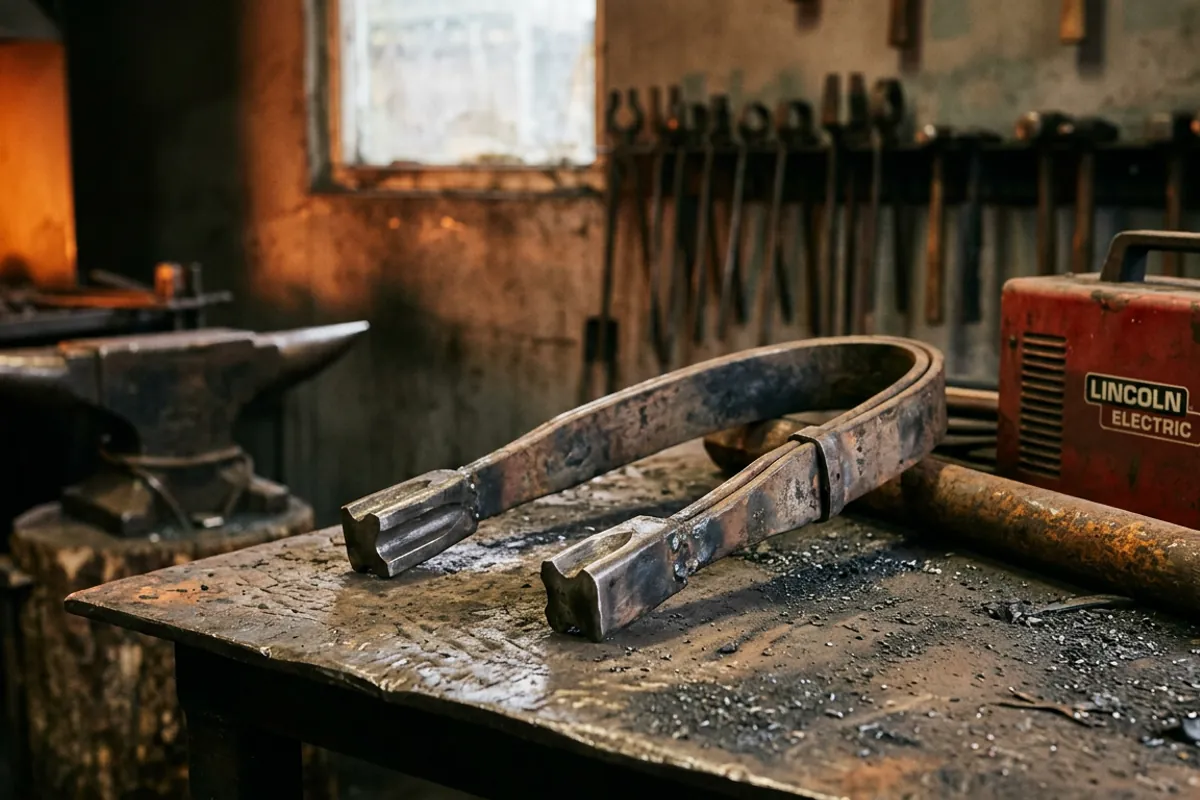
A basic spring fuller is a bent leaf spring with a die welded to each leg, sized to drop into your hardy hole. A boxed guillotine is a little more work, two plates and guides so the dies track, but it is still a weekend of cutting and welding. The die stock can be a chunk of leaf spring, a truck axle, or any medium carbon steel you can shape and, if you want them to last, heat treat. If you already have a hardy hole tool or two and a welder, the only thing you are really buying at the store is time. Build one, use it, and you will know exactly what you want if you later buy a nicer commercial frame or cut your own dies.
What owners say
For the imports I will be straight: owner signal on any single one of these models is thin and noisy, because so many of them are the same tool relabeled under different brand names, and the reviews that exist are short and mostly first impressions. I would not hang a verdict on one listing's star rating. Treat the imports as a class, a cheap frame and a starter die set, not a precision tool, which is the same way I framed them above.
For the genuine G2, the commentary I found is positive. On I Forge Iron a smith made the point that you could not build one as nicely for the same price, and owners keep coming back to the open sided design for running a fuller down blade stock. The recurring knock is the 1018 die material, which some smiths swap for harder dies over time, I Forge Iron.
For the commercial 4140 fuller die sets, the signal is thinner but consistent with the seller's own note: buyers like the real material and the stated hardness, and the standing advice is to temper the dies before hard use. The one point every camp agrees on, and it is loud across the I Forge Iron threads on guillotine dies and builds, is that some form of this tool belongs in a solo shop, and the most repeated recommendation is not which one to buy but to build one first, I Forge Iron.
Safety at the guillotine
A guillotine changes how you get hurt, so it is worth a word. You are striking a steel top die with a hammer, steel on steel, sometimes hardened on hardened, and that throws chips. Wear eye protection rated to ANSI Z87.1, not shop glasses that happen to be on the bench. I quenched a blade too close in a cotton shirt with no face shield early on, and the oil flared and took my eyebrows, and I kept my eyesight by luck, so I do not treat eyes as optional and neither should you.
A few more real hazards. Hot scale gets pinched and ejected when the dies close, so keep your face back and keep bystanders out of the line. Make sure the shank fits the hardy hole snugly; a loose tool can jump when you strike it, and that is how a hot piece ends up somewhere you did not plan. Dress for the heat in natural fibers, cotton or wool or leather, because synthetics melt onto skin. And if you are grinding your own die profiles from blanks, that is eye and lung protection at the grinder, every time.
What I would tell a friend
If you are buying, buy the Yesteryear Forge G2, size the shank to your anvil, and plan to swap the 1018 dies for something harder if you start doing production. If you want the die steel question settled out of the box, step up to a commercial guillotine with 4140 dies and temper them before you lean on them. If you have a welder and a free weekend, do what most experienced smiths will tell you to do and build one first, because thirty dollars of scrap will teach you more about how the tool works than any purchase. The budget imports are a fine cheap entry as long as you go in knowing you are buying a frame to fettle, not a finished tool. Whatever you land on, put it over a real anvil, keep the shank tight, and keep the Z87 glasses on. For more tools worth the bench space, the rest of my write ups live in the More from the shop hub.