Swage block guide
If you want one swage block in a home shop and you are not restoring a foundry, I would buy a 66 lb ductile iron block, set it in a heavy wooden stand at knee height, and be done thinking about it. That size gives you real through-holes, real half-round swages on the edges, and enough mass that the block does not walk across the shop when you hit it, and it still costs a fraction of a full-size industrial block. The honest framing before we go further: I have run a swage block for years and I know what the tool does on the floor, but I have not bench tested the specific imported blocks below. Those picks lean on published specs, seller-stated material grades, and what owner signal I could actually find, weighed against twenty-five years of shop experience.
I will also tell you up front that a swage block is not a first-year purchase. It is the tool you buy when your work has started asking for shapes your anvil cannot give you.
What a swage block actually is, and what it does that an anvil cannot
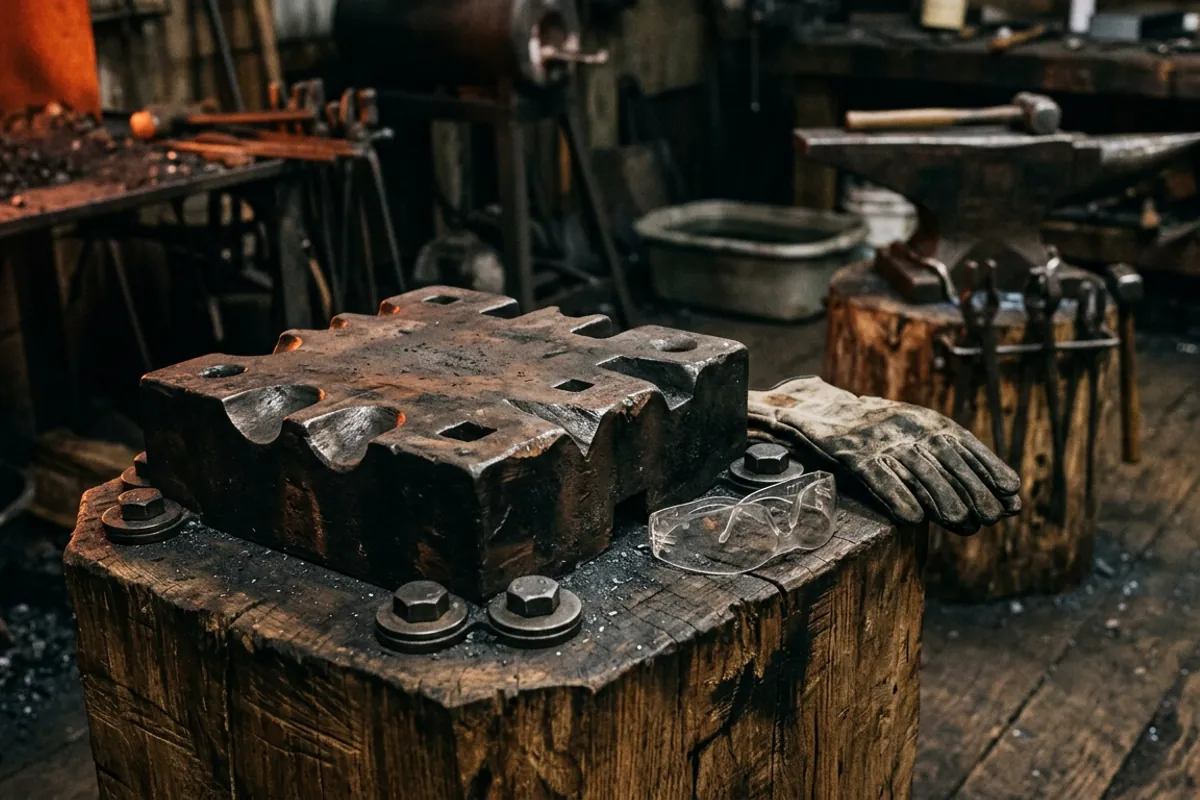
A swage block is a large, heavy block of cast iron or steel with variously sized holes through the face and shaped forms cast into the sides. The through-holes are round, square, hexagonal, and slotted, and they exist so you can drive hot stock down into a shape or punch through a bar with somewhere for the slug to go. The scalloped edges give you half-rounds, V notches, and angled planes to forge against. Wikipedia's summary of the tool is accurate as far as it goes: bending, cutting, punching, and forming, plus dished depressions on the artistic blocks for spoons, ladles, and bowls.
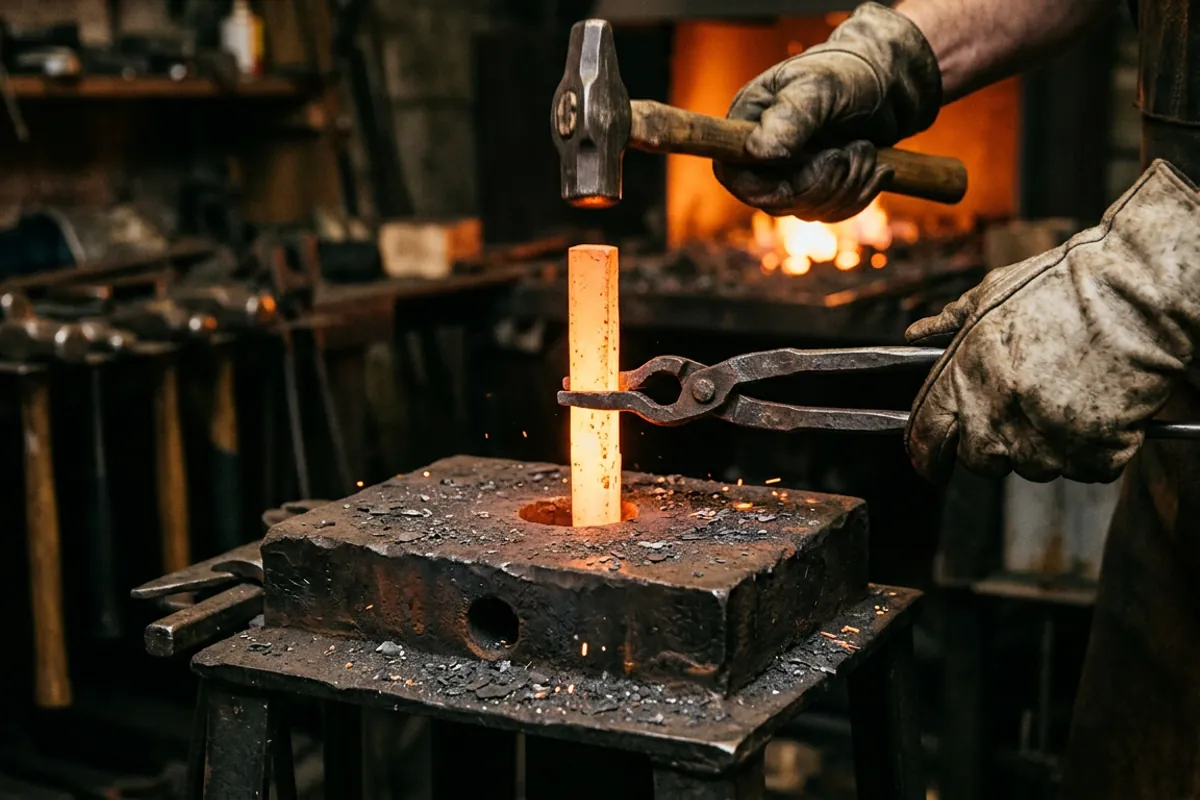
Here is the practical version. My anvil Bessie, a 148 lb Trenton, gives me a flat face, a horn, a hardy hole, and a pritchel hole. That covers most of what I do. What she cannot do is back up a bar in a half-round groove while I drive the top half round, or let me sink a bowl without stretching it into a potato chip, or give me somewhere for a punched slug to fall that is not my pritchel hole. A swage block does those three things, and it does them without me building a dozen bottom tools.
That is the whole case for the tool. It is a shape library in iron. If your work is hooks and leaves and simple tapers, you will not miss it. If you are heading bolts, forming sockets, sinking bowls, or putting a consistent round on a tenon shoulder, it earns its floor space fast.
How the field compares
Everything in this table is a published figure from the party named in the source column. Where a maker or non-marketplace retailer publishes a spec, I cite the page. Where the only figure available comes from the seller's own marketplace listing, I say so plainly rather than dressing it up, because those product pages are not something I am willing to treat as verified maker data.
Scroll horizontally to see all columns.
| Block | Weight | Material | Size | Notable features | Source of spec | Price tier |
|---|---|---|---|---|---|---|
| 66 lb import swage block | 66 lb | 65-45-12 ductile iron (seller stated) | 11.42 x 10.24 x 3.11 in | Slot, round and square through-holes; half rounds, 90 degree notches, hex and curved sides | Seller listing only | Budget |
| 50 lb import dished block | 50 lb | 65-45-12 ductile iron (seller stated) | 9 x 9 x 3 in | 4 bowls, 2 spoon depressions, 2 rivet dimples; half rounds and 60 degree V notches | Seller listing only | Budget |
| 4.5 lb U channel block | 4.5 lb | Heat treated steel (seller stated) | 8 x 1.5 x 1.5 in | Half round grooves 1/8 in to just under 1 in, dapping rounds 1/8 in to 3/4 in, 3 small V grooves | Seller listing only | Budget |
| Iron Mountain Forge swage block set, 4 pieces | Not published | 60/45/15 ductile iron | 6 x 2 in each, 3/4 in bar underneath for a vise | Swages 1-3/4 in and 2 in, radiuses 3/8 in to 1-1/2 in, two V dies, socket tapers | Iron Mountain Forge | Mid, published at $127.00 |
| Centaur Swage Block A | Not published | Not published | Not published | Full size shop block | Centaur Forge | Premium, published at $760.00 |
| Holland Anvil 100 lb block and stand | 100 lb block, stand about 78 lb per side | Ductile iron block, cast iron stand | 23-7/8 x 5-7/8 x 4 in | Sold with a purpose built cast stand | Holland Anvil | Premium, published at $1,600.00 and listed out of stock |
One note on that material grade, because it matters more than the weight. 65-45-12 is an ASTM A536 ductile iron designation: 65 ksi tensile strength, 45 ksi yield, 12 percent elongation, per the Penticton Foundry data sheet. Ductile iron is not gray cast iron. The graphite is nodular instead of flaked, so the casting bends and dents where gray iron cracks and throws chips. For a tool you are going to hit with a hammer, that difference is the whole ballgame. If a listing says "cast iron" and will not name a grade, assume the worst and keep looking.
The 66 lb import block: the one I would buy first
This is the size that makes sense for a one-person shop. At a published 11.42 x 10.24 x 3.11 inches and 66 lb, it is big enough to have useful through-holes and enough edge length for a real spread of half-rounds, hex forms, and 90 degree notches, but light enough that one person can wrestle it onto a stand without a hernia or a helper. The seller states 65-45-12 ductile iron, which is the right material call if it is accurate.
What I would expect from a block in this class, based on how imported cast tooling generally arrives: usable geometry, a rough as-cast surface, and possibly some flash or a sand-cast texture in the depressions that you will want to knock back with a flap disc before it prints into your work. That is normal for cast tooling at this price. What I would not expect is precision. If you need a 1 inch round swage to be exactly 1 inch, measure it before you design a joint around it.
Three inches of thickness is on the thin side for punching heavy stock over a through-hole. It is fine for light and medium bar. Do not use it as an anvil substitute for heavy drawing, and never hit the block with the hammer face directly. Steel on hardened work is one thing; a hammer face onto a cast block edge is how you chip both.
Check price on Amazon (paid link)
The 50 lb dished block, if bowls and ladles are the point
The other common import block trades through-holes for depressions. The published spec is 9 x 9 x 3 inches, 50 lb, seller stated 65-45-12 ductile iron, with four bowls, two spoon depressions, and two rivet dimples on the face, plus half rounds and 60 degree V notches on the sides. That is a different tool wearing the same name.
If you make ladles, spoons, small bowls, or anything that needs to be dished rather than drawn, this is the more useful of the two and it is not close. Sinking a bowl over a wooden stump works, but a stump does not hold its shape and it burns. A cast depression gives you a repeatable form, which means the second spoon looks like the first one.
If you mostly forge bar stock and want holes to punch over and swages to round tenons in, this block will frustrate you. Buy the through-hole block instead. I would not buy both to start. Pick the one that matches what is actually coming off your anvil this year, not what you imagine you will make in five.
Check price on Amazon (paid link)
The small U channel block for light and fine work
There is a whole class of small blocks sold to jewelers and tinsmiths that blacksmiths quietly buy too. The 4.5 lb U channel block is the common one: published as 8 x 1.5 x 1.5 inches in heat treated steel, with half round grooves from 1/8 inch to just under 1 inch, dapping rounds from 1/8 inch to 3/4 inch, and three small V grooves.
Be clear about what this is. It is not a swage block in the shop-floor sense. It is a small forming block for thin material, wire, tube, and light stock, and it belongs in a vise, not on a stand. At four and a half pounds it has nowhere near enough mass to back up a hot 1/2 inch bar under a two pound hammer; the block will just jump.
Where it genuinely helps is small work: rounding light stock, forming a bezel, backing a rivet, dapping small domes. If you make jewelry-scale pieces, hardware, or fine detail on larger work, it is cheap and it does a real job. If you are trying to solve "I need to swage a 3/4 inch tenon," this is the wrong tool and no amount of hammering will change that.
Check price on Amazon (paid link)
What the mid and premium end looks like
Above the import blocks there is a real market, and it is worth knowing the shape of it before you decide the budget block is a compromise you cannot live with.
At the mid tier, small American-made blocks that mount in a vise are the sleeper buy. Iron Mountain Forge publishes a four-piece set in 60/45/15 ductile iron, each block 6 x 2 inches with a 3/4 inch bar underneath for vise mounting, covering swages of 1-3/4 and 2 inches, radiuses from 3/8 to 1-1/2 inches, two V dies, and socket tapers, at a published $127.00. That is a lot of usable geometry for the money and it does not need a stand or a corner of the shop.
At the top, Centaur Forge publishes full-size shop blocks at $760.00 and $790.00, and a mini block at $68.00. Holland Anvil publishes a 100 lb ductile iron block with a cast stand at $1,600.00, currently out of stock. Those are real tools and they will outlive you, but understand what you are paying for: size, geometry count, and a supply chain that answers the phone. For a hobby shop, that money buys a much better anvil and a much better forge. Read the anvil weight guide before you convince yourself otherwise.
The other honest option is the used market. Old industrial blocks turn up at auctions and estate sales, and a hundred-year-old block with a chipped corner is still a hundred years of shape library. Check for cracks running between holes and for the dull thud of a repaired casting.
What owners say
I have to be straight with you here: owner signal on the specific imported blocks above is thin. I could not find substantive forum threads reporting long-term use of those particular listings, which is not the same as a bad review, but it is not a good sign either. When a tool has been in shops for a few years and nobody is talking about it, you are buying on specs and on the material grade, not on a track record.
What the forums do have is a long-running argument about the category itself. On I Forge Iron there is a thread titled "Swage Blocks: Do you guys have them and if so do you use them much?" opened by a beginner who noticed the same thing you probably have, which is that swage blocks look expensive for something you might not touch every week. Another, swage block instruction 101, asks flatly whether the block is one of those tools with no substitute when you need it, or a throwback to an era with different work. There is a whole subforum for the tool, which tells you smiths who own them take them seriously.
Ask ten smiths and you will get the split you would expect. The ones doing production, repair, or hollowware will not give theirs up. The ones making hooks, bottle openers, and knives use theirs a few times a year and admit it. Neither group is wrong, and which one you belong to is the actual buying decision.
Mounting it, and the hazards that come with a cast block
A swage block loose on the floor or perched on a bench edge is a broken foot waiting to happen. Sixty-six pounds of iron slides when you hit it off-center, and cast blocks have square corners. Build or buy a stand that holds the block at a working height, cradles it so it cannot rotate, and lets you flip it to the side forms without a wrestling match. A heavy timber stand with a routed pocket works fine and costs nothing but an afternoon. Bolt or strap it if there is any chance of it tipping.
Two hazards get skipped in the gear talk and they are the ones that actually hurt people.
First, chipping. Any cast block, ductile or not, can throw a chip when a hardened hammer face or a hardened punch strikes it at the wrong angle. That chip leaves at speed and it does not care about your eyes. ANSI Z87.1 rated eye protection is not optional at a swage block. It never was optional near a forge, but a block invites you to lean over your work and put your face right in the line. If you want the full rundown, I wrote it up in blacksmith safety gear.
Second, hot steel and hot iron. Work a block for an hour and the block itself gets hot around the holes you are using. It does not glow, so it does not warn you. Handle it with the same respect you give a hot anvil face, keep bare forearms off it, and wear natural fibers. Synthetics melt onto skin; cotton, wool, and leather do not. That lesson cost me my eyebrows once when quench oil flared with me standing too close in a cotton shirt and no face shield, and cotton was the only thing that went right in that story.
Good tongs matter more at a block than at an anvil, because you are often holding stock vertically over a hole with nothing supporting it but your grip.
What I would buy before a swage block
If you are still assembling a shop, a swage block is not where the next dollar goes. Mass under the hammer is. A heavier anvil improves every single thing you forge, every day, and a swage block improves a handful of operations you may run once a month. If you are choosing between the two, the anvil wins, and it is not a close call.

The order I would actually spend in: anvil, forge, hammer, tongs, vise, then tooling like a swage block, a cone mandrel, or a bick. A solid post vise in particular does half of what people buy a swage block for, and it does the other half of what people buy a third hand for. The short list of tools that actually matter has the full order, and the starter kit guide covers what to buy in year one.
There is also the shop-made route, which is how most of the smiths I know got their first forms. A length of heavy plate with a few holes drilled and half-rounds ground into the edges is not a swage block, but it will do a specific job you need done today for the price of stock and an afternoon. Smiths have been making their own bottom tooling for as long as there have been bottom tools.
What I would tell a friend
Buy the 66 lb ductile iron block if you want a general purpose swage block and you want it now. It has the through-holes and the edge forms that make the tool worth owning, it is a size one person can handle, and the stated 65-45-12 ductile iron is the right material for something you hit. Buy the 50 lb dished block instead if bowls and spoons are the work. Buy the small U channel block only if your work is small, and put it in a vise where it belongs.
Skip the premium blocks unless you are doing production work or you found one used at a price that makes you smile. That money is better anvil, better forge, better tongs.
The buying note that matters most: refuse any block whose listing says "cast iron" without naming a grade. Ductile iron dents, gray cast iron chips, and the chip goes toward your face. And the safety note I will not soften, because it is the one I paid for: ANSI Z87.1 eye protection every time you pick up a hammer near a cast block, no exceptions, no "just this once for a quick tap."
More guides, and the rest of the odds and ends that did not fit a neat category, live on the More from the shop hub.