I have enough to verify the picks and owner consensus. Writing the article now.
Here is the article.
If you have gone looking for a cast iron swage block, you have probably already noticed the thing nobody selling one wants to say out loud: most of the affordable blocks on the market are cast, they are heavy, and whether they survive a working shop depends almost entirely on what kind of iron went into the pour. My short version is this. For a home smith who wants curved dies, half rounds, and a set of punched holes without paying vintage-block money, a 66 lb ductile iron block is the one I would put on the stand, with a 50 lb block as the pick if your bench and your back want something smaller. These are not bench tests. I do not own either of these import blocks. What follows is published specs and owner reports from the forums, weighed against twenty-five years of running tools next to Bessie, my 148 lb Trenton.
Before you spend a dime, understand what you are actually buying, because "cast iron" on a listing is doing a lot of quiet work.
What a cast iron swage block actually is
A swage block is a big chunk of metal with a menu of shapes cast or cut into it: half-round grooves in ascending sizes down the edges, hollow bowl depressions on the flats, and a row of holes in round, square, and hexagonal profiles punched clean through. You lay hot stock in a groove and drive it down with a hammer or a matching top swage to form a consistent curve, or you set the block on edge and use the through-holes to neck down, punch, or start a taper. It is a forming tool, not a striking anvil. That distinction matters more than any single spec on the page. A good rundown of the shapes and their history is on the Wikipedia swage block page, and it is worth two minutes before you buy so you actually know what the grooves are for.
Here is the part the listings blur. "Cast iron" covers a range. Old gray cast iron is strong in compression and genuinely brittle in tension, which is why a dropped gray-iron block can crack and why nobody sane hits one hard with a sledge. Most of the current import blocks, including the ones I point at below, are sold as ductile iron, also called nodular cast iron. That is still a cast iron, but the graphite forms in nodules instead of flakes, and the result takes shock far better than gray iron does. The general material difference is laid out plainly in Reliance Foundry's cast iron versus cast steel writeup: cast iron gives you compressive strength and wear resistance, cast steel gives you impact resistance. A swage block spends its life in compression, so a good ductile iron pour is a reasonable fit for the job. A gray-iron mystery block from an unknown foundry is a gamble.
So when I say cast iron swage block, know that the ones worth owning at this price are ductile iron, and that is a feature, not a downgrade.
The picks at a glance
Only published figures are in this table. Where a maker does not state a number, it says not published rather than a made-up one.
Scroll horizontally to see all columns.
| Block | Weight | Material | Overall size | Holes / shapes | Price tier |
|---|---|---|---|---|---|
| 66 lb ductile iron swage block | 66 lb | Cast ductile iron | 11.5 x 10.25 x 3.1 in | 3 round, 3 square holes, one slot, half-round edges | Mid |
| 50 lb ductile iron swage block | 50 lb | Cast ductile iron | Not published | Bowl, ladle, spoon, rivet and dimple depressions, mixed holes | Budget |
Two things jump out. Neither maker publishes a hardness figure, which is normal for cast blocks and also a reason not to treat them as anvils. And the weights are modest. A 66 lb block is a shop tool you can still move; the historic cast steel blocks smiths chase on the used market run well past 100 to 200 pounds and take two people and a bad idea to lift.
The 66 lb ductile iron block
This is the one I would buy first. At 66 lb in an 11.5 by 10.25 by 3.1 inch footprint, it is big enough to hold real half-round grooves and a useful spread of through-holes, and small enough to live on a stump or a welded stand without a forklift. The listing states cast ductile iron, three sizes of round holes, three sizes of square holes, one slot, and shaped half-round edges. That is a genuinely useful menu for a home shop: the round holes and grooves cover most of the forming a hobby smith actually does, from rounding tenons to starting spoon bowls to necking down stock.
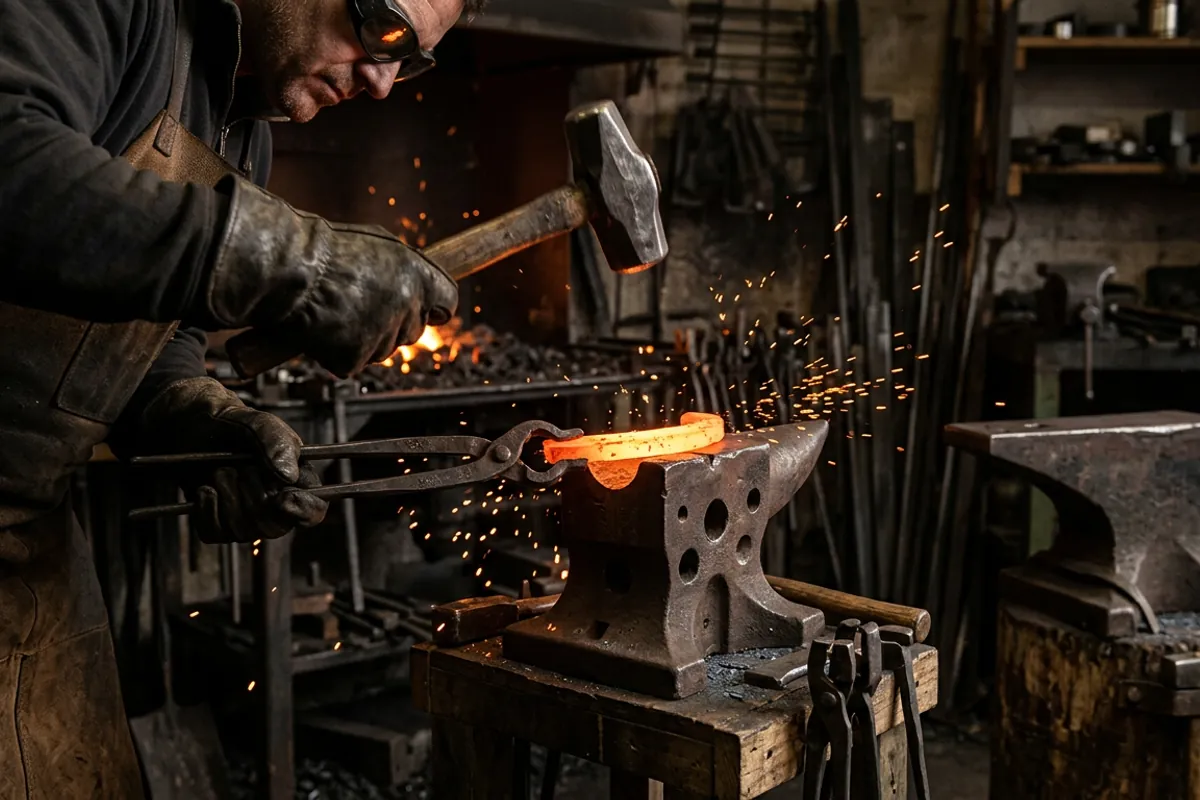
The honest tradeoff is the one that applies to every cast block in this class. It is a forming tool for hot steel, and you treat it like one. You do not use the through-holes as a hardy for heavy hot-cutting, you do not sledge it, and you support it so a drop cannot crack it. Used that way, a ductile iron block gives years of service. Used like an anvil, any cast block is living on borrowed time. For where a block sits in a starter kit, my longer take is in the blacksmith swage block buying guide.
Check price on Amazon (paid link)
The 50 lb block, and where it fits
If your bench is small, your stand is light, or you mostly want the bowl and dimple depressions for ladle, spoon, and rivet work rather than a full hole menu, the 50 lb block is the budget pick. Same material story, cast ductile iron, with the shape set leaning toward hollowing and dishing depressions plus a mix of holes. The maker does not publish the overall dimensions on the listing I found, so I am not going to print a size I cannot cite.
Be clear-eyed about what 16 fewer pounds costs you. Mass is what keeps a forming block from dancing under the hammer, and a lighter block wants a heavier, better-anchored stand to feel solid. For dishing bowls and light forming that is fine. For driving big stock into a deep groove, you will feel the difference and wish you had the 66. If your projects are small and your budget is tight, the 50 earns its place. If you can swing the extra, the heavier block is the better long-run tool.
Check price on Amazon (paid link)
What owners say
I have not run either of these import blocks down in my own shop, so this section is forum consensus, attributed, not a personal test.
The loudest and most consistent theme across I Forge Iron's swage block discussions is not about brand at all. It is that a lot of smiths who own a swage block reach for it far less than they expected to. In the "do you use them much" thread, plenty of people admit theirs mostly sits, and that the block earns its keep only when a specific project needs a consistent curve or a dished form you cannot get freehand. That squares with my own shop. A block is a specialist. If you are buying one because it looks like serious kit, you may be disappointed by how often it stays on the stand.
On function, the I Forge Iron function-of-swage-blocks thread is the clearest owner-level explanation of what the grooves, bowls, and holes are actually for, and it is a better teacher than any product listing. The takeaway from experienced smiths there is that a block shines for repeatable curved and hollow forms, and that most of what a beginner does can be done with a hardy tool, a spring swage, or a hollow in a stump long before a full block is justified.
On the import cast blocks specifically, owner signal is thinner and more mixed, and I will say so plainly rather than dress it up. The recurring caution across forum threads is exactly the material point above: buyers ask whether a cheap cast block is gray iron or ductile, because a gray-iron block treated roughly can crack, while the ductile blocks hold up to normal forming. Nobody I read reported hammering one to pieces in ordinary use, and nobody claimed one rings and rebounds like a cast steel block either, because it is not supposed to. Where the consensus is thin, treat it as thin: these are inexpensive tools with limited long-term owner history, so buy on the material claim and use them within their job.
Do you even need one yet
This is the section the seller will never write. For most beginners, the answer is not yet. The I Forge Iron threads on how often people actually use their blocks keep landing in the same place: master the hammer, the anvil, and a decent pair of tongs first, and let a real project pull the block into the shop later. A swage block does not teach you to forge. It helps you repeat a form you already know how to make.
If you are still building the core of the shop, put the money where it does the most work. The anvil comes first, every time, and if you are buying new on a budget a single-horn cast steel anvil is a far better first purchase than a forming block. That is a genuinely different tool with a genuinely different job, and I cover how to choose one in the anvil buying guide.

Then tongs, because you cannot safely hold hot stock in a groove without a pair that actually fits the stock. After that, when a project needs a consistent bowl or a clean half-round you cannot get freehand, the block makes sense. Buying it in that order means you never own a tool you do not yet have the skills to use.
A word on using one safely
A swage block does not change the two hazards that put me on this soapbox. The first is your eyes. You are driving a hammer onto hot steel sitting in a hard cast surface, and scale flies. Wear impact eye protection rated to ANSI Z87.1, every heat, no exceptions. I quenched a blade too close in a cotton shirt with no face shield early on, the oil flared, and I kept my eyesight by luck and lost my eyebrows. That lesson is why I will not soften this. The second is the block itself. Cast iron, ductile or not, does not like being dropped or struck edge-on with a sledge. Set it dead solid on a stand or stump that cannot tip, keep your hands clear of the through-holes when you punch, and never use it as an anvil substitute for heavy cutting. For the full kit that keeps you intact, see blacksmith safety gear.
What I would tell a friend
Buy the 66 lb ductile iron block if you want one general-purpose forming block with a real menu of grooves and holes, and buy the 50 lb block only if bench space, budget, or a focus on dishing work points you smaller. Make sure the listing says ductile iron, not just "cast iron," because the material is the whole ballgame at this price. Skip the block entirely for now if you are still learning to move steel cleanly; your money does more good on the anvil, then tongs, then the block when a project finally demands it. And whatever you buy, mount it solid and wear your Z87.1 glasses. A forming block is a nice thing to own. It is not the thing that makes you a smith, and no listing that tells you otherwise is being straight with you. For more on the tools that surround it, browse the rest of More from the shop and the deeper swage block buying guide.