Research is solid and I have two live-verified Amazon ASINs plus published maker specs. Writing the guide now.
If you have the money and the floor space, I would buy a purpose-built forging press over building one, and the one I would point a friend at is a Coal Iron Works H-frame. But be honest with yourself before you spend: most people searching for a blacksmith hydraulic press are trying to decide between a finished machine that costs as much as a used car and a shop press they bolt a cylinder into over a weekend. Both are real answers. Which one is right depends on your budget, your patience, and how much stock you actually plan to move.
I want to be straight about what this guide is. I do not own a hydraulic forging press. I have run stock under one at the club and I have watched enough builds come together to know what separates a good one from a frustrating one, but the picks below lean on published specs and owner reports weighed against shop experience, not a bench test in my own shop. Where the signal is thin, I will say so. A press is a serious machine that can take a hand off, so accuracy here matters more than usual.
What a hydraulic press actually does, and what it does not
A hydraulic forging press squeezes hot steel. That is the whole trick, and it is a different trick than a hammer. A power hammer delivers fast, repeated blows and moves surface metal quickly. A press pushes slow and deep, so the deformation goes all the way through the bar instead of skinning the outside. That is why press people love it for one job above all others: consolidating and drawing canister and pattern-welded billets without shearing the layers apart. If you are chasing Damascus or squashing big billets flat, a press earns its keep in a way nothing else does. If you want to see where that billet work sits in the larger process, I laid it out in my walk-through on bladesmithing from a bar of steel to a blade.
What a press does not do is replace a power hammer for general drawing and fullering. It is slower, it is quieter, and it does not put texture or life into a bar the way a hammer does. Plenty of shops own both. If you are still weighing the two, my power hammer buying guide covers that side of the fence, and the forging power hammer guide walks through sizing for a one-person shop. A press is a specialist. Buy one because you have a job for it, not because it looks like the next thing to own.
The honest verdict up front
There are three real paths to a blacksmith hydraulic press, and they sort cleanly by budget.
Buy a finished press if you can afford it and you value your weekends. Coal Iron Works and Riverside Machine both build presses aimed squarely at hobby and small-shop smiths, and a finished machine spares you the engineering, the leak-chasing, and the guesswork about whether your frame will flex at load.
Build an H-frame press from a shop press if you are handy and want a real machine for a fraction of the money. This is the most common route on the forums, and a good one, because a 20-ton shop press already gives you a rigid frame and a bottle-jack ram to start from.
Build an air-over-hydraulic jack press if money is truly tight and you already run a decent air compressor. It is the cheapest way in the door and it will forge, but it is slow, and slow gets old.
Here is the field at a glance. These are published maker figures for the Coal Iron presses and general figures for the build routes, where the real numbers depend on the parts you fit.
Scroll horizontally to see all columns.
| Press | Type | Tonnage | Stroke | Speed | Power | Price tier |
|---|---|---|---|---|---|---|
| Coal Iron Works 12 ton | H-frame, finished | 12 ton | 6 in | 3.5 IPS | 2 to 10 HP, 110V 20A | Premium |
| Coal Iron Works 16 ton | H-frame, finished | 16 ton | 8 in, 10 in daylight | 1.6 IPS | 2 HP, 110V 20A | Premium |
| DIY 20 ton shop press build | H-frame, self-built | 20 ton | depends on cylinder | not published | your pump and motor | Budget to mid |
| Air-over-hydraulic jack build | Bottle-jack, self-built | 20 ton | jack lift, roughly 9 in | slow under load | shop air, 100+ PSI | Budget |
Coal Iron specs are from the maker's H-frame press builder page. The build-route rows are deliberately vague where the number is yours to choose.
The finished press: Coal Iron Works H-frame
If I were writing a check for a press, this is the one I would look at first. Coal Iron Works, out of Indiana, builds H-frame presses in 12, 16, 25, and 60 ton sizes, and the thing that makes them sensible for a home shop is that the smaller ones run on ordinary house power. The 16 ton model runs on a 2 HP motor off a standard 110V 20 amp outlet, gives you an 8 inch stroke with 10 inch of daylight, moves at 1.6 inches per second, and stands about 24 by 28 by 80 inches at roughly 550 pounds. The 12 ton is faster on paper at 3.5 inches per second with a 6 inch stroke, and the frame breaks down light enough to bench-mount. Those are the maker's published numbers, cited above, not my measurements.
Which size? For knives and small tooling, the 12 or 16 ton is plenty, and the lighter machine is easier to roll around a one-car shop. The 25 ton is the one people buy when they are drawing big billets day in and day out, and it weighs and costs accordingly. The recurring caution I would give a friend is that the frame is only half the purchase: dies are extra, and good die sets from these makers are not cheap. Budget for a drawing die and flat dies on top of the press price.
Coal Iron does not sell through Amazon, and I would not want them to. This is a freight-delivered specialty machine you buy from the maker or a blacksmith supplier like Pieh Tool, and buying direct means you get their support if something leaks or the controller acts up. Riverside Machine is the other name that comes up constantly as a cheaper alternative in the same class. I have not run either long enough to rank them, and I would not pretend to.
The build route: a 20 ton shop press and a cylinder
This is where most smiths actually end up, and it is a good place to end up. A 20 ton H-frame shop press gives you a rigid welded frame, an adjustable bed, and a bottle-jack ram for a couple hundred dollars. On its own it is a slow hand-pump press, fine for pressing bearings and straightening but too slow for forging. The build turns it into a forging press by replacing the hand pump with a proper hydraulic cylinder, an electric pump, and foot-pedal control so both your hands stay on the work.
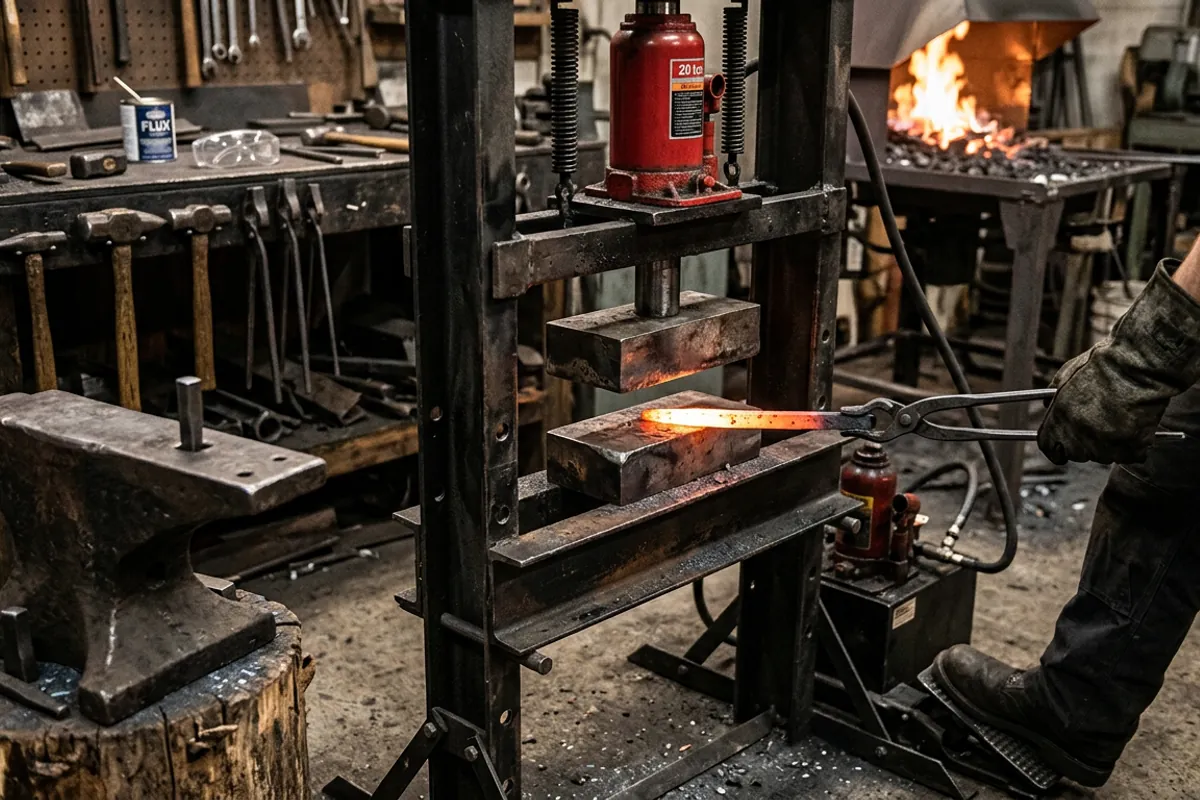
A serviceable starting frame is a basic 20 ton H-frame press.
Check price on Amazon (paid link)
Two honest cautions before you buy a frame to convert. First, the cheap import frames are built for occasional pressing, not the constant full-tonnage cycling of forging, so smiths who push them hard often gusset and reinforce the frame before trusting it. Second, a 20 ton shop-press frame paired with a real forging cylinder can generate more force than the frame was drawn for, which is exactly why the reinforcement matters. The frame is a starting point, not a finished forging tool. Read a couple of build threads all the way through before you cut anything.
The budget route: an air-over-hydraulic bottle jack
If the electric-pump build is out of reach, the cheapest working press is an air-over-hydraulic bottle jack driven by your shop compressor. You press a trigger, shop air drives the jack, and the jack squeezes the steel. A 20 ton air-over jack is an inexpensive, off-the-shelf part.
Check price on Amazon (paid link)
I want to set expectations honestly, because this is the route people are most often disappointed by. The ram is genuinely slow, and it gets slower the moment it meets resistance, which is the entire time you are forging. It also drinks air. The consensus on the forums is that you want at least a 2 HP compressor pushing real volume to keep one fed, and even then you will spend heats waiting on the ram. As one long-running air-over build write-up puts it, these presses work halfway decently and might surprise you, but a proper hydraulic press will outrun them. It will forge. It will draw out good-sized stock. It will just make you patient. For an occasional billet or someone testing whether they even want a press before committing to a full build, it is a reasonable and cheap way in.
What owners say
Because I do not own one of these, here is what the people who do report, product by product, attributed so you can read the threads yourself.
On the Coal Iron Works presses, owner sentiment is strongly positive on build quality and support. In a KnifeDogs thread on Coal Iron forging presses, owners praise how quiet the machines are and the fact that the smaller ones run on household current, which matters a lot in a residential shop. The recurring gripe in that same discussion and across BladeForums buying threads is die cost, not the press itself. The other consistent piece of advice from finished-press owners is the old one: buy once, cry once, and buy more tonnage and stroke than you think you need if the budget stretches.
On the shop-press conversion, the forums are full of finished builds and the honest failure modes. Discussions like the BladeForums hydraulic press build threads come back to the same two points I raised above: import frames flex or need reinforcement at forging loads, and cylinder plus pump plus valve sizing is where beginners get it wrong. The people who plan the hydraulics carefully report presses that rival a small commercial unit for a fraction of the cost. The people who wing it report leaks and slow rams.
On the air-over jack route, owner reports are the most mixed, and that is the honest read. Threads like the I Forge Iron air-assisted bottle jack press discussion confirm both halves of the story: it works, and it is slow and air-hungry. Nobody who has moved up to an electric-pump press seems to miss it, but plenty of smiths started there and got real work done.
Safety, because a press does not warn you
I got careless with hot oil early on and it took my eyebrows and nearly my eyesight, so I do not soften this part. A hydraulic press is a crushing machine that generates tons of force silently and does not care what is between the dies. Treat it accordingly.
Keep your hands and everything else out of the die gap. This sounds obvious until the ram is moving and you reach in to reseat a shifting billet. Foot-pedal control exists so both hands can hold tongs and stay clear, not so you can free a hand to fiddle in the danger zone. Set the work, then press.
Eye protection is not optional. Hot scale and the occasional bit of die or billet can leave the press with force. Wear ANSI Z87.1 rated eye protection every time, and stay in natural fibers near the forge and quench, not synthetics that melt to skin. The full rundown is in my blacksmith safety gear guide, and it applies double at a press.
Respect the hydraulics themselves. High-pressure fluid escaping from a failed hose or fitting can inject through skin, which is a genuine medical emergency, not a scrape. On the build routes especially, use hose and fittings rated for your working pressure, and never chase a suspected leak with a bare hand along a pressurized line. And do not overload a frame. A 20 ton shop press converted to forging can be pushed past what the frame was drawn for, which is the whole reason experienced builders gusset them first.
What I would tell a friend
If you have the budget and a real, ongoing use for a press, buy a finished one. A Coal Iron Works or Riverside H-frame in the 12 to 16 ton range runs on house power, saves you the engineering, and comes with support when something leaks. Buy the tonnage and stroke you will grow into, and budget for dies on top of the sticker.
If you are handy and want a real machine cheap, build an H-frame from a 20 ton shop press with a proper cylinder, electric pump, and foot pedal, and reinforce the frame before you trust it. That is the sweet spot for most home shops, and the belt grinder for knives you will want for cleanup afterward is the next tool on the list anyway.
The air-over jack is the one to build only if money is genuinely tight and you already own a strong compressor. It will forge, slowly, and it will tell you whether a press belongs in your shop before you commit to a full build. For more shop-tool breakdowns like this one, the rest of my more from the shop guides go deeper on the machines that surround a press, and the Anyang power hammer guide is worth a read if you find yourself wanting blows instead of squeezes. Whichever way you go, keep your hands out of the gap and your glasses on your face.