I have verified ASINs and specs. Writing the article now.
Most knife makers ask me the same question within their first month at the anvil: what belt grinder for knives should I buy, and can I get away with something cheap to start. The honest answer is that the grinder is where a knife actually gets made. You can forge a blade to shape on Bessie, but the bevels, the flats, the plunge lines, and most of the finish work all happen on abrasive belts. So this is the one tool where buying too small costs you twice, because you buy the small one, fight it, and then buy the real one anyway. Below are the machines I would point a beginner at, from a bench-top starter to a real 2x72, with an honest read on where each one stops being enough.
Before we go further, one thing I say every time: I do not own most of these specific models, and I will not pretend I have run each one down in my own shop. What follows leans on published specs, the way abrasive belts and motors behave in general use, and what owners report on the knife forums, weighed against twenty-five years of shop experience. Where the signal is thin, I will say so.
How I would spend the money, the short version
If you have the budget and the space, skip the small machines and buy a 2x72. That is not me being a gear snob. A 2x72 belt is the standard in knife making for a reason: the long belt runs cooler, tracks better, removes stock faster, and gives you a huge selection of belts in every grit and material. Everything you learn on it transfers to the next one you buy or build.
If the budget or the outlet will not allow a 2x72 yet, a variable-speed 1x30 is a genuine starting point for small blades and sharpening, and a 4x36 combo belt-and-disc sander is a workhorse for flats and handle work. Both are compromises, and both owners on the forums outgrow. But they let you make knives now instead of saving for a year. Just go in knowing they are step one, not the destination. For the deeper argument on why the 2x72 is the format worth building a shop around, I wrote a whole piece on the 2x72 belt grinder for knife making I would actually start with, and a companion belt grinder buying guide that goes model by model.
The specs that actually matter
Belt size is the headline, but it is not the only thing. Here is what I look at before anything else.
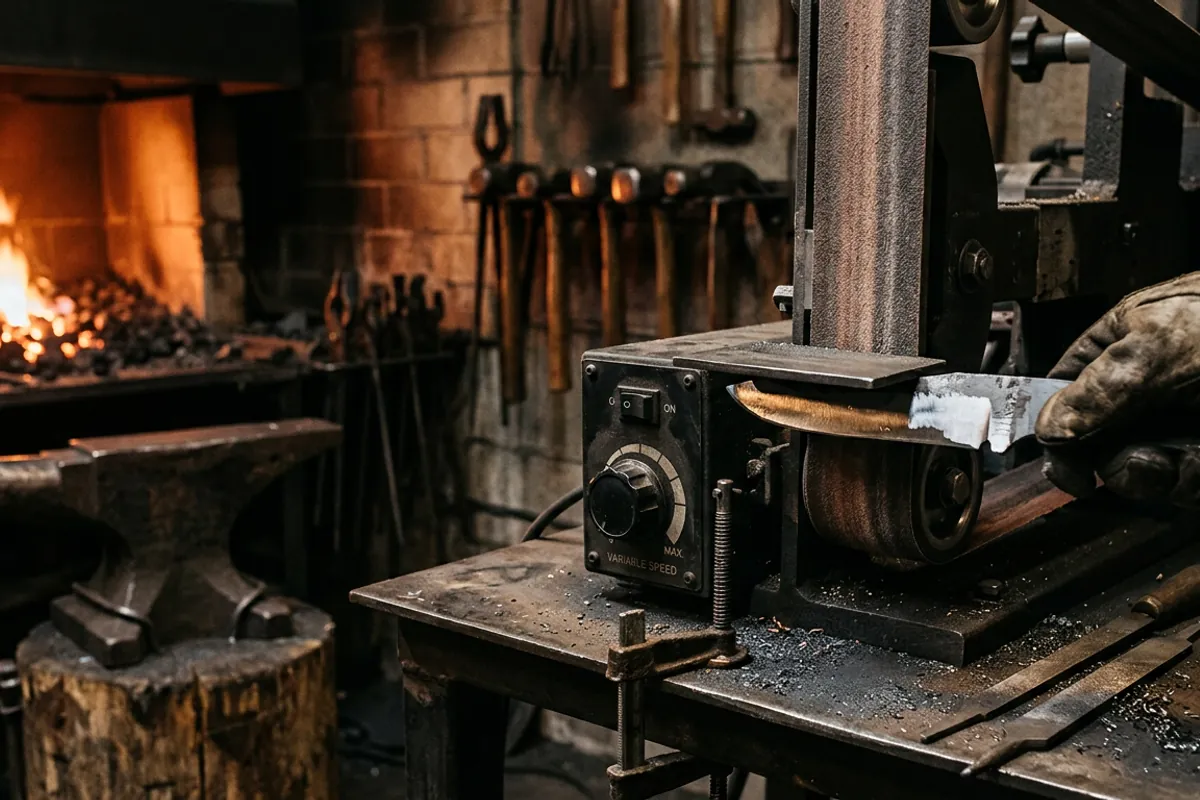
Belt length. Longer belt means the abrasive and the heat get spread over more surface, so the belt lasts longer and the steel runs cooler. A 1x30 belt gets hot and loads up fast. A 72 inch belt is a different world.
Variable speed. This is the spec I would not skip on anything meant for knives. Fast for hogging steel, slow for the finish grits and for anything with a temper you do not want to ruin. A single-speed grinder run too fast will blue your edge and undo your heat treat before you feel it. If you want a refresher on why that matters, see what tempering actually does.
Motor. More power holds speed under pressure. A weak motor bogs the moment you lean into it, which is where owners of the smallest machines complain the loudest.
Flat platen. For flat bevels you want a rigid platen behind the belt. The bench sanders in this guide have small work areas; the 2x72 machines are built around a real platen.
Here is the field at a glance. Only the WEN figure below comes from a manufacturer spec sheet; the others are the numbers stated on the product listings, so treat them as listed, not lab-verified.
Scroll horizontally to see all columns.
| Grinder | Belt size | Motor | Speed | Base | Price tier |
|---|---|---|---|---|---|
| VEVOR 1x30 variable speed | 1 x 30 in | 550 W (listed) | Variable, VFD | Bench top | Budget |
| WEN 6502T | 4 x 36 in plus 6 in disc | 4.3 A, 1/2 HP | Up to 3600 RPM | Cast iron | Budget |
| HayWHNKN 2x72 | 2 x 72 in | 1500 W (listed) | Variable, VFD | Steel frame | Mid |
| INTBUYING 2x72 | 2 x 72 in | 2 HP (listed) | Variable | Steel frame | Mid |
The WEN 6502T specs, motor rating, belt and disc size, and speed, are published on the maker's own product page. I could not find a comparable manufacturer spec sheet for the import 2x72 machines, which is itself worth knowing before you buy.
VEVOR 1x30 variable speed, the honest budget entry
A variable-speed 1x30 is the smallest machine I would tell a knife maker to buy. The belt is short and it will run hot, but the variable speed is the thing that makes it usable, because you can drop the speed for finish work and for anything near a hardened edge. For small EDC blades, kitchen paring knives, and putting an edge on things, it will get you making knives.
The VEVOR unit is a common example of this class: a stepless variable-speed drive, a small motor in the 550 watt range as listed, and a few starter belts in the box. It is not going to hog through a thick bar of stock, and if you lean on it the motor will tell you. But for light blades and sharpening it does the job, and it costs a fraction of a real grinder.
Check price on Amazon (paid link)
Tradeoffs, plainly: short belts load and heat fast, belt selection in 1x30 is limited compared to 2x72, and the small work surface makes long flat bevels a fight. This is a machine you will outgrow if you keep making knives, and most owners do. Buy it to start, not to keep.
WEN 6502T 4x36 belt and disc, the crossover shop sander
The 4x36 combination belt-and-disc sander is not a purpose-built knife grinder, but it earns its place in a lot of beginner shops because it does double duty. The wider 4 inch belt is friendlier for flats and for handle-scale work than a narrow belt, and the 6 inch disc is genuinely handy for squaring up tang shoulders and flattening small parts.
WEN publishes real numbers on this one: a 4.3 amp, half-horse motor, a 4 by 36 inch belt running up to 3600 RPM, a 6 inch disc, and a heavy cast-iron base that keeps the vibration down. That cast-iron base matters more than people expect; a light, buzzy sander is miserable to control on a blade.
Check price on Amazon (paid link)
The honest limits: it is single speed, so you have to manage heat with a light touch and frequent quenches in water, and there is no rigid platen setup for crisp plunge lines the way a knife grinder gives you. Think of it as a general shop sander that also happens to help with knives, not as a dedicated blade grinder. If a belt-and-disc sander is the direction you are leaning, I go deeper on the format in the belt sander for knife making guide.
HayWHNKN 2x72 with VFD, the first real knife grinder
This is where a knife maker stops fighting the tool. A 2x72 with a variable frequency drive is the format the whole hobby is built around. The long belt runs cool, tracks well once you set it, and hogs stock fast when you want it to and creeps for finish work when you slow it down. Every belt grit and material you could want gets made in 2x72, which by itself is a reason to standardize on it.
The HayWHNKN unit is one of the import 2x72 machines that show up on the marketplace with a VFD already fitted, a motor listed around 1500 watts, and a set of contact and platen wheels. On paper that is a lot of grinder for the money. I have not run this specific machine, and I want to be clear about that, but a working 2x72 with variable speed is a genuine step up in capability from anything with a shorter belt.
Check price on Amazon (paid link)
One caution with the import 2x72 machines: check the voltage before you buy. Several of these ship as 220 volt units, which means you need the right outlet in your shop. Build cost and belt selection aside, that outlet is the practical thing that trips people up. If you are weighing a bench sander against stepping straight to a 2x72, my knife makers belt sander writeup lays out that decision.
INTBUYING 2x72 variable speed, the other budget 2x72
The INTBUYING 2x72 is another import machine in the same family: a variable-speed 2 horsepower unit as listed, built around the standard 2x72 belt and wheel arrangement, with a base for bench mounting. It exists in the same conversation as the HayWHNKN and trades on the same pitch, which is a lot of belt for not a lot of money compared to the boutique American builders.
Check price on Amazon (paid link)
I would treat both import 2x72s the same way: they are the affordable door into the right format, and owners generally accept some fit-and-finish and tracking fussiness as the price of the low cost. If you have the tools and the patience, a lot of serious makers skip the import machines entirely and build their own 2x72 from a motor, a VFD, and a weldment, which gets you a heavier, more rigid grinder for similar money. That is a real path and worth researching before you spend.
What owners say
For the machines I have not run down myself, here is what the knife forums actually report, so you are not taking my word for it.
On the small grinders, the consensus is consistent and a little brutal. In a BladeForums thread comparing a variable-speed 1x30 against a single-speed 2x42, makers describe the 1x30 as okay for small EDCs with good ceramic belts, but underpowered, with several noting the motor whines and bogs under real stock removal. The recurring theme is that an inadequate grinder buys you frustration and wasted belts more than finished knives.
On stepping up, a KnifeDogs thread on the 1x30 or 2x42 question for beginners lands where most of these threads land: the small machine will make knives, but nearly everyone who keeps at the hobby ends up wanting more belt, more power, and variable speed. A common progression owners describe is starting on a 1x30, jumping to a wider or longer belt, and finding each step is a large improvement over the last, with the 2x72 as the machine they wish they had bought first.
On the import 2x72 machines specifically, owner signal is thinner and more mixed than on the established American builders, which is exactly why I am not going to dress up a few listings as a verdict. The praise is about value; the complaints are about tracking, wheel quality, and instructions. If you buy one, buy it expecting to fettle it. That honesty is the whole point of this section.
Safety at the grinder
I do not soften this part, and there is a reason. A belt grinder throws a constant stream of hot steel particles and abrasive grit straight off the belt, and it does it fast. Eye protection rated to ANSI Z87.1 is not optional at the grinder. Wear it every time, even for a ten second touch-up. I keep mine on a hook right at the machine so there is no excuse.
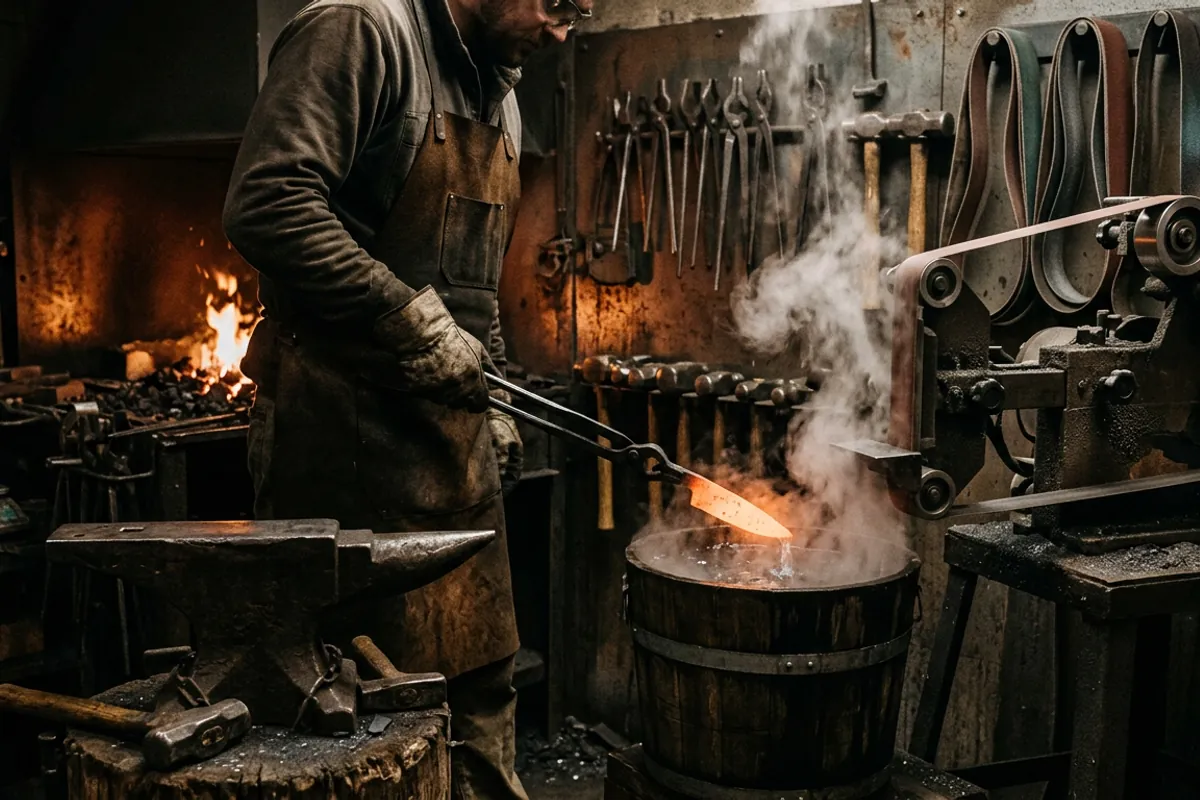
Beyond eyes, a few things I will not skip. A respirator or at least a good dust mask, because grinding steel and abrasive throws a fine dust you do not want in your lungs, and grinding certain handle materials and coatings is genuinely nasty to breathe. No gloves on a running belt grinder; a glove that catches the belt drags your hand in, where a bare hand would just get pushed clear. Tie back anything loose, sleeves, strings, hair, for the same reason. And keep a container of water at the grinder to dunk the blade often, both to protect your hands and to keep from overheating a hardened edge and ruining the temper you worked to put in. For the full rundown of what matters and what is marketing, see my blacksmith safety gear guide.
That temper point is worth repeating for knives specifically. On a single-speed machine run fast, you can draw the heat out of a thin edge and soften it without ever seeing a color change, because the steel is moving under the belt too fast to watch. Slow the belt down, keep the edge cool, and quench often. This is the single most common way a beginner ruins a good heat treat at the grinder.
What I would tell a friend
If you have the money and a place to put it, buy a 2x72 and do not look back. It is the right format, the belts are everywhere, and everything you learn on it carries forward. Between the two import 2x72s here they are close cousins; check the voltage, budget for a little setup fuss, and know that a home-built 2x72 is a real alternative if you can weld.
If a 2x72 is not happening yet, a variable-speed 1x30 will make small knives today, and a 4x36 belt-and-disc sander like the WEN will pull double duty for flats and handles. Both are step one. The mistake I see most is a beginner buying the cheapest single-speed machine, cooking an edge or two, and giving up thinking it was them. It was the tool.
Whatever you buy, put the eye protection on first and keep the water bucket close. And if you are still deciding what steel to feed the thing, the steel selector tool and the broader knife making hub are the next stops. For the whole arc from bar stock to a finished edge, knife making explained walks the beginner path.