The honest verdict first: for belt grinder knife making, the machine I would put in a shop is a 2 x 72 with variable speed, and if the money will not stretch that far, I would still rather see you buy a fixed speed 2 x 72 than a 1 x 30 you will outgrow before your third knife. Belt length is not vanity. It is heat, belt life, and how flat your bevels come out.
I need to be straight about what this guide is. I have been forging for about twenty five years, most of it on the anvil rather than the grinder, and I have not run every machine below down in my own shop. So this is published specs from the makers, plus what owners actually report on the knife forums, weighed against general shop experience with abrasives and motors. Where I am repeating owner consensus rather than speaking from my own bench, I say so.
What a grinder actually has to do for knife work
A knife grinder does four jobs: profile the blank, set the bevels, clean up after heat treat, and finish the handle. Three of those are stock removal on steel, and stock removal on steel is a heat problem more than a power problem.
That is the whole argument for a long belt. A 2 x 72 belt puts six feet of abrasive between the workpiece and the same grain coming back around, so the belt sheds heat and the blade stays cooler. A 1 x 30 gives you thirty inches. The grain hits the same spot again roughly two and a half times as often, the belt loads up faster, and the blade gets hot faster. Hot blades are not a comfort issue. A thin edge that goes blue after heat treat has lost its temper locally, and no amount of polishing puts that back. If you want the underlying metallurgy rather than shop lore, Knife Steel Nerds is where I send people, and our own writeup on tempering of metal covers why that blue edge matters.
The second thing a grinder has to do is run slower than you think. Full speed is fine for hogging a profile out of bar stock. It is the wrong tool for walking a bevel up to a crisp plunge line, and every hour of grinding you do at one fixed high speed is an hour where a half second of inattention eats a knife you spent a week on.
Third, it has to hold a flat platen square and hold it still. Wobble in the tracking is wobble in your bevel.
Everything below gets judged on those three things.
The picks at a glance
Published specs only. Where a maker does not publish a figure, it says so.
Scroll horizontally to see all columns.
| Machine | Belt size | Motor | Belt speed | Variable speed | Price tier |
|---|---|---|---|---|---|
| WEN 6515T belt and disc sander | 1 x 30 in, 5 in disc | 2.3 amp | up to 3160 FPM belt, 3450 RPM disc (WEN) | No | Budget |
| WEN 6502T belt and disc sander | 4 x 36 in, 6 in disc | 4.3 amp, 1/2 HP | up to 3600 RPM (WEN) | No | Budget |
| Kalamazoo 1SM | 1 x 42 in | 1/3 HP, single phase, 115V | 1800 SFPM (Kalamazoo) | No | Mid |
| Grizzly G1015 | 2 x 72 to 76 in | 1 HP single phase, 110V, 1725 RPM | 3600 FPM | No | Mid |
| VEVOR / Happybuy 2 x 82 chassis | 2 x 82 in | 2 HP, 1500 W | motor to 2800 RPM (VEVOR) | Yes, VFD | Mid |
| Reeder 2 x 72 | 2 x 72 in | 1, 2, or 3 HP, 3600 RPM, 56C face (Reeder) | Yes, KBAC drive | Premium |
The Grizzly figures are as published on retailer spec sheets for the G1015: 1 HP single phase at 1725 RPM, 3600 FPM belt speed, 8 inch buffing wheel, 105 lb machine weight. Grizzly's own product page would not load for me when I went to check it, so treat those as retailer published rather than pulled off the maker's site this session.
The 1 x 30 bench sander, and why it stalls
The WEN 6515T is the shape of machine most people actually start with: a 1 x 30 belt with a 5 inch disc, a 2.3 amp motor, belt speed up to 3160 FPM per WEN's published spec. It costs less than a decent pair of tongs and it will absolutely put a bevel on a knife.
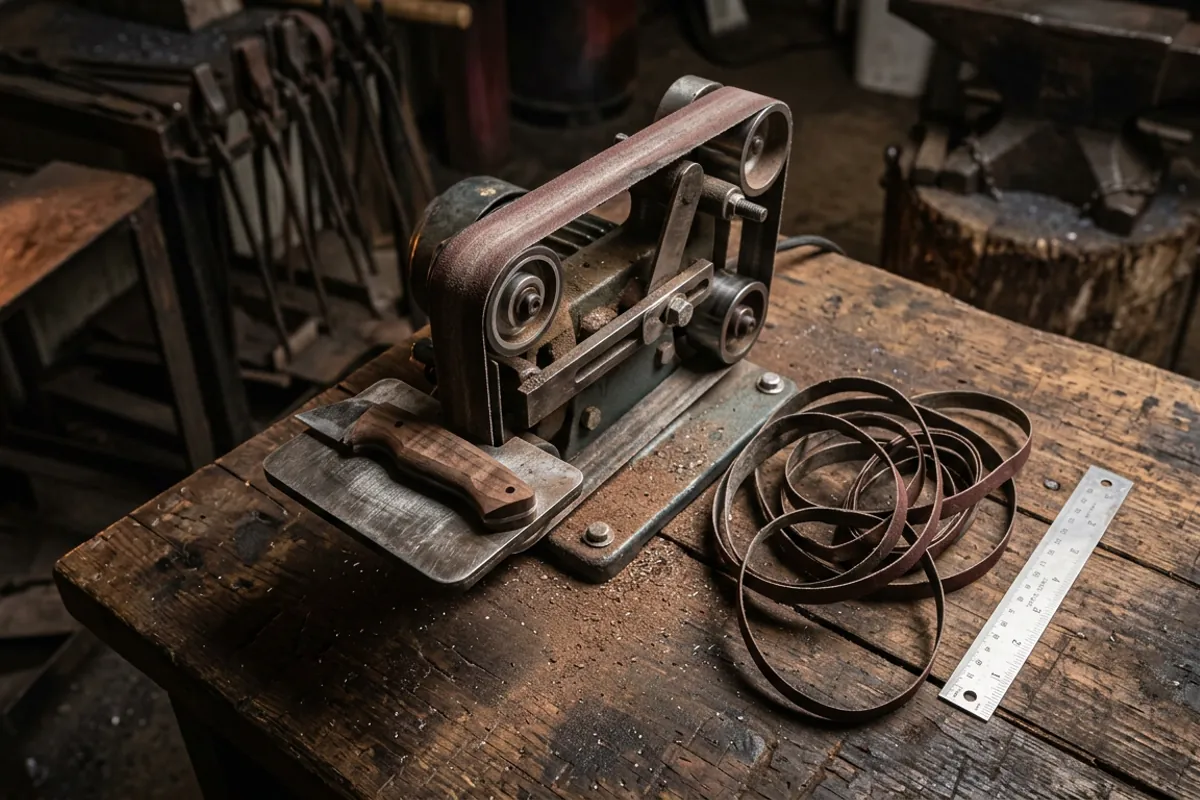
What it will not do is stay comfortable once you are past the first few blades. The belts are short, so they load and die quickly, and short belts in useful ceramic grits are a smaller market than 2 x 72, so your consumable cost per pound of steel removed is worse than the machine price suggests. The platen area is small. The tool rest on machines in this class is light stamped stuff, and holding a blade square against it while you fight belt tracking is the part that turns people off grinding entirely.
Where it earns its keep is as a second machine forever after. Handle shaping, small radii, cleaning up a bolster, touching up a punch or a drift. Nothing wrong with owning one. Just do not buy it as your knife grinder and then blame yourself for the bevels.
Check price on Amazon (paid link)
If you want more platen and more disc for roughly the same money, the 4 x 36 version, the WEN 6502T, has a 4.3 amp motor and a cast iron base. It is a woodworking sander with a big flat belt. It is fine for flattening scales and squaring a tang, poor for bevels, because a 4 inch wide belt gives you no way to work a plunge.
The Kalamazoo 1SM, the small sander that is actually built
The 1SM is a 1 x 42 industrial sander made in Kalamazoo, Michigan, with a 1/3 HP single phase 115V motor, 1800 SFPM belt speed, an all steel frame with sealed ball bearings, and a platen work area of 1-7/8 inches wide by 5-7/8 inches high, per Kalamazoo's published spec sheet. Shipping weight is 35 lb.
Read that belt speed again: 1800 SFPM, roughly half what the cheap 1 x 30 runs and half what the Grizzly runs. That is a genuinely useful number for knife work, because it is slow enough to control. What you give up is horsepower. A third of a horse will bog if you lean on it, so the 1SM is a finishing and small work machine, not a hogging machine.
Still a fixed speed machine, still a short belt. But it is a real tool with real bearings that will be worth money in twenty years, which is not something I would say about the disposable end of the bench sander market.
Check price on Amazon (paid link)
The Grizzly G1015, a real 2 x 72 for less money
This is the machine that has trained more knifemakers than any other budget grinder in America, and it has been on the market so long that the forum record on it is deep. It runs a 2 x 72 to 76 inch belt off a 1 HP single phase motor at 1725 RPM, 3600 FPM at the belt, with an 8 inch buffing wheel on the other arbor, and the whole thing weighs about 105 lb.
The good part is real: long belts, plenty of belt selection, and enough power to profile a blade without babysitting it. The bad part is also real and it is the same two complaints every time. It runs at one speed and that speed is fast, and the tracking on the stock machine gets described in unkind terms. Owners fix the second one with an aftermarket work rest, which tells you what the factory rest is like.
If you find one used at a fair price, it is a lot of grinder for the money. New, you are close enough to a VFD machine that I would think hard.
Check price on Amazon (paid link)
The 2 x 82 VFD chassis, variable speed on a hobby budget
The VEVOR and Happybuy 2 x 82 grinders, which are the same machine under two names, are the cheapest way I know of to get a variable speed belt grinder onto a bench. VEVOR publishes 2 HP, 1500 W, a motor turning up to 2800 RPM, and a frequency converter that takes single phase in and drives the motor as three phase, which is how you get the speed control. It ships as a chassis with a flat platen, contact wheel, and small wheel setup for different grinding shapes.
That variable speed is the whole reason to look at it. Being able to drop the belt down slow for the plunge lines and bring it up for hogging is, by the near unanimous view on the knife forums, the single thing that improves a beginner's grinds fastest.
The honest tradeoff is 82 inches. It is not a standard American knifemaking belt length, so your belt selection is narrower and often pricier per belt than the enormous 2 x 72 market. Some owners run 72 inch belts on these by adjusting the tracking arm, and the maker's other listing is explicitly described as compatible with 72 to 82 inch belts, but check the specific model before you count on it. Build quality on this tier of import machine is what it is: expect to check wheel runout, bearing quality, and squareness of the platen when it arrives, and to shim or true things yourself.
Check price on Amazon (paid link)
The buy once tier, and when it is the cheaper option
If you already know you are staying with knives, the US built 2 x 72 grinders are the end of the road: Reeder, KMG from Beaumont, TW-90, Ameribrade, Brodbeck, and the kit builds from the knifemaking suppliers. Reeder publishes motor options of 1, 2, or 3 horsepower at 3600 RPM on a 56C face mount, driven by a KBAC variable speed drive, and the frames take interchangeable tooling arms so one machine becomes a flat platen, a contact wheel, a small wheel attachment, or a rotary platen.
That last part is the real argument. You are not buying a sander, you are buying a platform, and a decade later it is still the current machine because you bolt on what you need. These are not Amazon purchases and I am not going to link one. You order from the builder, you wait a few weeks, and you pay accordingly.
The math that catches people: a 1 x 30, then a Grizzly, then a real grinder costs more than the real grinder did. If you are sure about this hobby, skip the middle.
Belts do more work than the machine does
I would rather see a beginner on a mediocre grinder with fresh ceramic belts than on a nice grinder with tired aluminum oxide. Cheap hardware store belts are aluminum oxide, they dull in minutes on hardened steel, and a dull belt is exactly how you cook an edge.
For steel, buy ceramic in the coarse grits. Ceramic grain fractures as it wears and keeps exposing fresh cutting edges, which is why it lasts and why it runs cooler. A 6 pack of 2 x 72 in 36 or 40 grit ceramic is the workhorse consumable in a knife shop.
Check price on Amazon (paid link)
For the finishing side, an assortment pack gets you through the grit progression without ordering six times.
Check price on Amazon (paid link)
Grit progression advice from me is simple: do not skip grits, and change belts sooner than feels frugal. A belt you are pressing harder on to compensate is a belt costing you a knife.
Safety at the grinder, which is not optional
I have the story that makes me tedious about this. Early on I quenched a blade in oil that was too cold, standing too close in a cotton shirt with no face shield. The oil flared and took my eyebrows, and I kept my eyesight by luck rather than judgment. Nothing about a grinder is gentler than that.
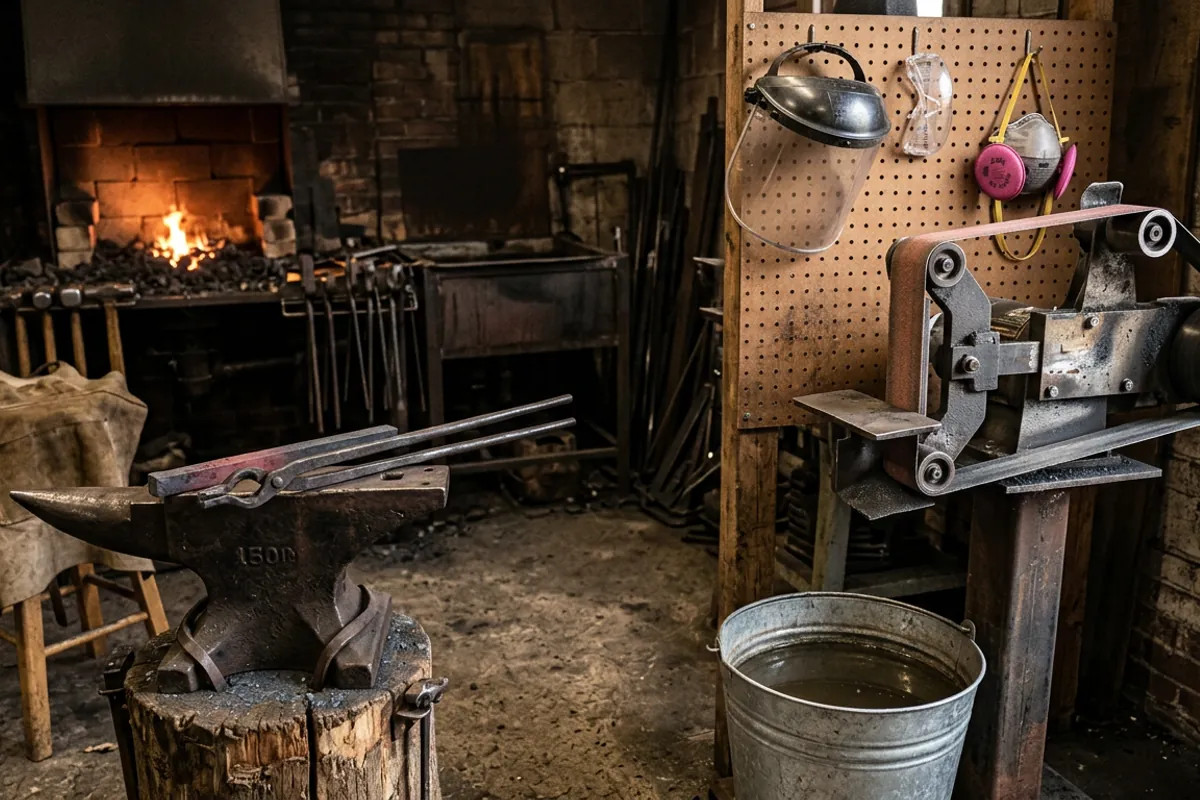
- Eye protection rated ANSI Z87.1, every time, plus a face shield over it for heavy stock removal. Belts break. When a belt lets go it comes apart at speed and it goes wherever it wants.
- Respiratory protection. Grinding steel makes a fine metallic dust, and grinding handle material makes its own. A NIOSH approved N95 is the floor, a P100 is better, and neither works over a beard. This is the hazard beginners ignore longest because it does not hurt today.
- No gloves on the contact wheel, and no loose sleeves. A glove that catches takes your hand into the wheel with it. Natural fibers near heat, never synthetics, which melt onto skin instead of burning away.
- Dust and sparks in the same collector is a fire. Steel sparks landing in a shop vac full of wood dust is a documented way to burn a shop down. Keep metal grinding debris away from combustible dust, and empty the collector.
- Keep water at the machine and dunk often. If the blade is too hot to hold bare handed, it is too hot for the edge you just ground.
- Titanium and magnesium burn. If you get into exotic handle hardware, know what you are grinding before you grind it.
Our fuller writeup on blacksmith safety gear covers what is worth buying and what is theater.
What owners say
For the machines I have not run down myself, here is what the forum record actually shows.
On the Grizzly G1015, the BladeForums thread Do you guys recommend the Grizzly G1015? is representative: one long term owner calls it a workhorse but says it runs about twice the speed of light, and the rest of the thread pushes newcomers toward a variable speed machine instead, naming KMG and Reeder builds as the upgrade path. The G1015 upgrade thread on the same forum is owners adding an aftermarket work rest to tame the stock setup, which tells you the factory rest and tracking are the weak points. That is consistent across the getting started discussions too.
On variable speed generally, the KnifeDogs threads say it plainly. In Looking for Grinder Recommendations and Budget belt grinder, experienced makers describe fixed high speed as the biggest obstacle to precise work, on the grounds that hours of careful work can be undone in a split second at full belt speed. When several unrelated makers give the same reason rather than the same conclusion, I take it seriously.
On the VEVOR and Happybuy 2 x 82 machines, the owner signal is thinner than I would like. They come up in the KnifeDogs budget threads as the bottom end of the range where a machine counts as a real grinder at all, but I did not find the depth of long term ownership reporting that exists for the Grizzly. Treat the reports as early rather than settled, and assume you may be doing some fettling.
I found no owner discussion worth reporting on the 1 x 30 bench sanders in a knifemaking context beyond the obvious, which is that people buy them, make a few knives, and want something longer.
What I would tell a friend
Buy the longest belt and the slowest available speed you can afford, in that order. If your budget is real money, a US built 2 x 72 with a VFD is the last grinder you will buy. If it is not, the 2 x 82 VFD chassis gets you variable speed today and you can live with the belt sourcing. If you find a used Grizzly G1015 cheap, take it and put an aftermarket work rest on it before you complain about the tracking. Buy the 1 x 30 only as a small parts machine, not as your knife grinder.
Spend the difference on ceramic belts. And if you are still deciding whether the knife side of this hobby is for you, the cheapest honest test is a forged blade with hand files and a bit of grinding, which is exactly what the railroad spike knife is good for. Once you know what you want the steel to do, the steel selector will point you at a stock to buy, the rest of the knife making hub covers heat treat and finishing, and the short list of tools that actually matter will keep you from filling the shop with things you do not use.
The grinder is the most dangerous machine most home shops own, and the one people wear the least gear at. Z87.1 glasses, a face shield, a real respirator, no gloves at the wheel. Every knife, every time.