I have everything verified. Writing the article now.
Here is the article:
If you want one honest answer about a power hammer for knife making, here it is: most knife smiths are best served by a small self-contained pneumatic in the 25 kg, which is 55 lb, ram class, something like an Anyang ST 25 kg or a Big Blu Mini, and a good number of folks would be better off building a tire hammer than buying anything at all. Before you read another word, let me be clear about what this guide is and is not. I hand forge on Bessie, my 148 lb Trenton, with a coal forge and a propane forge, and I do not own a power hammer. I have run club hammers at hammer-ins and watched a lot of blades come off other people's machines, so what follows is published specs and owner consensus from the forums weighed against shop experience, not a bench test I ran in my own shop. Where I am repeating what owners report rather than what I have felt through my own arm, I will say so plainly.
Start here: do you actually need a power hammer for knife making?
A power hammer moves metal. That is the whole job. It draws out bevels, spreads tangs, and squeezes billets, and it does in one afternoon what your shoulder does in a week. For a production knife maker or anyone forging pattern-welded steel, it stops being a luxury and becomes the difference between a tired hobby and a going concern.
For a beginner, it is almost never the first thing to buy. You learn to move steel by moving steel, and a machine that hits 250 times a minute will teach you your mistakes 250 times a minute too. On the I Forge Iron knife forum, the recurring advice when someone asks about power tools for knife making is to spend the first year learning hammer control by hand, then add a machine once you know what you are asking it to do. I agree with that. If you are still sorting out your first anvil and forge, put your money into a solid knife forging anvil and a 2x72 belt grinder first. The grinder will change your knives more than a hammer will, and it costs a lot less.
The honest test is simple: are your hands sore and your production capped by drawing out steel, not by grinding or heat treat? If yes, a power hammer earns its floor space. If no, it is a very heavy way to skip a lesson you still need.
The short list, and how the numbers compare
For knife work you do not need a big hammer. Knife stock is thin, and a smaller ram cycles faster and gives you more control over a bevel. A 55 lb ram is plenty for anything up to a big chopper, and plenty of makers do fine on 33 lb to 40 lb. The temptation is always to size up "so I never outgrow it," and then you own a machine that needs a deeper foundation, three-phase power, and a forklift to place. Buy the hammer for the knives you make, not the sculpture you imagine.
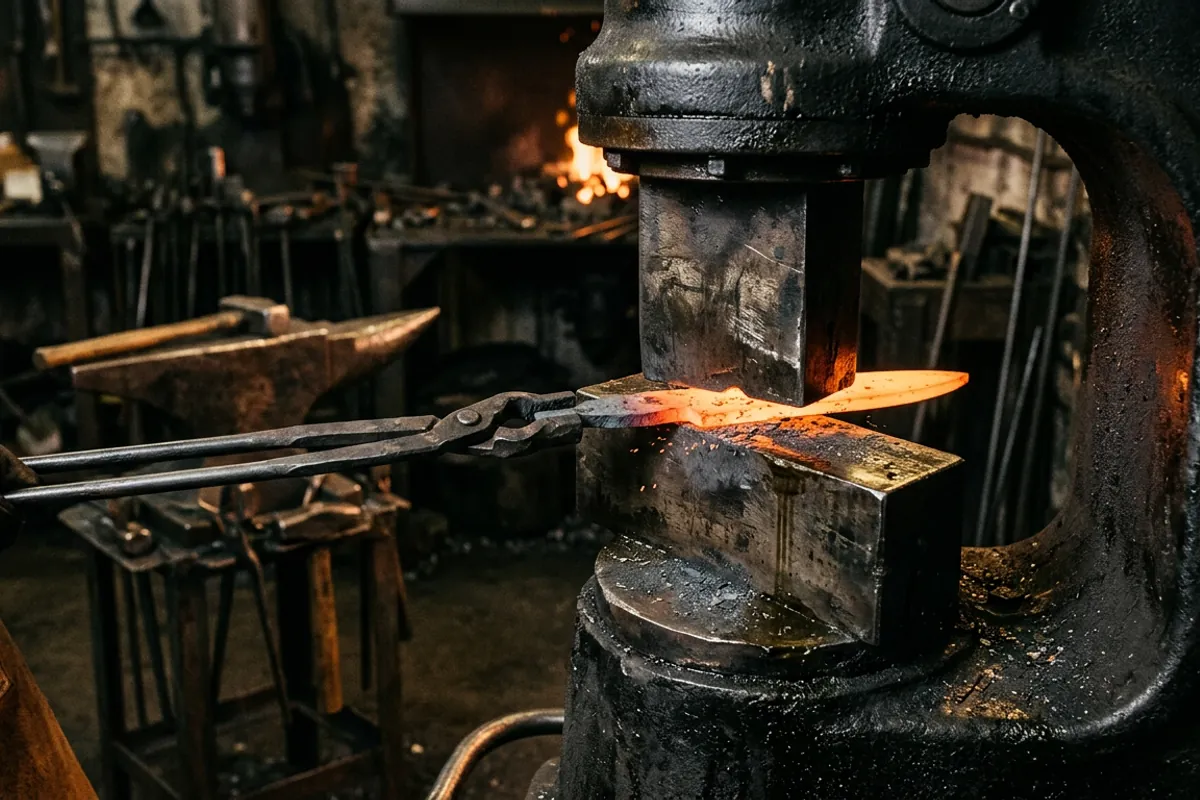
Here are the published specs on three real machines, plus the tire hammer for reference. Every number here comes from the maker or a non-marketplace retailer page, cited below.
Scroll horizontally to see all columns.
| Hammer | Ram weight | Blows per minute | Max stock | Machine weight | Price (published) |
|---|---|---|---|---|---|
| Big Blu Mini | 41 lb | 160 to 220 | half-size dies | about 160 lb | about 5,299 USD |
| Anyang ST 25 kg | 55 lb (25 kg) | 250 | 40 mm square, 48 mm round | 2,420 lb (1,100 kg) | about 9,950 USD |
| Anyang ST 55 kg | 121 lb (55 kg) | 230 | 60 mm square, 75 mm round | 3,740 lb (1,700 kg) | about 17,070 USD |
| Tire hammer (Clay Spencer plans) | about 50 lb typical | roughly 200 to 300 | small stock | varies with build | plans plus scrap and motor |
Specs from Blacksmith Source for the Anyang ST 25 kg, Blacksmith Source for the ST 55 kg, and Big Blu Hammer for the Mini. The tire hammer row is a general figure for the common home build, not a single published machine.
Anyang ST 25 kg: the knifemaker's sweet spot
If I were buying a hammer specifically to forge knives and could afford new, this is the size I would look at first. The Anyang ST 25 kg is a self-contained pneumatic, meaning the compressor is built into the machine, so there is no separate air compressor and no high-pressure hose to fight. Blacksmith Source lists it with a 55 lb ram, 250 blows per minute, a 3 kw, which is 4 hp, motor, and a maximum stock capacity of 40 mm square or 48 mm round. That capacity number is the one that matters for knives: 40 mm square is far more bar than any blade you are likely to forge, so you will never be starving this hammer with knife stock.
The tradeoffs are honest ones. It is a 1,100 kg, which is 2,420 lb, machine, so it wants a real concrete pad and it is not moving without equipment. The base model runs on three-phase power, and if you have single-phase home service you are buying the VFD option or a phase converter. And it is a China-built hammer, so the owner consensus is to check it over on delivery, chase down any loose fasteners, and get the oiling dialed in. Do that and people report they run for years. For more on this line specifically, I go deeper in the Anyang power hammer guide.
Big Blu Mini: American made and shop friendly
The Big Blu Mini is the one I would look at if floor space, power, and moving the thing are my real constraints. Big Blu publishes a 41 lb ram, 160 blows per minute under full pull with up to 220 for planishing, and it uses half-size Big Blu dies. The number that jumps out is weight: the Mini comes apart into a base of roughly 40 lb and a top section around 120 lb, so it lands near 160 lb total and can be set up by one person without a forklift. That is a genuinely different machine to live with than a 2,400 lb pneumatic.
It is a mechanical hammer, American made, and it takes the same die system as the larger Big Blu machines, so if you ever move up your tooling comes with you. The catch is price against capacity. Big Blu lists the Mini around 5,299 USD, which is real money for a 41 lb ram, and a mechanical hammer of this size does not hit with the authority of a heavier pneumatic on thick stock. For thin knife bevels and small billets, owners are happy with it. If your plan involves drawing out heavy bar, it is not the tool.
Anyang ST 55 kg: when knives are only part of the plan
Buy this one only if knives are not the whole story. The Anyang ST 55 kg is a 121 lb, which is 55 kg, ram at 230 blows per minute, a 7.5 kw, or 10 hp, motor, and a stock capacity of 60 mm square or 75 mm round per Blacksmith Source. That is a general blacksmithing hammer that happens to also forge knives, not a knife hammer. It will draw out axe stock, tooling, and thick damascus canisters that would bog a smaller machine, and it does it fast.
The reason most knife makers should skip it is the same reason it is capable: it is a 1,700 kg, which is 3,740 lb, machine that lists around 17,070 USD and needs serious foundation work and three-phase power. If you are forging blades, you are paying for headroom you will not use and fighting a foundation you did not need. Size the hammer to the work. A 55 lb ram forges knives beautifully and lives in a smaller shop.
Building one instead: the tire hammer
Here is the part the vendors will not lead with. A very large share of the power hammers in home knife shops are built, not bought. The Clay Spencer tire hammer, a mechanical design driven off a rubber tire clutch, is the most common home build, and the plans have been forged into hundreds of working machines. On the I Forge Iron home-built power hammer threads, the story repeats: commercial hammers were either too big or too expensive, so folks built their own from plans, scrap steel, and a used motor.
I will not pretend I have built one. What I can tell you from the consensus is that a tire hammer in the 50 lb ram range costs a fraction of a new pneumatic if you can weld and scrounge, that group builds at hammer-ins are common and a good way to get one made right, and that the finished machine forges knives just fine. The cost is your time and fabrication skill, plus a genuine respect for the safety of a spinning clutch and a heavy reciprocating ram. If you are handy, this is the most sensible path into powered forging for a lot of knife makers, and it is the route I would point a capable friend toward before a five-figure purchase. I lay out the build-versus-buy math further in the knife forging power hammer guide.
Power hammer or hydraulic press?
If your knives are pattern-welded, this is the real question, and it comes up on BladeForums every week. In the power hammer or press first discussions, the common split is this: a hydraulic press squeezes, so it is the better tool for setting welds and consolidating billets without the risk of a hammer bouncing a cold shut into your damascus. A power hammer draws out fast, so it is the better tool for turning a welded billet into a long blade. Makers who do a lot of pattern welding often end up wanting both, and if they can only have one first, many reach for the press for billet work.
For plain carbon or stainless knives with no welding, the press advantage mostly disappears and a hammer is the more useful single machine, because drawing out is where your time goes. I keep a fuller comparison in the hydraulic press guide. The short version: welds first means press, drawing out first means hammer.
What that "power hammer" on Amazon actually is
Search Amazon for "power hammer blacksmithing" and you will find pneumatic planishing hammers with a throat and a foot pedal, sold for metal fabrication and car body work. Read the listing and it is honest about what it is: a planishing hammer for shaping sheet, running on shop air at 50 to 100 psi. That is not a forging hammer. A planishing hammer taps thin sheet metal into shape between two dies. It does not have the mass or the stroke to draw out a hot bar of blade steel, and no amount of wishing turns one into a forging machine.
I mention it because the name collision genuinely fools beginners. If you are forging knives, a marketplace planishing hammer is the wrong tool, and there is no shortcut where a real forging power hammer shows up cheap on Amazon. The machines that draw out blades come from makers and dealers like Anyang, Big Blu, and the used market, or you build one. Spend the search time reading spec sheets and forum build threads instead.
The safety gear you set up before you touch the pedal
You will notice I am not linking you to a hammer on Amazon, because the real ones are not sold there. What is worth buying online, and what you should have staged before the machine ever runs, is the gear that keeps a power hammer from hurting you. This is where I get stubborn, and I have earned it: early on I quenched a blade in oil that was too cold, standing too close in a cotton shirt with no face shield, and the flare took my eyebrows. I kept my eyesight by luck. A power hammer adds two hazards on top of the forge: noise and flying scale.
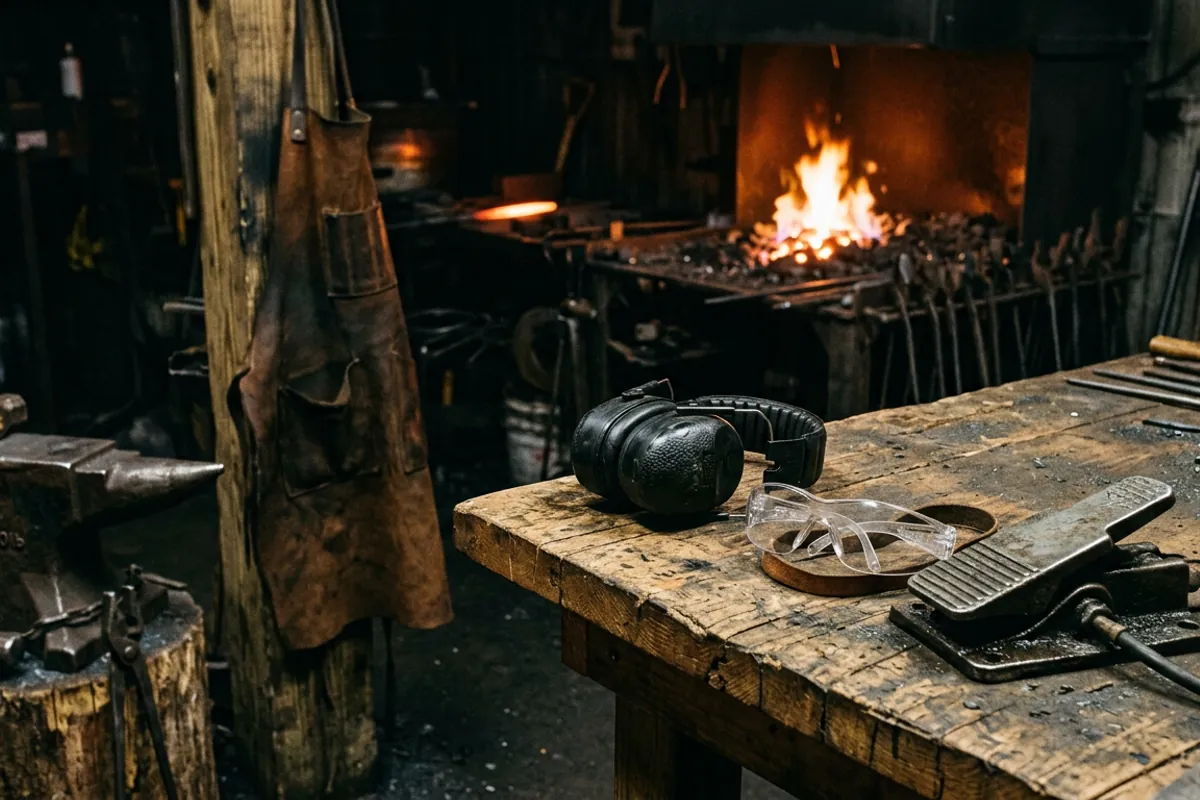
Noise first. A power hammer under load is loud, and it is repetitive loud, which is the kind that steals your hearing a little at a time without you noticing. Wear real muffs every session. I would run something like the Howard Leight Impact Sport earmuffs (paid link), rated NRR 22, which have electronic pass-through so you can still hear someone shout "stop" over the machine. Any muff with a published NRR you actually wear beats the expensive pair sitting on the bench.
Eye protection is not optional at a hammer that throws hot scale on every blow. Wear safety glasses that meet ANSI Z87.1, and wear them under a face shield if you are close to the dies. A pair like the 3M SecureFit 400 glasses (paid link) are Z87 rated and cheap enough to keep several around the shop so you never have an excuse. Add natural-fiber clothing, leather over cotton, no synthetics near heat, and closed leather boots. The full rundown is in my blacksmith safety gear guide, and none of it is negotiable around a machine that hits harder and faster than you can react.
What owners say
For gear I do not run daily, the forums are the honest signal, so here is what owners actually report. On how big of a hammer to buy at I Forge Iron, the consensus for knife and light work lands squarely in the 25 lb to 55 lb ram range, with experienced hands warning that most beginners oversize and then struggle with the foundation and the electrical service a big pneumatic demands. That matches everything I would tell a friend: the regret is almost always buying too much hammer, not too little.
On the self-contained Anyang machines, owner reports are broadly positive once the machine is set up right, with the recurring caveats being delivery inspection, keeping the oiling correct, and sorting three-phase power. On the Big Blu Mini, owners like the light weight and the shared die system and are realistic that it is a small mechanical hammer, not a heavy pneumatic. And across the home-built threads, the tire hammer keeps proving itself as the practical answer for a home shop that can weld. Where owner signal is thin is on long-term reliability of the very newest import machines, so I would weight the older, established reports more heavily than a listing's marketing.
What I would tell a friend
Buy the hammer for the knives, not the fantasy. For most knife makers, a 55 lb ram self-contained pneumatic like the Anyang ST 25 kg is more than enough, and a Big Blu Mini is the pick if weight, power, and moving the thing are your real limits. If you are handy, build a Clay Spencer tire hammer and put the savings into a better grinder and steel. Skip the big 121 lb pneumatic unless you are doing general blacksmithing on top of knives, and do not be fooled by a planishing hammer wearing the words "power hammer" on a marketplace listing.
Whichever you land on, do not run it until your ears and eyes are covered and your foundation is real, and spend a year on hand-hammer control first if you have not already. A power hammer makes a good smith faster. It does not make a beginner good. When you are ready to go deeper on the machines themselves, start with the Anyang guide and the knife forging power hammer guide, and keep the rest of the craft in view over at the knife making hub.