If you have been told a belt sander for knife making is the cheap way into the hobby, that is half true. A 1 x 30 benchtop sander will absolutely turn a piece of flat stock into a knife, and it beats a file the way a forge beats a campfire. But the machine most beginners actually want, and the one they end up buying second, is a 2 x 72 grinder with variable speed. So this guide covers both ends honestly: the small sanders worth starting on, the one category I would tell you to skip for bevels, and the real grinder to save for.
Fair warning about what this is. I am a hobby smith with about twenty five years on the anvil, and I make knives the way a blacksmith makes knives, not the way a production bladesmith does. I have not run every one of these machines down in my own shop, so the picks here lean on published specs from the makers, owner reports from the knife forums, and general grinding experience from years of standing in front of abrasives. Where a claim is secondhand, I say so.
The short version
If you want the one line answer:
- Testing the water on a tight budget: a 1 x 30 benchtop sander. The RIKON 50-151 is the one I would take over the cheapest thing on the shelf, because the tables tilt and the machine is built a bit heavier.
- Cheapest way in at all: the WEN 6515T. It is the same idea with less machine around it.
- You already know you are staying: a 2 x 72 with a variable frequency drive. The VEVOR is the budget door into that class.
- Buy for life, small footprint: the Kalamazoo 1SM 1 x 42, made in the USA and slow enough not to cook a blade.
- Skip for bevels: 4 x 36 combo sanders. Great for handle scales and flattening. Frustrating for grinding a bevel.
If you want the long version of the 2 x 72 conversation, I wrote it up separately in the belt grinder guide. This one is about the smaller machines and where they honestly stop.
What the belt sizes actually mean
Belt size is not a spec, it is a decision about how you will work.
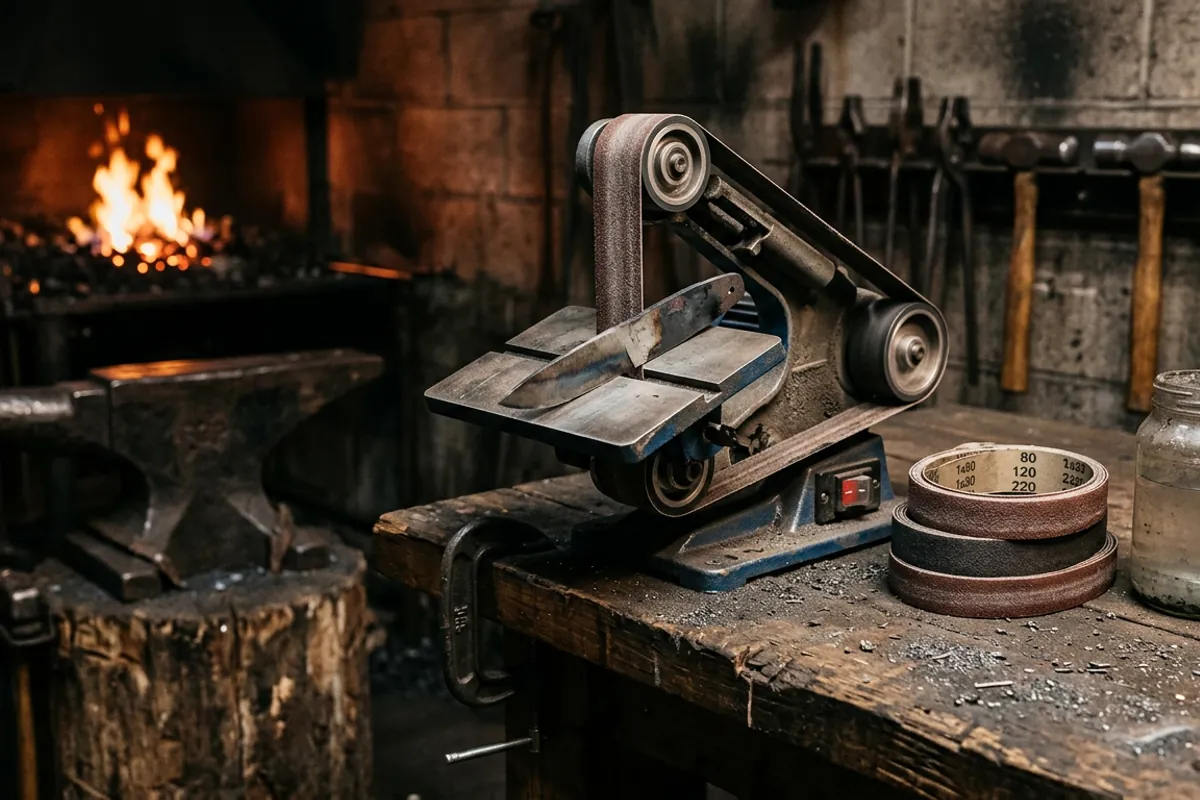
1 x 30. The entry point. Belts are cheap, common, and available in decent abrasives from the knife suppliers. The narrow belt is easy to control on a small blade and easy to dish a bevel with if you are careless. Motors in this class are around 1/3 HP, which means the belt stalls if you lean on it. You work light and you work patiently.
1 x 42. The quiet sweet spot for small shops. Same narrow control, longer belt, more heat sink, and machines in this size tend to be built like real machines instead of like sanding accessories.
2 x 42. Wider face, decent for flat grinding, but belt selection is thinner than either 1 x 30 or 2 x 72 and the machines have largely faded from the market.
4 x 36. A woodworking sander wearing a metalworking costume. The belt is wide, the platen is often not flat out of the box, and the drive is geared for stock removal on wood.
2 x 72. The standard. Every serious abrasive, every structured belt, every ceramic belt worth having is made in 2 x 72. Long belts run cooler because each square inch of abrasive gets a longer trip back to open air between cuts. This is why the whole knife world settled here.
The practical point for a beginner: belt cost and belt availability decide how good your knives look, more than motor power does.
Specs side by side
Published figures only, from the makers or from spec sheets, cited below the table. Where a maker does not publish a figure, it says so.
Scroll horizontally to see all columns.
| Machine | Belt | Motor | Published belt speed | Variable speed | Weight |
|---|---|---|---|---|---|
| WEN 6515T | 1 x 30 in | 2.3 A | up to 3,160 FPM | No | Not published |
| RIKON 50-151 | 1 x 30 in | 1/3 HP, 2.3 A | 3,270 SFPM | No | 15.5 lbs net |
| Kalamazoo 1SM | 1 x 42 in | 1/3 HP, 115V | 1,800 SFPM | No | 35 lbs shipping |
| WEN 6502T | 4 x 36 in | 4.3 A | 1,900 FPM no load | No | 41 lbs net |
| VEVOR 2 x 72 VFD | 2 x 72 in | 1500 W | see note below | Yes, VFD | 110.78 lbs |
Sources: WEN 6515T product page, RIKON model 50-151, Kalamazoo 1SM, the WEN 6502T spec sheet, and FactoryPure's listing for the VEVOR 2 x 72.
The VEVOR note: the published belt line speed is 32 m/min, which works out to about 105 feet per minute. That is slower than a hand file feels, and it does not square with a motor rated to 2,900 RPM. I read it as a bad conversion in the spec sheet rather than a real number, so I am not going to repeat it as fact. Judge that machine on the VFD and the frame, not on a printed speed.
WEN 6515T: the cheapest honest way in
This is the small benchtop combo unit, a 1 x 30 belt plus a 5 inch disc on a 2.3 amp motor, with a beveling work table and two dust ports. WEN publishes a belt speed of up to 3,160 feet per minute and a disc speed of 3,450 RPM, with a two year warranty.
Who it suits: the person who wants to find out whether they like grinding steel before spending real money. You will make knives on it. You will also spend a lot of time on hand sanding afterward, because a small sander leaves a wavier bevel than a rigid platen does, and a light motor rewards a light touch.
The honest tradeoffs: a 2.3 amp motor bogs under pressure, the platen area is small, and there is no speed control, so post heat treat work has to be done in short passes with a water dip. Do not expect a 1 x 30 to hog a thick bar down. Profile with an angle grinder or a hacksaw first, then let the sander do shaping and finishing.
Check price on Amazon (paid link)
RIKON 50-151: the 1x30 I would pick first
Same belt size, more machine. RIKON publishes 1/3 HP at 2.3 amps on 120V, a 1 x 30 belt at 3,270 SFPM, a 5 inch PSA disc at 3,450 RPM, tables that tilt 0 to 45 degrees, and a net weight of 15.5 lbs. The extra mass matters more than it sounds like it should: a light sander walks on the bench and the vibration goes straight into your bevel.
Who it suits: the beginner who suspects they will stick with this and wants the starter machine to still be useful later as a dedicated handle and finishing station once a bigger grinder arrives. That is the realistic career of every 1 x 30 in a knife shop. It gets demoted, not sold.
The honest tradeoffs: it is still a 1/3 HP light duty sander, RIKON says as much, and it is still fixed speed. The tilting tables are genuinely useful for squaring a tang shoulder or truing a scale.
Check price on Amazon (paid link)
Kalamazoo 1SM: the 1 x 42 that outlives the hobby
The Kalamazoo 1SM is a different animal from the import benchtop units. Kalamazoo publishes a 1/3 HP single phase 115V motor, a 1 x 42 belt running 1,800 SFPM, a removable steel platen with a work area of 1-7/8 in wide by 5-7/8 in high, a 3 by 3 inch table adjustable 0 to 45 degrees, sealed ball bearings, spring loaded belt tension, and a shipping weight of 35 lbs. It is made in the USA.
Look at that belt speed against the others: 1,800 SFPM is roughly half what the 1 x 30 machines run. Slower belt, less heat per pass, more control. For finish work and for anything you are grinding after heat treat, slower is a feature, not a weakness.
Who it suits: the smith who wants one small machine that will still be running in twenty years, and who does not have space or budget for a 2 x 72 today. It is a real industrial sander, priced in the mid tier rather than the bargain bin, and belts in 1 x 42 are easy to buy from the knife suppliers.
The honest tradeoffs: fixed speed, small platen, and no tooling arm ecosystem. You cannot bolt on a small wheel attachment and start grinding finger choils. It does what it does, very well, and nothing else.
Check price on Amazon (paid link)
WEN 6502T 4 x 36: right tool, wrong job
I am including this one because it is the machine beginners buy by mistake. The spec sheet lists 120V at 4.3 amps, a 4 x 36 belt at 1,900 FPM no load, a 6 inch disc at 3,600 RPM, a belt bed that tilts 0 to 90 degrees, a cast iron base, a 2-1/4 inch dust port and a net weight of 41 lbs.
None of that is bad. As a bench sander it is a lot of machine for the money, and in a knife shop it earns its keep flattening handle scales, squaring guard material, and cleaning up flats. The problem is bevels. On the knife forums the recurring complaint is that the platen on these combo sanders is not flat out of the box and takes real work to true, and that the wide belt makes it hard to feel where you are cutting. See the BladeForums thread Belt Sander/Grinder 4x36, why doesn't this work for knifemaking for that discussion in the owners' own words.
So: buy it as a shop sander if you want a shop sander. Do not buy it as your knife grinder.
Check price on Amazon (paid link)
VEVOR 2 x 72 variable speed: the real machine at the low end of the price
This is the budget door into the standard knife grinder format. Published specs, per the FactoryPure listing linked above, are a 1500 W motor rated to 2,900 RPM with a variable frequency drive for stepless speed control, a 2 x 72 belt, three grinding positions, machine dimensions of 33.46 by 11.81 by 18.5 inches, and a weight of 110.78 lbs.
Two things make this class worth the jump. First, variable speed. Being able to drop to a crawl for post heat treat work is the single biggest difference between a machine that ruins edges and one that does not. Second, belts. Once you are in 2 x 72 you can buy ceramic belts for hogging and structured abrasive belts for finishing, which is where knife grinding gets genuinely pleasant.
The honest tradeoffs: this is an import grinder, and the owner consensus on import grinders of every brand is consistent. Expect to spend an afternoon on setup, check the wheel alignment and tracking, and treat the included belts as packing material. Buy real belts from a knife supplier before you cut anything. It is not a Bader or a KMG, and nobody should tell you otherwise, but it is a working 2 x 72 for a fraction of the price of one.
Check price on Amazon (paid link)
Belts do more work than the motor
This is the part I repeat to every beginner who comes to a weekend session with a new machine and a bag of hardware store belts.
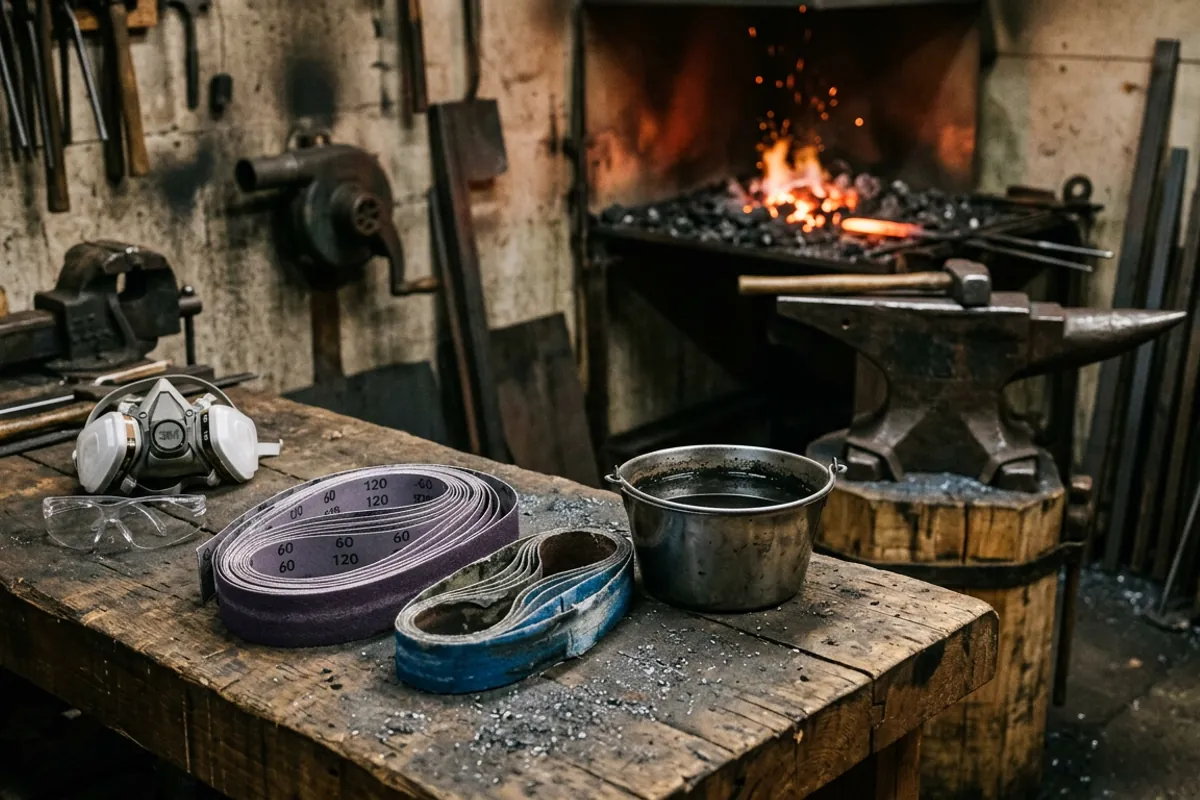
Cheap aluminum oxide belts are made for wood. On hardened steel they glaze in minutes, stop cutting, and then all they do is generate heat. Heat is what wrecks knives. Buy ceramic or zirconia belts from a knife supply house in the grits you actually use, which for most work means a coarse belt around 36 to 60 grit for shaping, something in the 120 grit range for cleanup, and a finer belt for finish. A fresh coarse belt cuts faster and cooler than a worn fine one.
The other rule: a belt that has stopped cutting is a belt that is costing you money in ruined steel. Throw it out. Belts are consumables the way charcoal is a consumable, and being stingy with them is the most expensive habit in knife making.
Heat is the enemy, especially after heat treat
Before heat treat you can be aggressive. After heat treat, every pass on a belt puts heat into the thinnest part of the blade, and the apex has almost no mass to carry it away. If that heat climbs past your tempering temperature, you have quietly undone your temper and the edge will not hold. It will not glow, it will not turn blue where you can see it, and you will not find out until the knife will not stay sharp.
The metallurgy on this is well covered by Larrin Thomas at Knife Steel Nerds in Does Sharpening with a Grinder Ruin Your Edge?, and his practical guidance is what I follow: grind slowly, use fresh and structured abrasives, keep the pressure light, and dip in water. If you want the background on what tempering is actually doing to the steel, I covered it in tempering of metal, explained from the forge floor.
This is also the argument for variable speed in one sentence. A fixed speed 1 x 30 running over 3,000 FPM gives you no way to slow down, so your only tool is a water bucket and discipline.
Grinding safety, the part nobody wants to read
I do not soften this section. I lost my eyebrows to a quench oil flare up early on because I was standing too close in a cotton shirt with no face shield, and I kept my eyesight by luck rather than judgment. Grinders hand out injuries just as freely and with less drama.
- Eye protection rated ANSI Z87.1, every time, no exceptions. Sparks and belt fragments come off a grinder at speed. Safety glasses under a face shield is the setup I use for anything spinning.
- A belt can and will grab a blade. Grind with the edge trailing, keep your fingers clear of the pinch point where the belt meets a wheel, and never reach around the back of a running machine.
- No gloves near a running belt. The forums argue about this and the machine shop rule is the one I follow: loose material near rotating machinery is how hands get pulled in. If you must protect your fingers from heat, dip the blade in water more often instead.
- Steel dust burns. It piles up under the machine, in the shop vac, in the dust bag. Do not run a grinder that shares a dust collector with wood dust, and do not let the pile sit next to the forge. Empty it into a metal can outside.
- Wear a respirator for grinding. Metal dust and abrasive grit are not things your lungs can clear. This matters more than people think, because the exposure is chronic and invisible.
- Natural fibers only. Cotton or wool, no synthetics near sparks. Synthetics melt onto skin.
More on kitting yourself out properly is in blacksmith safety gear, what matters and what to skip.
What owners say
Everything below is owner consensus from the knife forums, not my own bench test.
On whether a 1 x 30 is enough to start: the recurring answer on BladeForums is yes, with limits. Owners in threads like 1x30 Sander for Getting Started and Going to start knife making, is this belt sander sufficient describe it as slow for lack of power but far faster than files, cheap enough that it is not wasted money, and a sensible way to make a few blades and find out whether you want to commit before spending four figures on a grinder. The other consistent note in those threads: order real belts from a knife supply house, and expect hand sanding after the machine work.
On 4 x 36 combo sanders: the complaints are consistent, and they are about the platen not being flat and the machine running too fast for grinding near a heat treated edge. Owners there use them for handle work and flattening rather than bevels.
On import 2 x 72 grinders generally: the signal is thinner and more scattered than I would like, which is worth saying plainly. What comes through consistently is that the frames are usable, the setup and alignment need checking before first use, and the included belts get replaced immediately. I have not seen a durable long term reliability picture on these that I would call settled, so treat the price as buying a working platform rather than a finished tool.
What I would tell a friend
Buy the smallest machine that matches your actual commitment, not your ambition. If you are not sure knife making is going to stick, a 1 x 30 is a genuinely reasonable purchase, and I would spend the small premium on the RIKON over the cheapest option so the thing still earns bench space later. If you already know you are in, stop shopping for benchtop sanders entirely and put every dollar toward a 2 x 72 with variable speed, because you will buy one eventually and the money spent in between is money spent twice. And if you want a small machine that will still be running when your grandkids clean out the shop, the Kalamazoo 1 x 42 is the one that is built like that.
Do not buy a 4 x 36 to grind bevels. Buy it if you want a bench sander.
The one thing I would not compromise on, whichever machine you land on: eye protection rated ANSI Z87.1, a respirator, and belts fresh enough to cut instead of burn. A dull belt on a fast machine is how a good blade becomes scrap, and how a good eye becomes a hospital visit.
If you are still working out where knife making sits in a general blacksmith shop, start at the knife making hub, and if you want a first project that costs almost nothing in steel, the railroad spike knife is the classic. When you get to picking steel, the steel selector will save you a lot of guessing.