I have two verified live ASINs and solid maker/forum sources. Writing the guide now.
If you are past the file and the hacksaw and you are ready to grind real bevels, the tool that keeps coming up is the 2x72 belt grinder for knife making, and for good reason. A 2 inch by 72 inch belt gives you a long, fast-moving abrasive loop, a big platen to grind flat bevels against, and an enormous selection of belts in every grit and grain you could want. I run a coal forge and a propane forge and I do most of my knife work by hand and hammer, so let me be straight with you up front: this is not a bench test of every machine below. It is published specs and years of owner reports off the forums, weighed against what I know about shop tools and where beginners waste money. The honest headline is that the machine you can actually plug in and afford beats the dream machine you keep putting off.
If you want the wider view on abrasive machines for blades, I wrote a companion piece on the belt grinder I would buy for knife making and a gentler starting point in the belt sander for knife making I would actually start with. This guide is the deeper dive on the 2x72 format specifically.
Why a 2x72 is the grinder knife makers keep landing on
The 2x72 is not the only way to grind a knife. Plenty of good blades have come off a 1x30, a 2x42, and a lot of files and sandpaper. But once you have made a handful of knives, the reasons smiths converge on the 2x72 get obvious. The belt is long, so it runs cooler and clears swarf better than a short belt, and a cooler belt is a big deal when you are grinding thin steel that turns blue and ruins its heat treat if you cook the edge. The belt is wide enough to grind a full bevel in one pass against a flat platen, which is how you get flat, even grinds instead of the wavy hollow a small wheel leaves.
The other reason is the ecosystem. Because 2x72 is the shop standard for knife work, you can buy ceramic, zirconia, aluminum oxide, silicon carbide, and structured abrasive belts in that size from a dozen suppliers, and you can bolt on small wheel attachments, contact wheels, flat platens, and work rests to shape almost anything. You are buying into a platform, not just a machine. If you are still deciding whether you even want to grind stock versus forge to shape, my knife making, explained from the first bar of steel walks through both paths.
What actually matters when you buy one
Before I get to specific machines, here is where your money actually goes, in the order it matters.
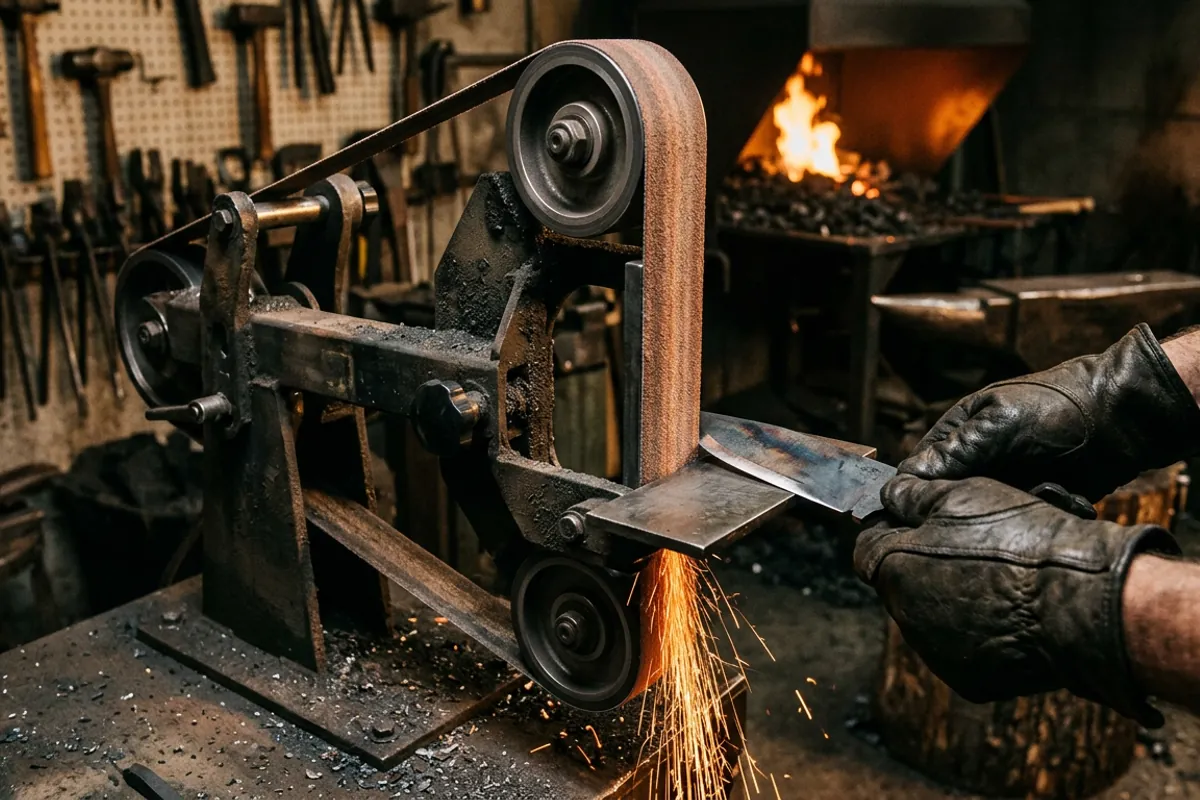
Motor and speed control. For a knife grinder, the near-universal advice from working makers is a 2 horsepower motor with a variable frequency drive, or VFD, running a 3 phase motor off single phase household power. The VFD is the part beginners try to skip and then regret. Slowing the belt down matters enormously for handle work, for polishing, and for grinding softer materials without loading the belt or throwing heat into the blade. On the BladeForums thread where makers hash this out, the short version was blunt: "absolutely to the VFD" (https://www.bladeforums.com/threads/looking-for-a-good-2x72-belt-grinder.1612741/). If you have to choose between a fancier frame and a VFD, buy the VFD.
Belt speed. A full-speed 2x72 typically moves the belt around 3000 to 4000 surface feet per minute. That is fast. Fast is good for hogging steel and bad for anything you want to keep cool or controlled, which is exactly why variable speed earns its keep.
The platen and tooling arm. The platen is the flat backing you grind your bevels against, and a flat, smooth platen with a replaceable face is what separates clean grinds from frustration. A tooling arm that accepts different attachments is what makes the machine grow with you. A common complaint on budget machines is a thin or poorly finished platen and weak gas struts on the tracking arm, both of which people end up upgrading.
Wheels and tracking. You want a tracking wheel that holds the belt where you put it and does not wander mid-grind. Better machines use CNC machined aluminum wheels and a solid tracking mechanism. Cheaper ones use cast or looser-toleranced wheels that need more fiddling.
Spec comparison at a glance
Only published figures below. Where a maker does not state a number, I say so rather than guess. Complete prices for the premium machines are the current setup ranges compiled by Torus CNC's brand comparison (https://toruscnc.com/forge-brain/beginner-guides/2x72-grinder-brands-compared/), and the KMG figure is from Beaumont Metal Works (https://beaumontmetalworks.com/).
Scroll horizontally to see all columns.
| Grinder | Motor | Speed control | Comes complete | Price tier |
|---|---|---|---|---|
| HayWHNKN 2x72 (import) | 1500W (about 2 hp) per listing | VFD variable speed | Yes, motor and VFD included | Budget |
| Origin Blade Maker | Buyer supplies or adds motor | VFD offered | Kit and complete options | Budget to mid |
| AmeriBrade | 2 hp typical build | VFD | Yes | Premium |
| Beaumont KMG-TX | 2 hp | VFD option | Yes | Premium |
| Wuertz TW-90 | Not published as single spec | VFD | Yes | Premium |
Prices as tiers only, because marketplace and maker pricing moves. Torus CNC lists complete-setup ranges of roughly 875 to 1985 dollars for Origin Blade Maker, 2584 to 3674 for AmeriBrade, 3420 to 4130 for the Beaumont KMG-TX, and 3900 to 4150 for the Wuertz TW-90.
The budget complete machines worth a real look
Here is where most beginners actually start, and there is no shame in it. The import 2x72 machines sold complete with a motor and VFD have gotten a lot better, and for someone who wants to grind knives this weekend rather than save for a year, they are a legitimate on-ramp.
The HayWHNKN 2x72 belt grinder is the one I see most often in this category. It ships as a complete machine with a 1500 watt motor, a variable frequency drive for speed control, and multiple grinding wheels and a reversible or multi-angle base, per the listing. That is the important part: motor and speed control in the box, so you are not sourcing and wiring a VFD yourself as a first project. There are two versions floating around, and both are live listings:
- The reversible-base version with the 3 wheel setup and VFD: Check price on Amazon (paid link)
- The multi-angle double-layer framework version: Check price on Amazon (paid link)
Be honest with yourself about what these are. They are import machines, most of them wired for 220V, so plan your outlet before it arrives. Fit and finish is not KMG territory, the platen and struts are the usual first upgrades, and customer support is whatever the seller feels like on a given week. But a 2 horsepower-class motor with real variable speed for a fraction of a premium machine's price is a genuinely useful tool, and plenty of good knives have come off exactly this class of grinder. If it gets you grinding and you learn what you actually want in a machine, it has done its job.
The mid and premium picks worth saving for
If you already know knives are going to stick for you, it can be smarter to save once than buy twice. None of these are sold through the marketplace links above, so I am pointing you at the makers, not an affiliate button.
Origin Blade Maker is the value darling in a lot of maker groups. On the BladeForums thread above, it comes up repeatedly as a well-built entry into the "real" 2x72 world without the top-tier price, and Torus CNC pegs complete setups starting under a thousand dollars. If you want a proper 2x72 but the premium machines make you wince, this is the one people point to first.
AmeriBrade gets described by owners as incredibly well built, very smooth, and reasonably priced for what it is. Reeder Products draws praise for its CNC machined parts, with one maker on that same thread calling it "a work of art." Northridge is newer but well reviewed.
At the top, the Beaumont KMG-TX and the Wuertz TW-90 are the two names full-time makers argue about. The KMG-TX is a 2 horsepower machine with extreme tilt and a VFD option, per Beaumont Metal Works, and it is the machine a lot of pros consider the reliable default. The TW-90 gets called the cadillac of grinders, with dual-axis tilt and machining people gush about, at a price to match. These are wonderful tools. They are also complete overkill for someone grinding their third knife, and I would not want a beginner to feel they need one to start.
What owners say
I have not run these specific machines down in my own shop, so this section is owner consensus off the forums, reported straight, complaints included.
On the import complete machines, the signal is consistent: they work, they get people grinding, and the common gripes are the platen quality, weak gas struts on the tracking arm, and hit-or-miss seller support. Makers who buy them generally accept a couple of small upgrades as the cost of the low price.
On VFD, the consensus is not subtle. Across the BladeForums discussion (https://www.bladeforums.com/threads/looking-for-a-good-2x72-belt-grinder.1612741/), experienced makers treat variable speed as non-negotiable for anything past pure bevel hogging, especially handle shaping and finishing. If a cheaper machine skips the VFD, factor the cost of adding one before you call it the cheaper machine.
On the premium field, the recurring theme is that people rarely regret buying quality, but they also rarely regret starting cheaper and learning first. The Benchmark Abrasives guide to 2x72 grinders (https://benchmarkabrasives.com/blogs/product-reviews/best-2x72-belt-grinders-for-knife-makers-and-metal-fabricators) makes the same point most floor-level makers do: the best grinder is the one that matches how serious you already are, not the most expensive one you can rationalize.
Safety at the grinder is not optional
I lost my eyebrows early in my smithing life to a quench oil flare-up because I stood too close in a cotton shirt with no face shield. I got my eyesight back by luck. That is exactly the kind of luck you should never plan around, and a belt grinder is its own set of hazards.
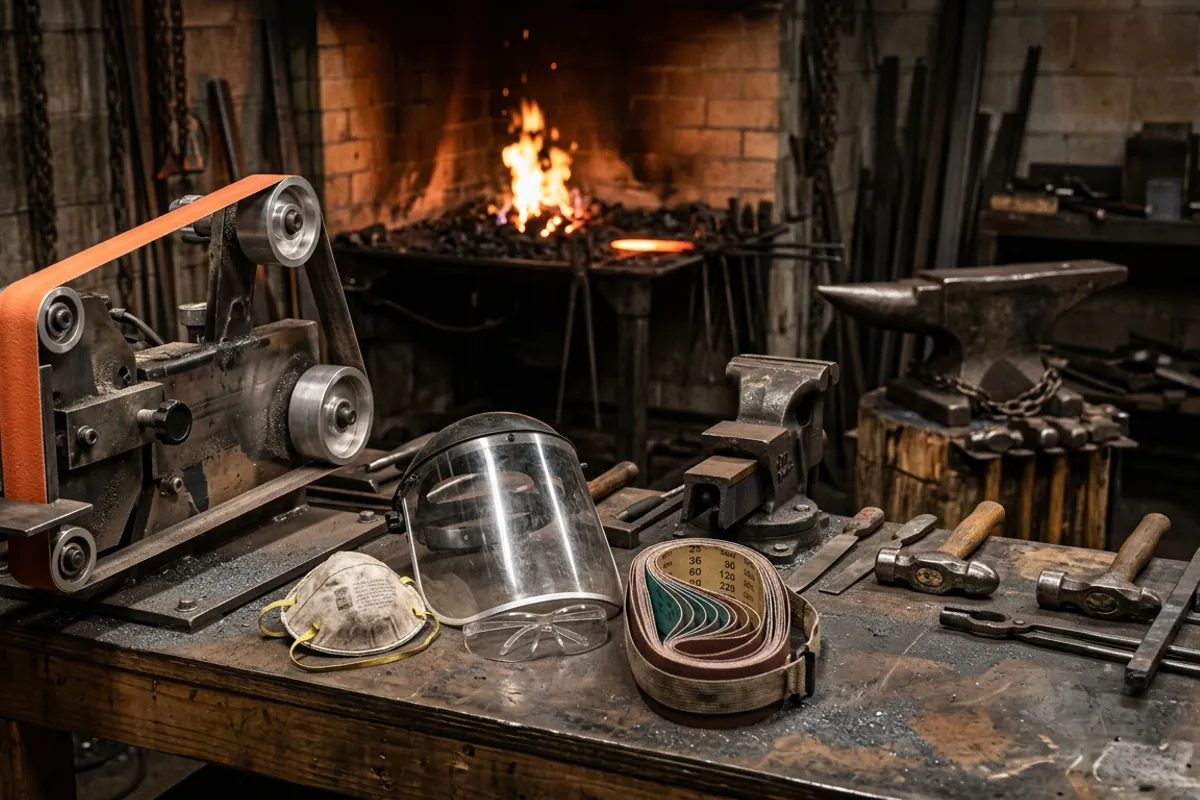
Wear eye protection rated to ANSI Z87.1, every single time, no exceptions. A belt can shed grit or snap, and a grinder throws a constant stream of hot steel particles right at your face. A face shield over safety glasses is better still when you are hogging metal.
Grinding steel, and especially grinding the epoxy, micarta, and stabilized woods on handles, throws fine dust you do not want in your lungs. Run a respirator rated for particulates, and pull the dust away with a vacuum or a downdraft if you can. Grinding stainless dry raises a real hazard from the dust, so read up before you grind stainless without collection.
Tie back anything loose, keep your fingers off the belt path, and never wear gloves at a running belt grinder if there is any chance the glove can get grabbed and pull your hand in. That last one runs counter to instinct, but a grabbed glove at 3000 surface feet per minute is far worse than a burned fingertip. For the broader kit, my blacksmith safety gear guide covers what matters and what to skip.
What I would tell a friend
If you are starting out and money is tight, buy a complete import 2x72 with a motor and a VFD already in the box, like the HayWHNKN, plan the 220V outlet before it ships, and accept that you may upgrade the platen and struts down the road. It will get you grinding real bevels now, which teaches you more than any spec sheet.
If you already know this hobby has you and you would rather buy once, save for an Origin Blade Maker at the value end or a Beaumont KMG-TX if you want the machine the pros stop worrying about. Either way, spend on the VFD before you spend on looks, and treat the eye and lung protection as part of the purchase, not an afterthought.
Whatever you buy, remember the grinder is only half the equation. The steel and its heat treat decide whether the blade holds an edge, so read up on tempering of metal, lean on the steel selector tool when you pick your stock, and see the rest of the knife path on the knife making topic hub. Grind safe, and grind cool.