Now I have verified specs and live listings. Writing the guide.
The budget import single-horn anvil, the NC Tool knifemaker anvil (Amazon ASIN B07ND3NTKH, live), a budget forged single-horn (SmarketBuy B08BLCDX3M, live), and the Kanca bladesmith with cited Centaur specs. Here is the article.
Most new knife smiths overthink the anvil and underthink the money. A knife forging anvil does not need to be a 300 pound London pattern monster with a graceful horn. For forging blades you are working a bar maybe three inches wide over a stretch of face about three inches by ten, and the single thing that matters most is a hard face that throws the hammer back at you instead of swallowing the blow. If you want the short answer: for most people starting to forge knives, a 70 to 90 pound anvil with a genuinely hard steel face is the sweet spot, and my pick for a purpose-built one is the NC Tool Knifemaker Anvil, with the Kanca Bladesmith as the step up if you want forged steel and a published hardness number.
I need to be straight about what this guide is and is not. I have put twenty-five years on my own Trenton, Bessie, a 148 lb wrought-bodied anvil with a hard steel face, so I can tell you exactly what a good working surface feels like under a hammer. But I have not run every anvil below down in my own shop. The picks here lean on published specs from the makers and their dealers, plus owner reports from the forums, all weighed against what I know a knife anvil has to do. Where a number is not published, I say so rather than invent one.
What a knife forging anvil actually needs
Strip away the romance and a knife anvil has three jobs. It has to be hard, so your hammer energy goes into moving steel instead of denting the anvil. It has to be heavy enough to stay put and not soak up every blow, which for blade work means north of about 70 pounds. And it has to give you a flat, smooth stretch of face plus at least a hardie hole so you can hold cutoff and drift tools. A horn is nice for the occasional curve but it is not central to forging a blade, and you can skip the pritchel hole entirely and never miss it.
Hardness is the number people ignore and then regret. A face that reads soft will dish out and mushroom, and every dent you put in it prints straight onto the next blade you forge. The forum consensus that lines up with my own bench is simple: you want rebound, and you test it with a ball bearing before you trust the tool. More on that at the end.
Here is the field, published specs only. Where a maker does not state hardness I have left it as not published rather than guess.
Scroll horizontally to see all columns.
| Anvil | Weight | Material | Face size | Hardness | Price tier |
|---|---|---|---|---|---|
| VEVOR single horn | 66 lb | Cast/forged steel (feed) | not published | ~55 HRC (listing claim) | Budget |
| SmarketBuy single horn | 66 lb | Steel, single horn | not published | not published | Budget |
| NC Tool Knifemaker | 70 lb | Cast (ductile) | 3.25 x 11.375 in | not published | Mid |
| Kanca Bladesmith | 77 lb | C45 drop-forged steel | 13.25 x 3.74 in | 54 to 62 HRC | Premium |
Specs for the Kanca are from Centaur Forge's product page, and the NC dimensions match what NC Tool's dealers publish. Note the one column that separates the real forging tools from the gamble: Kanca puts a hardness range in print, and the budget imports do not.
The budget import single horn anvil
This is where most people land first, and I understand why. These are the 66 pound single-horn steel anvils that show up under a dozen brand names, VEVOR being the one with the most listings and the most owner feedback. The feed card below is the VEVOR 66 pounder.

Honest read: at this weight and price you are buying a usable knife anvil, not a lifetime tool. VEVOR's own listing claims around 55 HRC on the face, which if true is perfectly workable for forging blades. The catch is consistency. "Ask ten smiths" and you will hear that these imports vary unit to unit, and the one thing you cannot verify from a listing is whether your particular casting hit its hardness number. That is why the ball bearing test in the last section is not optional on gear like this.
If you want the same class of anvil on Amazon, the SmarketBuy 66 pound single-horn steel anvil is the same idea from a different importer, and its listing publishes even less about hardness than VEVOR's does. Check price on Amazon (paid link). I am not going to dress this up: buy it, bounce a bearing on it, and if the rebound is dead, send it back. For a beginner who wants to find out whether they even like forging before spending real money, a 66 pound import is a reasonable, eyes-open bet. For anyone who already knows they are staying, I would put the money toward one of the next two. If you want the longer argument about how weight actually plays into this, I laid it out in the anvil weight guide.
One more note on these. A 66 pound anvil wants to bounce around the stump unless you bolt or strap it down hard. On a light anvil, mass you lose to the anvil skittering is mass that never reaches your steel, and it matters more the lighter you go.
The NC Tool knifemaker anvil
This is my default recommendation for someone who knows they want to forge knives and wants a tool built for exactly that. NC Tool has been making farrier and shop anvils in North Carolina for decades, and the Knifemaker is their answer to the blade crowd: a compact 70 pound body with a long, narrow rectangular face, a clip horn, and a 1 inch hardie hole in the heel. The published face runs about 3.25 by 11.375 inches, which is almost exactly the working stretch a knife smith actually uses, and none wasted on a fat horn you do not need. Check price on Amazon (paid link).
The tradeoff to be honest about: NC does not put a Rockwell number on this anvil the way a forged-steel maker does, and the body is cast rather than forged. What carries it is a long track record. Owner reports on the farrier and knife forums are consistent that these take a hammer well and hold their face, which is the thing you care about. It is not a wrought-and-steel Trenton like Bessie, but for forging blades specifically, the shape is smarter than most century-old London patterns, because the whole tool is the part you use. If you are still deciding what you are even building on it, the knife making explainer walks the whole path from bar to edge.
The Kanca bladesmith drop forged anvil
If you want to buy once, this is the one I would tell a friend to save for. Kanca is a Turkish maker that drop-forges its anvils from C45 carbon steel, and the Bladesmith model is a 77 pound anvil in a Southern German pattern with a broad, flat face. Centaur Forge publishes the specs I care about: a 54 to 62 HRC face, a 13.25 by 3.74 inch working surface, a 7/8 inch hardie hole, and a 3/4 inch pritchel hole, per Centaur's listing.
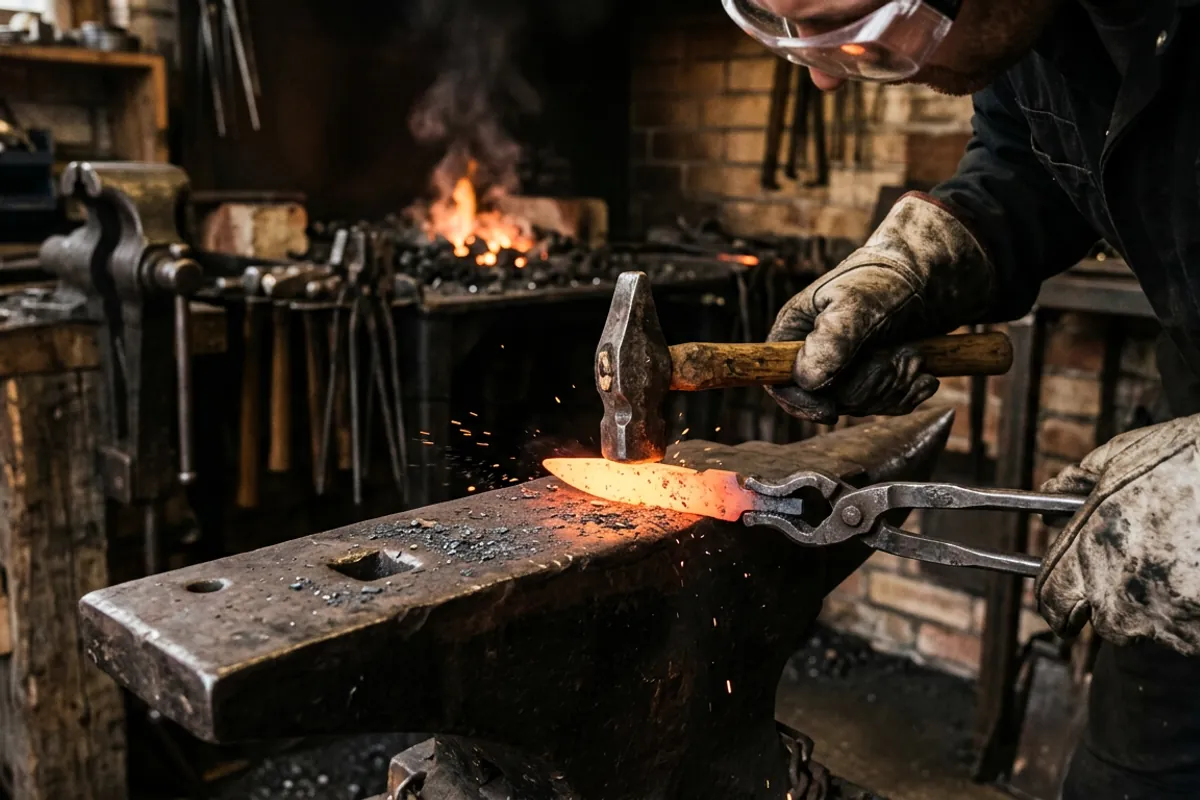
Two things make this the real forging tool of the group. First, it is forged, not cast, so the whole body is dense steel rather than a casting with a hardened top. Second, and more important, the maker prints a hardness range and stands behind it. A 54 to 62 HRC face is genuinely hard, hard enough that you will feel the rebound the moment you set a hot bar on it. That is the difference you pay for. Kanca sells through farrier and blacksmith suppliers rather than Amazon, so you buy it from a dealer like Centaur, not with a one-click cart, and that is fine. A tool this size will forge every kitchen knife, hunter, and camp chopper you are likely to make, and it will still be flat when you hand it to your kid.
What owners say
For the anvils I have not personally run, here is what the forums actually report, good and bad.
On weight and shape, the BladeForums thread on the best anvil for bladesmithing settles the question most beginners agonize over: anything above about 70 pounds is fine for blades, 100 to 150 pounds is more than enough, and the usable surface for knife work is only about three by ten inches. Several posters make the same point I do, that a purpose-built knifemaker anvil is often little more than an upright block of hardened 4140 with a rectangular top, and that the horn and pritchel are conveniences, not requirements. That is owner consensus lining up with shop reality, not marketing.
On the budget imports, the tone across the forums is cautious, not dismissive. Owners report that the good ones forge fine and the bad ones arrive soft or with a face that dishes early, and that you cannot tell which you have until you test it. The practical advice that repeats is to buy from a seller with an easy return, unbox it, and check rebound before you commit.
On cast anvils in general, the BladeForums discussion of Grizzly anvils is a useful reality check, because it separates Grizzly's cheap cast-iron shop anvils from anything you would actually forge on. Which brings me to the trap.
The cast iron trap, and how to test rebound
The single most common way a new smith wastes money is buying a cast iron anvil and expecting it to forge. Grizzly's popular 55 pound G8147 is, by Grizzly's own product page, cast iron. Cast iron is not a forging surface. It is soft, it can crack under a hard blow, and it will deaden your hammer instead of returning energy. It makes a fine bench block for light bending and a terrible knife anvil. If a listing says cast iron, walk away for forging purposes, no matter how cheap it is.
Here is the test that protects you from all of it, and it costs the price of a ball bearing. Drop a hardened steel bearing, say 1 inch, onto the anvil face from a known height and watch how high it bounces. A good hard face returns roughly 70 percent or more of the drop height. A dead cast face might give you 20 or 30 percent, and you will feel that deadness in your arm all day. Do this on the anvil before you buy it used, and do it the day an import shows up on your porch. Rebound is the one property that predicts how the tool will feel under a hammer, and it is the one thing every seller conveniently leaves out.
Whatever you forge on, the anvil is only half the safety story. Hot scale flies off the face on every blow, so ANSI Z87.1 rated eye protection goes on before the steel comes out of the fire, and natural fibers stay on your body near that heat. I learned the synthetics lesson the hard way years ago with a quench-oil flare that took my eyebrows, and I do not soften that warning for anyone.
What I would tell a friend
Buy the anvil for the knives you are actually going to forge, not the anvil in the catalog photo. If you are testing the waters and want the cheapest way in, a 66 pound import is a fair gamble as long as you bounce a bearing on it the day it arrives and return it if it is dead. If you know you are staying and want a tool shaped for blades, the NC Tool Knifemaker at 70 pounds is the smart middle, and its long flat face is honestly better proportioned for knife work than most old London patterns. If you want to buy once and never think about it again, save for the forged Kanca Bladesmith with its published 54 to 62 HRC face.
The one to skip is any cast iron anvil sold as a forging surface, full stop. And the note that matters most: hard face, tie it down, eyes protected, natural fibers on. Get those four right and a modest anvil will forge more knives than you will ever have time to grind. When you are ready to think about the rest of the bench, the beginner blacksmith kit guide and the whole knife making topic hub are where I would point you next.