If you want the short version: the knife makers belt sander I would put in a beginner's shop today is a 2x42 with variable speed, and if the budget stretches, a 2x72 like the Grizzly G1015 ends the upgrade cycle before it starts. A 4x36 wood sander will get you a knife, and a 1x30 will make you hate grinding. Everything else is detail.
Now the honest framing. I am a hobby smith, not a dealer and not a full time bladesmith. I have not run every machine on this list down in my own shop, and I am not going to pretend otherwise. What follows is published specs I pulled from the makers, owner reports from the knife forums with links so you can read them yourself, and about twenty five years of shop experience about what actually breaks, what bogs down, and what wastes money. Where owner signal is thin, I say so.
What a knife makers belt sander actually has to do
Grinding a blade is not sanding a board. You are removing hardened or near hardened steel along a flat bevel, and you need three things from the machine.
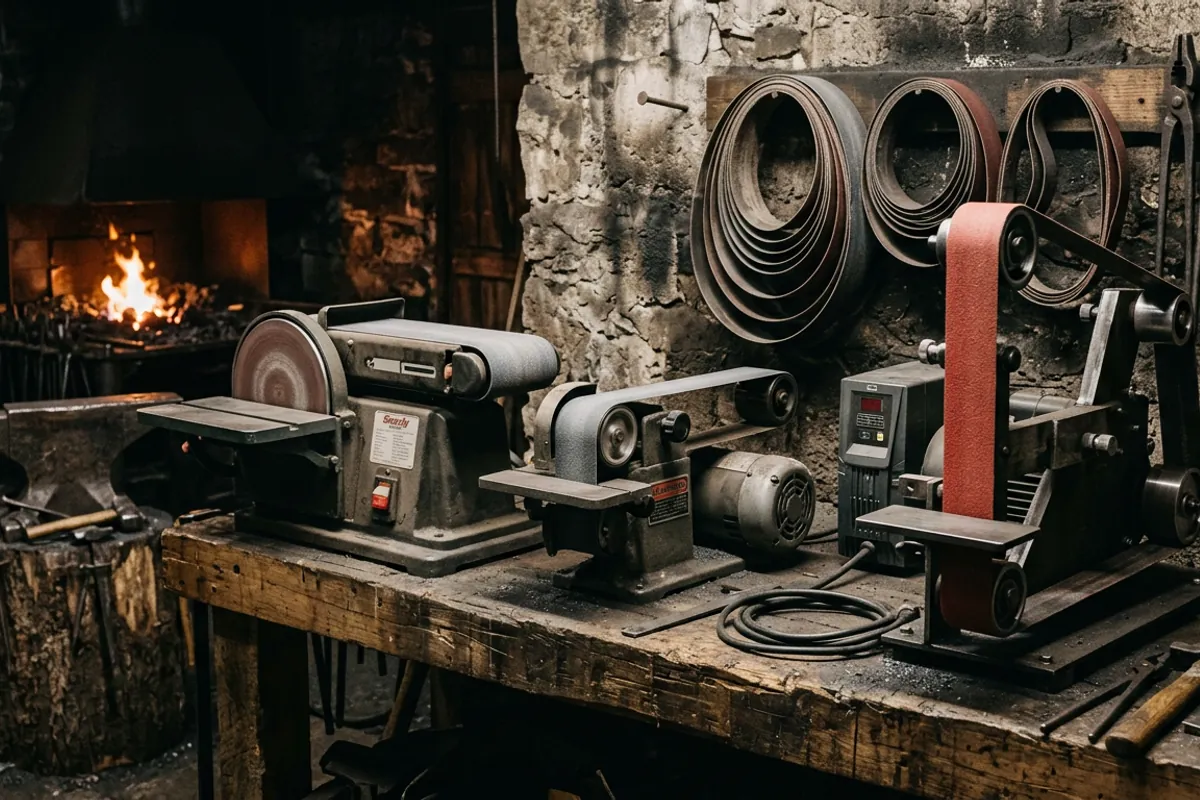
Power that does not bog. Steel loads a belt and a weak motor sags the second you lean on it. A 1/3 HP benchtop motor will make knives, but you will feel it fighting you on a 1/4 inch thick bar of 1084.
A flat, rigid platen. This is where the bevel comes from. If the platen flexes, or if the belt rides proud of it, you get waves. A machine with a removable platen and a decent backing is worth more than an extra tenth of a horsepower.
Belt selection. This is the one beginners underrate and the one that decides the machine. The 2x72 size exists in every abrasive, every backing weight, and every grit worth having. The 1x30 and 1x42 sizes exist in a fraction of that, and most of what is sold in those sizes is aluminum oxide meant for wood. Good ceramic belts cut steel; hardware store aluminum oxide belts polish it slowly while getting hot. More on that below.
If you are still deciding whether you want a dedicated grinder at all, my broader take on machine choice is in the belt grinder guide, and the beginner level version is in the belt sander I would actually start with. The whole knife making topic hub has the rest of the chain, from stock to heat treat.
How these machines compare on paper
Published figures only. Where the maker does not state a number, the table says so.
Scroll horizontally to see all columns.
| Machine | Belt size | Motor | Belt speed | Also does | Price tier |
|---|---|---|---|---|---|
| WEN 6502T | 4 x 36 in | 4.3 A, 1/2 HP | Up to 3600 RPM (SFPM not published) | 6 in disc | Budget |
| Bucktool BG2600 | 2 x 42 in | 1/3 HP, 120 V, 3.5 A, 3450 RPM | 4480 FPM | 6 in grinding wheel | Budget |
| Bucktool BS242V | 2 x 42 in | 3.5 A DC | 1240 to 4480 FPM | Belt only | Mid |
| Kalamazoo 1SM | 1 x 42 in | 1/3 HP, 1 PH, 115 V | 1800 SFPM | Removable steel platen | Mid |
| HayWHNKN 2x72 | 2 x 72 in | Not published by maker (seller states 1500 W, 220 V) | Not published | 3 wheels, VFD | Mid |
| Grizzly G1015 | 2 x 72 to 76 in | 1 HP, 110 V, 14 A, 1725 RPM | 3600 FPM | Aux arbor to 10 in wheels | Premium |
Specs from WEN, Bucktool BG2600, Bucktool BS242V, Kalamazoo Industries, and a Grizzly dealer listing for the G1015. I could not find a manufacturer spec page for the HayWHNKN machine at all, which tells you something on its own.
WEN 6502T 4 x 36 combo sander: the one most people already own
This is the benchtop belt and disc sander that lives in half the garages in the country. WEN publishes 4.3 amps and 1/2 HP, a 4 x 36 inch belt, a 6 inch disc, a cast iron base, and a belt arm that tilts 0 to 90 degrees.
Here is the honest read. A 4x36 will profile a blade, flatten scale, round a handle, and take a tang down to fit. It will not grind a clean, even bevel, because the belt is wider than the platen work you are doing and there is no small contact wheel for plunge lines or hollow work. The 3600 RPM number is motor speed, not surface speed, and this machine has no speed control, so you are grinding hardened steel at one fast setting with a dip can in the other hand.
Buy it if you also do woodwork and want one machine that does handle scales, rough shaping, and general shop cleanup. Do not buy it expecting to grind bevels on it and be happy.
Check price on Amazon (paid link)
Bucktool BG2600 2 x 42 combo: the cheapest machine I would call usable
Bucktool publishes 1/3 HP, 120 V, 3.5 amps, 3450 RPM, a 2 x 42 inch belt running at 4480 FPM, and a 6 x 1 x 1/2 inch grinding wheel on the other side, at a listed gross weight of 39.9 lbs. The belt arm swings 0 to 90 degrees and the platen comes off for contour work.
For a first knife machine this is a reasonable place to spend the least money you can spend and still get somewhere. The 2 inch belt is wide enough to lay a blade flat against, the platen is removable, and the belt speed is high enough that a fresh ceramic belt cuts fast.
The compromises are real. A 1/3 HP motor bogs when you push, and this is a fixed speed machine, which means at 4480 FPM you are always grinding fast. Fast is fine for hogging steel off an annealed bar. Fast is how you burn an edge after heat treat. Also, the grinder wheel side needs its work rest set properly before you touch it: the OSHA abrasive wheel rule calls for the work rest adjusted to within one eighth of an inch of the wheel, close enough that the workpiece cannot be dragged down between rest and wheel.
Check price on Amazon (paid link)
Bucktool BS242V 2 x 42 variable speed: the one I would buy first
Same belt size, different priority. Bucktool publishes a 3.5 A DC motor with a belt speed range of 1240 to 4480 FPM, a quick release tension handle, and three mounting positions: vertical, horizontal, or on a wall.
Variable speed on a knife grinder is not a luxury feature, it is the feature. Slow belts let you finish a hardened blade without cooking the edge, work handle materials that melt at high speed, and take a controlled pass on a plunge line instead of a panicked one. A DC motor also holds torque better at low speed than a fixed AC motor pretending to be slow.
The catch is that 3.5 amps is 3.5 amps. This is still a benchtop machine and it will still bog if you lean on a thick bar. And this model is new enough that forum signal on it is thin. I found video reviews and the maker's own page, but no long owner threads reporting how the DC controller holds up after a few hundred hours. Bucktool's older BG2600 has a decent reputation among hobby makers, which is the only track record I can honestly point at. Buy it on the spec sheet, not on a consensus that does not exist yet.
Check price on Amazon (paid link)
Kalamazoo 1SM 1 x 42: built to last, narrow on purpose
Kalamazoo publishes 1/3 HP, single phase, 115 V, a 1 x 42 inch belt at 1800 SFPM, a removable and adjustable steel platen with a work area of 1-7/8 inches wide by 5-7/8 inches high, a table that tilts 0 to 45 degrees, and about 35 lbs shipping weight. It is made in the United States and it is built like a small industrial machine, not a benchtop toy.
I like this machine for what it is: a sharpening and detail grinder that will outlive its owner. If you make small blades, sharpen a lot, or want something that never wobbles, it earns its keep.
I would not buy it as a primary bevel grinder, and this is the whole 1 inch belt problem. A 1 inch belt is narrower than the bevel you are grinding, so the platen edge tracks across the blade instead of supporting the whole face at once. That is how you get grooves and waves. It also costs more than a 2x42 while giving you less belt selection. Good tool, wrong job for most beginners.
Check price on Amazon (paid link)
Grizzly G1015 2 x 72: the step that ends the upgrade cycle
Dealer listings for the G1015 publish 1 HP, 110 V single phase, 14 amps, 1725 RPM motor speed, a 2 inch belt in the 72 to 76 inch range at 3600 FPM, a belt arm that tilts 0 to 90 degrees, an auxiliary arbor that takes buffing wheels, drums, or flap wheels up to 10 inches on a 5/8 inch bore, and roughly 113 lbs shipping weight.
This is the cheapest well known machine that puts you in the 2x72 belt world on ordinary household power, which matters more than anything else on its spec sheet. In 2x72 you can buy Norton, VSM, 3M ceramics in every grit, cork belts, trizact, leather belts for stropping. That selection is the actual upgrade.
What you give up compared to a purpose built maker's grinder: it is fixed speed, the frame is lighter than a TW-90 or a Reeder, and the wheel set is basic. Owners commonly add a variable frequency drive or a better work rest. That is a known and normal path, not a defect.
If you can afford this instead of two cheap machines, buy this instead of two cheap machines. That is the pattern I see over and over with beginners: they buy small, outgrow it in a year, and the small machine sells for very little.
Check price on Amazon (paid link)
The import 2 x 72 machines, and the voltage trap
There is a whole shelf of Chinese built 2x72 grinders sold online with three wheels, a reversible base, and a variable frequency drive, and the price looks impossible next to a name brand. The HayWHNKN units are the ones that show up most.
Read the voltage before you get excited. The common listing states 1500 W and 220 V, which in a US home shop means a dryer style circuit or an electrician's visit, not a wall outlet. I could not find a manufacturer specification page for these machines anywhere, so belt speed, wheel material, platen flatness, and bearing quality are all not published. When a maker publishes nothing, you are buying a photograph.
I would only touch one of these if you already have 220 V in the shop, you are comfortable wiring and tuning a VFD, and you accept that support may amount to nothing. Plenty of people run them happily. Plenty also spend a weekend truing wheels and re-machining a platen. Know which weekend you signed up for.
Check price on Amazon (paid link)
What owners say
This is secondhand by design, and here is the thread by thread version.
On BladeForums, in a 1x42 versus 2x42 discussion, posters lean clearly toward the 2x42 for a first machine. The recurring technical complaint about the narrower belt is exactly the one I described above: the narrower the belt, the harder it is to lay the face of the blade against the platen, and the easier it is to leave grooves and waves in the flats. Several owners report keeping a budget 2x42 after upgrading, and report modifying it, reinforcing the platen and building a better work rest, rather than replacing it.
On KnifeDogs, in a 1x30 versus 2x42 thread for beginners, the experienced posters mostly say skip both and save for a 2x72. The specific complaints about 1x30 machines are motor whine, not enough power, a platen that needs modifying, thin belt selection, and poor resale when you outgrow it. Their alternative budget path is interesting and honest: either use a basic 4x36 to learn the fundamentals, or build a 2x72 from a kit rather than buying a small machine you will replace.
Where the signal is thin, I will say it plainly. I did not find substantial long term owner threads on the Bucktool variable speed model, and I found no maker documentation at all for the import 2x72 units. Absence of complaints is not evidence of quality when a machine is simply too new or too obscure to have generated any.
Belts do more of the work than the machine does
Every one of these machines gets better with good abrasives and worse with bad ones. If you put hardware store aluminum oxide wood belts on a 2x42 and grind hardened steel, you will conclude the machine is junk. It is not the machine.
Buy ceramic belts for hogging, in something like 36 and 60 grit, then work up. Ceramic grains fracture as they wear and keep presenting fresh edges, so they cut instead of rubbing. Rubbing is what makes heat, and heat is what ruins blades. Budget for belts the way you budget for propane: they are a consumable, not a one time purchase.
A dull belt is also a safety issue, not just a slow one. Pushing harder to make a worn belt cut is how hands slip.
Safety at the belt sander
I take this seriously because I learned the hard way. Early on I quenched a blade in oil that was too cold while standing too close in a cotton shirt with no face shield, the oil flared, and it took my eyebrows. I kept my eyesight by luck. Luck is not a plan.
At the grinder, specifically:
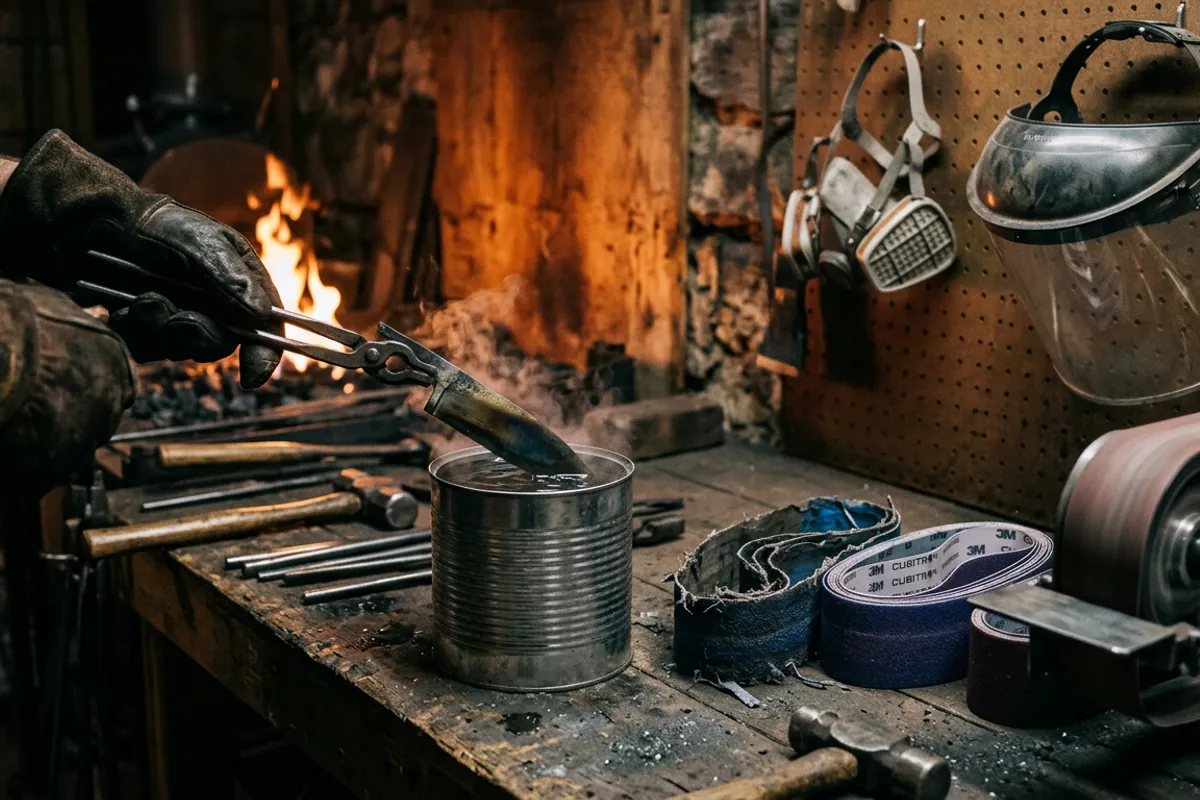
Eye protection rated to ANSI Z87.1, and a full face shield over it for heavy grinding. A belt throws hot steel particles and can throw belt fragments if a joint lets go.
Natural fibers only. Cotton or wool, no synthetic fleece or nylon near sparks. Synthetics melt onto skin.
Respiratory protection. Steel dust is bad; ground G10, carbon fiber, and stabilized handle materials are worse. A disposable N95 is the floor, a P100 cartridge respirator is what I would use, and dust collection at the machine beats both.
No loose gloves at a running belt, no rings, no long sleeves flapping, hair tied back. A belt or a contact wheel grabbing a glove is worse than a hot blade.
Steel dust is combustible in fine accumulations. Do not let your grinding dust pile up next to the forge or the quench oil, and vacuum it up rather than letting it drift.
Keep a can of water at the machine for hardened blades and dip often. Knife Steel Nerds has good testing based writing on whether grinding ruins an edge, and the practical takeaway is the old one: if the edge turns blue, you drew the temper and the fix is a re heat treat, not a touch up. If you want the background on why that matters, my write up on tempering covers what you just undid. General shop PPE thinking is in the safety gear guide.
What I would tell a friend
Buy the Bucktool BS242V 2x42 if you want a machine that will do real bevel work on a normal outlet for the least money that makes sense, and accept that it is a benchtop machine with a benchtop motor. Buy the Grizzly G1015 instead if you can stretch, because 2x72 belt selection is the thing you are really buying and 1 HP on 110 V is the thing that makes it practical at home.
Skip the 1x30 class entirely. Skip the import 220 V machines unless you already have the circuit and enjoy tuning a VFD. And if you already own a 4x36, do not rush out and replace it tomorrow; use it for profiling and handles while you save for a 2x72.
One last thing. The grinder does not make the knife, the steel and the heat treat do. If you have not settled on a steel yet, the steel selector will narrow it down, and the bar of steel to finished blade walkthrough is the process the machine slots into. A cheap grinder and a good heat treat beat the reverse every time.