Verified three live ASINs, real forum threads, and published specs from non-marketplace sources. Writing the guide now.
Here is the article.
If you want one forge for knife making and you are buying it this month, I would start you on a single burner propane forge and put the money you save toward a decent grinder and good steel. A single atmospheric burner brings a blade blank up to an even orange forging heat, sips propane, and does not turn your whole shop into an oven while you work one small piece. The honest framing up front, because that is how we do it here: I run a propane forge and a coal forge in my own shop and have for years, but I have not lit these exact commercial models. What follows leans on their published specs and on what owners actually report on the forums, weighed against a lot of hours running gas.
So this is a buying guide, not a bench test. I will tell you what a forge for knife making has to do, put three real forges side by side, and be plain about where the owner signal is solid and where it is thin. If you are still deciding between fuels at all, read coal or propane first before you spend a dollar. For knives specifically, propane is almost always the right first answer, and the knife making propane forge guide goes deeper on that call. This one is about which box to buy.
What a forge for knife making actually needs to do
A knife forge has three jobs, and none of them require a big expensive box.
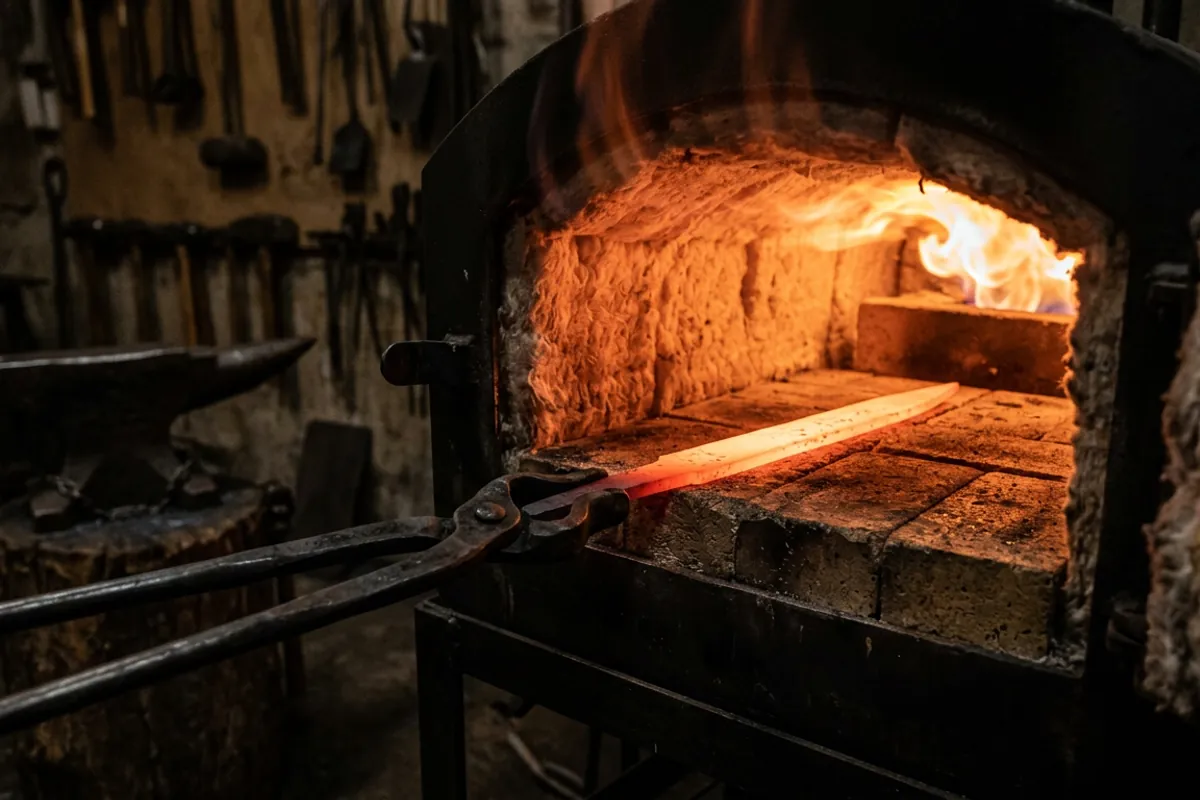
First, it has to reach and hold forging heat. For carbon blade steels that means a bright orange to light yellow, roughly in the neighborhood of 1500 to 2200 F. Every propane forge worth buying clears that with room to spare. The temperature ratings you see stamped on these units, 2300 F or 2600 F, are ceiling claims for the insulation, not a number your steel sits at, and no atmospheric forge is calibrated like an oven. That distinction matters later.
Second, it has to heat evenly along the length of a blade. A blade is long and thin, so you want a chamber that is long enough to get the whole thing hot but tight enough to actually reach heat and stay there. A cavernous chamber built for gate hardware wastes gas and fights you on a paring knife. Small is a feature here.
Third, the insulation has to survive shop life. Every forge on this list uses a one inch ceramic fiber blanket over a firebrick floor. That works, but ceramic wool has one hard enemy: flux. Get borax flux on the blanket during forge welding and it eats the wool like water on a sugar cube, in the words of one owner I will quote below. A firebrick floor and a coat of rigidizer or refractory take the abuse; bare wool does not.
One thing a propane forge is not: a heat treat oven. It will get your blade to a forging heat by eye all day long, but hitting a precise austenitizing temperature for hardening, and holding it, is a tighter game than a glowing chamber can promise. Send that question to real testing rather than a color chart. Knife Steel Nerds is where I point people for actual heat treat data by alloy, and if you are working something like 4140 my own 4140 heat treat notes walk through how I handle it from the forge floor. The forge gets you the shape. Verified heat treat gets you a knife that holds an edge.
The forges at a glance
Published specs only. Where a maker does not state a figure, it says not published rather than a number I made up.
Scroll horizontally to see all columns.
| Forge | Burners | Temp rating | Interior chamber | Insulation | Made in | Price tier |
|---|---|---|---|---|---|---|
| Simond Store single burner | 1 | 2600 F rated | about 2.75 x 4 x 10 in | 1 in ceramic fiber, firebrick floor | Not published | Budget |
| Hell's Forge single burner | 1 | 2300 F | Not published | 1 in ceramic fiber, firebrick floor | USA | Budget to mid |
| Hell's Forge double burner | 2 | 2300 F | 19 x 6.75 x 3.5 in oval | 1 in ceramic fiber, firebrick floor | USA | Mid |
The chamber and temperature figures for the Simond single and the Hell's double come from a specs roundup at KnifeUp; the made in USA and 2300 F claims are Hell's Forge's own. Treat the temperature numbers as insulation ceilings, not working temps, and note that Hell's does not clearly publish an interior dimension for the single burner unit, so I will not invent one.
Simond Store single burner, the cheapest honest way in
If your budget is tight and you just need heat on steel, this is the entry point most beginners actually take. It is a single burner rectangular forge rated to 2600 F, with a stainless SS-304 burner nozzle, one inch of ceramic fiber and a firebrick floor, and a chamber around ten inches long. That length swallows most hunting, kitchen, and EDC blades without trouble.
What you are buying at this price is heat and a body, not refinement. It will forge knives. The tradeoff is that everything around the core is built to a number: owner reports and roundups flag fiddly assembly and regulators that vary unit to unit, and the long term durability signal on these imported forges is genuinely thin, so I am not going to pretend it is proven. If you go this route, budget a few dollars for a coat of rigidizer on the wool before first fire and check every threaded fitting with soapy water. For a first forge that you will run hard while you learn, it is a defensible way to spend the least and get forging.
Check price on Amazon (paid link)
Hell's Forge single burner, made in the USA
This is the one I would hand most new knife makers who can stretch a little past rock bottom. It is a single burner propane forge made in the USA, sized by the maker for exactly the work you are doing: hunting knives, chef knives, general small stock. Rated to 2300 F, one inch ceramic blanket over firebrick, and it ships with a container of the maker's refractory coating to protect the wool, which tells you they know where these forges die.
The reasons to pay the small premium over an import are support and consistency. When a US maker sells thousands of the same unit, the owner base is deep and the parts are here. The honest knocks, and they are real, are that the supplied propane hose runs short for some setups, and the burner points straight down rather than entering at a tangent (more on why that matters next). Neither stops you making good knives. For a single forge you will keep for years, this is the sweet spot between price and knowing what you are getting.
Check price on Amazon (paid link)
Hell's Forge double burner, room for bigger work
The double burner is the same family scaled up: a 19 by 6.75 by 3.5 inch oval chamber, two independently controlled burners, made in the USA, rated to 2300 F. You can run one burner for a single blade and light the second when you need to bring a longer bar or a welded billet up fast. If you already know you are headed for Damascus, camp choppers, or hardware alongside knives, this is the one that will not box you in.
The cost of that capacity is fuel and noise. An owner review I trust reports four to six hours of run time at 20 psi with both burners going flat out, so a bigger chamber and two burners genuinely drink more propane, and every owner calls these forges loud. If your knives are small and your projects stay small, you will pay to heat air you are not using. Buy the double burner because you have real plans for bigger stock, not as insurance.
Check price on Amazon (paid link)
One burner or two, and where the flame points
This is the question that fills forum threads, so let me give you the working answer. For knife making specifically, one good atmospheric burner is enough. The smiths in the I Forge Iron thread on exactly this question land where I do: a single burner handles knives and general small forging without drama, and you add a second burner when your stock gets long or thick enough that one flame cannot keep up. Read it yourself, it is a good one: one burner or two on I Forge Iron.
Burner angle is the subtler point. On these consumer forges the burners mount vertical, firing straight down, because that is far simpler to build. Knife makers on the forums generally prefer burners entering at a tangent so the flame swirls around the chamber and evens out the heat, which cuts down on hot spots along a blade. The forge hot spots discussion on KnifeDogs lays out why the angled setup heats more evenly and why commercial units skip it anyway. It is worth knowing, but do not let it stop you: plenty of good blades come out of straight down forges. You learn to move the steel and read the heat, and a hot spot becomes something you use rather than fight.
What owners say
I have not run these three forges down in my own shop, so this is owner consensus, attributed, not a personal test.
On the Hell's Forge double burner, the most useful firsthand account I found is a working owner's writeup: the forge is fun, plenty of people including the author have successfully made knives on it, it is very noisy, and you must be careful not to get flux on the ceramic blanket or, in the owner's words, it melts it like water on a sugar cube. He rates the build as well made for the price and does not consider the vertical burners a deal breaker. That squares with everything else I have read. Full review: Gallivanting Craftsman.
On the single burner question and on burner angle, the two threads above are the real consensus, not my opinion dressed up as one.
On the Simond Store single burner, I will be straight: the owner signal is thinner and shorter term than I would like. The recurring notes are good heat for the money, occasionally fiddly setup, and regulator quality that varies between units. I have not seen a deep, multi-year durability record on these the way you can find for the US made forges, so treat it as a proven value buy for learning, not a proven lifetime forge.
Safety at the propane forge
A propane forge is a controlled fire and a source of carbon monoxide, and it deserves respect on both counts. This is the part I never soften.
Ventilation first. Run a gas forge in open air or in a space with real cross ventilation, never a closed garage. Carbon monoxide from a running forge will put you down before you know it is happening. Check every fitting from tank to burner with soapy water before you light, secure the tank upright and away from the flame, and know how your burner behaves so you recognize a backfire or a flame lifting off.
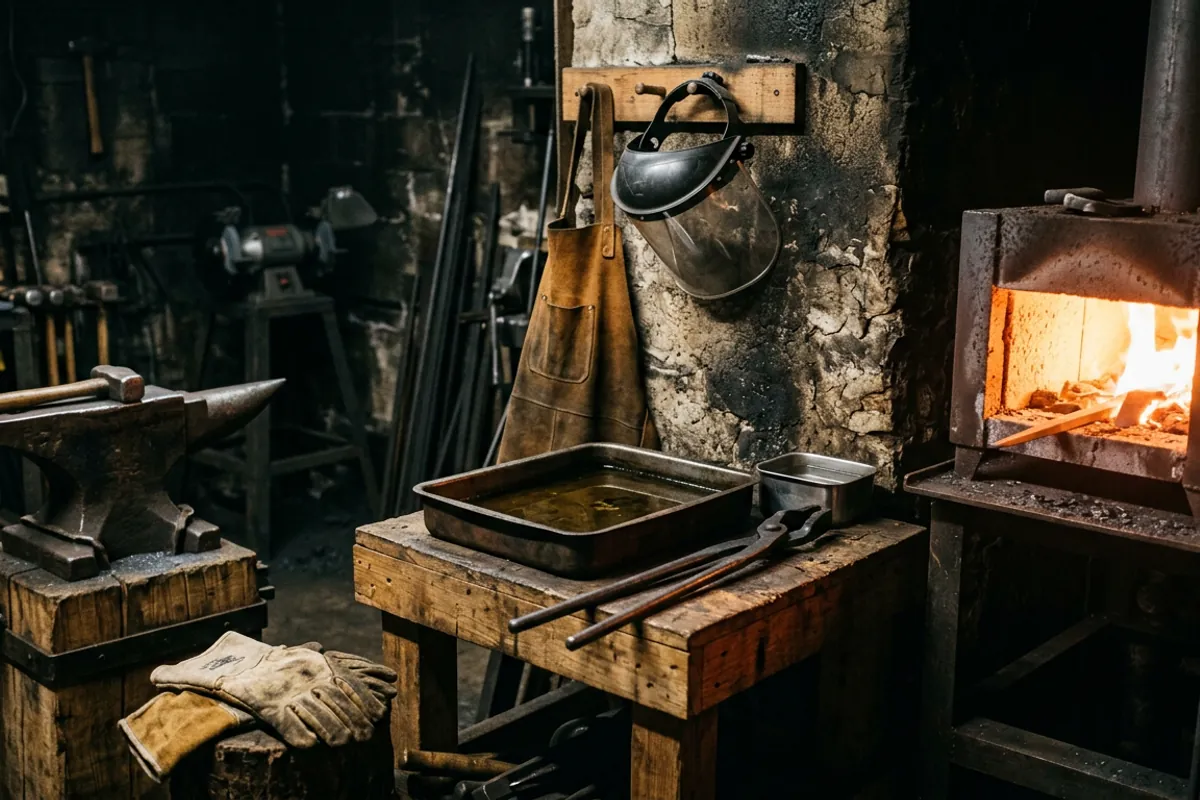
Eyes and skin next. Wear eye protection rated to ANSI Z87.1 whenever the forge is lit or the grinder is running; forge glare and grinder sparks are both waiting to take an eye. Dress in natural fibers, cotton, wool, or leather, and keep synthetics away from heat entirely. This is not a general rule I am passing along secondhand. Early on I quenched a blade in oil that was too cold, standing too close in a cotton shirt with no face shield, and the oil flared and took my eyebrows. I kept my eyesight by luck. So: quench oil at temperature, not cold, a face shield when you quench, a leather apron, and do not crowd the tank. And keep flux off the wool, both because it destroys your forge and because a flux fume faceful is its own bad day. If you want the full rundown, we keep one at blacksmith safety gear.
What I would tell a friend
Buy a single burner. If money is tight, the Simond Store single burner will get you forging for the least. If you can stretch a little and want a US maker behind it with a deeper owner base, the Hell's Forge single burner is the one I would actually pick. Skip the double burner unless you already know you are doing Damascus or longer stock, because otherwise you are paying in fuel and noise to heat air.
Then spend what you saved where it changes your knives most: a grinder. A forge shapes the steel, but the edge and the finish are ground, and a starter belt grinder does more for your results than a fancier forge ever will. Start with the 2x72 belt grinder for knife making, and if you want to compare the wider field of gas forges before you commit, the gas forge buying guide and the rest of the knife making hub are there. Remember the one thing a glowing chamber cannot promise you: the forge gets the shape hot, but a knife that holds an edge comes from verified heat treat, not a color you guessed. Buy the forge that gets you forging this month, and get to the steel.