4140 is one of those steels that shows up in a home shop long before anybody plans it. You buy a chunk of round bar for an axle repair, somebody hands you an offcut and says it makes good hammers, or you order it on purpose the first time you decide to make your own top and bottom tools. Then the question lands: how do you actually do a 4140 heat treat that gives you a tough, hard tool instead of a cracked one or a soft one? I have hardened plenty of it for striking tools and dies over the years, and it is a forgiving steel to work with once you understand what it is and what it is not. This is the reference I wish somebody had handed me: what 4140 is, how to normalize, anneal, harden, and temper it, and where the real hazards are.
Before I go further, one honest boundary. I am an experienced hobby smith, not a metallurgist and not a commercial heat treater. The chemistry ranges and the austenitizing temperatures below are published spec numbers you can check against any 4140 data sheet, and I have kept them exactly as published. The moment you need a guaranteed hardness on a critical part, you send it to a shop with a real furnace and a Rockwell tester, and I say so again at the end.
What 4140 actually is
4140 is a low-alloy, medium-carbon steel. The AISI number tells you most of what you need: the "41" means it is a chromium-molybdenum steel, and the "40" means roughly 0.40 percent carbon. The standard chemistry runs about 0.38 to 0.43 percent carbon, 0.80 to 1.10 percent chromium, 0.15 to 0.25 percent molybdenum, and 0.75 to 1.00 percent manganese, with the usual small amounts of silicon and the residual sulfur and phosphorus.
Those two alloying elements are the whole point. Chromium and molybdenum both push up what metallurgists call hardenability, which is not the same thing as hardness. Hardenability is how deep into the part the steel will harden on a quench, and how forgiving it is about quench speed. A simple carbon steel like 1045 has about the same carbon as 4140, but with no chromium or molybdenum it only hardens in a thin skin unless you quench it violently in water. 4140 will harden all the way through a decent-sized section in oil, calmly, without the cracking risk of a water quench. That is why it is a workhorse for tooling.
You will also run into 4140 sold "pre-hard," sometimes stamped 4140HT. That bar has already been quenched and tempered at the mill to somewhere around 28 to 32 HRC so it machines nicely and needs no further treatment for a lot of jobs. If you are making a tool that does not need to be hard, pre-hard 4140 is a gift: you cut it, drill it, and use it. If you want a hardened working face, you either start with annealed bar or you re-harden the pre-hard stock yourself.
Why smiths reach for 4140
For anybody making their own tools, 4140 sits in a sweet spot. It is tough, it takes a real hardness, it hardens deep, and it tolerates being worked and quenched without the drama of a shallow-hardening high-carbon steel. I use it for hammers, for hardy tools, for top and bottom fullers, for punches and drifts, and it is one of the common choices for power hammer dies. If you are building your own dies, the tradeoffs are worth reading up on separately in my notes on forge dies, because die steel selection is its own rabbit hole.
The reason it makes a good striking or struck tool is that medium carbon plus the alloy package gives you toughness. A hammer face at 0.40 percent carbon will not chip and shatter the way a poorly heat-treated high-carbon face can. The molybdenum also helps the steel resist temper embrittlement, a nasty condition where certain steels get brittle if you temper them in the wrong temperature window and cool them slowly. Molybdenum-bearing steels like 4140 are far more forgiving there, which is one more reason it is beginner-friendly for tooling.
The flip side, and I will come back to this, is that 0.40 percent carbon is low for a cutting edge. 4140 is a tool-body and striking-tool steel, not a blade steel.
Normalizing and annealing before you harden
If you have forged the part, the steel is now full of stresses and the grain structure is uneven from all that heating and hammering. Normalizing settles that down. You heat the piece to roughly 1600 degrees Fahrenheit, evenly, hold it just long enough to soak through, and let it cool in still air. Doing this once or twice after forging refines the grain and gives you a more predictable hardening later. I judge the temperature by color in a dim shop, but color is a rough gauge at best, and if you care about the number you use a thermocouple or a temperature-rated furnace.
Annealing is different from normalizing and gets confused with it constantly. Annealing is what you do when you want the steel as soft and machinable as possible, or when you need to drill and file the part before hardening. For 4140 you heat to about 1500 degrees Fahrenheit and cool it as slowly as you can, ideally in a furnace ramping down, or buried in vermiculite or wood ash so it loses heat over hours instead of minutes. Air cooling 4140 does not fully anneal it, because it hardens deep enough that still air already gives you a partial hardening. That deep hardenability that makes it a great tool steel is exactly what makes it stubborn to soften. If the difference between the two processes is fuzzy, I wrote a whole plain-language piece on what annealing actually does, and the same physics applies here.
The practical order for a home-shop tool is usually: forge it, normalize it, anneal it if you need to machine or drill it, then harden and temper.
The hardening step: austenitize and quench
Hardening 4140 is two moves: get it hot enough to become austenite, then cool it fast enough to trap that structure as hard martensite.
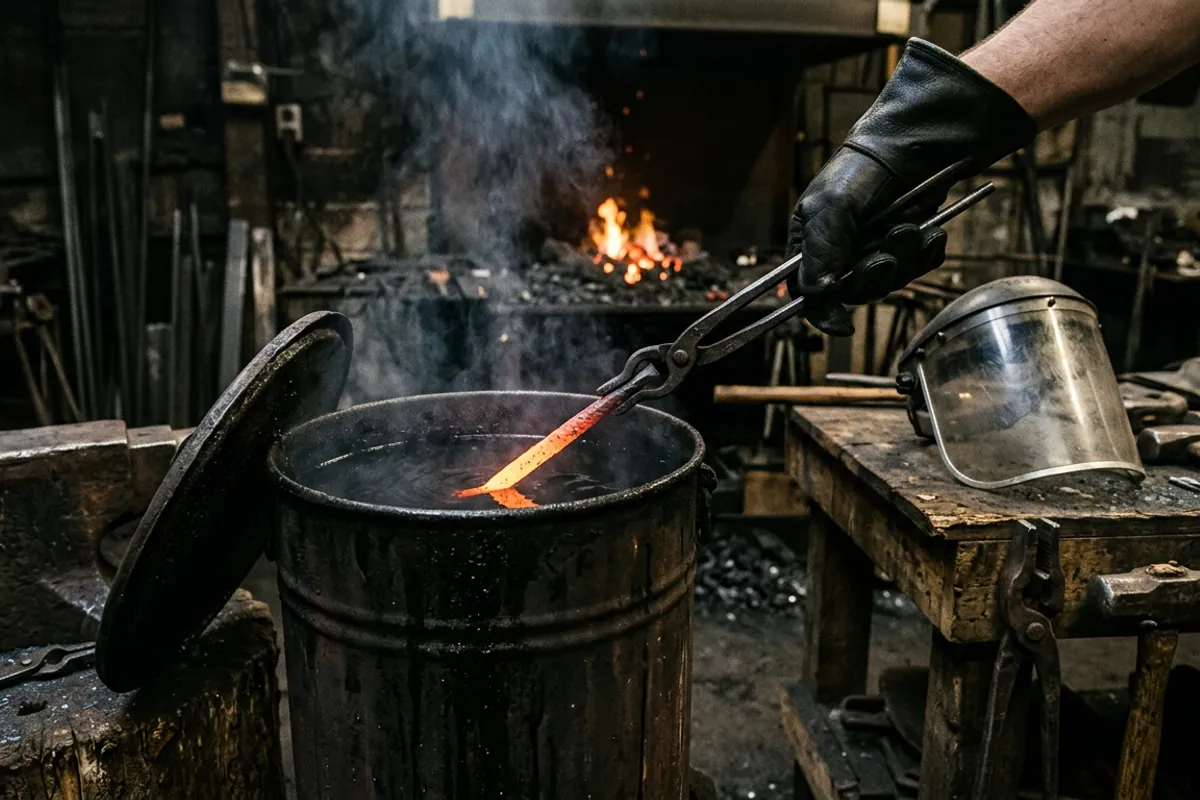
The published austenitizing range for 4140 is about 1550 to 1600 degrees Fahrenheit. You heat the part evenly to that range and give it a soak so the whole cross-section reaches temperature, not just the surface. Thin tools soak for a few minutes once they hit heat; thick sections need longer. A magnet is a decent field check for the low end, because steel loses its magnetism as it turns to austenite, but the non-magnetic point sits a little below your target for 4140, so you take it a shade past where the magnet lets go.
Then you quench in oil. 4140 is an oil-hardening steel and does not want a water quench; water is too aggressive for this alloy and invites cracking. A proper quenching oil, or in a pinch a canola oil that has been warmed, pulls the heat out at the right rate. Warm the oil first, to somewhere around 120 to 130 degrees Fahrenheit, because cold oil is thick, quenches unevenly, and is more likely to warp or crack the part.
As quenched, 4140 comes out in the mid to high 50s HRC, roughly 54 to 58 depending on the exact carbon and how clean your quench was. That is hard and brittle, and the part is under enormous internal stress. You do not let it sit there. It goes into the temper as soon as it is cool enough to handle.
The quench is where you get hurt
This is the step that took my eyebrows early on. I quenched a part in oil that was too cold, standing too close in a cotton shirt, no face shield, and the oil flared up the side of the tank and across my face. I kept my eyesight by luck, not by skill. So I will not soften this: an oil quench can flash into open flame, and hot steel plus oil is a real fire.
Quench in a metal container with far more oil than you think you need, so the mass of oil absorbs the heat without climbing toward its flash point. Have a metal lid within reach that fully covers the tank, because a lid smothers an oil fire and water does not. Never quench near your forge flame. Wear a face shield rated to ANSI Z87.1 and wear natural fibers, wool or cotton or leather, not synthetics that melt onto skin. Plunge the part in point-down and keep it moving, and keep your face back and out of the plume. I treat every quench as if it will flare, and most of the time it does not, and the one time it does I am ready.
Tempering 4140 for the job it will do
A freshly quenched 4140 tool is too brittle to use. Tempering trades away a little hardness for a lot of toughness, and where you land depends entirely on what the tool does. The general direction is simple: the hotter you temper, the softer and tougher the result. Tempering around 400 degrees Fahrenheit keeps most of the hardness; going up toward 900 or 1000 degrees drops you well down into the 40s and eventually the 30s HRC. Those are ballpark figures. For a target hardness you actually care about, pull the published tempering chart for 4140 and match your temper temperature to it, because the exact hardness at each temperature depends on the specific bar and your soak.
The way I think about it by job:
A punch or drift that has to survive being struck wants toughness over extreme hardness, so I temper it back toward the mid 40s HRC. A hammer or a fuller face wants to be harder to resist denting but still tough enough not to chip, so those live a little higher on the hardness scale. Power hammer dies are a whole conversation, because die hardness is a balance between resisting deformation and not spalling under repeated impact, and that is exactly the kind of question I would verify against a data sheet or a heat-treat reference rather than guess.
Temper for at least an hour once the part is fully up to temperature, and doing two tempering cycles is good practice. A kitchen oven works up to about 500 degrees Fahrenheit and is honestly fine for the harder tools; above that you need a proper furnace, because you cannot reliably hold 800 or 900 degrees in a home oven. If the whole idea of temperature versus hardness is new to you, my walk-through of how tempering works by heating and cooling covers the mechanism in plain terms, and it is worth reading before you commit a tool you spent hours forging.
One more note that trips people up: 4140 does not show reliable temper colors the way plain high-carbon steel does, and even when it does, those straw-to-blue colors are a crude gauge on any steel and useless on an alloy steel like this. Temper by measured temperature and time, not by watching the color run.
What can go wrong
Cracking is the big one, and it almost always traces back to the quench. Cold oil, a water quench on a steel that wanted oil, sharp internal corners that concentrate stress, or a part that was overheated well past its austenitizing range all invite cracks. Keep the oil warm, keep sharp inside corners radiused where you can, and do not soak the steel hotter or longer than it needs.
Warping comes from uneven heating or an uneven quench. Heat the part evenly, enter the quench straight and point-first, and keep it moving so the oil does not blanket one face.
Soft spots usually mean the steel did not get to temperature everywhere, or the quench was too slow in a thick section, or you had scale and crud insulating a patch of surface. 4140's deep hardenability helps you here, but it is not magic; a big cross-section still needs a real soak.
And the quiet failure mode: skipping the temper, or waiting too long to do it. A hardened, un-tempered 4140 tool can crack sitting on the bench overnight from its own internal stress. Temper it the same day you harden it.
What 4140 is not for
I get asked constantly whether 4140 makes a good knife. Owner consensus and my own experience both land in the same place: not really, not if you want an edge that holds. At about 0.40 percent carbon, 4140 simply does not have enough carbon to reach the high hardness a cutting edge needs for good wear resistance. You can make a knife-shaped object from it, and it will be tough as a pry bar, but it will not take and hold an edge like a proper high-carbon or alloy blade steel. For actual blades I reach for the steels I cover in how knife making really works, and I leave 4140 for the tools that beat on the knives.
Where 4140 shines is exactly where the load is impact and stress rather than a keen edge: hammers, struck tools, dies, axles, shafts, wrenches. Use it for what it is good at and it is one of the most useful bars in the rack.
When to send it out and where to read further
Here is the honest limit of a home shop. I can hit the austenitizing range by eye and magnet, quench in oil, and temper in an oven, and for my own tools that is plenty. But I cannot certify a hardness, I cannot hold a tight temperature across a big furnace load, and I cannot run a controlled slow anneal on a thick part the way a commercial furnace can. When a part is critical, or when I want a guaranteed number, it goes to a heat-treat shop. I walked through what that service actually buys you in my piece on commercial heat treating for a smith, and it is money well spent on anything that matters.
For the real metallurgy, the exact tempering response, the fracture toughness, the carbide behavior, I do not invent numbers and neither should you. Knife Steel Nerds is the source I trust for tested steel data and heat-treat science, and it is where I send anybody who wants to go deeper than shop rules of thumb. This whole subject sits inside the larger steel and metallurgy topic, where I keep the rest of my plain-language write-ups on how steel behaves in the fire. Learn the pattern once and you will heat treat 4140 with confidence, and know when to hand it off.