AEB-L steel comes up every time a student asks me which stainless a knife maker should learn on, and the answer usually surprises them, because AEB-L is not new, not expensive, and not exotic. You will see it written as AEB L steel, AEB-L, or sold under the near identical Sandvik designation 13C26 depending on who has it in stock, and in every case it is the same basic idea: a lean stainless with a very fine carbide structure, originally designed for razor blades, that happens to make very good knives. I have been forging about twenty-five years, mostly hot work with a hammer on plain carbon steels, so I want to be straight with you up front. Stainless is the corner of this craft where I read published testing more than I swing a hammer, and where I say plainly what is my experience and what is owner consensus and lab data. If you want the wider map of what steel does what, the steel and metallurgy hub is the place to start.
A razor blade steel that ended up in knives
AEB-L is a martensitic stainless steel from Uddeholm. The nominal analysis on the mill datasheet is roughly 0.67 percent carbon and 12.8 percent chromium, with small additions of silicon and manganese and essentially nothing else. No vanadium, no molybdenum, no niobium, no nitrogen. That short ingredient list is the whole story, and it is why the steel behaves the way it does.
Here is the part that matters and that most gear writing skips. Chromium is what makes a steel stainless, but chromium only protects the steel while it is dissolved in the matrix. When there is more carbon than the matrix can hold, carbon and chromium combine into chromium carbides, and every carbide that forms pulls chromium out of solution where it is no longer doing corrosion work. AEB-L is balanced so that at normal hardening temperatures almost all of that 12.8 percent chromium stays in solution. Very little of it gets locked up in carbide. The result is a steel that punches above its chromium number for corrosion resistance and that has, by the standards of stainless knife steel, almost no carbide in it at all.
Compare that to a high carbide stainless like 440C or D2. Those steels are full of large chromium carbides, some of them big enough to see easily under a shop microscope. AEB-L is not. The carbide measurements Larrin Thomas has published through Knife Steel Nerds put AEB-L down at roughly 4 to 6 percent carbide by volume, with particles a micron or less across. That is a different class of microstructure, and it drives everything else on this page.
Where it came from, and why that still matters
Uddeholm developed AEB-L as a razor blade steel. Think about what a razor blade has to do: be ground to an edge measured in fractions of a thousandth of an inch, hold up against hair and skin, and not rust in a wet bathroom. It does not need to survive cutting cardboard all day. It needs an edge that can be made absurdly thin without falling apart.
To do that, the steel has to have a microstructure where the carbide particles are much smaller than the edge itself. If your edge apex is a fraction of a micron wide and your carbides are five microns wide, the apex is essentially a row of gravel glued together, and pieces fall out. Fine carbides mean the apex is a continuous, supported edge. That is the design goal AEB-L was built around, and it is why a steel from the shaving industry ended up being one of the best kitchen knife steels available to a home shop.
The history also explains the format you will find it in. AEB-L is sold mostly as thin, precision ground flat stock, because that is what blade blanking lines want. Thicker bar exists but it is less common and you will pay more attention to sourcing it.
What the fine carbide structure buys you
Three things, and they are real.
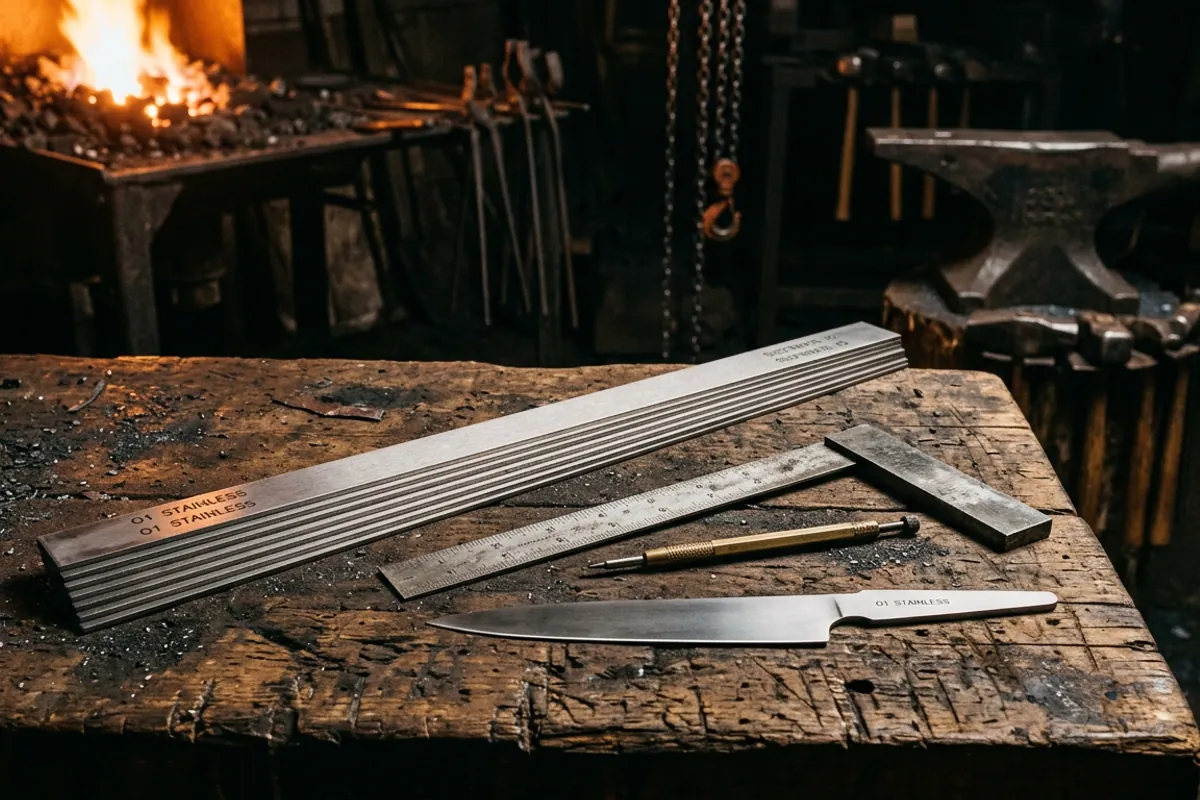
Toughness. In the impact toughness testing Knife Steel Nerds has published, AEB-L sits at or near the top of the stainless steels at comparable hardness, and it holds its own against a number of simple carbon steels people assume are automatically tougher. Big carbides are crack starters. A steel with almost none of them resists chipping and breaking in a way that surprises people who judge steel by its datasheet alloy list.
Edge stability. This is a different property from toughness and from wear resistance, and it is the one that makes a kitchen knife feel good. Edge stability is the ability to take a thin geometry without the apex deforming or crumbling. AEB-L will take a very acute edge and hold that geometry. You can grind it thin behind the edge, which is worth more in actual cutting than a couple of points of hardness ever will be.
Fine finish and easy sharpening. Low carbide volume means the steel is not abrasive on your stones or your belts. It takes a keen edge fast, it takes a clean hand rubbed finish, and a beginner can restore an edge on a cheap stone without any drama.
Add real corrosion resistance to that list. AEB-L is a genuine stainless. It is not immune, and citrus, salt, and a wet sheath will still mark it if you neglect it, but it will live in a kitchen or a fishing kit without complaint.
What AEB-L is not good at
Abrasive wear resistance. That is the trade, and it is not a small one.
Carbides are hard particles, and hard particles are what resist abrasion. A steel with almost no carbide has almost no abrasion resistance to sell you. Against a modern powder steel loaded with vanadium carbide, AEB-L will lose a slicing edge retention test badly. If your work is cutting cardboard, rope, carpet, or anything else that grinds an edge away rather than deforming it, AEB-L is the wrong choice and I would not pretend otherwise.
What confuses people is that a well ground AEB-L knife often feels like it stays sharp longer in the kitchen than a high wear steel does. That is geometry, not wear resistance. Thin cuts better, and a thin edge that survives is worth more than a thick edge that lasts. It is not that AEB-L resists abrasion. It is that you were allowed to grind it thinner in the first place.
The other limitation is availability of thick stock, which rules it out for choppers and heavy field knives more often than the steel itself does. And if you want a comparison against the current top of the stainless field, my writeup on MagnaCut covers the steel that was specifically designed to get both low carbide brittleness and high wear resistance in one alloy. AEB-L gets you one half of that at a fraction of the price.
The family: 13C26, 14C28N and Nitro-V
You will run into three near relatives, and knowing the difference saves you money.
13C26 is Sandvik's steel, at roughly 0.68 percent carbon and 13 percent chromium. For practical purposes it is the same steel as AEB-L. Makers use the same heat treat recipes for both and report the same behavior. Buy whichever your supplier has.
14C28N is Sandvik's later development, with more chromium, less carbon, and a nitrogen addition, roughly 14 percent chromium and about 0.11 percent nitrogen. Nitrogen does some of the work carbon does without forming carbide, so 14C28N trades a little peak hardness for better corrosion resistance. It is a different steel with a different heat treat window, not a drop in substitute.
Nitro-V is AEB-L with small nitrogen and vanadium additions, sold in the United States. Owner consensus is that it behaves very much like AEB-L in the shop with a small corrosion resistance gain. I have not seen independent testing that convinced me the difference matters for a home shop knife, and I would buy on price and stock thickness rather than on the marketing.
Heat treating AEB-L in a home shop
This is where I have to be blunt, because it is where people ruin good steel.
You cannot heat treat AEB-L by eye in a forge. Not in a coal forge, not in a propane forge, not with a magnet. The magnet test tells you when the steel passed its Curie point, which for stainless is hundreds of degrees below where you actually need to be, so nonmagnetic tells you nothing useful here. AEB-L needs a controlled oven, a real soak at temperature, and a fast quench. If you do not have a temperature controlled oven, send the blade out or pick a steel that suits the tools you own. There is no shame in that, and my stainless heat treat guide walks through the honest home shop options.
Austenitizing and the quench
Reseller and supplier sheets derived from Uddeholm's data put hardening around 1050 to 1080 C, the high 1900s Fahrenheit. I have not been able to put hands on an Uddeholm issued sheet to confirm it, so treat that as reseller published rather than the mill's own word. Most makers I have read settle around 1950 F with a soak in the ten to fifteen minute range once the blade is at temperature. Go to the current published datasheet from the mill and to the Knife Steel Nerds testing writeups for the exact numbers rather than to a forum post, because recommendations for this steel have been refined by actual hardness and toughness testing, and the refinements matter.
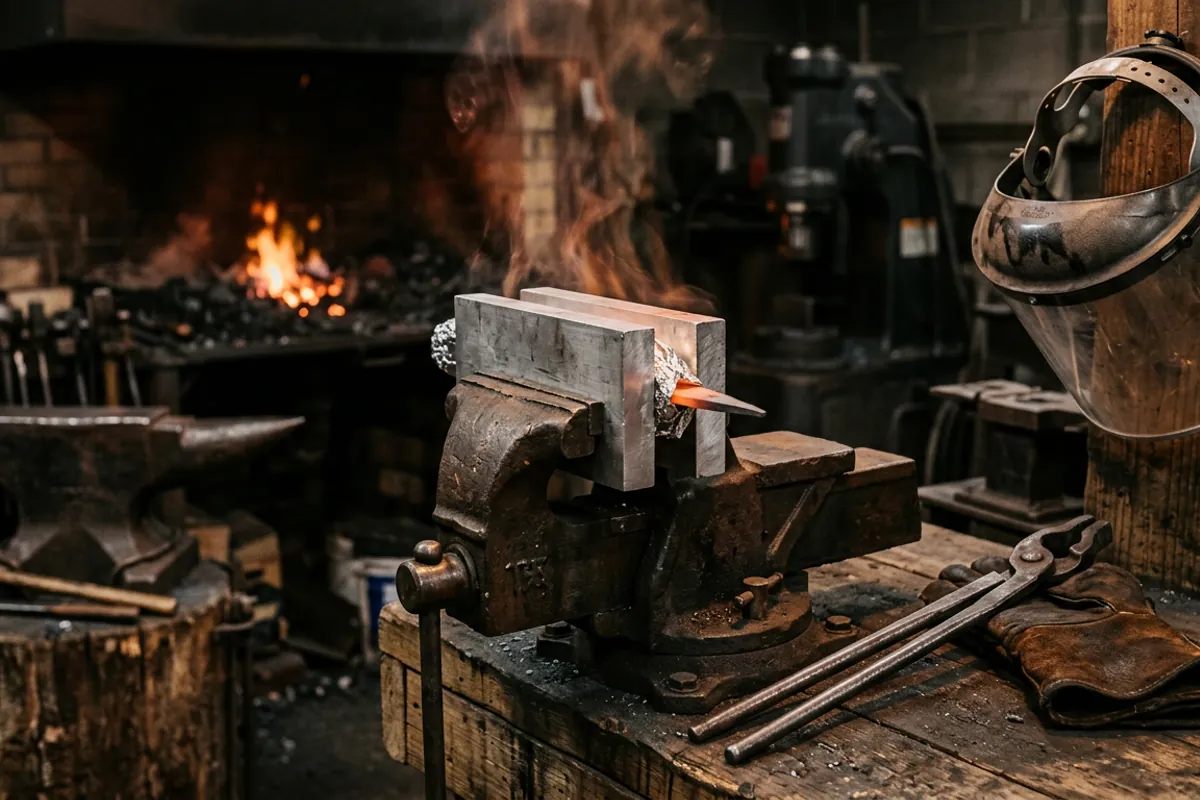
Wrap the blade in stainless foil to keep the surface from decarburizing and scaling. Quench between aluminum plates, which is the standard method for thin stainless stock and gives you two things at once: a fast enough cool and a flat blade. Oil will work but it warps thin blades more, and I do not need to sell anyone here on avoiding an oil quench. I stood too close to one in a cotton shirt with no face shield early on and lost my eyebrows to the flare when the oil was too cold. Plate quenching does not remove the hazard entirely either. That foil packet is coming out of the oven at close to 2000 F and it has sharp edges. Long tongs, a face shield, ANSI Z87.1 rated eye protection under it, natural fiber clothing, and leather. My full rundown on that is in the safety gear guide.
Cryo and tempering
AEB-L retains austenite after the quench. Untransformed austenite costs you hardness and can convert later, which is not something you want happening inside a finished blade. The fix is a subzero treatment immediately after the quench and before tempering. Dry ice in a solvent bath gets most of the benefit and liquid nitrogen gets slightly more.
Both of those carry real hazards that gear writing tends to gloss over. Liquid nitrogen displaces oxygen, so it does not belong in a closed shop, and skin contact causes cryogenic burns. Acetone, the usual dry ice slurry liquid, is highly flammable and has no business anywhere near a lit forge. Handle it outdoors or with strong ventilation, wear cryo rated gloves rather than welding gloves, and treat it like the chemistry it is.
Temper low, twice, two hours per cycle, in the 300 to 400 F band depending on the hardness you want. Do not chase the higher tempering ranges that plain carbon steels tolerate, because in a chromium steel that region costs you corrosion resistance and toughness. Most makers land AEB-L between 60 and 62 Rc, which is where the steel is doing its best work. If tempering itself is fuzzy for you, I cover the mechanism plainly in how tempering works, and the broader hardening picture is in hardening stainless.
Forging AEB-L, and why most people do not
AEB-L can be forged. Most people do not, and I think they are right.
The steel comes as precision ground flat stock in exactly the thicknesses knives want, so forging buys you almost nothing but risk. It has a narrower working range than a simple carbon steel, it is unforgiving if you work it cold, and it has enough alloy that a thin forged piece cooling on the bench will pick up hardness on its own rather than staying soft and file friendly. That means after any hot work you owe it a proper controlled anneal before you touch it with a grinder, and a slow cool at that. My annealing guide covers what annealing is actually doing and why a fast cool does not accomplish it.
AEB-L does show up in stainless damascus, usually paired with a nickel bearing stainless, but that work needs a press or power hammer and a controlled atmosphere. It is not coal forge work in a home shop, and the people doing it well have equipment and process control most of us do not.
Grinding, finishing and the part people skip
Annealed AEB-L is reported as easy, clean grinding, and the makers I trust say the same: no fight, no glazed belts, nothing like a high vanadium steel. That is one reason I steer beginners toward it.
Two cautions. First, after heat treat, heat is your enemy. It takes very little to draw the temper at a thin edge, and the damage is invisible until the knife will not hold an edge and you cannot understand why. Grind post heat treat with fresh belts, light pressure, and frequent dunks, or leave enough material to finish by hand.
Second, the dust. Grinding stainless throws chromium bearing particulate, and grinding dust in general is not something to breathe. That means a properly fitted respirator, not a paper dust mask, plus dust collection or at minimum working where the air moves. Eye protection at the grinder is not optional, and it is rated eye protection, not the sunglasses that were on the bench. Sparks off a belt find the gap in whatever you are wearing, so natural fibers, no synthetics, and no loose sleeves. If you want the grinder side of this in more detail, I covered what actually matters in a 2x72 grinder.
Who should be using AEB-L, and who should not
Buy AEB-L if you are making kitchen knives, paring knives, fillet knives, straight razors, or anything else where a thin, keen, stainless edge is the point. Buy it if you are learning stainless heat treat and want a forgiving steel with well documented parameters and a lot of published testing behind it. Buy it if you want a knife somebody will actually use, wash, and leave in a sink without ruining.
Skip it if your knives cut abrasive material for a living, if you want a chopper thicker than the stock you can find, or if you do not own or have access to a temperature controlled oven. Those are honest limits, not flaws.
For me the appeal is simple. AEB-L is an old, cheap, unglamorous steel that does one thing extremely well because it was designed to do exactly that thing, and it holds up against much more expensive steels in the properties that actually decide whether a knife cuts. That is the same reason I still work on a 148 pound Trenton instead of chasing something newer. If you want help comparing it against the other options side by side, the steel selector lays them out, and for the deep metallurgy, the hardness and toughness and edge retention testing published by Larrin Thomas at Knife Steel Nerds is where I send every question I cannot answer from the floor of my own shop.