Somebody asks me about forging galvanized steel about twice a year, usually while holding a free length of fence rail or standing next to a pile of angle iron a contractor dropped in their driveway. The answer is no, and this is one of the few questions where I do not have a nuanced version. Galvanizing is a zinc coating over steel, and forge heat sits above the temperature at which zinc boils, so the coating does not politely melt and drip off the bar. It leaves as vapor, condenses into fine zinc oxide particles in the air right in front of your face, and you breathe it. What follows is the why: what the coating is, what the published exposure limits actually say, what metal fume fever is and is not, how I spot coated stock before it gets anywhere near the fire, and what I do with the free steel instead.
What galvanizing actually is, and why forge heat is the problem
Galvanized steel is ordinary steel wearing a zinc coat, put there so the steel does not rust. Hot dip galvanizing dunks the whole part in molten zinc and leaves a thick, slightly rough layer, often with that crystalline spangle pattern you see on new fence posts and stock tank frames. Electroplated zinc is thinner and flatter, more of a dull uniform grey than a shine. Either way, the zinc is on the outside of the bar, which is exactly where the fire touches first and hardest.
The Royal Society of Chemistry's periodic table entry for zinc lists its melting point as 419.527°C (787.149°F) and its boiling point as 907°C (1665°F). Hold that second number against what you are doing when you forge. You are not working steel in a range where zinc merely melts and runs off. You are working it above the point where zinc boils. That is the entire physical argument, and I am not going to dress it up with anything fancier: the coating turns to vapor, and vapor in a shop is something you inhale.
This is also why there is no version of the job where the zinc quietly stays put. The American Galvanizers Association says of the welding case that "All welds on galvanized surfaces destroy the zinc coatings at the weld site." Forging is that problem spread out. A welder ruins the coating along a bead. You are heating the whole working length of the bar to forging heat, pulling it out, hitting it, and putting it back in for another heat, and another, with your head over the work the entire time.
What the exposure numbers actually say
The National Institute for Occupational Safety and Health publishes a pocket guide entry for zinc oxide, and the numbers in it are worth knowing because they are small. The NIOSH recommended exposure limit is a time weighted average of 5 mg/m3 with a short term limit of 10 mg/m3. The OSHA permissible exposure limit is a time weighted average of 5 mg/m3 for the fume. The immediately dangerous to life or health value, the level at which escape becomes the only thing that matters, is 500 mg/m3.
Those units are milligrams of material per cubic meter of air, and the time weighted average is spread across a work shift rather than measured in a single breath. That framing matters for a hobby smith, because a forty minute session at the fire is not a shift, and people use that to talk themselves into it. Here is the part that kills the argument. NIOSH's own writeup from the 1988 review of the OSHA limits says of zinc oxide fume that "exposures even at 5 mg/m3 can cause this syndrome." The limit is not a safe zone with a comfortable margin under it. It is the line a workplace is required to stay under, and people get sick at it.
I am not going to tell you how much zinc a given bar puts into your air, because I do not know and neither does anyone who has not sampled it. There is no personal sampling pump in my shop and there is not one in yours. That is the real problem with the numbers: they are perfectly checkable and completely unmeasurable where you and I work. When you cannot measure the exposure and the published limit is this low, the only control you actually have is not creating the fume.
What metal fume fever is, and what it is not
Metal fume fever is the illness that comes from breathing freshly formed metal oxide fume, and zinc is its most common cause. The American Galvanizers Association notes that it goes by "zinc chills, zinc shakes or Galvanize poisoning" in the trades, and describes the presentation as "a sweet taste in the mouth, dryness of the throat, fatigue, nausea, vomiting, chills or fever, rarely exceeding 102-degrees."
NIOSH's symptom list for zinc oxide is longer and worth reading in full rather than in summary: "chills, muscle ache, nausea, fever, dry throat, cough; lassitude (weakness, exhaustion); metallic taste; headache; blurred vision; low back pain; vomiting; malaise (vague feeling of discomfort); chest tightness; dyspnea (breathing difficulty), rales, decreased pulmonary function."
Read the back half of that list again. Chest tightness, difficulty breathing, crackling in the lungs, and reduced lung function are not a bad afternoon. The American Welding Society's fact sheet on metal fume fever says "the attack may last 6 to 24 hours. Complete recovery generally occurs without intervention within 24 to 48 hours." People take that sentence and turn it into "you get the zinc flu, you sleep it off, no harm done." I will not sign that. Resolving is not the same as harmless, the fact that most people recover says nothing about the person who does not, and I am not going to hand you home treatment advice from behind an anvil. If you have breathing symptoms after heating galvanized metal, that is a question for a doctor or poison control, not for me.
One more thing about the shape of it. Ask ten welders and they will tell you the same thing: it does not hit you while you are working, it hits you after. That is secondhand, not something I have any way to verify, but it explains why the mistake is so easy to repeat. You feel fine at the fire, so the fire seems fine.
How I spot galvanized steel before it goes in the fire
None of this is a lab test. It is what I look at, and I will say plainly that it is shop experience rather than something I can cite, so treat it as a filter and not a guarantee.
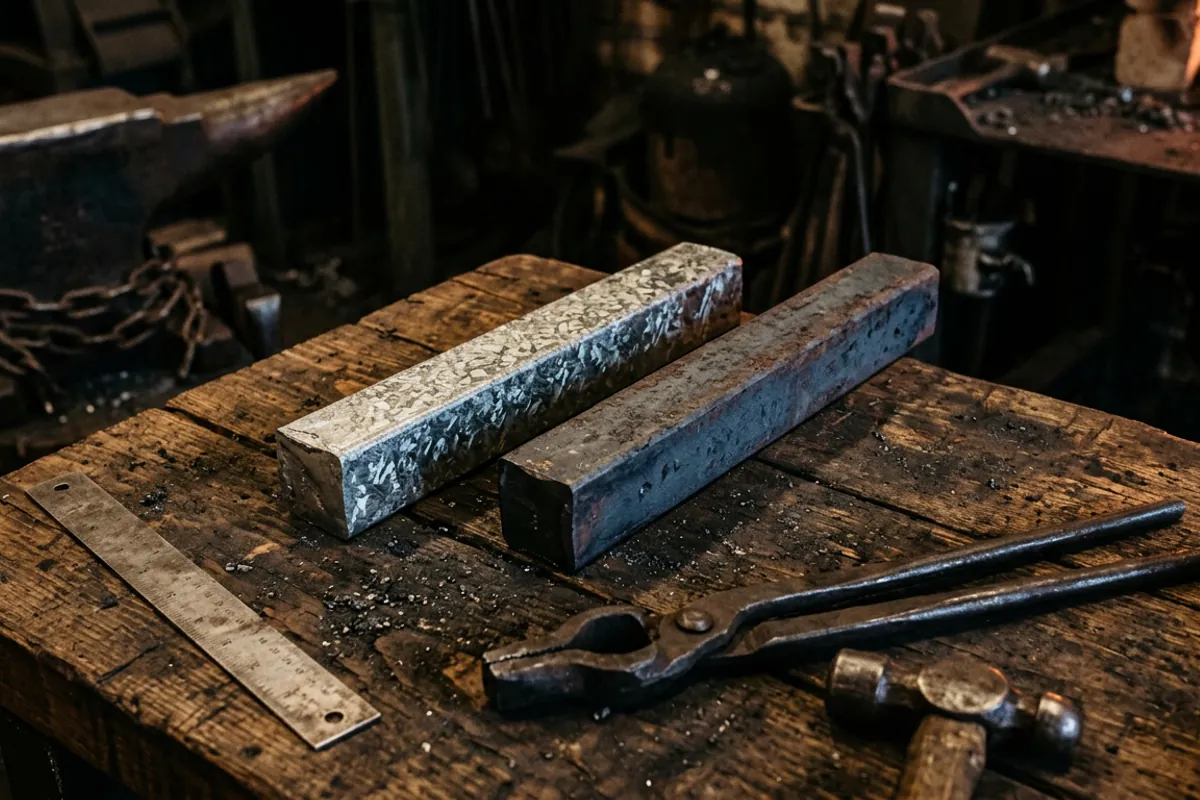
Hot dip is usually the easy one. The coating is thick enough to see and feel, the surface has a faint texture instead of mill scale's flat grey black, and fresh work often carries that spangle, the frost pattern of crystals across the surface. Older hot dip weathers to a chalky grey that still does not look like bare steel. Electroplated zinc is subtler: a thin, very even grey with a bit of sheen, the kind of finish that looks too uniform to be a hot rolled bar. Plated fasteners often carry a yellow or blue cast from a chromate over the zinc, which is a second coating I know even less about and a second reason not to heat them.
Then there is provenance, which tells me more than appearance most days. Chain link fence parts, cattle panel, stock tank hardware, roofing and ductwork sheet, electrical conduit, threaded water pipe and its fittings, trailer hardware, most of the bolts in a hardware store bin: assume coated until proven otherwise. Painted stock is its own unknown, and I do not put paint in the fire either.
When I cannot tell, the piece does not go in the fire. That is the whole rule. Free scrap is how most of us started, myself included, and I still think a beginner learns plenty from junkyard steel, but there is a difference between not knowing what alloy you have and not knowing what is coating it. The first is a forging puzzle, and I have written up how I test unknown steel for exactly that. The second is a breathing problem, and it has no puzzle to it. The same goes for the classic free stock projects: a railroad spike is bare steel and fair game, and a galvanized fence post is not, even though both showed up for free.
Can you forge galvanized steel if you burn the coating off first
This is the actual question behind the question, so let me answer it directly. Burning the coating off is the exposure. There is no step in that plan where the zinc leaves the steel without becoming fume, because becoming fume is how it leaves. Doing it outdoors, doing it upwind, doing it fast, doing it with the shop fan on: all of those change how much of it reaches you, and none of them change what is happening. I do not do it and I do not teach it, and I am not going to write a procedure here that somebody quotes back to me later as permission.
I get why the idea is appealing. Free material, an hour of work, a bar of perfectly good mild steel at the end. But steel is the cheap part of this hobby. A stick of new hot rolled bar of known composition costs less than most of the consumables in a session, and it does not ask you to gas yourself first. Free steel that comes with a respiratory exposure is not free, it is just billed later.
You will also hear people suggest stripping the coating chemically with muriatic acid. Muriatic acid carries its own set of hazards, I have not vetted a source on it that I would put my name behind, and it is outside what this article covers. Grinding the coating off trades fume for dust, and I have nothing sourced to hand you there either. When my honest answer is "I do not know a safe way to do that," you get the honest answer and not a confident guess.
What the workplace rule says, and why it is not a permission slip
There is a federal rule for this, and it is more specific than most people expect. OSHA's welding, cutting and brazing standard at 29 CFR 1910.252(c)(6) covers zinc bearing base or filler metals and zinc coated metals. For indoor work, it requires local exhaust ventilation or airline respirators. General ventilation, which is the category a fan and an open door fall into, does not satisfy it.
Understand what those two allowed controls actually are. Local exhaust means a hood or nozzle capturing the fume at the point where it is made, before it gets into the room air and before it gets to you. An airline respirator means clean breathing air piped to your mask from somewhere else entirely. A home shop, mine included, has neither of those things. So the workplace rule is not a set of hoops that lets you proceed. Read as an amateur, it says the two controls a regulator will accept for this exposure are both things you do not have, which leaves you at the hobby answer: do not forge it.
I want to be exact on one point, because it is where people go looking for a loophole. I will not tell you that a cartridge respirator from the hardware store makes forging galvanized steel acceptable. OSHA's answer to this exposure is exhaust at the source or supplied air, I have no sourced hobby respirator recommendation to hand you, and a poorly fit filter mask on a bearded smith is closer to a comfort item than a control. The line the American Welding Society puts on its fact sheet is the one worth remembering anyway: "Keep your head out of the fumes."
Ventilation in a forge shop matters for reasons that have nothing to do with zinc, and I have written those up on their own rather than repeating them here. If you are thinking about shop air in general, start with how I set up a shop, then the pages on forge carbon monoxide and on what coke changes in the firepot. The rest of the protective gear discussion lives in the safety and PPE hub and in my writeup on what safety gear actually earns its place.
The galvanized parts that live in a shop anyway
Zinc coated steel is everywhere in a shop and most of it is fine, because cold galvanized steel is not the hazard. Heat is. The bolts holding your anvil stand together, the galvanized bucket of scale by the door, the conduit in the wall: none of that is a problem sitting there. The problem is when a coated part ends up somewhere hot, usually by accident, and here are the ones I watch for.
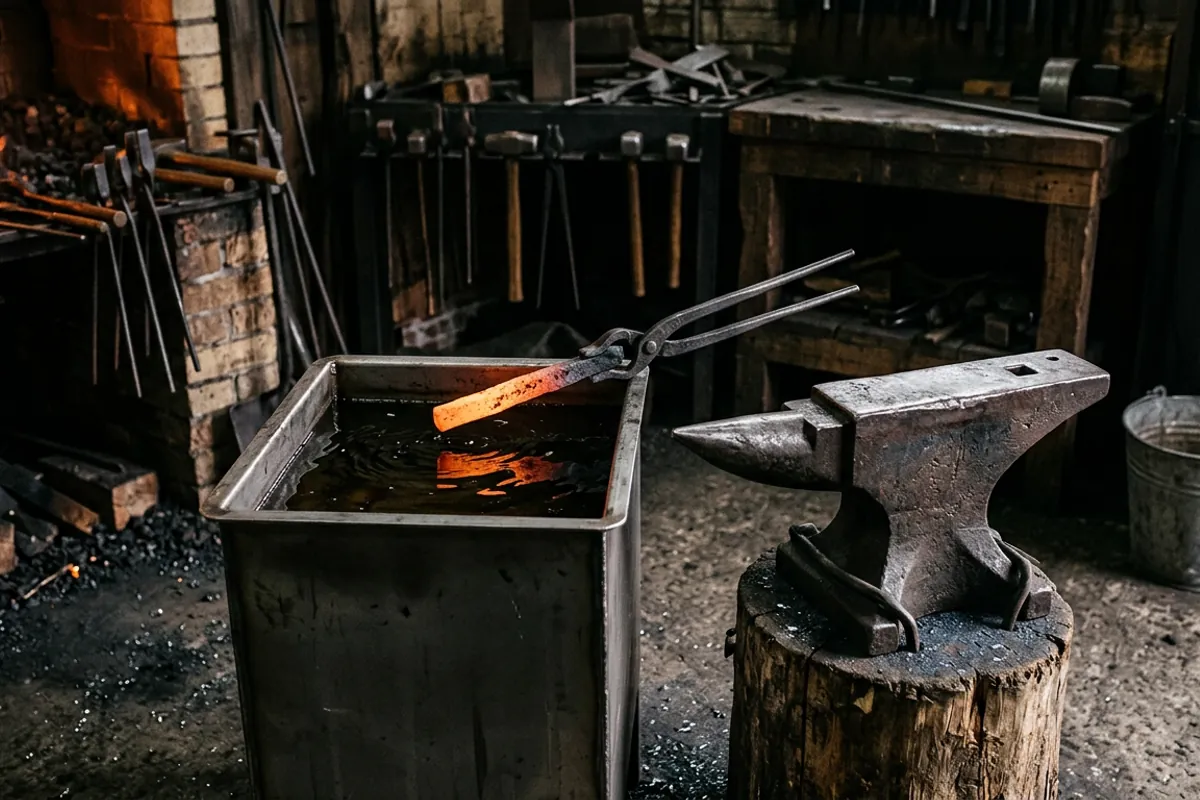
The quench tank is the big one. A galvanized pail is a common free container, and a bar at quenching heat going into one is hot steel pressed against a zinc coating. I use a plain steel tank with no coating on it, for that reason and because a pail is a tipping hazard next to a fire regardless. If you are working out what to quench in, that belongs with the rest of the quench oil discussion rather than being decided by whatever bucket was in the garage.
Then there is galvanized wire. It is the handiest tie material in the world and it is the wrong thing to bundle stock with if the bundle is going in the fire. Same for using a scrap of galvanized sheet as a fire shield or a scrap of conduit as an improvised handle on a hot tool. And if you are building a hood or a flue over a solid fuel forge, think about which parts of it sit in genuinely hot gas before you pick your material. I keep coated stock out of the hot end of anything I build.
The practical fix is boring and it works: I do not store coated material in the steel rack. It lives somewhere else entirely, so that on a busy afternoon when I am grabbing a piece by feel, the wrong bar is not in reach.
What I use instead
New hot rolled mild bar is the answer for most shop projects, and it is cheap enough that this is barely a decision. It comes uncoated, it forges predictably, and you know what you have. For anything where the steel needs to harden, buy known steel from a supplier who states the alloy, because guessing at heat treat on top of guessing at composition is a recipe for a part that fails in use. If you want to go deeper on the metallurgy of any of this, send those questions to people who actually test: Knife Steel Nerds runs real experiments on heat treatment and steel behavior, and that work is worth more than any number I could invent.
For the scrap pile, the sort is simple. Bare steel of unknown alloy goes in the pile for practice work, hooks, hardware and tool experiments, and I stay away from using it for anything that has to hold an edge or take a load. Coated steel goes to the metal recycler, where it is worth money to somebody with the equipment to handle it properly. Painted steel goes with it. If you are stuck for something to make with the honest half of that pile, my writeup on picking a forging project that teaches you something is a better use of an afternoon than trying to rescue a fence post.
The short version
Zinc boils at 907°C (1665°F) per the Royal Society of Chemistry, forging heat is above that, and the coating leaves the bar as fume you breathe. NIOSH and OSHA both hold zinc oxide fume to a time weighted average of 5 mg/m3, and NIOSH says exposures even at that level can cause the syndrome. Metal fume fever is real, it is documented by the American Welding Society and the American Galvanizers Association, and the fact that most attacks resolve in a day or two does not make it something to accept on purpose. OSHA's rule for indoor work on zinc coated metal allows local exhaust or airline respirators and not general ventilation, which for a home shop means the honest answer is do not forge it.
So: check the bar before it goes in the fire, keep coated stock out of the rack, buy known steel, and keep your head out of the fumes. That is the whole page, and it is the one piece of gear advice on this site that costs nothing and is not negotiable.