Buying forge coke is less like buying a tool and more like buying gravel. Most of what you pay is freight, what you can even get depends on where you live, and the difference between a good bag and a bad one is written on an analysis sheet most sellers never put in front of you. Before anything else, here is my footing: I have never bought coke by the pallet. My own fire is a coal forge for heavy stock and welding, and a propane forge for most of the day to day work. So everything below about specific bagged product leans on sellers' published analyses that I pulled and read on 2026-08-19, plus what owners report, weighed against shop experience. It is not a bench test and I am not going to dress it up as one.
The short version, if you want the verdict before the reasoning: buy sized metallurgical coke in 50 pound bags from the nearest farrier or blacksmith supply that will hand it to you over the counter, buy several bags at once or go in with your club, and spend what you save on freight on a blower that can actually feed the fire and a carbon monoxide alarm on the shop wall. If you have never run solid fuel at all, start with the fuel and forge basics in the Forges topic hub first, because coke is a fuel that punishes a badly built fire faster than coal does.
Who actually bags forge coke
Coke is coal that has been baked until the volatiles are driven off, leaving mostly carbon. That single paragraph is all I am going to spend on the chemistry, because smithing coal, explained from the forge floor already walks through how a green coal fire builds its own coke core and why the ring around the fire matters. Read that one if the mechanism is what you are after. This guide is about coke as a thing you buy, in a bag, with a price and a shipping problem.
The important thing about the supply chain is that nobody makes coke for blacksmiths. Coke is made at industrial scale for foundries and blast furnaces, and what reaches us is screened out of that stream, sized down to something that will burn in a firepot, and bagged by a handful of farrier and blacksmith suppliers. That is why the product names read like brands but behave like commodities. Two sellers a thousand miles apart may be bagging coke from the same source, or from sources with very different ash and moisture, and the only way to tell is to read what each one publishes.
It also means supply is fragile in a way tool supply is not. Pieh Tool Company in Arizona carries a note right on its blacksmithing coke page warning that they expect trouble getting coke, and that the coal they used to sell is no longer being mined. When a seller writes that on their own product page, believe them. Solid fuel sourcing changes under us every few years.
The bagged coke I would buy, and what each seller publishes
Only published figures below, from pages I read on 2026-08-19. Where a seller does not publish a number, the cell says so rather than getting a number I made up.
Scroll horizontally to see all columns.
| Seller and product | Bag weight | Published sizing | Published analysis | Price when I checked |
|---|---|---|---|---|
| Centaur Forge, smithing coke | 50 lb | 1/4 in x 3/4 in, with a 1 in x 7/16 in screening also listed | 9% max ash, 1% max sulfur, 1% max volatiles, 7% moisture, 14,000 Btu per pound | $36.00 per bag |
| Northeast Farrier Supply, L Brand Mid Atlantic premium | 49 lb | 1/4 in x 1 in, max 5% plus 1 in, 12% minus 1/8 in | 91% carbon, 1% volatile matter, 8% ash, 0.7% sulfur, 12% to 18% moisture | $29.40 per bag |
| Canadian Forge and Farrier, L Brand forge coke | 50 lb, boxed | Not published | Over 90% carbon, less than 0.75% sulfur, ash described only as low | Listed sold out |
| Pieh Tool Company, blacksmithing coke | Not published | Not published | Not published | Call for a quote |
Read the moisture column twice, because it is the one that costs you quietly. Centaur publishes 7% moisture on its coke. Northeast Farrier publishes 12% to 18% on theirs. You pay freight on that water by the pound, and then you pay again in the fire, because drying wet fuel is heat that did not go into your steel. Canadian Forge and Farrier makes the same point from the seller side, claiming a guaranteed 50 pounds and up to 20% savings compared to wet coke. That is their marketing claim, not my measurement, but the logic is sound and it is worth asking any seller what their moisture runs before you commit to a pallet.
Sizing is the second thing I would sort on. Both of the sellers who publish sizing land in the same neighborhood, roughly a quarter inch up to about an inch, which is what you want for a firepot: small enough to pack around the work, big enough that it does not sift down through the grate and out the ash dump. Coke that arrives as a bag half full of fines is a bag you paid full price for and will burn maybe two thirds of.
Sulfur is lower in coke than in the coal it came from, and that is a real advantage, but look at the published numbers before you decide it is zero. One percent maximum and 0.7% are not nothing. If you want the honest side by side on how the fuels behave in a fire, blacksmith coal, explained from the forge floor covers that ground; my comparison here stays on what changes operationally when you swap a working coal fire over to coke.
What freight does to the price
Here is the whole economics of forge coke in one table's worth of numbers, from Centaur Forge's coal and coke listings on 2026-08-19. One 50 pound bag of their smithing coke was $36.00. Ten bags, 500 pounds, was $320.00. Twenty bags was $590.00. Forty bags, a full ton, was $1,095.00. That is $36.00 a bag falling to about $27.40 a bag purely on quantity, and the bulk tiers all ship commercial truck with the freight quoted separately by phone or email, not at checkout. Their page also states they do not ship coal or coke by Next Day Air, Second Day Air, or USPS, and that returns are not accepted.
None of that is a sale gimmick. It is what happens when a product weighs 50 pounds and is worth about thirty dollars. Pieh Tool says it plainly on their page: shipping by UPS can cost more than the fuel itself, and they suggest buying at least 200 pounds and moving it by motor freight instead. Freight is not a line item on this purchase, it is the purchase.
Three ways out of that trap, in the order I would try them. First, drive to it. A farrier supply within a two hour radius that sells over the counter beats every online price, and you get to see the bag before you buy it. Second, buy with your club or with two other smiths and split a truck delivery, which is the same move the coal forge coal buying guide recommends for coal and which matters more for coke, because fewer sellers carry it. Third, if you must buy small and online, understand that you are paying a premium for the privilege.
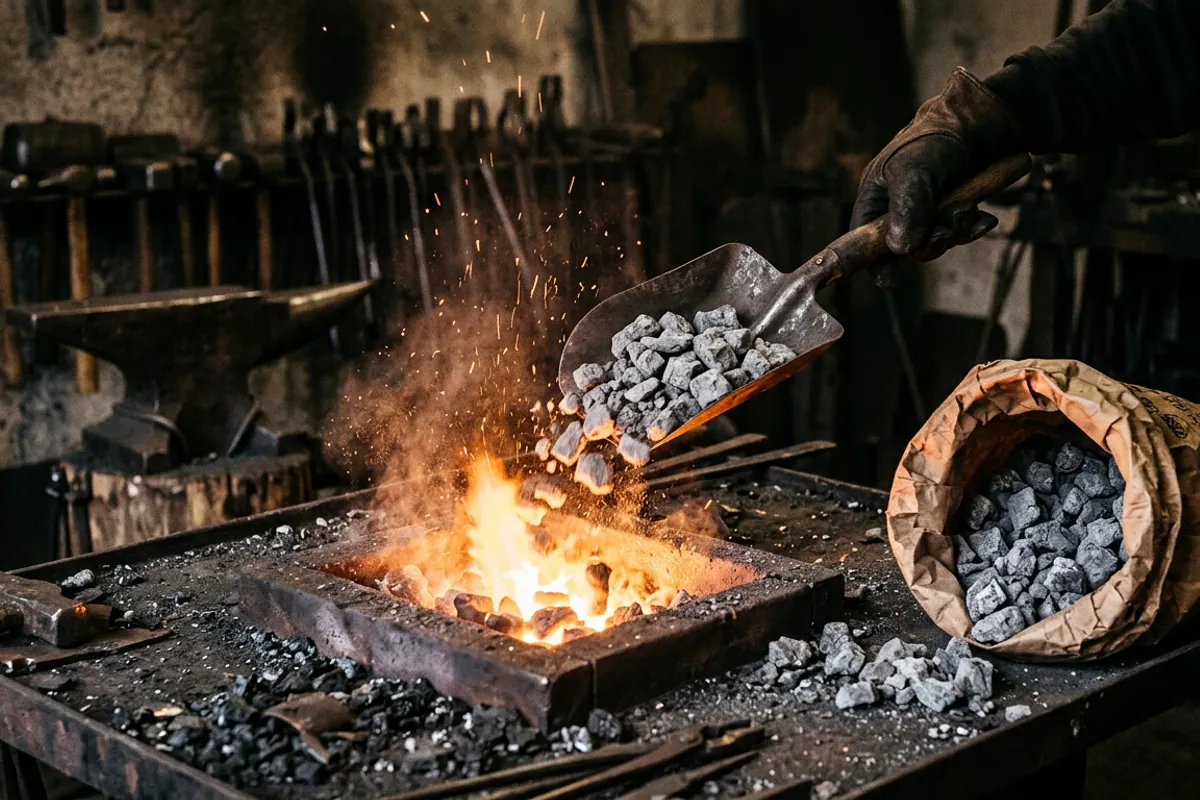
What you will not find is real bagged coke on the big marketplace. I went looking and could not turn up a legitimate coke listing. What comes back for forge fuel searches there is bituminous coal in small boxes, like this roughly 25 pound box of bituminous blacksmith coal (paid link). That is coal, not coke, and per pound delivered it is the most expensive solid fuel you can buy. It has exactly one honest use: a first fire, to find out whether you like solid fuel at all before you commit to a 50 pound bag and a place to store it.
What changes in the firepot when you switch to coke
This is the part no forge or blower guide covers, and it is where people get frustrated. A coal fire builds its own structure. Green coal cakes on the outside, the coke core burns in the middle, and the whole thing holds a shape you can work around. Bought coke does none of that. It is loose, it does not cake, and it burns where the air is, so the fire is only as good as the pot's geometry.
That argues for depth. A shallow rivet forge pan, the kind that works fine for small coal fires, tends to give you a wide thin coke fire that eats fuel and never gets a proper heart. A dedicated firepot with real depth, a clinker breaker in the bottom, and an ash dump underneath is the right home for coke. As one concrete example with published numbers, Simond Store's welded firepot lists 10 in x 12 in x 4.5 in inside dimensions, half inch plate, a 3 in outside diameter air inlet 4.5 in long, a 2600 F rating, and about 45 pounds of weight, with a clinker breaker rod and weighted ash dump included, per the maker's own product page. It is a firepot only, so you are still building or buying the table around it. Check price on Amazon (paid link)
I have not run that pot myself, and the import firepot market is a moving target on quality control, so inspect the welds when it lands. If you are building the whole forge rather than dropping a pot into an existing table, the coal forge buying guide covers the table, hood, and tuyere decisions that go with it.
The other firepot change is housekeeping. Coke makes less clinker than most bituminous coal, which sounds like less work and is not quite. What it makes instead is ash and fines that settle and choke the grate from below. Working the clinker breaker and dumping ash on a schedule matters more with coke than the low clinker number suggests.
The blower a coke fire actually wants
Coke wants more air than coal, and it wants it steadily. That is the single most consistent thing owners report, and it shows up in the shape of the questions people ask: I Forge Iron has a standing thread titled hand crank forge blower for coke and another titled how do I light my stupid coke forge?!, which tells you where the friction is before you read a word of either.
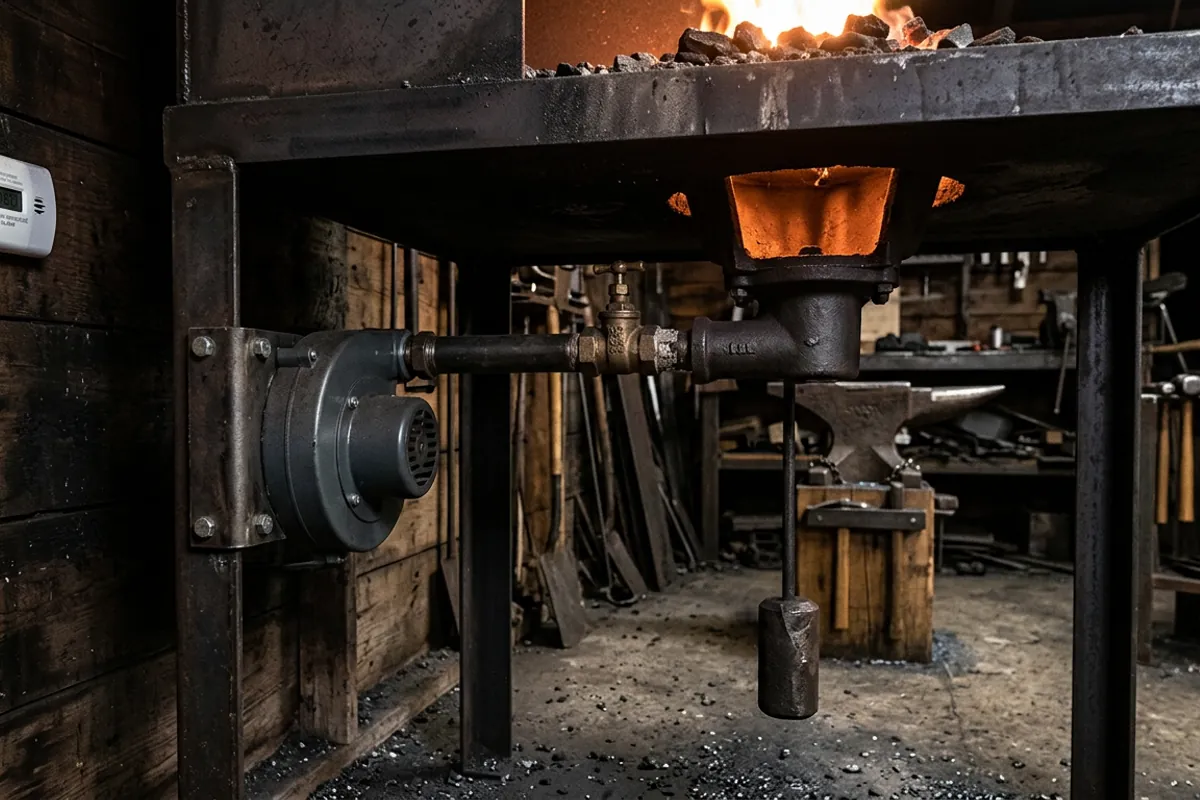
A hand crank blower will absolutely run coke, and smiths ran coke on cranks and bellows for generations. The catch is that you crank continuously, because a coke fire without air starts dying immediately instead of sulking politely the way a banked coal fire does. If you are working alone and want a hand on the work and a hand on the hammer, an electric blower with a real speed control earns its keep faster on coke than on coal. Something like this variable speed electric forge blower (paid link) is the common import pattern people use.
Be clear eyed about that category. These blowers publish essentially nothing outside their own listings, no maker site, no curve, no static pressure figure, and the same housing shows up under six brand names. That is a reason to buy on the cheap end and expect to replace it, not a reason to pay premium money. Whatever you feed the fire with, put a gate valve or air gate in the line so you can throttle at the pot instead of at the motor. The forge blower buying guide goes deeper on picking one, and the hand crank forge blower buying guide covers the vintage crank route if that is the way you want to go.
Running a coke fire, day to day
Lighting is the first surprise. Coke does not take a match the way green coal takes a flame off a wad of paper. The reliable method is a proper kindling fire built over the air inlet, established before the coke goes on, with a gentle blast at first and full blast only once the coke itself is lit. The Beautiful Iron page on lighting a forge fire describes exactly that sequence, adding coke over the paper little by little and mounding it several inches above the pot before going to normal blast. Rush the air or dump cold coke on early and you smother the thing and start over.
The second surprise is that you do not get the banked fire you are used to. There is no green coal ring to rake in over the heart and keep warm through a coffee break. A coke fire is either running or it is going out. Plan the work accordingly: batch your heats, and when you are done, rake the unburned coke out to cool and save it for the next fire rather than expecting it to keep.
The third is that the fire is quiet about itself. Coke burns with very little smoke and not much visible flame. With green coal you get an obvious yellow smoke signal that tells you the fire is fresh and the ventilation is working, or not. With coke you lose that cue entirely, which matters more for your lungs than your forging. Judge the fire by color and by where the sparks sit, not by smoke.
Consumption tracks air, not clock time. Sellers claim coke stretches further by weight than coal does, and Northeast Farrier goes as far as saying you may use up to 50% less than coal by weight. Treat that as the seller's claim, not a measured fact. Your burn rate is set by how hard you blow, how deep the pot is, and how much of the day the blower runs while you are at the vise instead of the anvil.
Ventilation, carbon monoxide, and the part coke does not fix
The general case for a solid fuel fire, hoods, stacks and cross ventilation, belongs to the coal forge coal guide. What is below is the part that is specific to coke, and the part coke does not fix.
Start with carbon monoxide, because it is the one that kills quietly. CO is colorless and odorless, so you get no warning at all from your nose. The published occupational limits, from the NIOSH Pocket Guide, are an OSHA permissible exposure limit of 50 ppm, a NIOSH recommended limit of 35 ppm with a 200 ppm ceiling, and an immediately dangerous to life or health level of 1200 ppm. Burning coke instead of coal cuts smoke and cuts sulfur. It does not cut carbon monoxide. Any carbon fire in an enclosed shop makes it, and the fact that a coke fire looks and smells cleaner is precisely what makes it more dangerous to be careless around.
The ABANA Safety Guide, in its general blacksmithing and forging section, puts the fuel swap and the ventilation in the same breath: sufficient ventilation, and burning coke, charcoal or gas instead of coal, can help reduce exposure to these hazards. Can help reduce. Not eliminate, and not on its own. ABANA's own countermeasure is appropriate ventilation plus a functioning carbon monoxide monitor, and I would treat both as mandatory rather than optional in any shop with a roof.
Sulfur dioxide is the other combustion product worth knowing, and unlike CO it announces itself as a colorless gas with a characteristic irritating pungent odor. The limits diverge depending on who is setting them: OSHA's permissible exposure limit is 5 ppm, or 13 mg/m3, while NIOSH recommends 2 ppm as a time weighted average with a 5 ppm short term limit, and ACGIH and Cal/OSHA also sit at 2 ppm with a 5 ppm short term limit. The IDLH is 100 ppm. Note that federal OSHA has no short term limit for sulfur dioxide at all; a 1989 attempt to move the limit to 2 ppm was vacated. Coke's lower sulfur helps here, which is the real basis for the "burns cleaner" reputation.
What I will not do is tell you what the air in your smithy measures. Nobody has published exposure data for a hobby or one person shop. The measurements that exist come from cement plants, steel mills, and industrial forge shops running fuel volumes and ventilation nothing like a home forge, and lifting a number out of one of those and calling it your shop would be fabrication. Ventilate properly, put a monitor where you stand, and do not reason from an industrial number.
For the alarm itself, a plain battery unit like the Kidde KN-COB-LP2, which the maker lists as battery operated with two AA cells included and a ten year warranty, is enough. Check price on Amazon (paid link) Mount it at head height where you actually work, not up in the hood where it will read the flue instead of your air, and check the data sheet's operating temperature range before you hang one in an unheated shop through a Midwest winter. The rest of the personal kit does not change with fuel: eye protection rated to ANSI Z87.1, natural fibers instead of synthetics near heat, and no bare arms over an open pot.
What owners say
The honest headline is that owner signal on specific coke brands is thin. There is no equivalent of the anvil forums' running argument about rebound. What you find instead is process talk, and the thread titles alone tell you where the friction is: lighting it, keeping air on it, and blower trouble. The recurring I Forge Iron threads are the evidence, including coke side blast fire management alongside the lighting and blower threads above. I could not read the full discussions directly, so I am pointing you at them rather than putting words in anyone's mouth.
The other consistent report is regional. Smiths near a bagging supplier talk about coke as ordinary and affordable. Smiths a few states away describe it as a special order with freight that doubles the price. Both are telling the truth. That is why a price you read on a forum from someone in another region tells you almost nothing about your own cost, and why I gave you sellers, dates, and freight structure instead of a single headline number.
What I would tell a friend
Buy coke if you can get it locally, if your firepot has real depth, and if you have a blower you trust. In that case owners describe a pleasant fuel: low smoke, low clinker, and no fussing with a green coal ring. Buy 100 pounds first and see how your fire likes it before you commit to a ton.
Skip it if getting it means paying parcel freight on 50 pound bags from three states away. In that case good bituminous coal from a club buy will do everything you need, and the coke you actually forge on will be the coke your own fire makes.
The part I would not flex on: coke's clean burn is a smoke and sulfur story, not a carbon monoxide story. Ventilate the shop and put a working CO monitor where you stand. The fuel that gives you no warning smell is the one you have to instrument.