What actually separates a good gas forge from a cheap one
If someone hands me a budget and asks which propane blacksmith forge to put in a home shop this month, I give the same answer every time: a two burner, blanket lined forge from a maker who publishes what is actually inside it, and plan on spending a little more to put a hard floor under the fire. If money is tight, a single burner will teach you everything a two burner will, just slower and with less elbow room. What I would not do is buy the biggest three burner box on the page because it looks like more forge per dollar.
Fair warning on how this guide is built. I run both fuels in my own shop, a coal forge for heavy stock and forge welding and a propane forge for most of the day to day work, so I can speak to how gas behaves from years of lighting one. I have not run every model below on my own bench, and I am not going to pretend otherwise. Those picks lean on the makers' published specs, on what owners report on the forums, and on what I know goes wrong with gas forges after a couple of hundred heats. If you have not settled the fuel question yet, read Coal or propane: which first forge makes sense? first, then come back. Everything else in this cluster lives on the forges topic hub.
Four things decide whether a gas forge is worth owning, and none of them are the number on the box.
Chamber volume versus burner output. A burner heats a volume of space, not a piece of steel. Two burners over a small chamber will get to welding heat and hold it. Two burners over a chamber twice that size will get warm and stall. This is why a small forge that runs hot beats a big forge that runs lukewarm for almost everything a beginner does.
Insulation, and specifically what is on top of the insulation. Nearly every affordable forge is lined with one inch of ceramic fiber blanket. Bare blanket is fragile, it soaks up flux, and it sheds fibers. A rigidizer plus a coat of Satanite, or better a cast hard refractory floor, is what turns a blanket lined box into a forge that survives. Several kits now ship the rigidizer and the Satanite in the carton, which tells you the makers know it matters.
The floor. Flux eats ceramic. Borax will chew through a blanket floor and then through the shell. On BladeForums a smith opened a thread after a three burner forge deteriorated in ten months, and the advice that came back was blunt: expect to redo the inside regularly if you flux weld, or build a removable floor to catch it, and do not leave ceramic blanket exposed.
Openings. A forge with a fixed front and back door is a forge that only ever fits what fits through those doors. Open ended, or with removable brick doors, means you can pass long stock through and choke the opening down when you are working something short.
Notice what is not on that list: brand country of origin, stainless versus painted mild steel, and whether the badge says 2600 degrees. Every one of these forges claims a big number. The number is what the lining is rated to survive, not what your steel will see.
The published specs, side by side
Only figures the maker or a non marketplace retailer actually publishes are in here. Where I could not find a number on a source I am willing to cite, it says not published, and I would rather leave a hole than invent a figure.
Scroll horizontally to see all columns.
| Forge | Burners | Published chamber or size | Published max temp | Lining | Price tier |
|---|---|---|---|---|---|
| Hell's Forge single burner | 1 | Not published | Not published | Ceramic blanket, firebrick floor | Budget |
| Hell's Forge MAX double burner | 2 | Not published | Not published | Ceramic blanket, firebrick floor | Budget to mid |
| Simond Store single burner, two doors | 1 | Not published | Not published | Ceramic blanket | Budget |
| Mr Volcano Hero 2 | 2 | Not published | 2600 F | 1 in Superwool XTRA, rigidizer and Satanite in kit | Mid |
| Devil Forge DFPROF3 family | 3 | 5.8 x 5.8 x 24 in | 2500 F | 1 in ceramic blanket, 20 mm firebrick floor | Mid |
| Atlas Mini Forge V2 | 1 | 2.5 in dia x 10.5 in | 2500 F | Mullite brick | Mid |
| NC Whisper Momma | 2 | 12 x 3 x 6.5 in | 2350 F | Not published | Premium |
Sources for those rows: the Devil Forge DFPROF3 product page for the three burner chamber, blanket thickness, firebrick floor and 240,000 BTU total; the Atlas Knife and Tool forge page for the mullite brick chamber and the 30,000 BTU burner; Centaur Forge's NC Whisper Momma listing for the inside dimensions, 2350 F and 45 lb weight; and the Mr Volcano Hero 2 assembly manual for the Superwool XTRA lining, the 2600 F rating and the 600 F exterior surface warning.
The empty cells are not laziness. Hell's Forge and Simond Store both advertise big temperature numbers, but the only places I found them were marketplace listings, and marketplace listings are not a spec sheet. The maker sites would not load for me when I went looking. That is worth knowing before you buy: a company that will not publish a chamber dimension on a page you can find is telling you something about how much documentation you will get after the sale.
The single burner I would start most people on
A single burner forge is the honest beginner answer. It heats a smaller chamber, it burns less propane per hour, and the work it cannot do is work a beginner has no business doing in month one anyway. You will make hooks, bottle openers, drifts, punches, tongs, and a lot of tapered scrolls in a single burner without ever wishing for the second one.
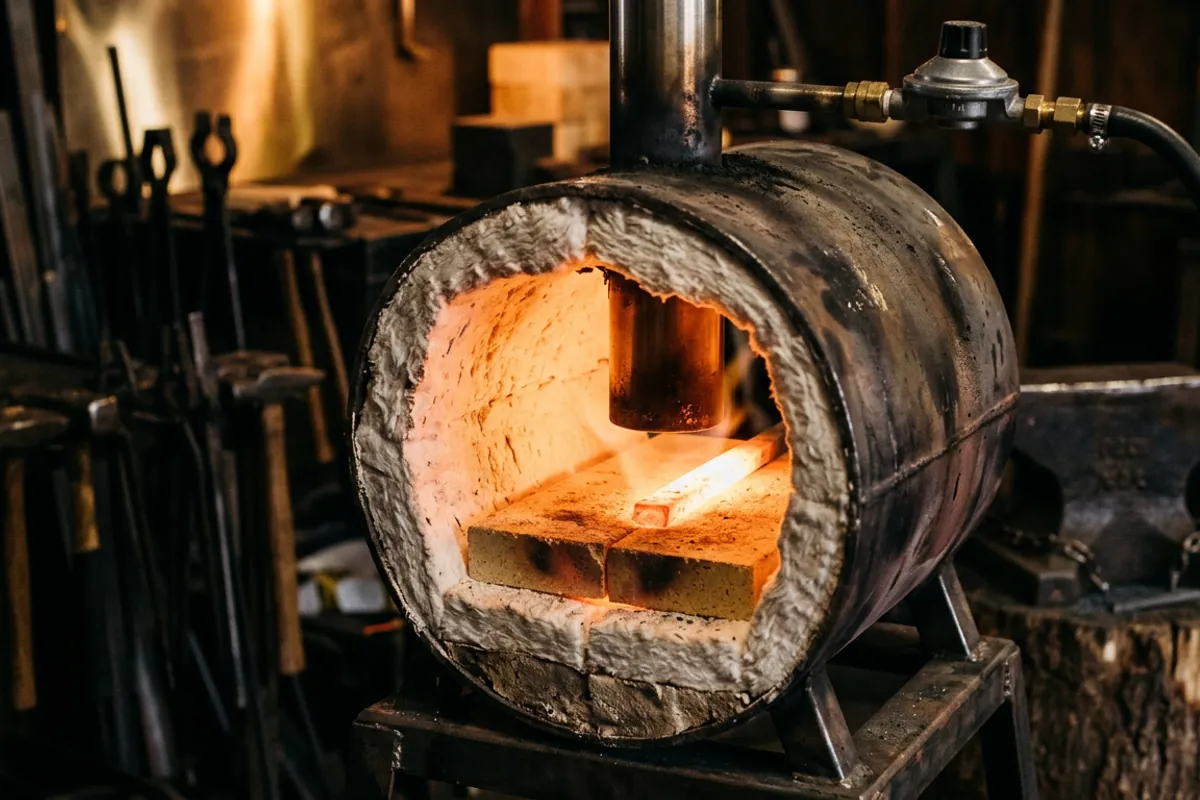
The Hell's Forge single burner (paid link) is the one I see in the most first year shops. It arrives close to assembled, it is built in the USA, and the whole proposition is that you unbox it, hook up a tank, and go. That is genuinely worth something to somebody who has never lit a forge. It is also a one inch blanket forge with a firebrick floor, which puts it squarely in the consumable category. Treat the interior as maintenance, not as permanent.
If you want a single burner where the maker actually hands you the materials to finish the lining, the Mr Volcano Hero single burner kit (paid link) ships as a complete kit with rigidizer and Satanite refractory mortar, on the same Superwool XTRA blanket as its two burner sibling. That is the version of "budget forge" I would rather buy: cheap shell, correct lining plan, and instructions that assume you are going to coat it.
The two burner I would buy if I knew I was staying
Once you know you are not quitting, the two burner is the sane size for a home shop. It gives you room to heat a longer section for a scroll, it holds temperature better when you are opening the door constantly, and it will reach welding heat in a chamber that is not oversized for it.
The Mr Volcano Hero 2 (paid link) is my pick in this bracket, mostly because of the lining. The manual specifies Superwool XTRA, which is a low biopersistence fiber that emits zero crystalline silica, and the kit includes the rigidizer, 3.5 lb of Satanite for the initial coat and another 8 oz for maintenance, plus two firebricks. That is not marketing, it is the maker admitting that a blanket forge needs finishing and then supplying the finish. The manual also states plainly that the exterior surfaces reach up to 600 F and that the forge must only be run in a well ventilated area or outdoors. Take both of those literally.
The Hell's Forge MAX double burner (paid link) is the other name you will see constantly at this size. It is a bigger, heavier version of the single burner with the same design philosophy: burners firing more or less straight down into a rectangular chamber. Smiths who prefer a swirl pattern, where the burner enters at a tangent and the flame circulates, argue that straight down firing gives you a hot spot under each burner rather than an even chamber. That is a real criticism and I think it is fair, but it has not stopped a great many people from making perfectly good knives in one.
The budget import route, and what it actually costs you
There is a whole tier below the US built forges. The Simond Store single burner with two doors (paid link) is representative: a rectangular blanket lined shell with brick doors front and back, sold at a price that undercuts almost everything else with a burner attached.
What you are buying is a shell and a burner. What you are not buying is documentation, consistent quality control, or much of a parts pipeline. The two doors are the genuinely useful feature here, because a pass through forge is far more versatile than a closed box, and being able to brick down an opening is how you keep a small chamber hot.
If you go this route, budget from day one for rigidizer and a hard refractory coat, and assume you will be doing the lining work yourself. A cheap forge you finish properly outlasts an expensive forge you neglect. If that appeals, the diy forge parts guide covers burners, regulators and refractory separately, and honestly, buying the pieces and building the box is a legitimate path.
The three burner question
Three burners look like an upgrade. Most of the time they are a bill.
The Devil Forge DFPROF3+1D (paid link) is the well known example, and the maker's specs for the DFPROF3 family are unusually complete: a 5.8 x 5.8 x 24 in chamber, 240,000 BTU across three burners, 16 gauge steel shell, one inch of ceramic blanket with a 20 mm firebrick floor, 1 to 25 PSI operating range, and a stated 2500 F. The plus 1D version adds a door. Credit where it is due, that page tells you more than most.
Here is the problem. That is a chamber two feet long. Running all three burners to heat the whole thing consumes propane at a rate that will surprise you, and most hobby work only needs six inches of it hot. The saving grace is that the burners run independently, so you can fire one and brick off the rest. If you know you need long heats, for damascus billets or for putting a full twist in a long bar, that length is exactly why you buy it. If you are making hooks, you just bought a very expensive way to heat air.
The buy once options that are not on Amazon
Two forges keep coming up when experienced smiths give advice, and neither is a marketplace purchase.
The NC Whisper Momma is the farrier standard that a lot of blacksmiths ended up with. Centaur Forge publishes a 12 x 3 x 6.5 in interior, up to 2350 F, 45 lb, no blower needed, push button ignition, and an open end model with 1.5 x 3 in ports on each end. That 2350 F number is lower than the marketing numbers on the budget forges, and I trust it more precisely because it is not a round advertising figure. It is a shallow chamber, which is a real limitation for thick stock, and it is a premium price. It is also a forge people run for a decade.
The Atlas Mini Forge V2 goes the other direction: a 2.5 in diameter by 10.5 in chamber lined with custom mullite brick rated to 2500 F, a swirl chamber, and a 30,000 BTU burner, delivering roughly 500 BTU per cubic inch. It is a knife forge, not a general blacksmithing forge, and the tiny chamber is the entire point. Hard refractory instead of blanket means it does not need the rigidize and coat ritual and it does not shed fiber. The maker specifically warns off borax flux because it damages the refractory, which is exactly the honest tradeoff note you want in a spec page.
What owners say
Everything in this section comes from what other people report, not from my bench.
On lining, the argument that will not die on I Forge Iron is whether you need rigidizer at all. Threads like "Do I NEED rigidizer for Kaowool?" and "You do not need rigidizer, the ceramic wool hardens by itself?" run long, and the practical consensus that comes out of them is that rigidizing plus a hard coat is about erosion resistance and about keeping fibers out of the air, not about whether the forge will light. That is a health argument as much as a durability one, and I side with the rigidizer camp.
On durability, the BladeForums "Need a new forge" thread is the one I would send a new buyer to read. Ten months to failure on a three burner, and the replies converge on the same points: no exposed blanket, plan a replaceable floor if you flux, and consider the US built farrier forges or a custom build if you want longevity.
On the specific budget forges, the signal is thinner than the review counts suggest. Most of what you find is unboxing content rather than long term ownership. The most useful exception I found is a smith who wrote up a Mr Volcano two burner after roughly six months and then updated it: the forge insulates well and reaches welding heat without an absurd propane burn, but a construction failure meant repair welding, and the writer became noticeably less willing to recommend it to a beginner with no welding skills. One person's unit is not a pattern, but it is a real report, and it matches the general shape of the complaints about this whole tier: the fire is fine, the fabrication is where corners get cut.
The recurring criticism of the Hell's Forge units is the straight down burner geometry and the single inch of blanket where two would insulate better. Neither of those is a defect. They are the design decisions that produce the price.
The parts of a propane forge that can actually hurt you
I am not going to soften any of this.
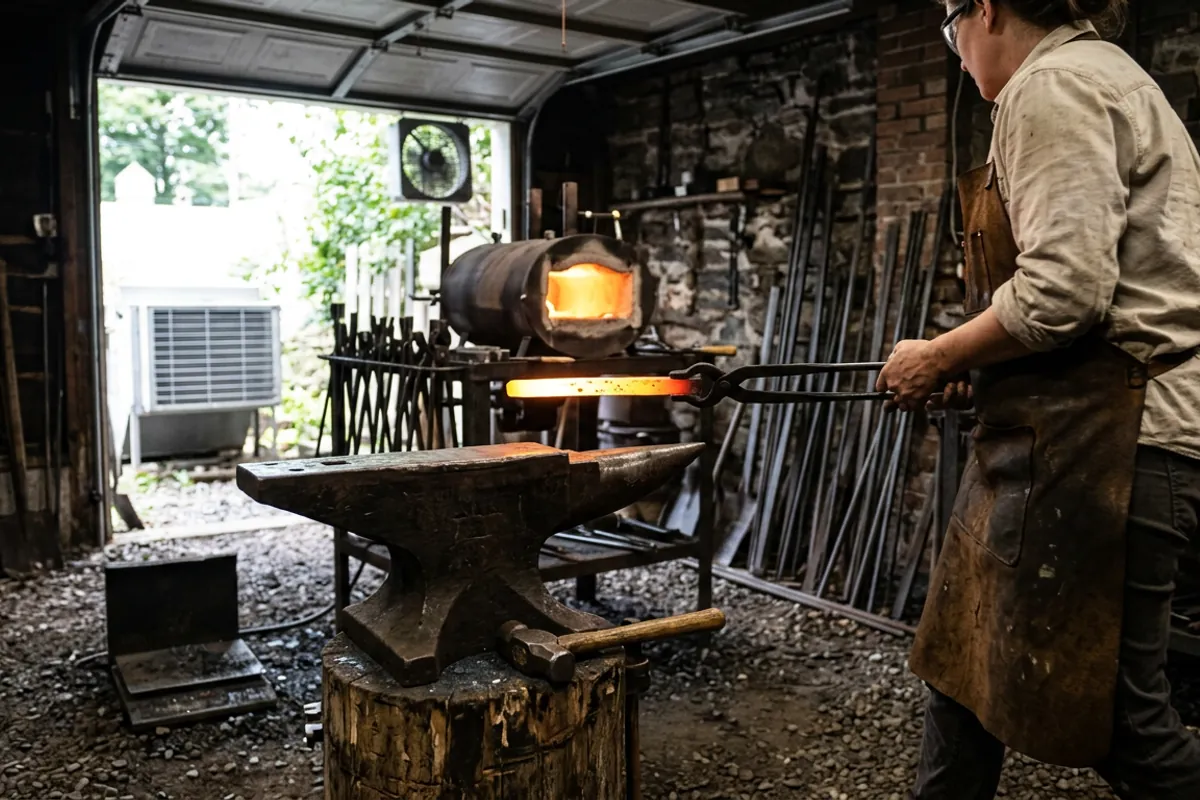
Carbon monoxide. A gas forge consumes oxygen and produces carbon monoxide, which you cannot see or smell. Run it outdoors or in a space with real cross ventilation and, ideally, a CO alarm on the wall. The Mr Volcano manual says to use the forge only in a well ventilated area or outdoors, and every maker says some version of it. This is the hazard that kills people in closed garages in winter.
Ceramic fiber dust. Respirable ceramic fibers are, per the National Toxicology Program, reasonably anticipated to be human carcinogens, and OSHA covers synthetic mineral fibers as a respiratory hazard. That is the argument for rigidizing and coating your blanket instead of letting bare fiber blow around, and for a proper respirator when you cut, handle, or repair a lining. Some newer kits ship low biopersistence wool such as Superwool XTRA instead of traditional refractory ceramic fiber, which is a meaningful improvement, but a dust mask habit is still cheap insurance. Mr Volcano's own manual calls for an N95 and gloves just to handle the Satanite powder.
Your eyes. Impact protection to ANSI Z87.1 is the baseline any time you are at the forge or the anvil, full stop. On top of that, a gas forge chamber is an infrared source, and staring into one all day is a real exposure. Anvilfire's write up on filter lenses is the clearest treatment I have seen: a shade 3 gas welding lens gives the protection but is dark enough to make anvil work awkward, which is why a lot of smiths use lighter IR filtering lenses for forge work.
Burns and clothing. The Hero 2 manual's 600 F exterior figure is the one people ignore. The outside of a running forge is not a place to set your hand or lean a hose. Wear natural fibers, cotton or wool or leather. Synthetics melt into skin. I have my own reason for being loud about this: early on I quenched a blade in oil that was too cold, standing too close in a cotton shirt with no face shield, and the flare took my eyebrows. I kept my eyesight by luck, not by judgment. The safety gear guide covers what is worth buying and what is theater.
Propane itself. Tank outside, hose checked with soapy water, regulator matched to the burner, and nothing stored where a leak can pool. Propane is heavier than air and settles.
What I would tell a friend
Buy the two burner if you know you are staying, and buy it from whoever tells you the most about the lining. Today that means the Mr Volcano Hero 2 (paid link), which ships with the rigidizer and the Satanite because the maker knows a bare blanket forge is half finished. If you are testing whether the craft sticks, the Hell's Forge single burner (paid link) or the Mr Volcano Hero single burner (paid link) will do everything a beginner needs and will cost you less propane while you learn.
Skip the three burner unless you can name the long piece of work you are buying it for. Skip the biggest chamber you can afford, generally. And if you are going to be forge welding with flux, accept now that you are buying a consumable interior, and either plan a replaceable hard floor or spend up front on a hard refractory forge like the Atlas.
The forge is one leg of the stool. A hot forge with nothing to hit on is a space heater, so if you have not sorted the other two, what size anvil you actually need and the tongs that actually grip are the next two decisions, in that order.
The one thing I would not compromise on is ventilation. Everything else on this list is a preference, a budget, or a maintenance schedule. Carbon monoxide is not.