The honest answer for most people asking about a charcoal forge is that you should build the fire pit and buy only the air. A charcoal forge does not need much: a shallow, contained fire with a tuyere blowing across it, something noncombustible holding the fuel, and a blower you can throttle. The gear that costs money is the blower and, if you want a steel firepot instead of a box of dirt, the pot itself. Everything below leans on published maker specs and what owners report on the solid fuel forums, checked against ordinary shop experience with solid fuel. I have not run these specific models down in my own shop, and I am not going to pretend otherwise.
I run a coal forge and a propane forge, and charcoal has burned in the coal forge more than once. That is the whole reason I am blunt about this: charcoal is the easiest solid fuel to get and the easiest one to waste money around, because the gear sold under the "coal forge" label is built for a fuel that behaves differently.
What a charcoal forge is good at, and what it costs you
Charcoal lights easily, comes off the shelf at any hardware store, throws no sulfur into your steel, and makes ash instead of the fused clinker that a coal fire builds up in the bottom of the pot. With forced air it reaches welding heat without complaint. It will also burn your steel if you walk away from it, same as any solid fuel.
What it costs you is fuel. Charcoal is far less dense than bituminous coal, so a given volume holds less energy, and a forced air fire eats through it visibly. That is the single most common complaint on the solid fuel boards, and it is worth reading the threads yourself: "Is Coal worth it? charcoal burns so fast" on I Forge Iron is exactly what it sounds like, and the older "Coal/coke vs charcoal or wood" thread covers availability and cost. If you have a free supply of hardwood scrap and the patience to make your own charcoal, that math changes completely. If you are buying bags of lump at retail, charcoal is convenient, not cheap.
The other honest cost is sparks. Charcoal pops and throws lit embers in a way coal does not. That is a clothing and a workspace problem, and I will come back to it.
If you are still deciding between fuels at all, read Coal or propane: which first forge makes sense? before you spend anything, and browse the rest of the forges topic hub. Charcoal sits close to coal in that comparison, with cheaper entry and more expensive running.
Side blast or bottom blast: the decision that matters most
This is the part the product listings will not tell you. Almost all of the "coal forge" hardware sold online is bottom blast: a firepot with a 3 inch air inlet coming up through the bottom, a clinker breaker, and an ash dump. That layout was designed around coal, which cokes into a crust and holds a deep fire.
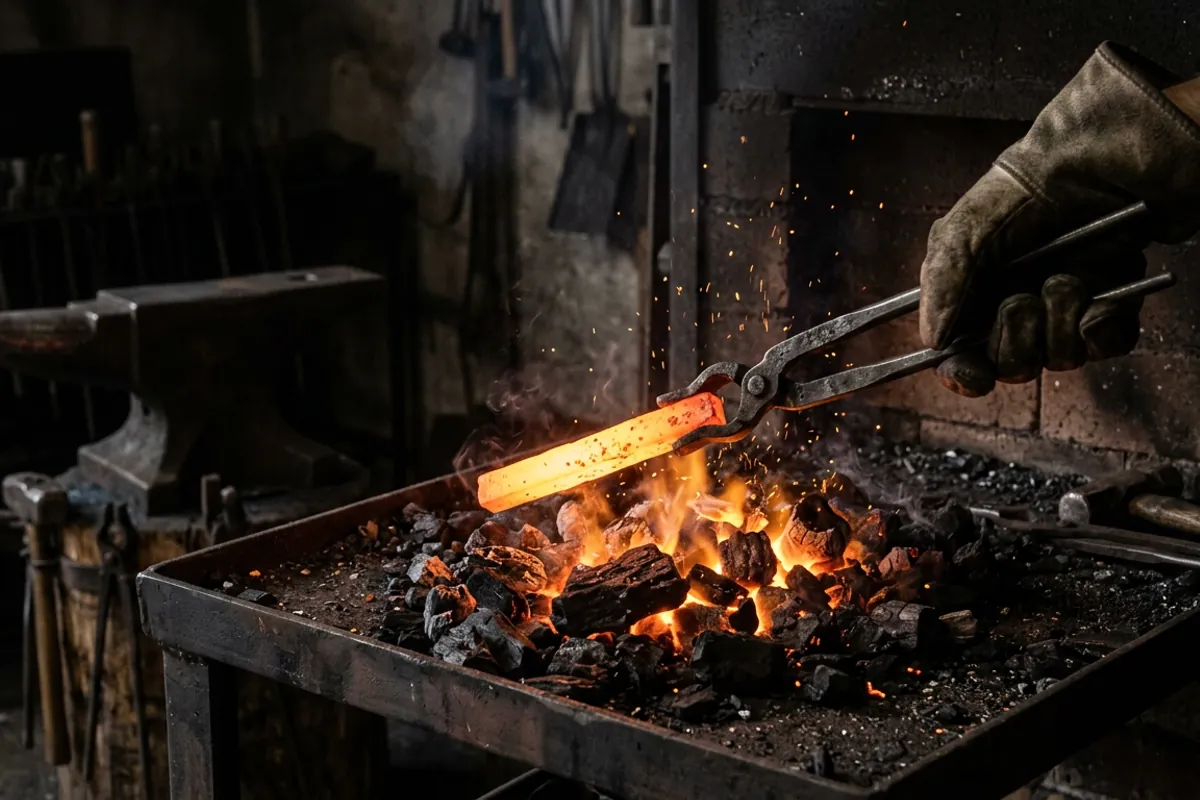
Charcoal is light. Blow air up through a deep bed of it and you get two problems: small pieces get lifted and thrown, and the whole column burns at once because air is passing through all of it. The recurring recommendation on the solid fuel boards is a side blast, where the tuyere enters horizontally at the level of the work and the fire sits in a shallow trench. The reasoning gets argued out in Side blast for charcoal, why? and worked through in practice in Side blast charcoal forge build.
The cheapest honest version of this is the design those boards push at every new smith: a wooden box filled with packed dirt or clay, a length of pipe through the side as a tuyere, and the fire shaped into the dirt with your hands. It costs almost nothing, it can be reshaped in five minutes when the fire is wrong, and it teaches you what fire shape does before you commit steel and money to a layout. If you want to spend the money instead, the firepot below is a reasonable buy. But nobody should buy a firepot because they think a dirt forge will not get hot. It will.
One layout note that has nothing to do with fuel: build the fire at a height that puts your work at the same level it will sit at on the anvil. Bessie's face height is what I set everything else against, and a forge two inches off from that shows up in your back by hour three. There is more on shop layout in Blacksmith shops, explained from the floor of one.
The setups worth comparing
Published figures only. Where a maker does not publish a number, it says so.
Scroll horizontally to see all columns.
| Setup | What it is | Published specs | How it behaves on charcoal | Price tier |
|---|---|---|---|---|
| Simond Store welded firepot, 10 x 12 | Firepot only, you build the table around it | 10 x 12 x 4.5 in inside, 1/2 in plate steel, 45 lb, 3 in OD air inlet, ash dump 11 in long with 3.5 in square section, maker rated 2600 F | Deep bottom blast, works but drinks fuel unless you bank the fire small | Budget |
| Simond Store vintage style forge with hand blower | Small cast iron bowl plus pedal crank blower | Bowl 7.5 in, 15 in long, 8 in tall, about 5 kg | Fire too small for anything past light stock | Budget |
| Simond Store hand crank blower, 8 in casing | Manual blower | 8 in cast aluminum casing, 2 in air outlet, 1:28 gear ratio, weight not published | Ample air for a charcoal fire, control is in your wrist | Budget |
| Centaur Forge hand crank Super Blower | Heavy manual blower | 200 CFM, 4100 FPM, 18 lb, 3 in outlet, 25:1 worm gear | Far more air than charcoal wants, gated by how slow you crank | Premium |
| Whitlox full size wood fired forge | Purpose built trench forge for wood and charcoal | 12 gauge steel, firebed lined with 1/2 in kaowool then firebrick, adjustable tuyere, movable divider, optional 50 cfm electric fan | Designed around this fuel, shallow trench fire | Premium |
Sources: Simond Store firepot page, Simond Store vintage forge page, Simond Store 8 in blower page, Centaur Forge Super Blower, Whitlox full size forge.
The welded firepot: the honest starting point if you buy steel
If you want a bought firepot rather than a dirt trench, the fabricated plate steel type is the sane choice. Simond Store publishes 10 x 12 x 4.5 inches inside, half inch plate welded inside and out, 45 pounds, a 3 inch outer diameter air inlet, and a weighted ash dump 11 inches long with a 3.5 inch square section, all on their own product page. The 2600 F figure is the maker's rating, not a measurement anyone posted.
The reason to prefer welded plate over cast iron here is thermal shock. Cast iron firepots crack; plate steel warps and keeps working. That is the standard argument and it matches how cast iron behaves everywhere else in a shop.
The catch for charcoal is depth. A 4.5 inch deep pot full of charcoal is a lot of burning fuel at once. The fix is not to fill it: bank the charcoal into a smaller heap over the tuyere, use firebrick or packed clay inside the pot to shrink the working volume, and crank only enough air to hold heat. You are effectively converting a coal firepot into a smaller charcoal fire, and it works fine.
Check price on Amazon (paid link)
You will also need a table to drop it into. The maker states it fits forge holes from 10.5 x 12.25 inches up to 11.75 x 13.75 inches, so if you are welding your own stand or cutting a hole in a steel pan, cut to that.
A ready made cast iron forge and blower, and where it runs out
The small vintage style cast iron forges with a pedal crank blower show up everywhere under the charcoal forge search. Simond Store publishes a 7.5 inch bowl, 15 inches long, 8 inches tall, roughly 5 kg, blower and stand included, on their page for it.
Be clear about what that is. A 7.5 inch bowl is a campfire sized fire. It will heat a small bar, a spike, a hook, a knife blank if you are careful about how much of it you need hot at once. It will not heat the middle of a 3 foot bar, and an 11 pound cast iron assembly is not a forge you will grow into. Owners buy these for portability and for demos, and the honest use case is exactly that.
If that is genuinely what you want, it is inexpensive and it works within its size. If you think it is a shop forge, it is not.
Check price on Amazon (paid link)
Air: the hand crank blower question
Charcoal wants less air than most beginners give it. Too much blast burns fuel and scales your steel; the skill is holding a small fire at the right heat, not making the biggest flame.
A hand crank blower gives you that control naturally, because the air stops when your arm stops. The Simond Store 8 inch unit publishes a cast aluminum casing and impeller, a 2 inch air outlet, and a 1:28 gear ratio; it does not publish a weight or a CFM figure, and I am not going to invent one. For a charcoal fire, 2 inches of outlet is plenty.
Check price on Amazon (paid link)
The same maker sells an 11 inch casing version if you want more mass and a bigger wheel, though the published spec sheet there is equally thin.
Check price on Amazon (paid link)
For contrast at the other end, Centaur Forge publishes real numbers on its hand crank Super Blower: 200 CFM, 4100 FPM, 18 pounds, a 3 inch outlet, and a 25:1 worm gear. That is a coal forge blower, and it is more air than a charcoal fire needs. Published figures are one of the few ways to compare blowers honestly, and most budget sellers publish almost nothing.
The cheap alternative many charcoal smiths use is a small electric fan with a gate valve or a simple flap to dump excess air. Whitlox, for instance, offers a 50 cfm electric fan with a stomp switch as the powered option on their forges. Fifty CFM is the right order of magnitude for a single charcoal fire, which tells you how little air this actually takes. Never plumb a blower straight to the fire with no way to bleed air off; a full blast electric fan on charcoal is how you turn fuel into sparks and scale.
The purpose built option: a wood and charcoal forge
If you want to buy the answer instead of building it, Whitlox makes forges designed around wood and charcoal rather than coal. The full size model publishes 12 gauge steel construction, a firebed lined with half inch kaowool and then firebrick, an adjustable tube within tube tuyere, a movable divider to concentrate the fire, and a cutaway back so longer bar can lie through it. Blower, stand and hood are separate options. It was listed at $583 and showing sold out when I checked their site.
That is a premium price for a solid fuel forge, and the case for it is that it is the shape charcoal actually wants: a shallow trench with a side blast and a lined bed, rather than a coal pot you have to work around. Owner signal on it is thinner than on mass market gear because the maker is small, so treat that as a design argument rather than a chorus of reviews.
Fuel: lump charcoal, briquettes, and what never goes in the fire
Buy lump hardwood charcoal, not briquettes. Briquettes are compressed charcoal fines with binders and fillers; they make more ash, they burn cooler and slower than lump, and the ash smothers the fire. Lump is what the solid fuel boards recommend and it is what behaves.
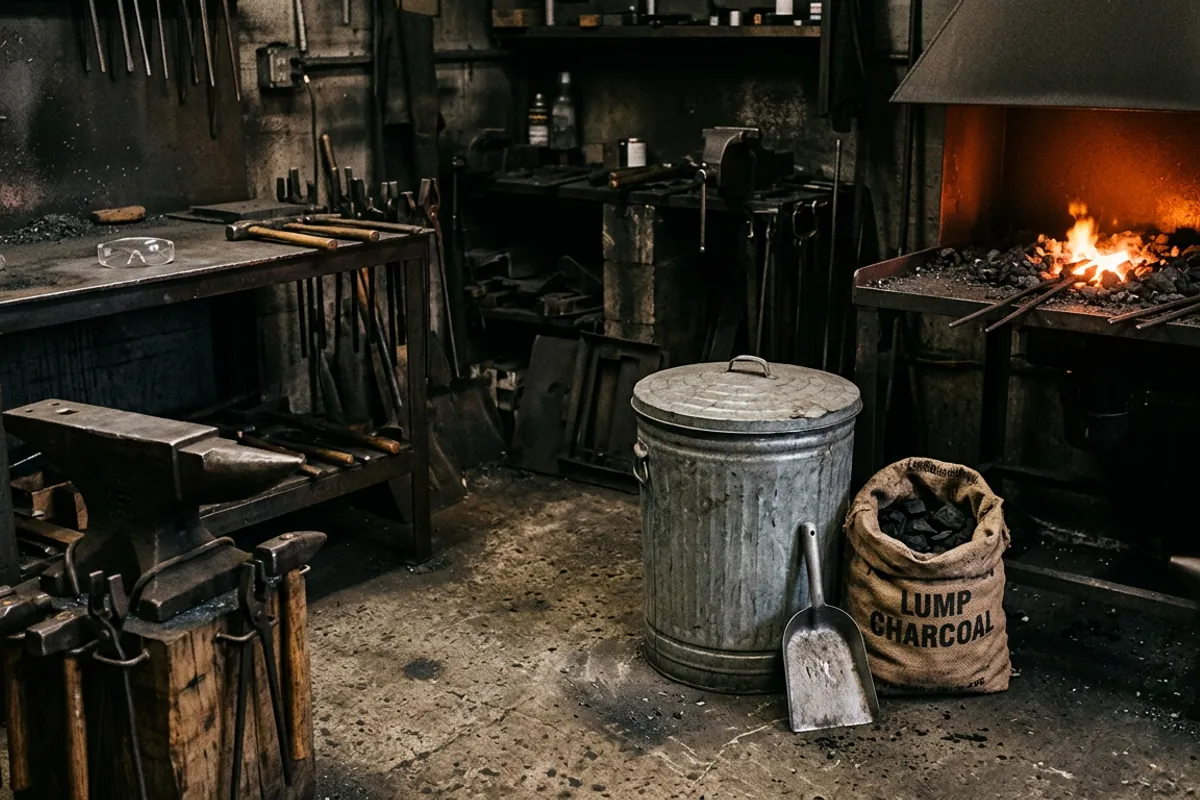
Break the lumps down to roughly thumb size before they go in. Big irregular chunks leave voids, and voids let air through without heating anything. A tight bed of small pieces is what gets you an even heat.
Never burn pressure treated, painted, stained, or glued wood, and never make charcoal out of it. Treated lumber can contain arsenic and chromium compounds; plywood and particleboard carry adhesives. The smoke and ash from that are genuinely poisonous and there is no safe version of it in a forge. Clean hardwood only.
Fuel choice does not change your heat treat. Charcoal, coal, and propane are all just ways of getting steel to temperature, and the numbers that matter are the ones for your alloy. Send those questions to real testing rather than forum lore; Knife Steel Nerds is where I point people. The forge-side reading is in Tempering of metal, explained from the forge floor.
Safety around a charcoal fire
Take this section as seriously as the gear.
Carbon monoxide is the hazard that kills people who are otherwise being careful. A charcoal fire produces a lot of it, it has no smell, and it does not need a closed door to hurt you. A charcoal forge does not belong in a closed garage, a shed, a tent, or a basement. Outdoors, or in a shop with a real hood and real cross ventilation, and never with the door pulled shut against the cold. If you get a headache, get dizzy, or feel sick at the forge, get outside first and ask questions second.
Charcoal throws sparks and lit embers further than coal. Wear natural fibers: cotton or wool. Synthetics melt into skin, and a shirt that melts is worse than a shirt that chars. Eye protection is not optional, and it needs to be rated: ANSI Z87.1 marked safety glasses at minimum, a face shield over them for grinding.
I say that plainly because I learned it the stupid way. Early on I quenched a blade in oil that was too cold, standing too close in a cotton shirt with no face shield. The oil flared and took my eyebrows. I kept my eyesight by luck, not by judgment. Nothing about that story is unusual, which is the point.
Two more charcoal specifics. First, embers smolder long after you think the fire is out; charcoal will sit and glow quietly for hours. Do not walk away from a hot forge, and never dump ash into a plastic or paper container. A metal ash can with a lid, set on a noncombustible surface, away from the building. Second, keep water and a rated extinguisher within reach, not across the shop.
The full rundown of what actually matters in protective gear is in Blacksmith safety gear: what matters and what to skip.
What owners say
Two honest caveats before the summary. The recurring themes below come from the Solid Fuel Forges boards on I Forge Iron, linked in place. And owner signal on the specific budget firepots and blowers sold under the charcoal forge label is thin: a lot of listings, not much durable long term discussion from smiths who have run them for years. Where I cannot find real signal, I would rather say so than invent a consensus.
The themes that repeat:
Charcoal consumption is the number one complaint. It comes up over and over, including that thread on whether coal is worth it, where smiths compare bought lump against homemade charcoal and talk about how fast the bag goes. Nobody argues that charcoal is slow to burn.
Side blast is the standard recommendation for charcoal. The why side blast discussion and the side blast build thread both come back to the same idea: a shallow fire with a horizontal blast suits this fuel better than a deep coal pot, and people who started on a bottom blast brake drum tend to move that way.
Charcoal reaches the temperatures people worry it will not. The charcoal vs coal forge thread starts from exactly that question. The answers are not shy about it.
Cast iron firepots crack, welded plate does not. That claim is the makers' own selling point and it lines up with how cast iron behaves under repeated heat cycling everywhere else. Treat it as the reason to prefer plate, not as a lab result.
What I would tell a friend
Build the fire, buy the air. Make a side blast box out of a wooden crate and packed dirt, put a length of black pipe through the side, and spend your money on a blower you can throttle. You will learn what fire shape does, and you will know whether you actually want a solid fuel shop before you own a 45 pound firepot.
If you want to buy hardware anyway, get the welded plate firepot and shrink the fire with firebrick, not the little cast iron bowl. The bowl forge is fine for demos and small work, and it is honestly nothing more than that. Skip anything that sells you an unthrottled electric fan bolted straight to the tuyere.
And the safety line I will not soften: a charcoal forge produces carbon monoxide, it is odorless, and it does not care that you left the window open a crack. Outdoors or under a real hood, natural fibers on your body, ANSI Z87.1 on your eyes, ash in a metal can. Every other decision on this page is a preference. That one is not.
If you are still assembling the rest of the shop, the short list is in Blacksmithing tools: the short list that actually matters, and the wider forge comparison lives in The blacksmith forge I'd actually put in a beginner's shop.