If I were putting a coal forge in a home shop tomorrow, I would not buy a finished forge. I would buy a real firepot and a blower, drop the pot into a steel table I built myself, and spend the leftover money on coal. That is the honest verdict up front, and it is the same thing I tell the weekend beginners who ask me every spring. A coal forge is not one appliance. It is a fire container, an air supply, a table to rake fuel across, and a way to get smoke out of the building, and the cheap all-in-one kits get three of those four wrong.
Fair warning on what this guide is and is not. I have run a coal forge for years alongside a propane one, so the fire management, the clinker, the fuel talk and the ventilation come from my own floor. The specific products below are a different matter. I have not run any of these models down in my own shop, so what you are getting is published specs from the makers, checked against what owners report and against what I know a coal fire needs. Where a maker does not publish a number, I say so instead of inventing one.
The short version of what I would buy
Buy a firepot with real depth and a working ash dump, then feed it with a blower you can control. The Simond Store welded 10 x 12 firepot (paid link) is the one I would start from: half inch plate, welded inside and out, 4.5 inches deep inside, with a clinker breaker and an ash dump already fitted. Pair it with a hand crank blower with an 8 inch casing (paid link) if you like the mechanical simplicity, or a small squirrel cage fan on a dimmer if you would rather have both hands free.
Skip the little tabletop forge with the pedal-style crank handle. It is a nice campfire cooker. It is not a forge you will still be using in a year.
If you have not decided on fuel yet, read coal or propane first before you spend anything, and browse the rest of the forges topic hub. Coal is the better fuel for heavy stock and forge welding and the worse fuel for a garage with no chimney, and no firepot on this page fixes that second part.
What you are actually buying when you buy a coal forge
Five parts, and only two of them cost real money.
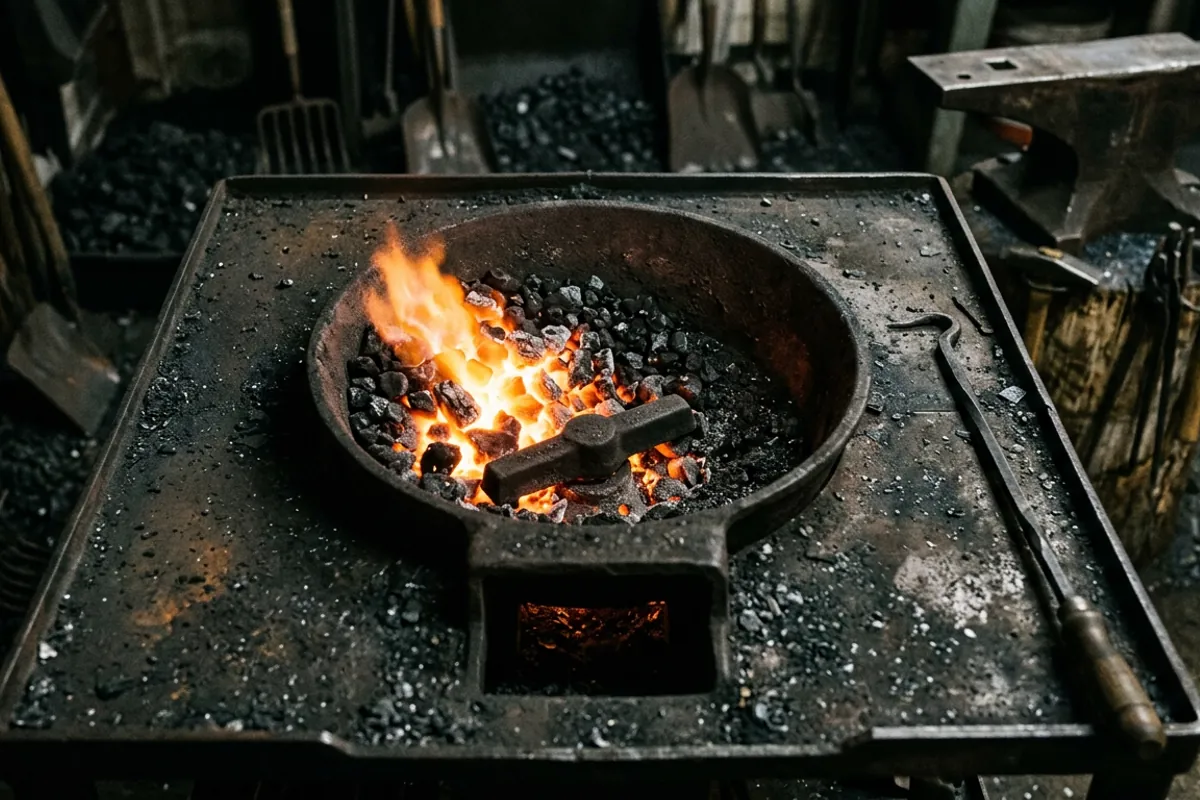
The firepot is the bowl that holds the burning fuel. Depth is the whole game. A shallow pot spreads the fire wide and thin, burns fuel fast, and never gives you the deep, oxygen-starved heart you need for a weld. Four inches of inside depth is a working minimum for general smithing, and the pots sold by the traditional suppliers cluster right around there.
The tuyere is the air pipe entering the pot, usually 3 inches in diameter on commercial pots. The ash dump is the gate under it that lets you drop ash and clinker out of the bottom, which is the difference between clearing the fire in five seconds and shutting down to dig it out with a poker.
The clinker breaker is a rotating bar in the bottom of the pot. Clinker is the glassy slag that forms from the mineral content in coal, and it will choke your air supply mid-heat if you cannot break it loose and pull it out. Any pot without one is a pot you will be fighting.
The table is just sheet steel around the pot, holding banked green coal you rake in as the fire eats itself. You can weld one out of scrap in an afternoon. That is exactly why I would not pay a premium for a bundled table.
And the hood or chimney, which nobody sells you with the kit and which matters more than everything above it combined. More on that below.
How the pieces compare on paper
Scroll horizontally to see all columns.
| Item | Inside pot size | Inside depth | Material | Air inlet | Published weight | Price tier |
|---|---|---|---|---|---|---|
| Simond Store welded firepot 10 x 12 | 10 x 12 in | 4.5 in | 1/2 in mild steel plate, welded inside and out | 3 in OD, 4.5 in long | 45 lb | Budget |
| Centaur Vulcan firepot, sliding ashgate | 8 x 10 in | 4 in | Cast iron, 3/8 in bowl | 3 in | Not published | Mid |
| Simond Store stand, firepot and blower kit | Not published | Not published | Steel | Not published | Not published | Budget |
| Simond Store tabletop forge with hand blower | 7.5 in bowl | Not published | Steel body, aluminum blower | Not published | 5 kg | Budget |
| Simond Store hand crank blower, 8 in casing | n/a | n/a | Cast aluminum casing and impeller | 2 in outlet | Not published | Budget |
Every figure there is the maker's own published number, cited in the sections below. Where a maker does not state one, the cell says not published, and you should read that as a small warning flag rather than a neutral blank.
The Simond Store 10 x 12 welded firepot
This is the import firepot you see under half the home-built coal forges on the internet, and on paper it is a lot of steel for the money. The maker publishes inside dimensions of 10 x 12 x 4.5 inches, outside dimensions of 12 x 14 x 16, half inch mild steel plate welded inside and out, a shipping weight of 45 pounds, a 3 inch outside diameter air inlet 4.5 inches long, a weighted ash dump with an auto open and close action, and a rotatable clinker breaker on a half inch rod (Simond Store product page).
Take the depth seriously, because that is the number that earns the purchase. At 4.5 inches you have enough fuel above and below the work to run a proper fire, including a welding heat if your air is right. The half inch plate is heavier than the 3/8 inch bowl on the traditional cast pot below, and fabricated steel takes a knock better than cast iron does.
The tradeoffs are real. The maker's 2600F rating is a marketing figure with no test standard behind it, so read it as "this thing is made of thick steel" and nothing more. Steel firepots scale and thin out over years of fire where good cast iron mostly just sits there. Import welding quality varies unit to unit, and you are the quality control. And the pot is only the pot: you still need a table, legs, an air pipe, a blower, and a hood.
Check price on Amazon (paid link)
The Centaur Vulcan cast iron firepot
The old-school answer, and the one a lot of farriers and club smiths still run. Centaur Forge publishes 12 x 14 inch outside dimensions, an 8 x 10 inch inside bowl, 4 inches deep, cast iron with a 3/8 inch thick bowl, a 3 inch air inlet, and a sliding ashgate (Centaur Forge). Weight is not published on that page.
A smaller bowl than the import pot is not automatically worse. An 8 x 10 pot concentrates the fire and burns less fuel per hour, which is what you want for tongs, hooks, hardware and knife-sized stock. Where you feel it is long bar work and anything needing a wide heat, because you are limited to the fire the pot can hold.
Cast iron is the honest reason to spend more here. It shrugs off decades of fire in a way plate steel does not, and these pots come off farrier rigs into second and third owners' hands all the time. The catch is that cast iron cracks if you shock it, so do not quench a hot pot and do not drop a bar of cold stock into it edge first.
There is no marketplace link here on purpose. Centaur sells direct, and a firepot is exactly the sort of item worth buying from a supplier who has been in blacksmith gear since long before any of us started.
Blowers: hand crank or squirrel cage
You need moving air, not much of it, and you need to be able to turn it down. That last part is where beginners get burned, literally, because too much air burns your steel up rather than heating it.
The Simond Store hand crank blower with an 8 inch casing (paid link) publishes a 2 inch air outlet, a 1:28 gear ratio, a cast aluminum casing and impeller with steel handle, pipe and stand, and an oil port for the gearbox (Simond Store). A crank blower gives you infinitely fine control by feel, costs nothing to run, and works in a field with no power. The cost is that one hand is always busy cranking, which gets old fast when you are learning to move steel with the other one.
The alternative most home smiths land on is a small squirrel cage fan wired through a speed control, with a gate valve or a simple sliding plate in the air pipe as a bleed. That bleed matters: throttling a fan with a valve on the outlet is more controllable than fighting the fan's own low-speed behavior. Either way, an air gate near the pot is the cheapest upgrade on this whole page.
Check price on Amazon (paid link)
The little tabletop coal forge with the pedal handle
You have seen these: a small round bowl on three legs with a geared crank blower bolted to the side, sold as a vintage-style coal forge. Simond Store's page for one of them publishes a 7.5 inch bowl, 15 inches wide, 8 inches high, and a weight of 5 kg, shipped as blower, furnace, stand and handle (Simond Store). Note that near-identical listings from the same maker quote different bowl sizes and heights, which tells you something about how tightly these are specified.
Here is the plain read. Eleven pounds of sheet metal with a 7.5 inch bowl is a fire container for cooking, not a forge. There is no clinker breaker, no real ash dump, and no depth, and a fire that shallow will not give you a welding heat or evenly heat anything longer than a few inches. People do use them, mostly for small stock and demonstrations, and they are genuinely fun. They are not a shop's coal forge.
Check price on Amazon (paid link)
The same caution applies to the bundled stand, firepot and blower kits (paid link). Simond Store's own page for that bundle lists what is in the box and the material, and publishes no dimensions at all for the stand or the pot (Simond Store). Buying a firepot whose depth the seller will not state is a coin flip, and depth is the one number that decides whether the forge works.
Fuel, and why what you burn matters more than the pot
A good pot burning bad fuel is a bad forge. What you want is bituminous smithing coal, low in sulfur and ash, sized small enough to cake properly. Blacksmiths Depot sells its blacksmithing coal as premium metallurgical grade bituminous in pea size, 3/8 inch to 1-1/4 inch (Blacksmiths Depot), and that is the description to look for wherever you buy. Hardware store stoker coal, anthracite meant for heating, and bagged barbecue briquettes are all the wrong thing.
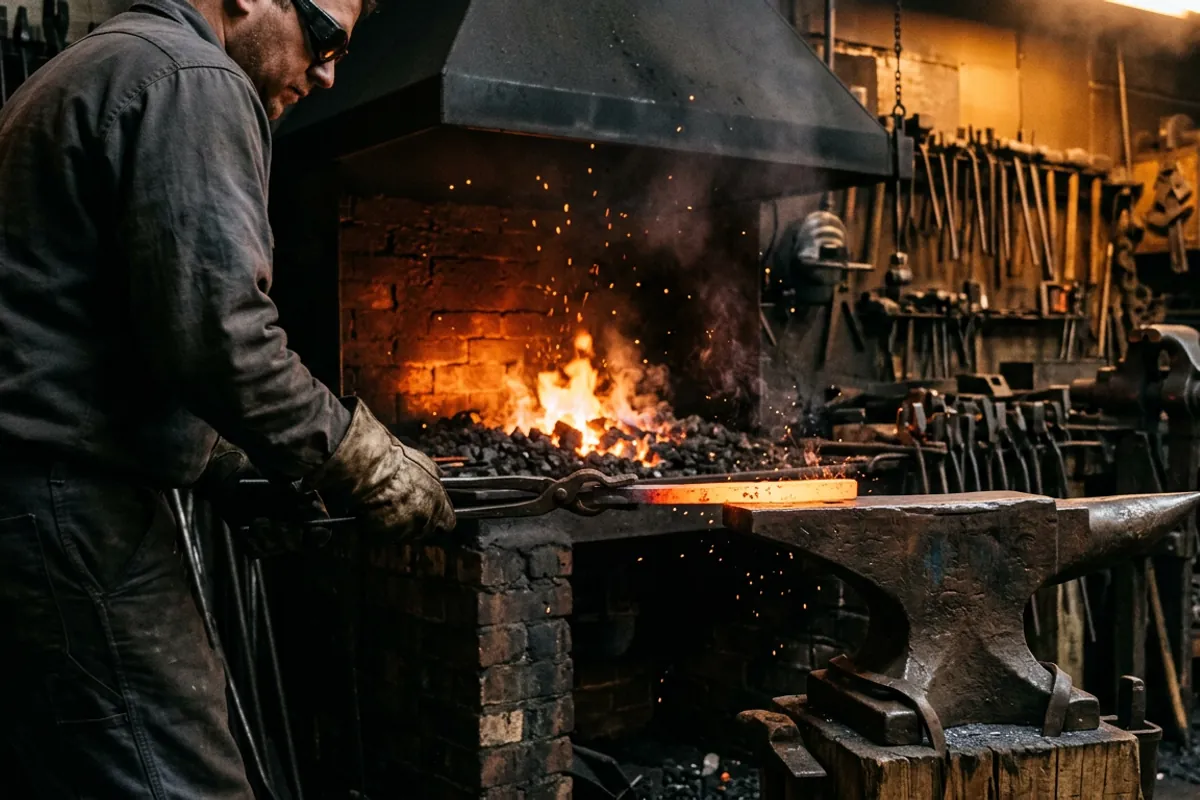
The workflow that makes coal worth the trouble: you light a small fire, bank green coal in a ring around it, and let the fire cook that ring into coke. You rake coke into the heart, keep the green coal wet at the edges, and pull clinker out of the bottom every so often. Done right you get a clean, deep, reducing fire that will forge weld all day, which is exactly why my coal forge still exists next to a propane one that is easier in every other way.
Coal also has to come from somewhere, in a bag, in your car, and that is not nothing. If you cannot source real smithing coal locally, look hard at a charcoal forge before you commit, since lump charcoal is available everywhere and burns clean in the same pot. And if a solid fuel fire in your building is genuinely not workable, the honest answer might be the gas route instead.
What owners say
I want to be straight about the limits here. Owner signal on these specific import firepots is thin. There is a thread on I Forge Iron's solid fuel board asking, in its title, exactly the question buyers keep asking about the small Simond Store coal forge, whether it is worth getting for small projects. That the question keeps coming up, and that nobody points to a long track record with these, is itself the finding. Take a maker's spec sheet as the claim and not the review.
What is not thin is the firepot depth conversation. Search that same board and you find the question over and over: a beginner asking whether two inches of depth will do, another builder working out pot dimensions from scratch, a long-running firepot depth thread in the solid fuel section. Nobody has to convince a smith who has run a shallow pot; they show up on the forum having already learned it and asking how much deeper to go. That is the consensus worth acting on, and it is why depth is the first column in my table.
Ventilation, carbon monoxide, and the part I will not soften
Coal produces carbon monoxide. So does charcoal, so does propane, so does every fire you will ever light in a shop. Carbon monoxide is colorless, odorless, and gives you nothing to react to before it puts you down. OSHA's permissible exposure limit is 50 parts per million as an eight hour time weighted average (OSHA annotated Table Z-1), and a solid fuel fire in a closed garage will clear that without any drama at all.
So: a coal forge needs a chimney or a side draft hood with a pipe that actually goes outside and up, plus cross ventilation, plus a carbon monoxide alarm on the wall that you test. A side draft hood with a 10 inch or larger stack pulls smoke far better than the overhead hoods you see in old photographs, and it does it without hanging in your way. This is real construction work, and it is the part people skip because it is not fun to buy. Do not skip it.
The rest of the safety kit is not optional either. Eye protection to ANSI Z87.1, always, and a face shield over it for anything that throws sparks or hot scale. Natural fibers only near the fire: cotton, wool, leather. Synthetics melt into your skin, and there is no version of that story that ends well. I learned my own lesson standing too close to a cold oil quench in a cotton shirt with no shield, and I got off light with only my eyebrows gone. The rest of what matters, and what does not, is in the safety gear guide.
Coal adds one more: green coal smoke is nasty stuff and coal fires throw sparks a long way. Keep a fire extinguisher within reach, keep the area around the forge clear of anything that burns, and give the fire an hour of attention after you shut down before you walk away.
What I would tell a friend
Buy the pot, build the table. The Simond Store 10 x 12 welded firepot (paid link) gives you 4.5 inches of depth, an ash dump and a clinker breaker in half inch plate, which is everything the fire actually needs, and you can weld a table around it out of scrap in a weekend. If you would rather buy the tool your grandchildren argue over, spend more on a cast iron Vulcan pot from Centaur and never think about it again.
Skip the tabletop forge with the crank handle, and skip any bundle that will not publish the depth of its firepot. Put the money you saved into good bituminous coal, a real side draft hood and stack, and a carbon monoxide alarm.
And if you are still deciding, be honest about your building before you are honest about your budget. A coal forge in a shop that cannot vent it is not a bargain, it is a hazard with a firepot attached. Get the fuel decision right first, then come back and buy the pot. Once that is settled, the next thing that will hold you back is what you are hammering on, and anvil weight is a shorter conversation than this one.