I have verified three ASINs (all titles matched live), published specs from the maker/retailer, and two real forum/owner sources. Note: the two curated VEVOR refs are both anvils, so neither genuinely belongs in a gas-forge guide, and I'm leaving the placeholder out per the rules. Writing now.
Most smiths I teach on the weekends end up with a blacksmith gas forge as their first fire, and honestly, that is usually the right call. If you want the short version before the detail: for most people starting out, I would buy the Hell's Forge portable double burner. It heats a useful length of stock, gets to welding-adjacent heat in a few minutes, and it is built well enough that you are not going to be shopping again in a year. If your bench and your budget are tight and you only want to make small knives and hooks, a single burner Simond Store forge does the job for less. And if you already know you want to heat big stock or run longer sessions, the Hell's Forge MAX gives you the room.
I want to be straight about what this guide is and is not. I have run gas and coal both for years, so I can talk with confidence about how a propane forge behaves, what makes one worth owning, and where the money actually goes. But I have not bought every one of these specific models and put a stopwatch on them in my own shop. What follows leans on published specs, the maker pages, and owner reports from the forums, weighed against a couple of decades of standing in front of a hot forge. Where a claim is owner consensus rather than something I ran down myself, I say so.
The picks at a glance
Here is the field, with only the figures the makers actually publish. Where a maker does not state a number, it says so rather than me guessing.
Scroll horizontally to see all columns.
| Forge | Burners | Working chamber | Max temp (rated) | Insulation | Price tier |
|---|---|---|---|---|---|
| Simond Store single burner | 1 | ~4.8 x 4.8 x 10 in (rectangle) | 2600 F | 1 in ceramic fiber blanket + fire brick | Budget |
| Hell's Forge portable double burner | 2 | 19 x 6.75 x 3.5 in | 2300+ F | 1 in ceramic fiber blanket + two fire bricks + HELLCOAT | Mid |
| Hell's Forge MAX double burner | 2 | Larger, taller opening (not separately published) | 2300+ F | 1 in ceramic fiber blanket + fire brick + HELLCOAT | Premium |
Simond publishes the chamber and insulation figures on its own product pages (simondstore.com), and Hell's Forge's dual-burner working chamber of 19 by 6.75 by 3.5 inches and 2300-plus degree rating are listed on retailer spec sheets (retailmarket.net). If you want the wider view of how gas stacks up against solid fuel before you commit, I laid that out in the coal or propane guide and in the broader gas forge buying guide.
Simond Store single burner: the smallest sensible start
The Simond Store single burner is the forge I point people to when the whole hobby is still a maybe. It is a rectangular steel shell lined with a one inch ceramic fiber blanket over fire brick, with a single atmospheric burner and a rated ceiling of 2600 degrees Fahrenheit. The working chamber runs roughly 4.8 by 4.8 by 10 inches on the rectangle version, which is enough to bring a knife blank, a hook, a bottle opener, or a short length of bar up to forging heat.
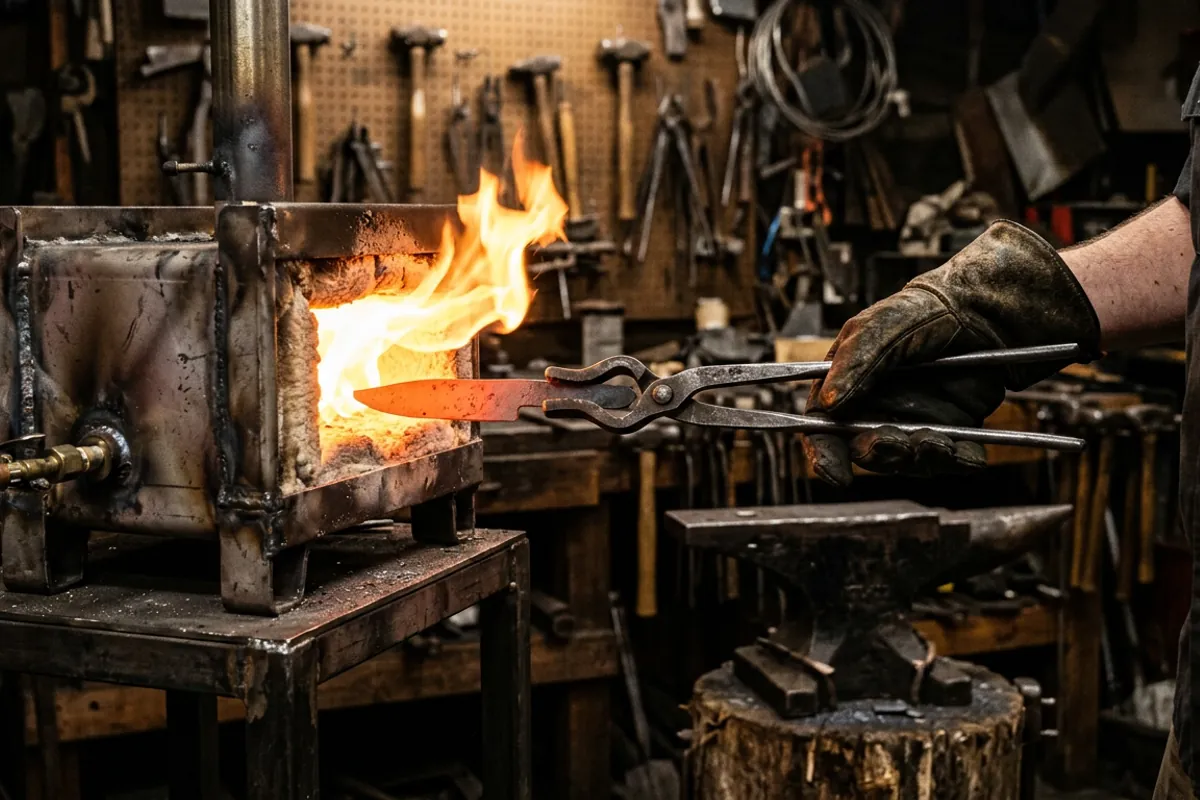
What you get for the low price is a real forge that lights, holds heat, and does not fight you. What you give up is length and recovery. One burner means one hot zone, and if you feed in cold stock the temperature dips a little longer before it comes back than a two burner box would. For small work that is fine. For anything longer than the chamber, you are stuck sliding the piece through and heating it in sections, which is workable but slow.
A couple of honest notes. The doors on these budget forges are usually just brick openings, so you lose some heat out both ends unless you block one off with a spare fire brick. And the burner on entry level forges is set up to run rich out of the box, which shows up as a lot of "dragon's breath" flame at the door. That is normal on a cheap forge, and it is one reason ventilation is not optional (more on that below). If your plan is small blades and hooks and you want to spend the least to find out whether you like this, this is the one.
Check price on Amazon (paid link)
Hell's Forge portable double burner: the one I would point most people to
If I had to hand one gas forge to a new smith and walk away confident they would still be using it in three years, it is the Hell's Forge portable double burner. It is made in the USA, the shell is lined with a one inch high density ceramic fiber blanket, it ships with two fire bricks for the floor, and the interior carries the maker's HELLCOAT refractory coating over the blanket, which is a step a lot of buyers otherwise have to do themselves. The working chamber is 19 by 6.75 by 3.5 inches, and the maker rates it to over 2300 degrees Fahrenheit, reached in under five minutes (retailmarket.net).
Two things make this the sweet spot. First, two burners give you a long, even hot zone, so you can heat most of a knife or a decent length of bar at once instead of chasing it section by section. Second, that HELLCOAT liner matters more than it sounds. A bare ceramic fiber blanket sheds fibers and degrades faster under flame; a rigidized and coated liner lasts longer and is safer to live with. Getting that from the factory is worth real money.
The tradeoffs are honest ones. Two burners burn more propane, so a 20 pound tank empties faster than it would on a single burner, and in cold weather you may need to keep the tank from freezing up during long sessions. The 3.5 inch chamber height is generous for flat and bar stock but not built for tall or bulky pieces. And like every gas forge, it does not forge weld as easily as a coal fire, though plenty of people do weld in one with flux and patience. For general bladesmithing, tool making, and everyday shop work, this is the forge I would buy. If you want to see how it fits next to other propane options, I compared the field in the propane forge buying guide.
Check price on Amazon (paid link)
Hell's Forge MAX double burner: when you need the extra room
The MAX is the same idea as the portable double burner with more interior height and volume. It is still a two burner, made in the USA box with a ceramic fiber blanket liner and refractory coating, rated to the same 2300-plus degrees. The reason to reach for it is room: if you already know you want to heat thicker stock, hammer heads, tongs, or larger tool work, the taller opening earns its keep. Hell's Forge does not separately publish a clean interior dimension for the MAX the way it does for the standard double burner, so I will not print a number I cannot verify.
Who should skip it: a beginner making knives and hooks. The extra volume means more propane to fill it and more time to bring it up, and you pay for capacity you may never use. Buy the MAX when the work has outgrown the standard chamber, not before. Bigger is not automatically better with a gas forge; a larger chamber costs fuel on every heat whether or not you use the space.
Check price on Amazon (paid link)
How to read gas forge specs before you buy
Spec sheets on these forges are thin, so here is what actually matters and what is noise.
Burners
One burner is a small hot zone and slower recovery; two burners give you length and hold heat better when you feed cold steel in. If your work is small, one is plenty and cheaper to run. If you want to heat most of a blade at once, get two. The I Forge Iron thread on one burner versus two is the clearest owner discussion of that tradeoff I know of, and the consensus there matches what I see: match burner count to the length of steel you actually heat, not to how powerful it sounds.
Chamber size
The temptation is to buy the biggest chamber you can. Resist it. Every cubic inch of chamber is volume the burners have to heat and keep hot, and that is propane out of your tank on every session. A chamber sized to your work heats faster, holds temperature more steadily, and costs less to run. Undersized is a real problem; oversized is a quiet, permanent fuel tax.
Insulation and liner
The liner is the part that decides how long the forge lasts and how safe it is to own. Ceramic fiber blanket (the kaowool type) insulates beautifully but sheds respirable fibers and needs to be rigidized and coated with a refractory to hold up and to stay put. A forge that ships already coated, like the Hell's Forge with its HELLCOAT liner, saves you that job. A bare blanket forge is not wrong, but budget for rigidizer and a refractory coating, and do that work before you run it hard.
Temperature rating
Every one of these will reach forging heat easily; that is the easy part. A "2600 F rated" liner is telling you what the insulation survives, not that your burner holds the chamber there. Do not choose between these forges on the rated number. Choose on burners, chamber, and liner.
What owners say
For gear I have not run down in my own shop, here is what the forums and owner reviews report, with the honest spots called out.
On the Hell's Forge double burner, owner sentiment is genuinely positive. A detailed hands-on review at Gallivanting Craftsman calls it clean with no smoke, easy to set up and put away, quick to temperature, and a well built starter for the price. That tracks with the general forum read: people who buy it tend to keep it, and the built in liner coating comes up repeatedly as the reason it holds up better than bare blanket forges in the same bracket. The recurring gripe is the one you would expect from any two burner, which is propane use, plus the usual note that gas does not weld as readily as coal.
On the Simond Store forges, owner reports are more mixed, and I would call the signal thinner and noisier. Buyers like the price and the fact that they light and work out of the box. The common complaints are the rich factory burner tune and heavy dragon's breath, the brick doors leaking heat, and some variation in build quality unit to unit. None of that makes it a bad first forge; it makes it a budget forge that behaves like a budget forge. If you go in expecting to block a door and possibly tune the burner, you will be happy with it.
On the single versus double question generally, the I Forge Iron regulars land where I do: a single burner is fine and economical for small work, two burners are worth it once you are heating longer stock, and buying more forge than your work needs just costs propane.
Safety with a gas forge
I do not soften this part, and here is why. Early on I quenched a blade in oil that was too cold, standing too close in a cotton shirt with no face shield, and the oil flared and took my eyebrows. I kept my eyesight by luck. That is the whole reason this site treats protective gear as non negotiable, and a gas forge has its own hazards that are easy to underestimate because there is no smoke to remind you.
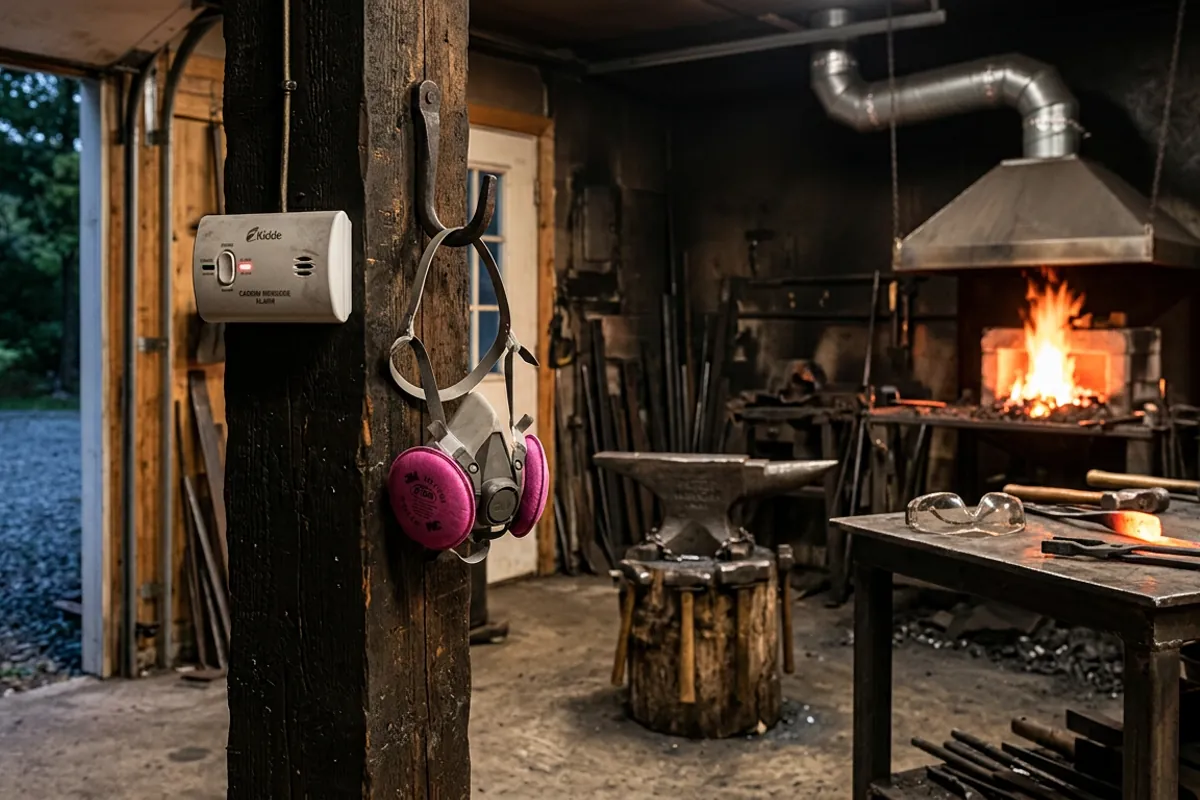
Ventilation and carbon monoxide come first. A gas forge produces carbon monoxide, which you cannot see or smell, and the "dragon's breath" flame at the door is unburned fuel and exhaust. Run a gas forge outdoors or in a space with real cross ventilation and a working carbon monoxide alarm, never in a closed garage or basement. This is the hazard that actually kills people, and it does it quietly.
Ceramic fiber is the second one. The blanket liner in every forge here can release respirable fibers, especially when it is dry, torn, or being cut. Rigidize and coat the liner so it stays put, and wear a proper respirator (an N95 at minimum, a P100 is better) any time you handle, cut, or patch ceramic wool. Do not run a forge with bare, flaking blanket.
Then the ordinary forge safety that still applies: ANSI Z87.1 rated eye protection whenever the forge is lit and especially at the grinder, natural fiber clothing rather than synthetics that melt to skin, and tongs that actually fit the stock so hot steel does not slip. Keep the propane tank upright, check your hose and regulator for leaks with soapy water, and shut the tank off at the valve when you are done, not just the forge. I put the full rundown in the blacksmith safety gear guide, and it is worth reading before your first fire, not after.
What I would tell a friend
Buy the Hell's Forge portable double burner. It heats a real length of steel, gets hot fast, ships with a coated liner that most people otherwise have to build themselves, and it is made well enough that you will not be shopping again soon. That is the one for most people.
Go with the Simond Store single burner if money is tight and your work is genuinely small, and go in knowing you may block a door and tune the burner. Reach for the Hell's Forge MAX only when your work has actually outgrown the standard chamber, because the extra room costs propane on every heat.
Whichever you pick, spend the safety money too: a carbon monoxide alarm, real ventilation, a respirator for the liner, and Z87.1 eye protection. A gas forge is the easiest fire to light and the easiest to get careless around. For the wider view of how these fit the rest of a shop, start at the forges topic hub and the gas forge buying guide, and take the safety chapter seriously before you strike the first heat.