When someone new asks me what metal forge to buy, they usually want a brand name and a link. The honest answer is shorter than they expect: for most home shops, a two burner propane forge with a stainless body, a firebrick floor, and a door on at least one end will do ninety percent of what a hobby smith wants, and the one I would point a beginner at today is the Simond Store double burner with one side door. It is not exotic, it is not the cheapest thing on the page, and it will heat stock long enough to make hooks, tongs, and knives without you fighting it.
Before you read another word: I have run a coal forge and a propane forge in my own shop for years, and Bessie, my 148 lb Trenton, has taken everything both of them have heated. But I have not bought and bench tested every forge in this guide. What follows is published maker specs, checked against what owners report on the forums, weighed against what I know about how a forge behaves once it is yours. Where I am repeating owner consensus rather than my own hours, I say so.
What a metal forge actually has to do
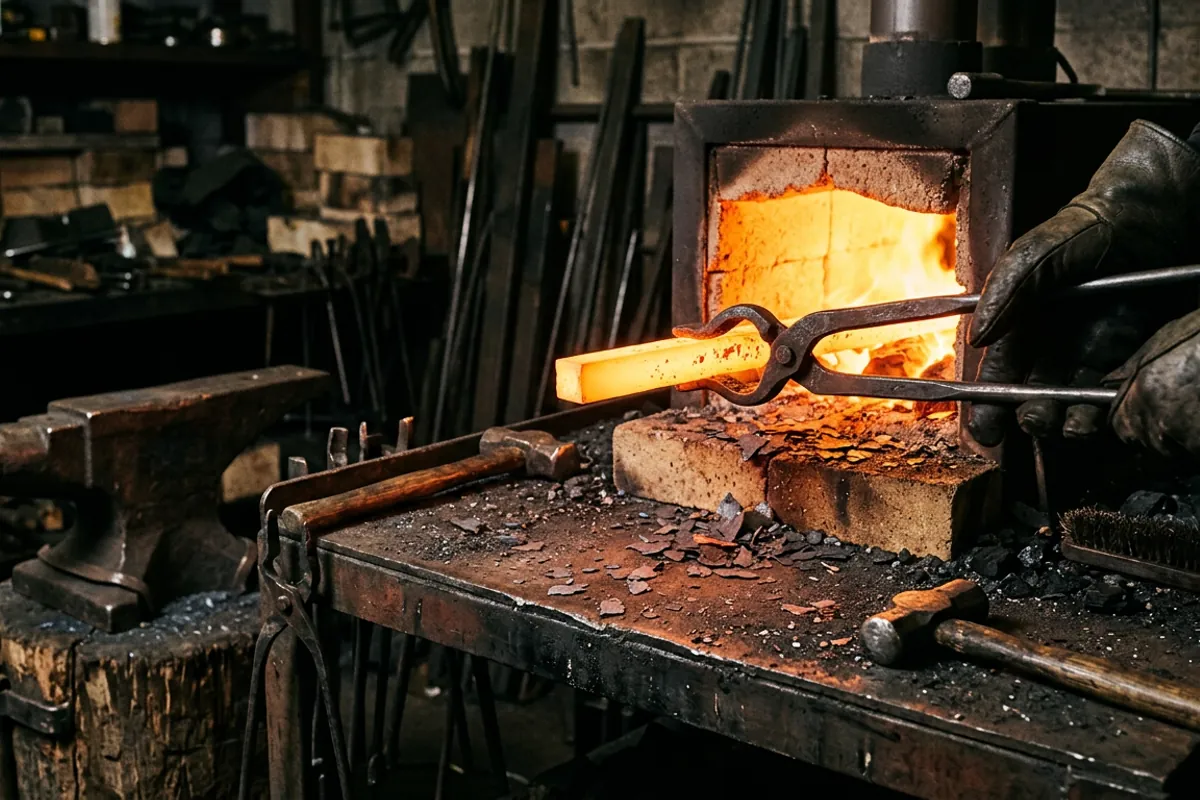
Strip the marketing away and a forge has four jobs. It has to get a piece of steel to forging heat, which for mild steel means a bright orange to yellow, roughly 2100F. It has to hold that heat evenly across the length of stock you actually work, not just at one hot spot. It has to let you get the work in and out without gymnastics. And it has to not fall apart or shed insulation into your lungs while doing it.
Everything else is preference. Chamber size is the spec that decides most of your future frustration: a small chamber heats fast and burns less gas, but you cannot get a 3/4 inch bar in sideways to put a scroll on the end, and you cannot heat a knife blade evenly if the blade is longer than the forge is deep. A door on the end changes the same forge from a knife heater into something you can pass long stock through.
The other thing a forge has to do is match your fuel. If you have not settled that question yet, read coal or propane first, because a forge you bought for the wrong fuel is money gone. Short version from my floor: propane for fast, repeatable, even heat and most day to day work; coal for heavy stock, localized heat, and forge welding. I use both and I would not give up either.
The field at a glance
Published figures only. Where a maker does not state a number, this says so rather than guessing.
Scroll horizontally to see all columns.
| Forge | Fuel | Published chamber | Insulation | Rated temp | Weight | Suits |
|---|---|---|---|---|---|---|
| Simond Store single burner, oval stainless | Propane | Not published | 1 in ceramic fiber blanket plus firebrick | 2600F rated | Not published | Small work, tight space |
| Simond Store double burner, one side door | Propane | 5.4 in H x 5.4 in W x 18 in L | 1 in ceramic fiber, 10 lb density, 1 in firebrick floor | 2600F rated | 41.8 lb | General smithing, knives |
| Devil Forge DFPROF2b | Propane | 5.6 in W x 5.6 in H x 16 in D | 1 in ceramic blanket, 20 mm firebrick bottom | 2500F / 1370C | 27 lb | Farrier work, knives, portability |
| Simond Store coal firepot, 10 x 12 | Coal or charcoal | 10 x 12 in, 4.5 in deep | Welded 1/2 in steel plate, no lining | 2600F rated | 45 lb | Heavy stock, forge welding |
Two names you will meet constantly and will not find in that table are Hell's Forge and Mr Volcano. Both are made in the USA, both have real followings, and I left them out for one boring reason: I could not pull their published specs from a maker page I was able to load, and I am not going to copy numbers off a marketplace listing and call them specs. That is a sourcing problem on my end, not a verdict on the gear.
Simond Store single burner, oval stainless
This is the smallest metal forge I would tell someone to actually buy. Simond Store publishes a 16 gauge polished stainless SS-304 body, a stainless nozzle, a 1 inch pre-rigidized ceramic fiber blanket plus firebrick lining, and a 2600F rating on their product page. They do not publish internal chamber dimensions on that page, which is exactly the number you want most, so go in expecting a small chamber sized for short work.
Who it suits: someone with a garage corner, a 20 lb propane tank, and plans that stop at hooks, bottle openers, small tooling, and short blades. One burner means less gas burned per hour and a forge that comes to heat quickly.
Where it will annoy you: one burner heats a short zone. If you try to bring a 12 inch billet to an even heat you will be sliding it back and forth chasing the hot spot, and the ends will lag. Most smiths who start here buy a two burner within a year or two. That is not a defect, it is the arc of the hobby.
Check price on Amazon (paid link)
Simond Store double burner with one side door
This is the pick. Simond Store publishes an internal chamber of 5.4 inches high by 5.4 inches wide by 18 inches long, a 16 gauge SS-304 stainless body, walls lined with 1 inch of 10 lb density refractory ceramic fiber, a 1 inch rigid firebrick floor, a 2600F rating, and a shipping weight of 41.8 pounds on the maker's page. The kit includes the regulator with gauge, hose, clamps, firebricks, and extra blanket.
Eighteen inches of chamber with a door on one end is the spec that matters. That is enough length to heat a knife blade evenly, enough to pass long stock through when you are drawing out a taper, and enough to get a pair of tongs to heat without stacking them at an angle. The firebrick floor is the part beginners underrate: you will drop hot stock, drag scale, and scrape flux, and a hard floor survives that where bare blanket does not.
Honest tradeoffs. A 5.4 inch square chamber is not a big forge, and two burners eat propane faster than one, so expect shorter runs off a 20 lb tank, especially in cold weather when a single tank can frost up and start starving the burner. Stainless looks good and stays looking good, but it does not make the forge hotter. And like nearly every forge in this class, the burners are naturally aspirated venturi burners: they are simple, they are tunable, and they are sensitive to wind, so do not set up in a cross breeze and then blame the forge.
Check price on Amazon (paid link)
Devil Forge DFPROF2b
Devil Forge is the one maker in this roundup that publishes a full spec sheet without you having to dig. On the DFPROF2b page they list interior dimensions of 5.6 by 5.6 by 16 inches, two connected DFP burners rated 160,000 BTU combined, a 2500F / 1370C maximum, a 16 gauge steel body, 1 inch of ceramic blanket with a 20 mm firebrick bottom, an operating pressure range of 1 to 25 psi, and a 27 pound weight. The package includes tongs, gloves, a regulator with gauge, hose, clamps, and rigidizer powder with a brush.
The feature I like on paper is individual gas valves on the two burners. Running one burner when you only need a short heat is real fuel savings, and it lets a two burner forge behave like a single burner forge on the days you want that. At 27 pounds it is also genuinely portable, which is why farriers keep showing up in the reviews.
The tradeoffs are the mirror image of the Simond. Mild steel body rather than stainless, so it will scale and discolor. It ships with rigidizer as a powder you mix and apply yourself, which is the right approach for lining life but means the forge is not a five minute unbox. And a 2500F rating is a rating, not a promise: what you get depends on your burner tune, your pressure, and your ambient temperature.
Check price on Amazon (paid link)
The solid fuel option: a welded firepot
If you already know you want coal, do not buy a coal forge as a finished appliance. Buy a firepot and build the table. Simond Store publishes a 10 by 12 inch firepot with a 4.5 inch inside depth, built from 1/2 inch mild steel plate welded inside and out, 45 pounds, with a 3 inch round tuyere 4.5 inches long, a weighted automatic ash dump, and a clinker breaker on a rotating rod. Those figures are on their firepot page, including the hole size it drops into: minimum 10.5 by 12.25 inches, maximum 11.75 by 13.75 inches. Measure before you cut.
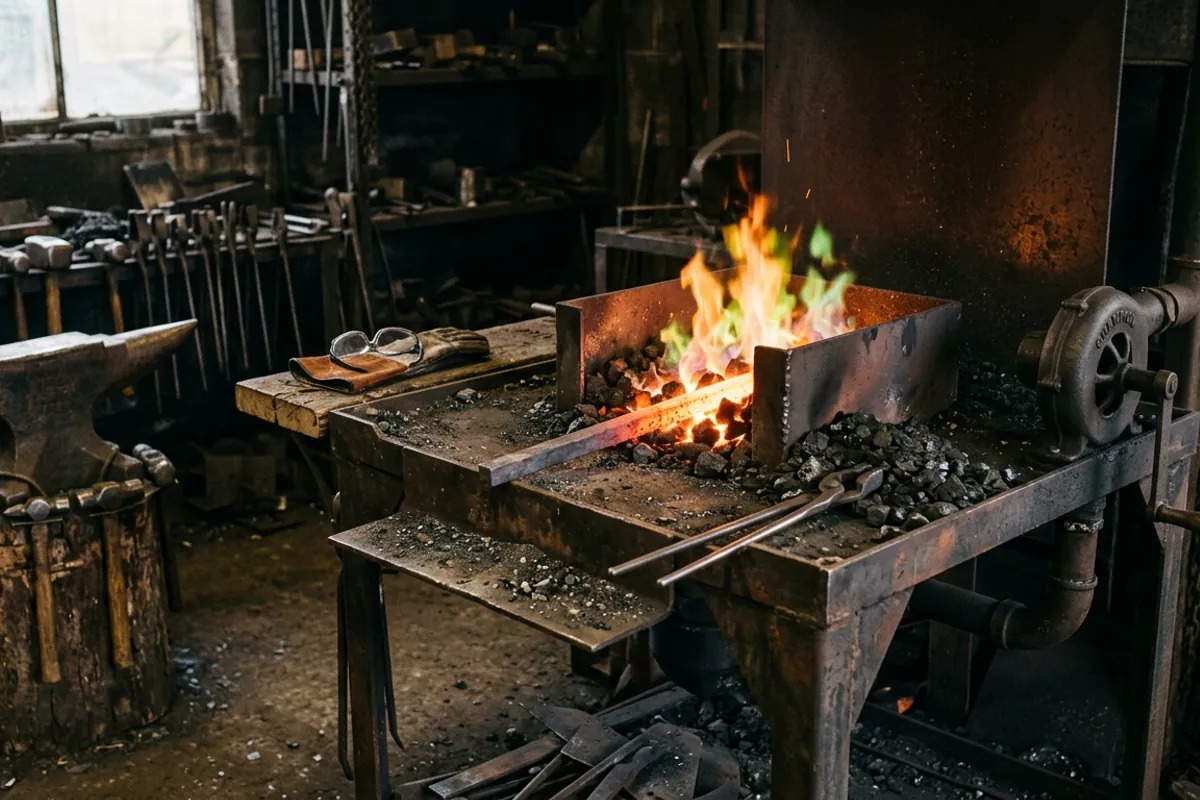
Why a firepot and not a complete coal forge: the pot is the part that has to survive, and welded half inch plate does not crack the way cast iron can under thermal shock. The table around it is just steel and time, and building it teaches you more than buying it does. A clinker breaker is not optional equipment on a coal fire, so I am glad it is included rather than an upsell.
What coal costs you that propane does not: smoke, a chimney, neighbors, ash, and attention. What it buys you is localized heat you can put exactly where you want it and a fire deep enough to forge weld in. My coal forge is where heavy stock and welds happen, and I would not run a shop without one, but it is the second forge for most people, not the first.
Check price on Amazon (paid link)
What owners say
For gear I have not run down myself, the forums are the honest signal, so here is what turns up and where it is thin.
On gas forge ventilation, the I Forge Iron thread Setting Up Gas Forge, Ventilation Considerations? covers the point that gets skipped in product listings: a gas forge does not usually need a chimney the way coal does, but it absolutely needs air exchange. The separate carbon monoxide thread in the safety section is the one to read if you are thinking about a closed garage in winter.
On fuel choice, the perennial gas or coal thread is worth an hour of your evening. It is not settled and it never will be, which is itself the answer: both work, and the deciding factors are your neighbors, your ventilation, and what you plan to make.
On burners, the consensus in Ribbon Burners, Really that Efficient? is that ribbon burners run at much lower pressures than venturi burners for the same work. That is an upgrade path, not a first purchase. None of the forges above ship with one.
On Simond Store specifically, owner signal is thinner than I would like. There is an I Forge Iron thread asking flatly whether their coal forge is worth getting for small projects, which tells you the question is common enough to ask in public. What I see repeated across marketplace and forum comments is consistent on two points and I will report both: the forges work as delivered, and you should soap test every propane fitting before first light because these ship as kits and a kit is only as tight as the person who assembled it. That is not a knock on one brand. It is true of every gas forge sold as parts in a box.
Ventilation, ceramic fiber, and the rest of the safety bill
This is the section I will not soften.
Carbon monoxide is odorless and it will kill you before you feel clever about it. A propane forge in a closed garage is not a small risk, it is the classic way hobby smiths end up in an emergency room. Run a gas forge outdoors or in a space with real cross ventilation and put a carbon monoxide alarm in the shop. An alarm costs less than one burner.
Ceramic fiber blanket is the other hazard nobody puts on the box. Respirable ceramic fibers are listed by the National Toxicology Program as reasonably anticipated to be human carcinogens, and OSHA's page on synthetic mineral fibers covers the respiratory and skin effects. What that means at your bench: wear a fitted respirator and gloves when you handle or cut blanket, rigidize it, and coat it with refractory before you run the forge hard. A blanket that has been rigidized and coated does not shed fibers into your breathing air the way bare blanket does. The Devil Forge kit includes rigidizer powder for exactly this reason, and the Simond forges ship with pre-rigidized blanket, but the coating step is still on you.
Eye protection is ANSI Z87.1 rated, every heat, no exceptions, and natural fibers only near the forge. Synthetics melt into skin. I learned the PPE lesson the expensive way: early on I quenched a blade in oil that was too cold, stood too close in a cotton shirt with no face shield, and the oil flared and took my eyebrows. I kept my eyesight by luck, and luck is not a safety system. If you want the full list of what actually matters, I wrote it up in blacksmith safety gear.
One more: forge heat and metallurgy are different subjects. A forge rated to 2600F does not mean your steel wants 2600F, and forging heat is not heat treat temperature. When you get to hardening and tempering, go read real testing at Knife Steel Nerds rather than trusting a forum number or a color chart in a marketing photo.
What I would tell a friend
Buy the two burner with a door. The Simond Store double burner with one side door (paid link) has the 18 inch chamber and the firebrick floor that keep it useful after your first year, and the extra cost over a single burner is small next to the cost of buying twice. If you know you want a farrier friendly, portable unit with independent burner valves and a published spec sheet, the Devil Forge DFPROF2b (paid link) is the sensible alternative.
Skip the single burner unless space or budget genuinely forces it, and skip the complete coal forge on a stand: if coal is your path, buy the welded firepot and build the table around it.
And spend the money you saved on the rest of the shop before you upgrade the forge. A forge with nothing to hit on is a space heater. Sort out the anvil first with what size anvil you actually need, get the short list of tools that actually matter, and if you want more on picking a first fire, the forges topic hub and my longer blacksmith forge guide cover the ground from a different angle.