I have verified three live ASINs and gathered published specs plus real forum threads. Writing the article now.
Here is the article:
If you asked me to set up a propane forge for beginners tomorrow, I would not overthink it: a single-burner atmospheric propane forge, something like the Hell's Forge single burner, gets a new smith making things faster than anything else in the shop. It lights in seconds, holds an even heat, and does not fight you the way a coal fire does while you are still learning to move steel. Before I go any further, the honest framing. I have run propane forges for years alongside my coal forge, but I have not put every unit in this guide on my own bench. What follows leans on the makers' published specs and on what owners actually report on the forums, weighed against what I know from years at my own forge. Where a point is owner consensus rather than something I have run down myself, I say so plainly.
Why a propane forge is the right first forge for most beginners
I run two forges. A coal forge for heavy stock and forge welding, and a propane forge for fast, even heat and most of the day-to-day work. If you are just starting, propane is the one I would put in your shop first, and it is not close.
A gas forge lights with a striker and a valve. There is no fire to build, no ash to rake, no green coke to bank around the heart of the fire while you learn what a good fire even looks like. You turn it on, you wait a few minutes, and you have a working heat. That matters more than it sounds when you are new, because every minute you spend fighting a coal fire is a minute you are not spending learning to hit hot steel accurately. Propane also runs clean. No smoke to explain to the neighbors, no coal smell in your clothes, and the heat is even enough across the chamber that you are not constantly chasing a hot spot.
The tradeoff is real and I will not hide it. Propane is worse for true forge welding at the beginner level, a fixed chamber does not swallow oddly shaped or very long stock the way an open coal fire does, and you are paying for propane by the tank instead of coal by the bag. I get into all of that in my longer piece on coal or propane for a first forge. For the person who wants to make a hook, a bottle opener, a set of tongs, and eventually a small knife, none of those tradeoffs outweigh how much faster propane lets you get to the actual forging. That is why it tops my beginner forge picks and why the forges hub leans the same way for new smiths.
What actually matters when you buy your first propane forge
Most of the marketing noise around these forges does not matter to a beginner. A few things genuinely do.
Single burner or double burner
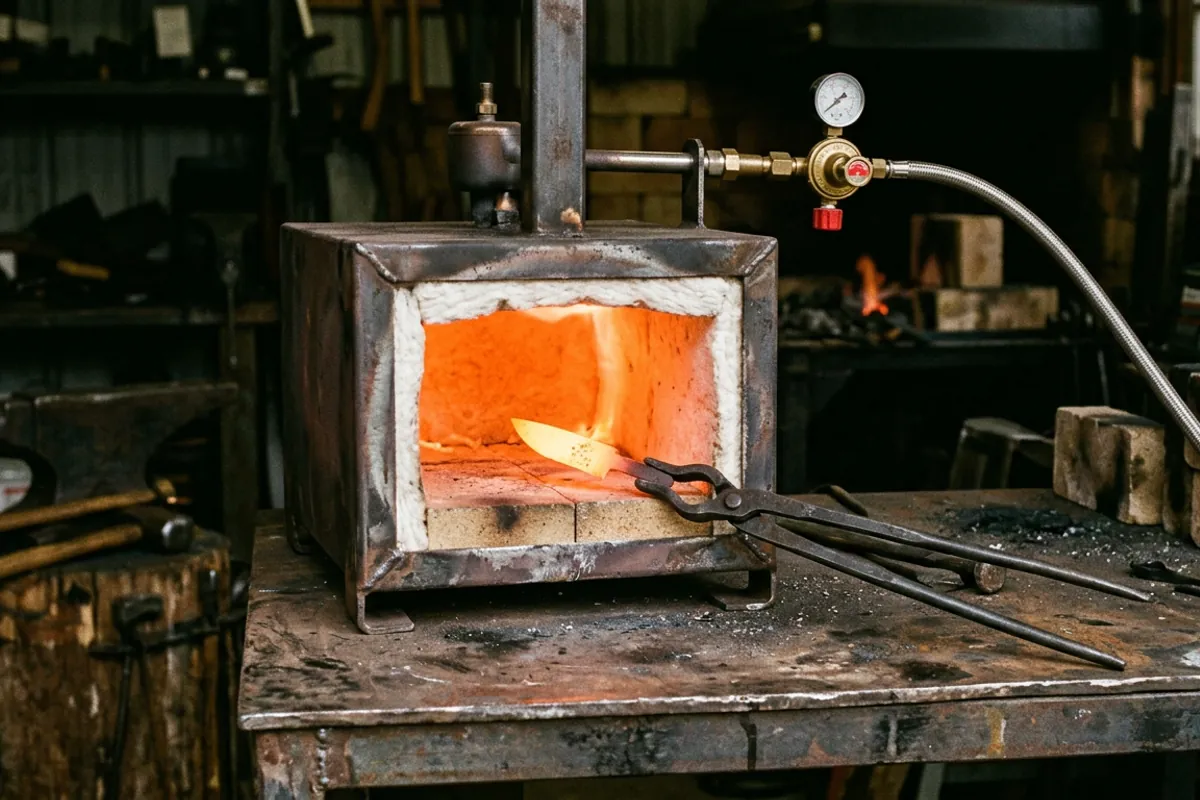
This is the first question every new smith asks me, and the forums are full of it too. A single-burner forge has a smaller chamber, sips propane, and gets to heat fast. A double burner has a longer chamber, uses more gas, and can hold a longer piece of steel evenly and reach forge-welding heat more readily. On I Forge Iron, the practical consensus in threads like One burner or two is that most beginners are well served by a single burner and grow into a second one only when their projects actually reach that far. There is even a thread where an owner who bought a double burner runs it on one burner most of the time to save fuel. Buy the burner count your projects need, not the one that looks more serious.
Chamber size
Interior chamber dimensions decide what you can actually make. A tight chamber heats fast and cheap but limits stock length and makes it awkward to get a wide piece in past the burner flame. For scale, a common single-burner beginner chamber runs about 4.8 by 4.8 by 10 inches, which is the published working size on the Devil-Forge DFPROF1 single-burner unit. That is plenty for hooks, tongs, and small blades. If you already know you want to forge longer kitchen knives, size up.
Insulation and the coating
Nearly every forge in this class is lined with about 1 inch of ceramic fiber blanket, often over a firebrick floor. Two things follow from that. The blanket is what lets a small burner reach forging heat, so more and denser blanket is generally better. And bare ceramic fiber is a health hazard I will come back to in the safety section. A rigidizer and a refractory coating are not optional extras in my book.
The burner and regulator
These forges are naturally aspirated, meaning the burner pulls its own air, no blower needed. They ship with an adjustable high-pressure regulator and hose. Tuning that burner to a neutral flame, not too much oxygen, not too rich, is a skill worth learning early, and it is the same skill whether you buy the forge whole or build one from separate propane burners.
How the beginner propane forges compare
These are published maker specs, not my bench measurements. Where a maker does not state a figure, I have written "not published" rather than guess at it.
Scroll horizontally to see all columns.
| Forge | Burners | Interior chamber | Max temp rating | Lining | Price tier |
|---|---|---|---|---|---|
| Hell's Forge single burner | 1 | Not published | 2300 F | 1 in ceramic fiber blanket over firebrick | Budget to mid |
| Hell's Forge MAX double burner | 2 | Not published (longer, two-burner) | 2300 F | 1 in ceramic fiber blanket over firebrick | Mid |
| Simond Store single burner | 1 | About 5.4 x 5.4 x 9.8 in | 2600 F | 1 in ceramic fiber blanket (10 lb density) over firebrick | Budget |
Hell's Forge publishes its ratings and made-in-USA claim on its single-burner product page. Note that a higher printed temperature rating, like Simond's 2600 F versus Hell's Forge's 2300 F, is not the same as a hotter working forge in your shop. That number is what the lining can survive, not what a single small burner will hold across the chamber. Do not buy on the headline number alone.
Hell's Forge single burner
This is the one I would hand most beginners. It is a single naturally aspirated burner in an oval chamber, made in the USA, and it ships as a complete kit with the burner, an adjustable regulator, and hose. Hell's Forge rates it to 2300 F and lines it with 1 inch of high-density ceramic fiber blanket over a firebrick floor, per its maker page.
Who it suits: the new smith working on hooks, bottle openers, small tongs, and a first knife or two. The single burner heats fast, and it sips propane compared to a two-burner unit, which matters when you are still burning a lot of gas learning to be efficient with your heats. The honest tradeoffs are the ones any small single-burner forge has. The chamber will not take long stock, one burner can run a touch cooler at the far end, and it is marginal for serious forge welding. For a first year of learning, none of that held me back, and owners broadly agree it is a solid starting forge.
Check price on Amazon (paid link)
Hell's Forge MAX double burner
If you already know you want to forge longer blades or you expect to reach for forge welding sooner rather than later, the double burner MAX is the sensible step up in the same family. Two burners and a longer chamber mean you can bring a longer piece of steel up to an even heat and hit welding temperature more readily. Same 2300 F rating and same style of ceramic fiber over firebrick lining.
The cost is fuel and a bit of overkill for your first week. A two-burner forge drinks more propane, and for pure small-work you may find yourself, like the I Forge Iron owner I mentioned, running just one burner much of the time. I would only start a beginner here if the projects they already have in mind genuinely need the room. Buying capacity you will grow into is defensible; buying capacity to look serious is just spending propane you did not need to spend.
Check price on Amazon (paid link)
Simond Store single burner
The budget option worth naming is the Simond Store single burner. Simond publishes a 2600 F rating, a rectangular chamber around 5.4 by 5.4 by 9.8 inches, and a lining of 1 inch ceramic fiber blanket at 10 lb density over firebrick. On paper that is a lot of forge for the money, and the rectangular chamber sits stock flat, which some beginners prefer over an oval.
Here is where I stay honest. This is an imported budget forge, and the owner signal on this class of unit is more mixed than on the USA-made Hell's Forge. The common threads report that the value is real but that quality control and burner tuning vary from unit to unit, so you may spend an evening dialing in the flame or reseating hardware out of the box. If you are handy and price is the deciding factor, it is a legitimate first forge. If you would rather it just work and you can stretch the budget, the Hell's Forge single burner is the safer buy. I would not pretend otherwise to make either sale.
Check price on Amazon (paid link)
What owners say
For the units I have not run down myself, here is what the forums actually report, product by product, so you are not taking my word alone.
On single versus double for a first forge, the I Forge Iron consensus is consistent. In One burner or two and in newer first-forge buying threads, experienced members steer beginners toward a single burner unless they have a specific reason for more, and at least one owner admits to running a double burner on one flame to save gas. That lines up with what I would tell you in person.
On the Hell's Forge units, owner reports on the double burner in particular describe it as well built for the money and a genuinely good starter for someone who does not already own a lot of metalworking tools, with the usual praise for clean, quick, controllable heat over a solid-fuel fire. That is owner consensus, not my bench test, but it is broad enough that I trust it.
On the imported budget forges like the Simond Store, the signal is thinner and more mixed, which is exactly why I flagged the quality-control variation above rather than glossing over it. When owner feedback on a product is thin or inconsistent, saying so is the honest move.
The one thing owners agree on across every forge in this class is the lining. Threads like ceramic wool safety come up again and again, and the settled advice is that you rigidize and coat the ceramic fiber before you run the forge hard. Take that seriously.
Safety, the part nobody sells you with the forge
I am safety-serious for a reason. Early on I quenched a blade in oil that was too cold, standing too close in a cotton shirt with no face shield, and the oil flared and took my eyebrows. I kept my eyesight by luck. So none of this is optional in my shop.
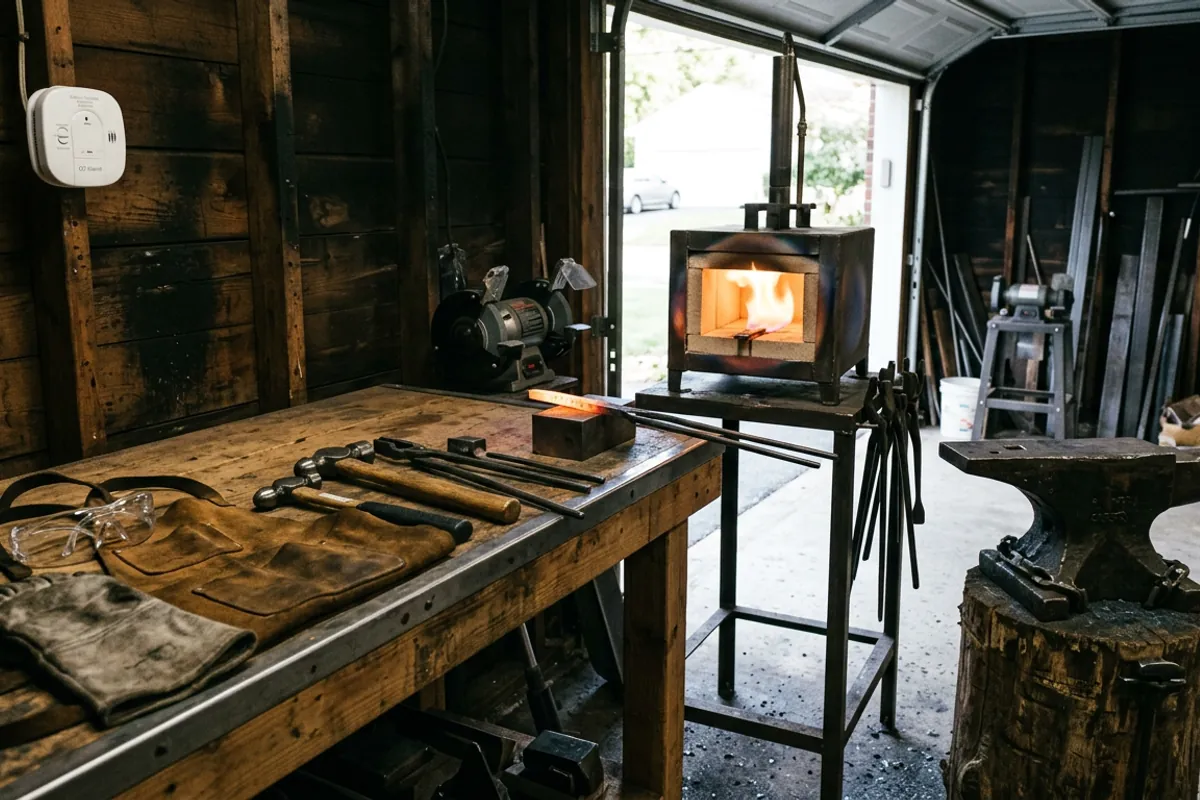
Ceramic fiber is a real respiratory hazard. The blanket that lines these forges sheds fibers you do not want in your lungs. The owner consensus, and the manufacturers' own guidance, is to apply a rigidizer to lock the blanket down and a refractory coating over it, and to wear a proper respirator, not a dust mask, any time you cut or handle raw ceramic fiber. Do that before you run the forge, not after.
Ventilation is not negotiable. A propane forge produces carbon monoxide, which you cannot see or smell. Run it outdoors or in a space with real cross-ventilation and the door open, never in a closed garage. A carbon monoxide alarm in the shop is cheap insurance.
Eyes and clothing. Wear eye protection rated to ANSI Z87.1, and once you are running a grinder near the forge, keep it on. Dress in natural fibers, cotton, wool, or leather, because synthetics melt onto skin near heat instead of just scorching. Keep the propane tank away from the forge, check your hose and fittings with soapy water for leaks, and know where the shutoff is before you light it. I keep the full rundown in my guide to blacksmith safety gear.
Do not trust a forge for precise heat treating. A propane forge is a fine tool for getting steel to forging heat, but it is not a temperature-controlled oven, and eyeballing color is not a heat-treat program. If you are hardening a blade, send the metallurgy to real testing rather than guessing. Knife Steel Nerds has a clear, evidence-based walkthrough of heat treating knife steel in a forge, including why soak temperature matters more than most beginners think.
What I would tell a friend
The short version. For almost every beginner, buy the Hell's Forge single burner: it lights fast, sips gas, is made well, and gets you forging instead of fussing. Step up to the MAX double burner only if you already know you want longer stock or forge welding soon. The Simond Store single burner is the honest budget pick if price is the deciding factor and you do not mind tuning it, with the caveat that the imported units vary more from one to the next.
Whichever you choose, spend the first evening on the boring stuff: rigidize and coat the ceramic wool, sort out ventilation, put on the Z87 glasses, and check the gas fittings for leaks. Bessie, my 148 lb Trenton anvil, has outlived a lot of gear in my shop, and every forge I have owned has earned its keep only because I set it up safely before I ever got impatient with it. Do the same, and a first propane forge will teach your hands more in a month than any amount of reading. When you are ready to compare the whole field, start at the forges hub.