I have verified live ASINs and real forum threads. Writing the article now.
Here is the article:
If you want the honest short version, a blacksmith coal forge is one of the cheapest ways to get real, controllable heat into steel, and for most beginners I would not buy a whole fabricated unit at all. I would buy a good welded firepot, drop it into a steel table you build yourself, and hang a hand-crank blower off the side. The one I keep pointing people at is the Simond Store welded firepot: it is honest steel, it is cheap, and it does the single job a firepot has to do. If you would rather buy something that already stands on its own legs the day it lands on your porch, the Simond Store forge with a hand blower gets you forging without a welder, and it is the one I would hand someone who does not want a project before the project.
Here is the framing before we go further, because it matters. I have run a coal forge in my own shop for years, alongside a propane forge, so I can speak to how a coal fire actually behaves, what a firepot has to do, and where the smoke and the danger live. What I have not done is run every one of these specific commercial units down in my own shop. So these picks lean on published specs, on what owners report on the forums, and on years at my own coal fire, and I will tell you plainly when a claim is a spec sheet or a forum thread rather than my own hands. If you are still deciding between fuels at all, read coal or propane first before you spend a dime here, and browse the rest of the forges hub for the neighboring guides.
What actually makes a coal forge work
A coal forge is four things: a firepot to hold the burning fuel, an air source to force oxygen up through it, a way to dump the ash and clinker, and something to stand the whole mess on. Everything else is comfort.
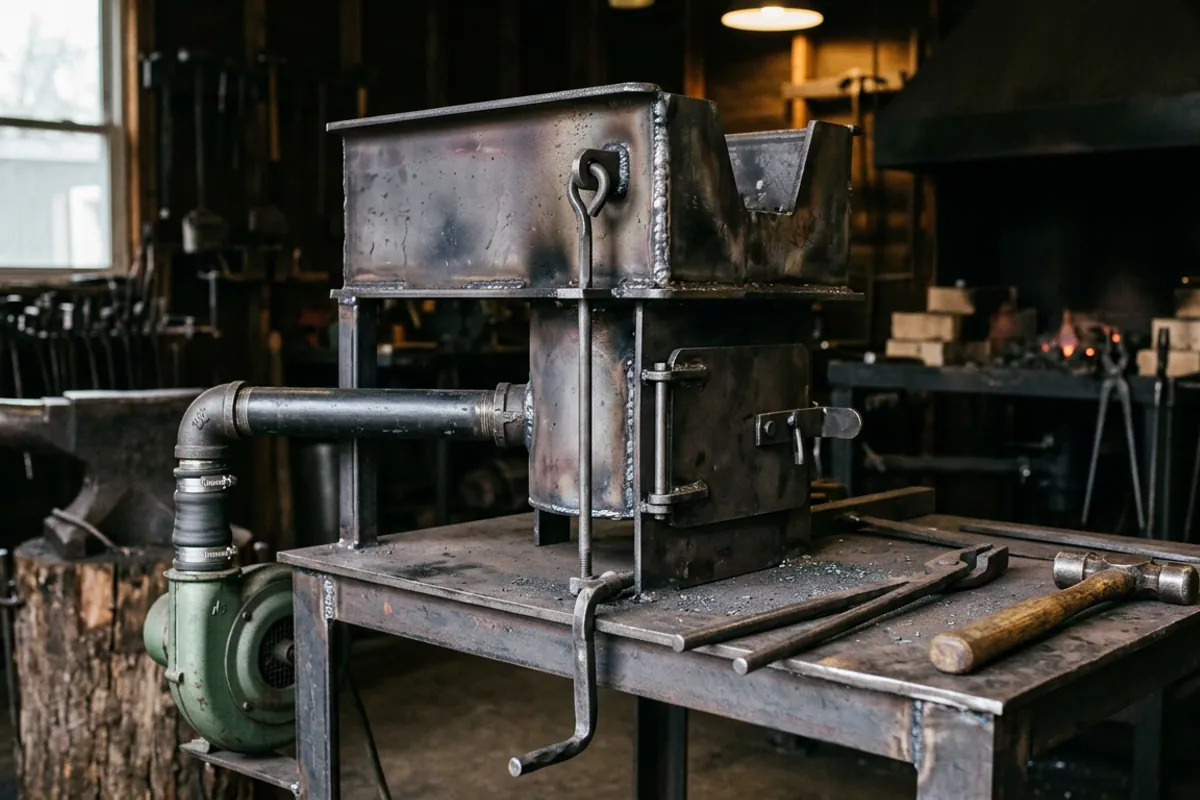
The firepot is the part that matters most and the part people overthink. It needs to be deep enough to bury your steel in the heart of the fire, where the hottest, most oxygen-starved zone lives, and no deeper. Too shallow and your work sits up in the oxidizing part of the flame, scaling and burning; too deep and you are just shoveling coal to fill dead space. A firepot in the 4 to 5 inch deep range covers most general work, which is why the common commercial pots land right there. The air comes up through a grate or a tuyere from below, and you want a clinker breaker so you can clear the fused ash glob that forms at the bottom of any coal fire without tearing the whole fire apart.
The blower is the throttle. A hand-crank blower gives you fine control and never needs power, which is why traditional smiths swear by them; an electric blower with a dimmer or a gate valve is set-and-forget. Either works. If you want to go deep on that choice, I wrote a whole forge blower buying guide. And the fuel itself is not a side note: real bituminous smithing coal behaves nothing like the hardware-store lump you might grab by mistake, so read the coal I would actually buy and, if you are leaning that way, blacksmith charcoal explained.
The field at a glance
Only published figures are in this table. Where a maker does not state a number, it says not published. Firepot dimensions and ratings for the Simond units come from the maker's own product pages (Simond Store firepot listing).
Scroll horizontally to see all columns.
| Product | Type | Firepot size | Construction | Blower | Price tier |
|---|---|---|---|---|---|
| Simond Store welded firepot | Firepot only | 10 x 12 in, ~5 in deep | 1/2 in welded steel plate, 2600F rated | Not included | Budget |
| Upgraded welded coal forge firepot | Firepot only | 10 x 12 in | Listing states 1/2 in plate, 44 lb, 2600F | Not included | Budget |
| Simond Store forge with hand blower | Complete portable forge | 10 x 12 in style pot | Welded steel, pedal-type hand blower | Included (hand crank) | Mid |
| Simond Store coal forge stand kit | Firepot, stand, and blower | 10 x 12 in pot | Heavy-gauge steel stand and pot | Included (hand crank) | Mid to premium |
Simond Store welded firepot
This is the one I would buy first, and it is deliberately the least exciting thing on the list. It is a welded steel firepot, 10 by 12 inches, with an inside depth of roughly 5 inches, rated by the maker to 2600F, built from half-inch steel plate welded inside and out rather than cast (maker specs). It comes with a clinker breaker on a half-inch rod and a self-closing ash dump. It does not come with a table, legs, or a blower. That is the point.
Why start here? Because a firepot bolted into a sheet-steel table you build is the coal forge most working smiths actually run, and welded plate is the honest choice over cast iron. Cast firepots crack when they are heated hard and fast; a welded steel pot takes the thermal shock and shrugs. The half-inch plate gives it enough mass to hold heat and enough life to outlast a beginner's mistakes. You supply a hand-crank or electric blower and a simple steel table, and you have a forge that will forge anything a home shop needs to forge, for less than the price of a decent pair of tongs from a name maker.
The honest tradeoff is that you need to build the table and rig the air, which means either a welder or a friend with one. If that is a wall for you, skip to the complete units below. But if you can drill and bolt steel, this is the most forge per dollar on the page.
Check price on Amazon (paid link)
Upgraded welded coal forge firepot
This is the same idea from a different seller, and I include it because a firepot is a firepot and a second option is worth having if the first is out of stock. It is a 10 by 12 inch welded coal forge firepot; the listing states half-inch plate, a 44 pound weight, and the same 2600F rating you see across this category. I want to be straight with you: there is no separate maker spec sheet I could pull to check those numbers against, the way there is for the Simond pots, so treat the weight and thickness as the seller's claim rather than a verified figure.
Functionally it is what you would expect: a heavy welded pot with an ash dump, meant to be dropped into a table. If it lists at a similar price to the Simond pot and the reviews are current when you look, it is a fine substitute. If it is priced above the Simond firepot, I would just buy the Simond one, because that one has published specs I can point you at. Same job, same category, pick on price and stock.
Check price on Amazon (paid link)
Simond Store forge with hand blower
This is the one for the person who does not want a project before the project. It is a complete portable coal forge: a welded firepot in the same 10 by 12 inch family, a stand, and a pedal-type hand blower, all in one box. Overall assembled weight and stand dimensions are not published in any spec sheet I could find, so buy it for what it plainly is rather than to a number.
The appeal is obvious. You do not need a welder, you do not need to source a blower separately, and you do not need to build anything. It arrives, you assemble it, you light a fire. For a lot of people that difference is the difference between actually starting and letting a firepot sit in a box for six months waiting on a table that never gets built. A hand-crank blower is genuinely the traditional right answer for control, so having one included is a real plus, not just a bundle.
The tradeoffs are the ones that come with any commercial all-in-one at this price. The firepot runs on the small side, which is fine for knives, hooks, small tools, and general learning, and cramped if your ambitions run to long stock or heavy bar. The stands on these units are lighter than a shop-built steel table, so expect to steady it and not to beat on it like it is an anvil stand. Within those limits it is an honest way to get a beginner forging fast.
Check price on Amazon (paid link)
Simond Store coal forge stand kit
The step up from the plain complete forge is the kit that pairs the firepot with a dedicated stand and a hand blower as a matched set. Simond sells this as a coal forge stand with firepot and hand blower, built from heavy-gauge steel with non-slip feet (maker listing). It is the most finished, least DIY option in the roundup, and it costs accordingly.
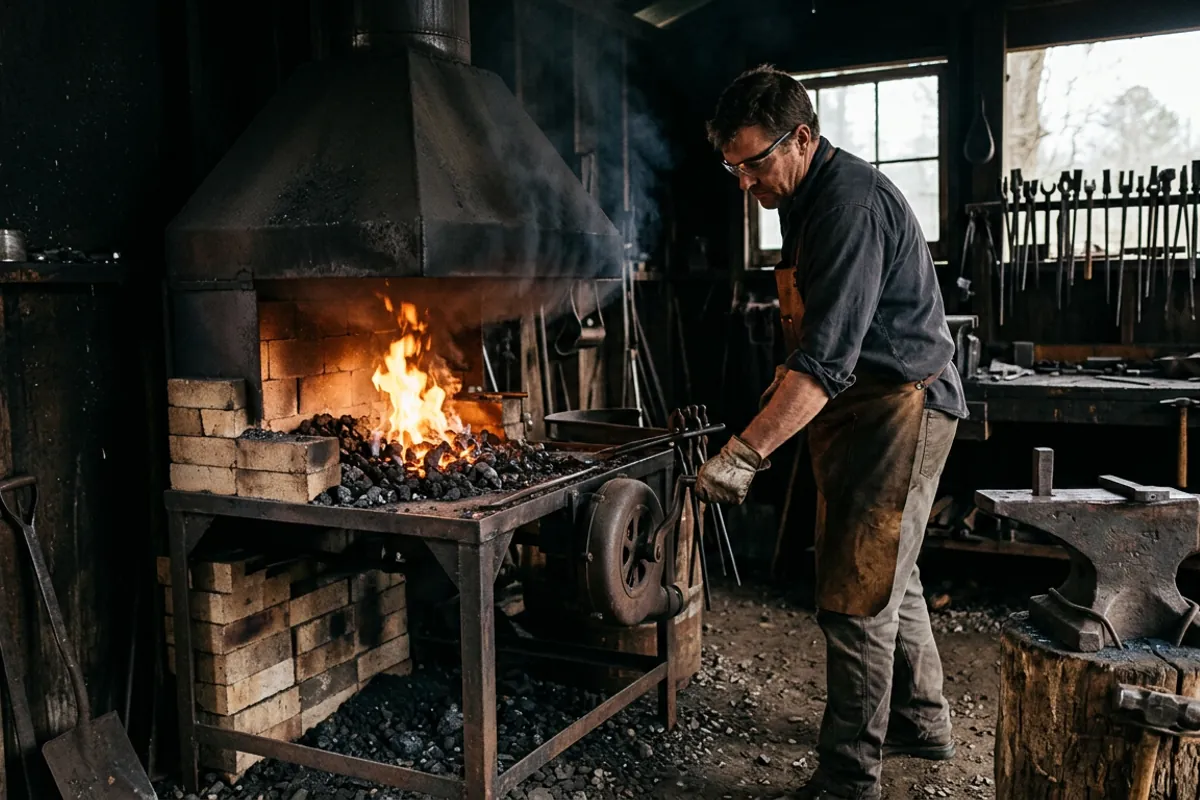
I would reach for this over the plainer complete forge only if the stand is genuinely sturdier and the price gap is small when you look. The firepot is the same working part; you are paying for a better base and the convenience of a matched kit. That can be worth it if you have no way to build a table and you want something that stands solid on a shop floor without wobble. It is not worth a large premium over the plain forge-plus-blower unit, because the thing that heats your steel is identical.
As with the others, treat the overall weights and stand measurements as not published in a real spec sheet. Buy it for the finished convenience, not for a number on a listing.
Check price on Amazon (paid link)
What owners say
For gear I have not run down in my own shop, here is what the forums actually report, attributed so you can go read it yourself.
The most useful single thread I found is on I Forge Iron, titled plainly Simond Store blacksmithing coal forge, worth getting for small projects. The tenor there matches the tenor everywhere these welded firepots come up: they are solid, honest steel for the money, the welds are good, and they are a fine little pot for starting out and for small work. The recurring caveat is size. Owners describe the pot as on the small side, big enough for something like a 4 inch blade or general small stock, and cramped once you want to heat longer or heavier pieces. That is not a defect, it is the category; a small commercial pot is a small pot. If most of your work is knives, hooks, and learning, that is exactly the size you want.
The other common owner note is about the air inlet geometry on these commercial pots, where the intake comes in at a right angle rather than at an incline, which a few owners find slightly awkward to plumb a blower to. Minor, but real, and worth knowing before you are on your back under the table with a pipe fitting.
On firepot dimensions in general, the long-running I Forge Iron discussion on firepot dimensions for a coal forge is the reference smiths point new folks to. The consensus there lines up with what I run at my own fire: a pot in the 4 to 5 inch deep range handles the general run of work, and deeper is not automatically better, it just burns more coal. The 10 by 12 inch commercial pots in this roundup sit inside that sensible range, which is the main reason they work as well as they do for the price.
Owner signal on the specific complete-forge and stand-kit bundles is thinner than on the bare firepots, so I am not going to pretend there is a deep consensus on those. What signal there is tracks the firepot: good pot, lighter stand than a shop-built table, get forging. When the data is thin I would rather tell you it is thin.
The safety part I will not soften
A coal fire makes carbon monoxide. That is not a footnote, it is the thing that can kill you quietly. Run a coal forge outdoors or under a proper hood with real draft, never in a closed garage, and if you ever get a headache or feel foggy at the forge, you leave, immediately. Green coal also throws thick, acrid smoke as it cokes down; your neighbors and your lungs both have opinions about that, which is one more reason for open air and a chimney.
The rest is the same discipline every hot fire demands, and I learned one piece of it the hard way. Wear eye protection rated to ANSI Z87.1, not sunglasses, not nothing; the fire throws sparks and scale, and a bit of hot scale in an eye is a hospital trip. Wear natural fibers, cotton or wool or leather, never synthetics, because synthetic fabric melts onto skin instead of brushing off. I quenched a blade in oil that was too cold once, standing too close in a cotton shirt with no face shield, and the oil flared and took my eyebrows. I kept my eyesight by luck, and I do not build safety advice around luck anymore. Keep a bucket of water and a real fire extinguisher within reach, and tie back anything that dangles. For the full rundown, blacksmith safety gear covers what actually matters and what you can skip.
What I would tell a friend
Buy the welded firepot, build a simple steel table, hang a hand-crank blower off it, and you will have a coal forge better than most beginners ever need, for the least money on this page. That is the Simond Store welded firepot (paid link), and it is where I would put my own dollars.
If you cannot weld and will not, buy the complete Simond forge with the hand blower and start forging this weekend; the stand kit is worth the step up only if the base is meaningfully sturdier and the price gap is small. Whichever you pick, the firepot is small, so match your ambitions to it, and if you want the deeper build-versus-buy argument I make the whole case in the coal forge I would build a shop around.
And the part that is not optional: coal makes carbon monoxide, so it lives outdoors or under a real hood, eye protection is rated Z87.1, and your shirt is cotton, not polyester. Get those three right and the rest is just practice.