Every time I help somebody put together their first gas forge, the same question shows up about halfway through the build: how much kaowool do I need, and can I just stuff it in the shell and light it? The answer to the first half is usually two inches. The answer to the second half is no, and the reason is worth more than the blanket costs. Kaowool is the material that made small propane forges practical in home shops, and it is also the material most likely to hurt you quietly if you treat it like the pink fiberglass batt from the hardware store. This is the reference I wish somebody had handed me before my first gas forge build, written the way I would explain it standing next to Bessie with the blanket still in the roll.
What is actually in the roll
Kaowool is a trade name, not a material name. It belongs to Morgan Thermal Ceramics, and like Crescent wrench or Sawzall it got used so widely that smiths now say kaowool when they mean any alumina silica ceramic fiber blanket. The generic term is refractory ceramic fiber, usually shortened to RCF. It is spun or blown from molten alumina and silica into fine fibers, then needled into a felt blanket, and the needling is what holds it together, which is why the manufacturer sheets list no organic binders.
What makes it useful in a forge is that it is almost all air. A ceramic fiber blanket is a tangle of fibers with very little mass, so it does not soak up heat the way a solid firebrick does, and it does not conduct heat out to the shell very well either. Light a two inch lined propane forge and you are at working heat in ten or fifteen minutes. Light a forge lined with hard firebrick and you can go make lunch while it comes up, because you are heating several hundred pounds of brick before you heat any steel.
That low thermal mass is the whole argument. It is why small propane forges became something a hobby smith could build in a weekend instead of masonry work, and it is a good chunk of why the coal versus propane decision looks different now than it did fifty years ago. A coal fire does not need a ceramic liner. A gas forge lives or dies on one.
The tradeoff is that a blanket made of air and fine fiber has no strength, no abrasion resistance, and no chemical resistance to speak of. Everything else in this article follows from that.
What the numbers on the roll mean
Three numbers get printed on the packaging, and beginners routinely buy on the wrong one.
Density
Ceramic fiber blanket is sold by density in pounds per cubic foot. The common grades are 6 pcf and 8 pcf, with 4 pcf out there too. Higher density means more fiber packed into the same thickness. For a forge, 8 pcf is what I would use. It holds its shape better when you compress it into a shell, it stands up to gas velocity from the burner better, and it takes rigidizer more evenly. The 4 pcf material is fine for wrapping a pipe. In a forge it slumps and channels.
Thickness
Blanket comes in 1 inch and 2 inch thicknesses, usually on 24 inch wide rolls. Two inches is the practical floor for a propane forge you intend to actually work in. One inch will get hot, and it will also dump heat into the shell, cook your regulator hose, and burn propane the whole time it is doing that. Two layers of 1 inch, wrapped so the seams do not line up, is functionally the same as one 2 inch layer and often easier to fit into a small shell. Some smiths run three inches in a forge welding setup. I have never regretted more insulation, only less.
Temperature rating
You will see 2300 F and 2600 F grades. Here is the part people get wrong: that number is a classification temperature, not a continuous use temperature. It is the point at which the material still holds together under test conditions, not the temperature you can park it at forever without it degrading. The continuous use limit is lower, and the manufacturer's data sheet is where that number lives. Look it up for the specific product you bought rather than trusting a forum post.
Why it matters: forge welding heat sits up around 2300 F at the steel, and the interior of a well sealed forge is not cooler than the work in it. Run a 2300 F blanket at welding heat every weekend and it will shrink, glaze, and get brittle much faster than the number on the box suggests. If forge welding is on your list, buy the 2600 F grade and coat it properly.
Why bare blanket never goes in a running forge
Of everything a first forge build gets wrong, this is the one that follows you home in your lungs. Bare ceramic fiber blanket in a running forge does three bad things at once.
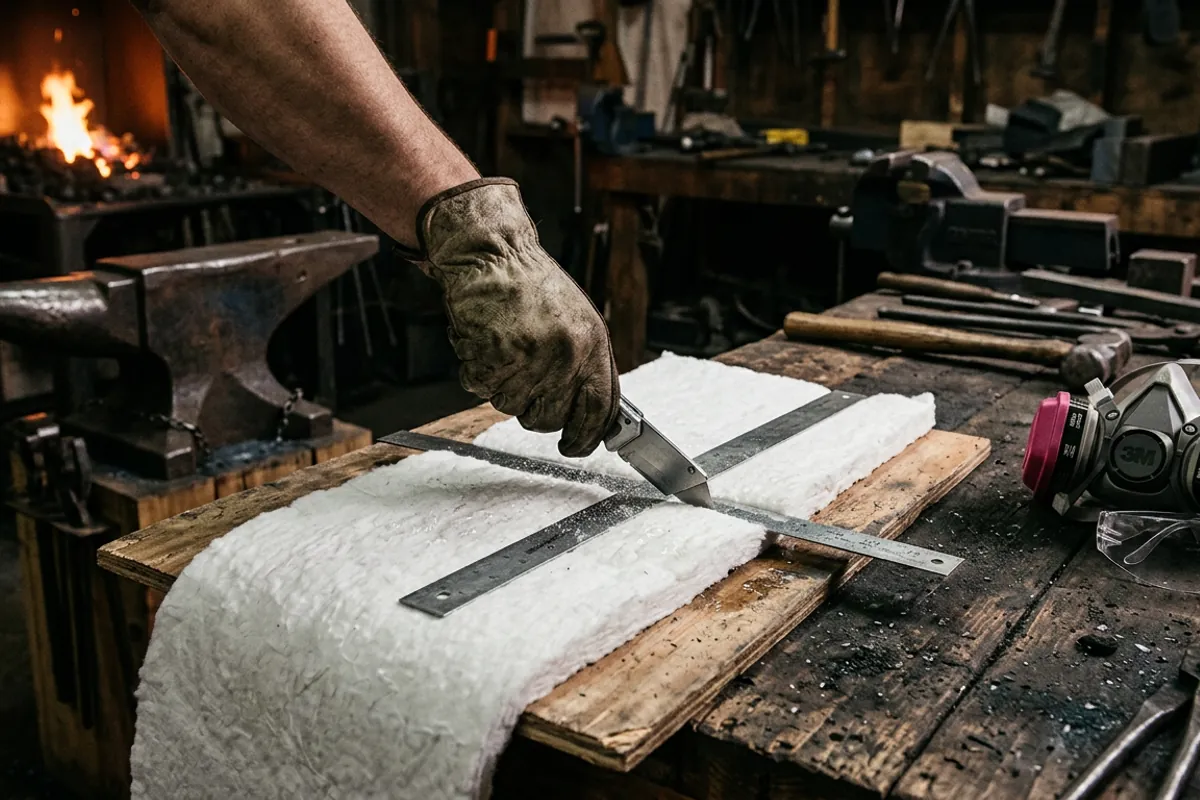
It sheds. Burner velocity picks fiber off the exposed surface and carries it out the door of the forge, into the air you are breathing, and onto everything in the shop. Every time you slide a bar in and out you abrade the surface some more.
It erodes. The blanket has essentially no mechanical strength. A bar dragged across the floor of an uncoated forge digs a trench. Within a season you have a hollow where the flame path is.
It reflects poorly. A raw fiber surface absorbs and re-radiates less usefully than a hard, dense, reflective face. Coating the interior gets you back some efficiency, which shows up as less propane burned for the same heat.
So a proper lining is three stages. First, rigidizer: a colloidal silica solution you spray or brush onto the blanket until it is damp through, which dries and then fires into a hardened skin that locks the surface fibers down. Second, a hard face: a thin layer of insulating castable refractory rated well above your working temperature, troweled over the rigidized blanket, or at minimum a refractory mortar coat. Third, on the floor, something genuinely sacrificial and flux resistant that you can replace without rebuilding the forge, such as a kiln shelf or a hard firebrick split laid in loose.
Two cautions on the castable. It needs a real water cure, typically covered and damp for about 24 hours, and then it needs a slow dry out with low heat before you ever run it hard. Water trapped in refractory turns to steam and blows chunks off the surface at speed. That is not a cosmetic problem, that is hot ceramic leaving the forge in your direction. Follow the mixing and dry out instructions on the bag exactly, and do not shortcut the schedule because you want to forge on Saturday.
This is the material side of the job. The step by step build, with the parts list and the order you buy them in, lives in the DIY forge parts buying guide and the propane forge build guide; what follows here is what each layer is for, so you can tell when one of them is missing.
The dust, said straight
I am safety serious about this one because the hazard is invisible and delayed, which is the worst combination for a hobby shop where nobody is watching.
Refractory ceramic fiber is classified by the International Agency for Research on Cancer as Group 2B, possibly carcinogenic to humans. NIOSH recommends an exposure limit of 0.5 fibers per cubic centimeter, averaged over a work shift of up to ten hours in a forty hour week. You have no way to measure that in a home shop, so the only sane rule is to keep the fiber out of the air and out of your lungs, every time, including the five minute job.
There is a second hazard that most people never hear about, and it is the more serious one. Ceramic fiber that has been held at high temperature, above roughly 1800 F, gradually devitrifies. The amorphous fiber converts to cristobalite, a form of crystalline silica. Crystalline silica is an IARC Group 1 carcinogen, the highest category, and it is also what causes silicosis. That means used, after service blanket that you are tearing out of an old forge is more hazardous than the fresh roll you are putting in, and it is more friable, so it crumbles into dust with less provocation. Tearing out a five year old forge liner with a shop vac and no respirator is the worst thing you can do with this material.
What I wear, every time, new blanket or old:
- A NIOSH approved particulate respirator. N95 is the minimum. I use a P100 half mask because it is what I already own for grinding, and because the seal on a half mask is more reliable than an elastic band on a folded cup. A respirator does nothing if it does not seal, and a beard breaks the seal. That is not an opinion, that is how the equipment works.
- Eye protection to ANSI Z87.1. Fiber in the eye is a mechanical irritant and rubbing it makes it worse.
- Long sleeves and gloves. The fibers itch like fiberglass because they abrade skin the same way.
And what I do around it: mist the blanket lightly with water before cutting so the fibers stay put, work outdoors or in the doorway with air moving away from me, never use compressed air to blow dust off anything, vacuum only with a HEPA filter, wipe surfaces damp instead of sweeping, and wash those clothes separately from the household laundry. Old liner material goes in a contractor bag, sealed, before it leaves the shop. None of this is theater. Fine respirable fiber is exactly the category of dust your body has no good way to clear.
If you want the wider picture on what protection is worth owning in a smithy, I laid that out in the guide to blacksmith safety gear. A respirator earns its place in that list mostly because of jobs like this one.
Cutting and fitting it without filling the shop with fiber
Blanket cuts with a sharp utility knife and nothing else. A dull blade tears and makes dust, so change the blade more often than feels reasonable. Cut on a scrap board, not on the bench you eat lunch at.
Measure the inside circumference of your shell and add a little, because you want the blanket compressed slightly rather than butted with a gap. Fiber shrinks a few percent at high temperature, and a joint that was tight cold can open up hot. Stagger the seams if you are running two 1 inch layers, so no gap runs straight through to the shell.
Burner ports get cut after the blanket is in, from the outside, using the shell's hole as a guide. Cut a clean circle rather than punching through. Any place the flame can find a path between the blanket and the shell becomes a hot spot, and a hot spot on a steel shell is how people burn their hands on the outside of a forge.
Expect smoke and a sharp smell on the first firing. That is the rigidizer and the coatings curing out, not the blanket itself, which carries no organic binder to burn. Do it outside or with the doors wide open, and stay out of the plume. While we are on ventilation: a propane forge produces carbon monoxide, and a garage with the door cracked six inches is not ventilation. CO has no smell and gives you no warning. That applies whether the liner is fresh or five years old.
For where the lining fits into the rest of a build, the gas forge build guide covers the shell, burner, and plumbing side that I am deliberately skipping here.
What kills a kaowool lining
Flux, first and worst. Borax at welding heat is a solvent for silica, and ceramic fiber and most refractories are largely silica. Flux that drips onto an uncoated blanket floor will eat straight through it and keep going into whatever is underneath. This is why the forge floor gets a sacrificial layer you can lift out and replace. Nothing in a home shop is truly flux proof. The goal is a floor that is cheap and easy to swap, not a floor that lasts forever.
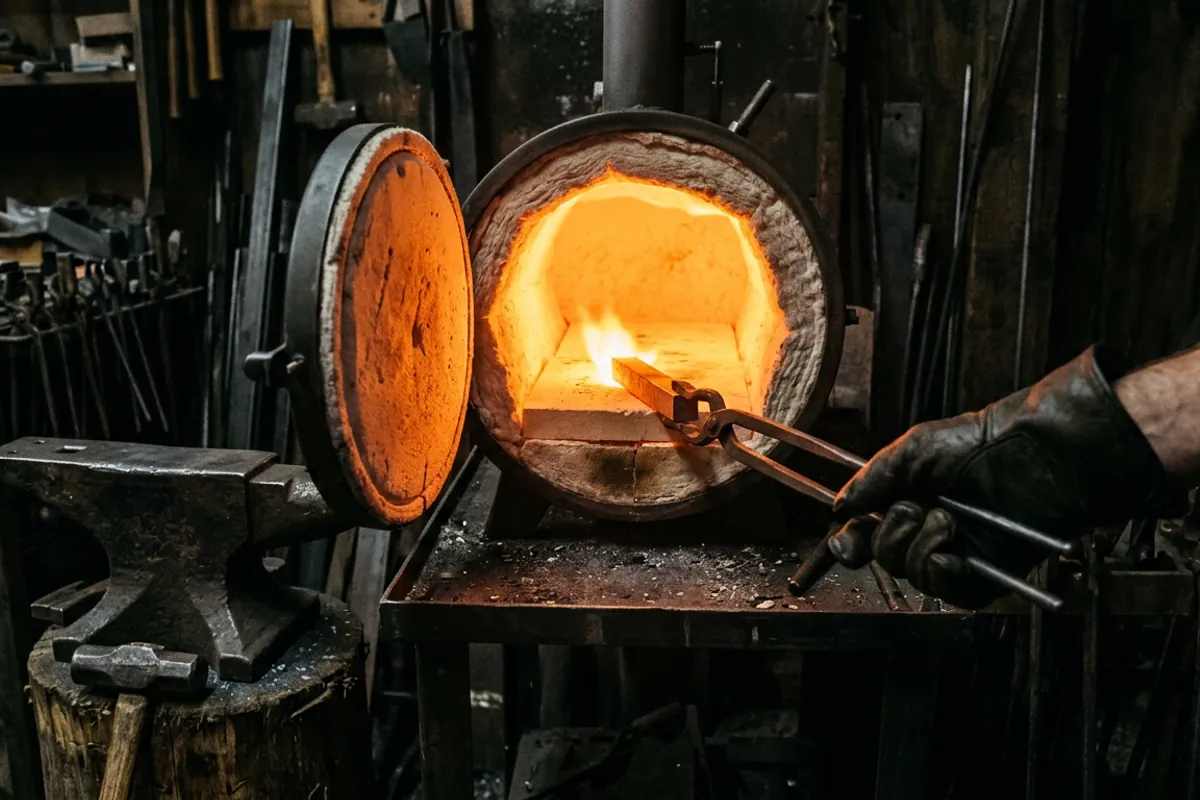
Mechanical abuse, second. Sliding stock in and out, poking around with tongs, propping a bar against the roof. A rigidized and coated liner survives normal handling. A bare one does not survive a month of it.
Heat cycling and time, third. Every trip to welding heat shrinks the fiber a little and moves it further along toward cristobalite. A forge run at bright orange for general work will outlive one run at welding heat every session by a wide margin.
Water, fourth. Wet blanket that gets fired fast can steam and delaminate. Let a forge that has been rained on dry slowly at low fire.
When the lining does fail, you will see it as a soft spot that glows differently, a shell that gets hotter than it used to on the outside, or the forge suddenly taking much longer to come to heat. That is a rebuild, not a patch, and rebuild day is respirator day.
Kaowool, firebrick, and castable
Three ways to line a gas forge, and they are not interchangeable.
Ceramic fiber blanket gives you the fastest heat up, the least weight, and the least durability. It is the default for a small propane forge and for anything portable.
Insulating firebrick, the soft kind sold in 2300 F and 2600 F grades, is light, cuts with a hand saw, and holds a shape without rigidizer. It is more durable to touch than blanket but still soft enough to gouge with a fingernail, and it costs more for the same volume. A lot of good forges are brick floor plus blanket walls and roof, which is a sensible split: brick where things get dragged, blanket where they do not. Do not confuse insulating firebrick with hard firebrick. Hard brick is dense, holds enormous heat, and belongs in the bottom of a coal forge or a fireplace, not in the walls of a gas forge you want hot in fifteen minutes.
Castable refractory as a full liner is heavy and slow. As a thin hot face over blanket it is exactly right. That is the combination most experienced smiths land on, and the consensus you will hear on any forum thread that runs longer than ten posts.
If you are still choosing a forge rather than lining one, the tradeoffs between building and buying are covered in the propane forge buying guide and the broader gas forge guide.
The bio soluble option
There is an alternative fiber worth knowing about. Alkaline earth silicate wool, sold as bio soluble or body soluble blanket, is engineered so the fibers dissolve in lung fluid over a relatively short period rather than lodging there for years. Because of that, it is not classified as a carcinogen the way refractory ceramic fiber is, and in the European Union it is exempt from the classification that applies to RCF.
It costs more, and the common grades have somewhat lower temperature ratings, so read the data sheet against how hot you actually run. For a forge that spends its life at general forging heat rather than welding heat, it is a reasonable trade. I still wear the respirator with it. Dust is dust, a mechanical irritant is still a mechanical irritant, and the habit is worth more than the marginal risk difference.
The exposure math also changes with how much you handle it. A smith who builds one forge in five years is in a very different situation from someone rebuilding liners every few months.
Other jobs the blanket does around the shop
Once you have a roll, it turns up in other places. A scrap piece makes a forge door that you can shape around irregular stock and that costs nothing to replace when it burns. Offcuts plug the back opening of a pass through forge when you are heating short pieces, which cuts fuel use noticeably. It lines the inside of a small heat treat oven or a pipe muffle.
Smiths also use it as an insulating wrap for slow cooling, which is where it touches heat treating. Wrapping a hot part to slow its cooling rate is a real technique, though for a full anneal most home shops get more consistent results burying the part in dry vermiculite or shutting it in the forge and killing the gas. If you want the actual metallurgy behind cooling rates rather than shop lore about them, I put the plain version in the guide to heat treating steel, and for the deep questions on transformation temperatures and specific alloys I would send you to real testing work like Knife Steel Nerds rather than trusting anything I could tell you from the forge floor.
One place it does not belong: a coal forge firepot. Coal forges want a clay or hard refractory lining and a cast firepot. Ceramic blanket in a solid fuel fire gets ash, clinker, and mechanical abuse, and it will not last.
What I check before I light a fresh lining
The short list I run through on any forge I have just lined, mine or somebody else's:
Is the blanket at least two inches thick, seams staggered, no path from the interior straight to the shell? Is every square inch of exposed fiber rigidized, with no dry gray patches? Is the hot face coated, and has the castable had its full water cure and slow dry out? Is the floor something I can replace in ten minutes when flux eats it? Are the burner ports clean circles with no gap the flame can crawl into? Is the first burn happening outdoors or with real ventilation, and am I standing out of the cure out smoke? Is the respirator, the Z87.1 eye protection, and the vacuum with the HEPA filter still sitting where I left them for teardown day?
None of that is difficult. It is just the difference between a forge that runs for years and one that has a soft spot glowing through the shell by the end of the season, and between a hobby that costs you money and one that costs you lung function.
The rest of the forge writing lives on the forges hub. I would rather you read this one twice than skip the respirator once.