Bufco is the trade name Buffalo Forge Company stamped on its cast-iron hand-crank blowers, so this is a vintage-tool guide with honest modern alternatives. I have verified two live Amazon ASINs and pulled cited specs from Centaur Forge. Writing now.
If you want a Bufco forge blower, know first what you are actually shopping for: Bufco is the trade name Buffalo Forge Company of Buffalo, New York stamped on its hand-crank blowers, and nobody makes them new anymore. So the honest verdict up front. A clean vintage Buffalo Forge geared hand blower, one where the gears run quiet and the crank spins free, is a lifetime tool and worth buying if you find it at a fair price. If you cannot find a good one, or the only ones near you sound like a coffee can full of gravel, a modern hand-crank blower or a small electric blower will feed the same coal fire for less money and less fuss. None of what follows is a bench test. I run a coal forge and a propane forge in my own shop, but I have not torn down every blower named here. This leans on published specs, the manufacturers' own pages, and what owners report on the forums, weighed against what I know about feeding a fire.
What a Bufco forge blower actually is
Buffalo Forge Company started in 1878 and spent decades building blacksmith equipment before it wandered off into industrial heating and air handling. The blowers you see stamped "Bufco" are geared, cast-iron, hand-crank centrifugal fans. You turn the crank, a worm gear or spur gear steps the speed way up, and a fan wheel inside the housing throws a steady stream of air out a spout that pipes into the bottom of a coal forge. That is the whole trick, and it has not changed in a hundred years because it works.
The reason smiths still hunt these down is the gearing. A good geared blower turns easy and coasts, so a slow, relaxed crank keeps a strong fire going without wearing your arm out. The cast-iron body is heavy and shrugs off heat and abuse. There is no motor to burn out, no cord to melt, nothing electric near the fire. For a coal forge, that is a genuinely nice way to work. The catch is age. Every Bufco out there is decades old, and how it was stored decides whether you are buying a tool or a boat anchor.
If you are still deciding between coal and gas before you worry about air at all, read Coal or propane: which first forge makes sense? first, because a hand blower only matters on a solid-fuel fire. A propane forge runs off a gas burner and needs no blower like this. This whole guide assumes you are building or running a coal or charcoal fire, the kind covered in The coal forge I would actually build a shop around. You can see where blowers sit in the wider forge picture over on the Forges topic hub.
How the blowers compare on paper
Here is the field at a glance. The vintage Bufco line has no published spec sheet anymore, so those cells read "not published" rather than a number I made up. The modern figures come straight from the makers' pages, cited below.
Scroll horizontally to see all columns.
| Blower | Type | Published airflow | Outlet | Weight |
|---|---|---|---|---|
| Buffalo Forge "Bufco" (vintage) | Hand crank, geared cast iron | Not published | Not published | Not published |
| Centaur Forge Super Blower (new) | Hand crank, 25 to 1 worm gear | Up to 200 CFM, 4100 FPM | 3 in | 18 lb |
| Centaur PB50VS (electric) | Electric, variable speed | Over 500 CFM | Not published | Not published |
| Dayton 115V shaded pole (electric) | Electric | Over 134 CFM at 1500 RPM | Not published | Not published |
The Centaur Super Blower figures are published on the Centaur Forge Super Blower page, including the 25 to 1 worm gear ratio and the 3 inch outlet. The electric numbers come from Centaur's PB50VS listing and its Dayton 115 volt blower page. Do not read too much into raw CFM. A coal fire does not need a gale. It needs a steady, controllable trickle of air, and every option here can supply more than a single hand-built firepot will ever use. What separates them is control, upkeep, and how they feel to work with.
Buying a vintage Bufco or Buffalo Forge hand blower
This is the one people actually search for, so let me be straight about it. A vintage Buffalo Forge hand blower is a great tool when it is right and a headache when it is not. There is no maker warranty, no returns, and no spec sheet. You are buying a used mechanical object on condition alone.
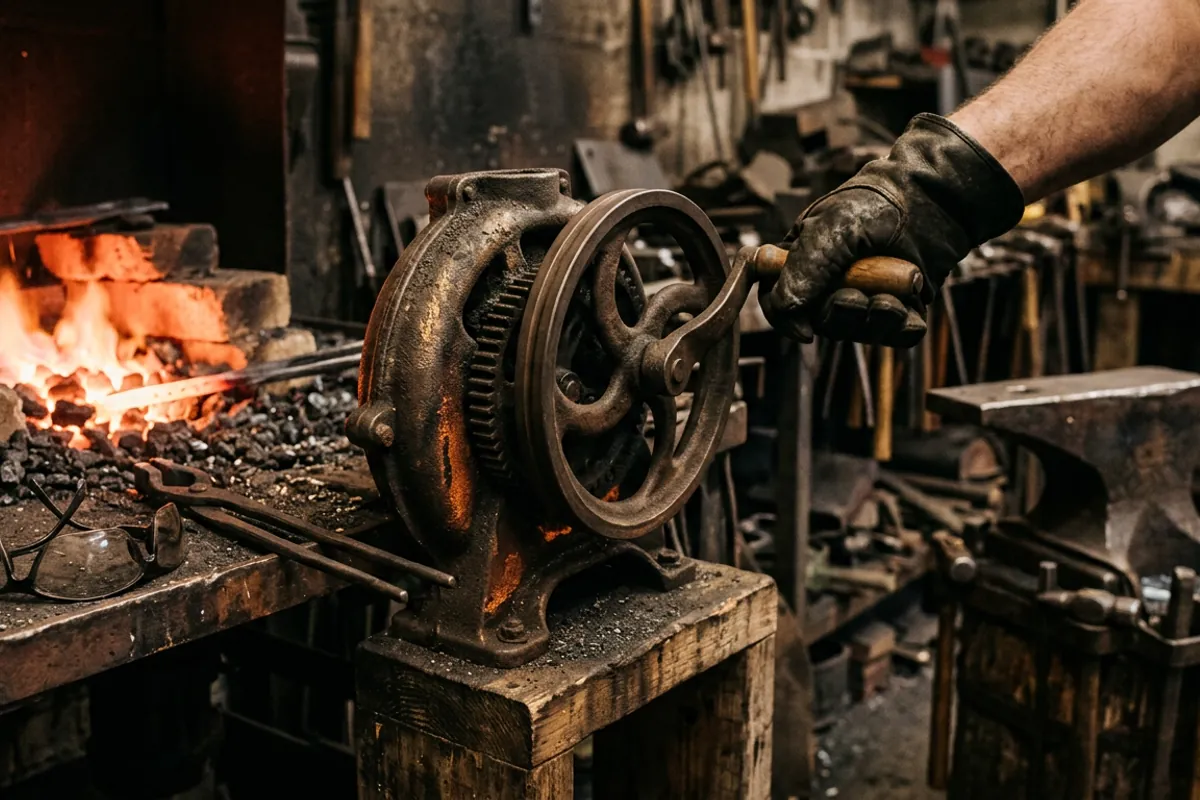
What to check before money changes hands. Spin the crank and listen. It should turn smoothly, step up the fan fast, and coast for a second or two when you stop. A little whir is fine. A grinding, rock-in-a-can rattle means the gears are worn, dry, or full of hardened old grease and grit. Check for cracks in the cast housing, especially around the mounting foot and the spout, because a cracked casting is hard to fix and leaks air. Look at the fan spout for a matching pipe size so it will actually mate to your forge's air inlet. And expect to open the gear case. Most of these run better after you flush out ancient hardened grease and refill with fresh gear oil or grease per how the case is built. On the forums the split is roughly even between oil-bath and grease guys, and both work if the seals are sound.
Owner reports back this up. On the I Forge Iron hand-crank blower thread, longtime smiths treat these as durable, serviceable tools where condition is everything, and a good cleaning and re-lube brings most of them back. Auction and resale descriptions collected on Worthpoint's Buffalo Forge listings tell the same story from the other side. One unit left out in the weather "cranks a bit hard but still blows." Another "sounds like it is full of rocks but still puts out a great stream of air." That is the honest range you are shopping in. The mechanism is forgiving, but a neglected one is a project, not a plug-and-play tool.
Price is all over the place because it is a collector and user market at once. A rough but working blower can be cheap at a farm sale. A clean, restored one from a dealer costs real money, sometimes more than a brand-new blower. Do not overpay for patina. You want a fire-feeder, not a mantel piece. If antique tools are your thing generally, the same buy-on-condition discipline in The antique anvils worth buying, and the ones to walk away from applies here almost word for word: heavy and old is not the same as good.
The modern hand-crank option
If you love the idea of a geared hand blower but do not want to gamble on a hundred-year-old casting, buy one new. The Centaur Forge Super Blower is the obvious pick because it is essentially the same design Buffalo Forge sold, still built for smiths. Centaur publishes it at up to 200 CFM and 4100 FPM through a 3 inch outlet, driven by a 25 to 1 worm gear, weighing 18 pounds, on the Super Blower product page. That gear ratio is the whole point. A slow crank makes a strong wind, and it coasts, so you are not pumping frantically to hold a heat.
The tradeoff is cost. A new geared hand blower is not cheap, and you are paying for the mechanism and the cast body. But you get a known-good tool with no restoration lottery, and it will outlast you if you keep grit out of the gears and a little oil in the case. For a smith who specifically wants the hand-crank experience, the quiet, the independence from a wall outlet, the pleasant rhythm of it, this is the safe way to get it. It is the tool I would point a friend to if they came back from three auctions in a row with nothing but rattly junk.
The electric route, and two blowers that will do it
Most new smiths do not actually want to crank. They want both hands on the work and a fire that holds itself. That is what an electric blower gives you, and it is why a lot of coal forges today run a cheap centrifugal fan on a speed control or a simple air gate. The physics is the same. A small squirrel-cage or centrifugal fan pushes air into the firepot, and you throttle it down, because raw output is never the problem, control is.
For a budget electric setup, two listings I checked live this session both push plenty of air for a home firepot. The first is a compact 110 volt, 250 watt unit rated by its seller at 125 CFM, which is more than enough for a single hand-built forge if you gate it down. Check price on Amazon (paid link). The second is a heavier 110 volt blower listed at 300 CFM through a 3 inch outlet, which is closer to what a bigger or deeper coal fire likes, and it mates cleanly to standard 3 inch pipe. Check price on Amazon (paid link). I have not run either one down in my own shop, so treat those seller CFM figures as manufacturer claims, not my measurement. What I can tell you is that a blower in this class, throttled properly, feeds a coal fire fine, and smiths have been building forges around exactly this kind of fan for years.
The one thing an electric blower must have is a way to reduce the air. Straight to full blast, a 300 CFM fan will blow your fire apart and burn coal for nothing. Use a variable-speed control, a dimmer rated for the motor, or the old reliable trick of a tee with a gate that dumps excess air to the side. If you want the fuller shopping picture on both hand and electric options, I go wider in The forge blower I would buy first, and the ones I would skip.
What owners say
For gear I have not personally rebuilt, here is the forum read, product by product, so you know where consensus is solid and where it is thin.
On vintage Buffalo Forge and Bufco blowers, the signal is strong and consistent. Across the I Forge Iron discussion and years of resale notes on Worthpoint, the theme is durability plus mandatory service. Buyers routinely report units that still blow strong after decades, alongside honest admissions that a weathered or dry-geared one cranks hard or rattles until cleaned and re-lubed. Nobody I found calls the design bad. The complaints are always about condition and neglect, which is exactly what you would expect from a century-old tool.
On the new Centaur Super Blower, owner signal is thinner because far fewer people buy a premium new hand blower than scavenge old ones. What is out there is positive on build and on that easy geared crank, which tracks with the published gearing. I would not oversell it past that.
On the cheap import electric blowers, the forum consensus is practical, not glowing. Smiths use them, they move air, and they are inexpensive. The recurring gripes are motor noise, plastic or thin metal impellers on the smallest models, and the flat statement that you must add speed control or an air gate or you will waste fuel. That matches the tier. These are tools you buy knowing they are budget, not heirlooms.
Setup and safety notes
Two things matter more than which blower you pick. First, control your air. A coal fire is managed by the air you give it, and too much is as bad as too little. A gate or a speed control is not optional on an electric blower, and even a hand blower rewards a light, slow crank over frantic pumping. Second, keep the blower and any cord away from the fire and from hot scale. Route wiring so a dropped bar or a raked coal cannot land on it.
And wear real eye protection at the fire and the grinder, every time. I say that on every guide for a reason. Early on I quenched a blade in oil that was too cold, stood too close in a cotton shirt with no face shield, and the oil flared and took my eyebrows. I kept my eyesight by luck, not by care. ANSI Z87.1 rated safety glasses are cheap, and natural fibers over synthetics near heat is a rule, not a preference. The full rundown is in Blacksmith safety gear: what matters and what to skip.
What I would tell a friend
If you can find a clean vintage Buffalo Forge or Bufco hand blower where the crank spins free and coasts, the housing is not cracked, and the price is fair, buy it. It is a lifetime tool and it is the real answer to the search that brought you here. Just plan to open the gear case and re-lube it, and buy on condition, never on patina.
If the used ones near you all rattle, do not force it. Buy the new Centaur Super Blower if you want the hand-crank feel guaranteed, or grab a budget electric blower and a speed control if you would rather keep both hands on the steel. The one to skip is any old blower you cannot hear run before you pay, and any electric blower you plan to wire straight to full blast. Feed the fire, do not blast it, keep your glasses on, and any of these will keep a coal forge honest for years.