If you want one forge welding flux on the shelf and no argument about it, buy plain anhydrous borax by the pound and stop there. Everything else in this guide exists for a narrower job than the one you actually have, and two of the products people most often end up buying under the words "forge welding flux" are not forge welding flux at all. I have run borax in a coal fire for a long time and I will tell you what that is like to own. I have not bench tested the branded fluxes below, and I will say so every time it matters: those picks lean on manufacturer datasheets, published specs and owner reports from the forums, weighed against what happens on my own forge floor.
The other thing worth saying up front is that flux is the cheapest part of a forge weld and the least important variable in whether it works. Heat control is the expensive part. Flux buys you a margin; it does not buy you a weld.
What flux actually does in the fire
Steel at welding heat grows oxide faster than you can move a billet from the fire to the anvil. That oxide layer is what keeps the two faces from bonding, and it forms again the moment you expose clean metal to air at that temperature.
Flux does two things and only two things. It melts into a liquid glass that dissolves iron oxide into a low melting borate slag, and that same liquid layer sits on the joint and keeps fresh air off it until the faces close under the hammer. Dissolve what is already there, exclude what is coming. That is the whole chemistry.
What flux does not do is fill a gap, glue anything, or rescue a bad fit. If your scarf is hollow in the middle, flux will pool in the hollow and you will forge a beautiful inclusion. The technique side of this, how to set a scarf and how to bring two pieces up together, is a different subject and I have covered it in what blacksmith working actually involves. This guide is about the powder.
The melting point numbers, and why the published ones disagree
Here is where the product literature falls apart, and it is worth knowing before you let a spec sheet talk you into anything.
Rose Mill's spec sheet for anhydrous borax lists a melting point of 1368 F, along with B2O3 of 68.5 to 69.5 percent, equivalent Na2B4O7 of 99.0 percent minimum, and CAS 1330-43-4. It gives no Celsius figure at all. The NIOSH Pocket Guide entry for borates, tetra sodium salts (anhydrous), the same CAS number, gives 741 C / 1366 F.
Now look at what the vendors print. Superior Flux's datasheet for Anti-Borax Forge Borax says 741 C / 1350 F. Superior's own forge welding flux page says 740 C / 1350 F, and Centaur Forge's listing for the same can repeats 740 C / 1350 F. Both of those pairs are internally wrong: 741 C is 1366 F, not 1350 F. Somebody converted once, badly, a long time ago, and it has been copied down the supply chain ever since. Do not treat a vendor's paired figures in this product category as correct.
The practical read is simpler than the mess suggests. Every one of those numbers lands somewhere around 1350 to 1370 F, and that is hundreds of degrees below any temperature at which steel welds. Your flux is fully liquid and running long before the steel is anywhere near ready. So melt point is not a reason to pick one product over another. It is a reason to flux early, at a dull red or a low orange, so the coating is liquid and covering before scale gets ahead of you, and to flux again on the way back up if the first coat runs off.
Welding temperature by steel class, and the 200 F spread
This is the number that actually decides whether your weld takes, and the published guidance spans a wider range than most people realize.
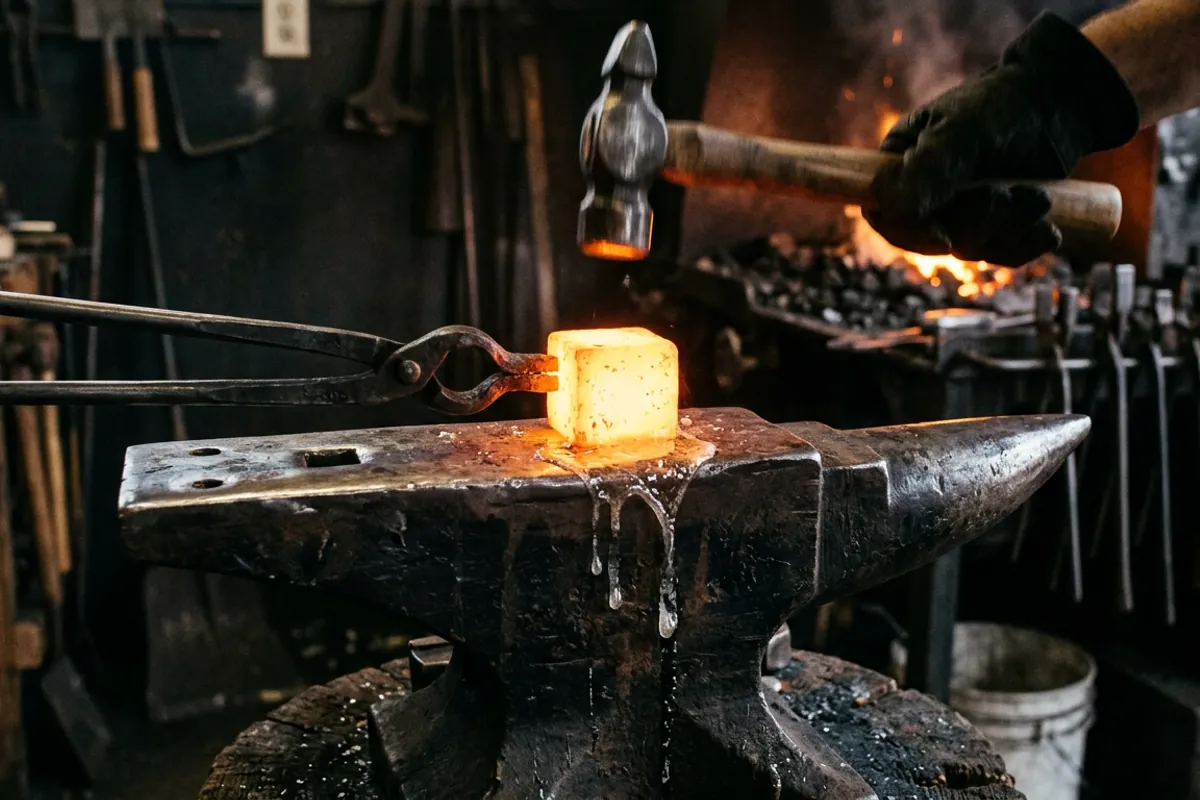
Knife Steel Nerds puts it plainly: it is common for damascus smiths to use very high forge welding temperatures such as 2300 to 2350 F, or sometimes hotter, and that typically works for steels like 1084 and 15N20. That squares with the roughly 2300 F I have given for welding 15N20 in what 15N20 steel actually is.
The trouble starts as carbon goes up. Higher carbon lowers the melting temperature of the steel, and the grain boundaries melt first. Once the grain boundaries have gone, the billet crumbles under the hammer and there is nothing to be done about it. Knife Steel Nerds says this matters especially for steels above 1.2 percent carbon, naming 26C3, ApexUltra, 1.2562, Blue Super and White #1, and adds that even 1 percent carbon steels like W1 and 52100 cause problems for smiths who are used to pushing temperature as hard as they can with lower carbon mixes. For those very high carbon steels the article calls for a reduced temperature, something like 2150 to 2200 F, and notes that a longer soak can make up for the lower heat.
So the published spread for the same operation runs from 2150 F to 2350 F depending on what is in your billet. That is 200 F, and no flux on the market closes it. A burned billet is burned. What the flux choice buys you is a little more forgiveness at the low end of that range, where you have less thermal margin and the coating has to be on early and stay put.
The flux field at a glance
Scroll horizontally to see all columns.
| Flux | What it is | Published melt figure | Metal content | Where it fits |
|---|---|---|---|---|
| Anhydrous borax, generic | Fused sodium tetraborate, CAS 1330-43-4 | 1368 F (Rose Mill spec sheet); 741 C / 1366 F (NIOSH) | None | The default for almost everything |
| Superior Flux Forge Borax | Anhydrous borax packaged for forge and farrier work | Vendor prints 740 C / 1350 F, which is not a correct pair | None | Same chemical, in a can, at can prices |
| Superior Flux EZ-Weld (also sold as Cherry Heat and Climax) | Metal bearing forge welding flux | Not published | About 40 percent metal | Mild to mild, farrier work |
| Superior Flux Stableweld | Lower metal bearing forge welding flux | Not published | 12 percent metal | Same job, less filler in the joint |
| Superior Flux Crescent | Metal free borax substitute for fine work | Not published | None | Finishing heats, toe caulk, plow work |
| Boric acid, technical grade | H3BO3, CAS 10043-35-3 | 340 F / 171 C (CAMEO Chemicals) | None | Blended into borax so the mix flows earlier |
Sources for the table, in order: the Rose Mill spec sheet linked above, the NIOSH Pocket Guide entry linked above, Superior Flux's forge welding flux page and its Anti-Borax product page for the metal percentages, and CAMEO Chemicals for boric acid. Where a maker does not publish a figure I have written "not published" rather than guessing one.
Anhydrous borax, the one I would buy first
Anhydrous just means the water of hydration has been driven out. That matters because water in the powder boils off in the fire and the flux puffs and foams instead of laying down flat, and because the water has to leave before the flux does anything useful. The full argument about the decahydrate you buy in the laundry aisle, whether it works, and how smiths cook their own, is already written up in the flux section of my blacksmithing supplies guide, so I will not repeat it here.
The odd part of buying it is that nobody sells anhydrous borax to blacksmiths on the big marketplaces. It is sold to jewelers, gold refiners and glass people, and it is the same chemical in the same bag. PMC Supplies packages granular anhydrous borax for crucible seasoning and precious metal refining, and describes it on its own site as refined and dehydrated borax that melts quickly and removes oxides. That description is doing the same job in a graphite crucible that it does on your billet.
A pound is enough to find out whether you like forge welding at all. Check price on Amazon (paid link)
If you already know you weld, the five pound bag is the better buy per pound and one bag will outlast a lot of billets. Check price on Amazon (paid link)
Two ownership notes from actually keeping this stuff around a shop. It picks water back up out of the air, so it goes in a sealed container with a lid, not an open coffee can on a shelf in a damp garage. And a wide, shallow tray beats a can for dipping a hot billet, because you want a thin even coat, not a scoop.
Boric acid, and why smiths cut borax with it
Boric acid is the other white powder in this conversation and it is a different chemical: H3BO3, CAS 10043-35-3, an odorless white solid with a published melting point of 340 F / 171 C per CAMEO Chemicals. That is a thousand degrees below borax. Blended into borax it gives you a flux that starts flowing much earlier in the heat, which is the whole reason smiths reach for it.
You will find mixed recipes on the forums, and the one quoted most often runs roughly 75 percent anhydrous borax, 10 percent boric acid, 10 percent fluorspar and 5 percent fine powdered charcoal. I want to be straight about that: it is a forum recipe I have read, not a mix I have measured or tested, and I do not run fluorspar. Fluoride bearing compounds at welding heat are a fume problem I have no measurement for and no way to reassure you about, so I leave them alone and I would not put one in a home shop with a box fan for ventilation.
A straight borax and boric acid blend I am comfortable pointing at. Alliance Chemical publishes 100 percent technical grade, white fine crystalline powder, CAS 10043-35-3, in sizes from two pounds up. Worth knowing: their own product page lists plating, wood treatment, flame retardant and fertilizer uses and does not name welding flux, so the flux use is ours, not theirs. Check price on Amazon (paid link)
Metal bearing flux: EZ-Weld, Cherry Heat and Stableweld
These are the fluxes with iron in them, and they are genuinely a different product rather than a fancier borax.
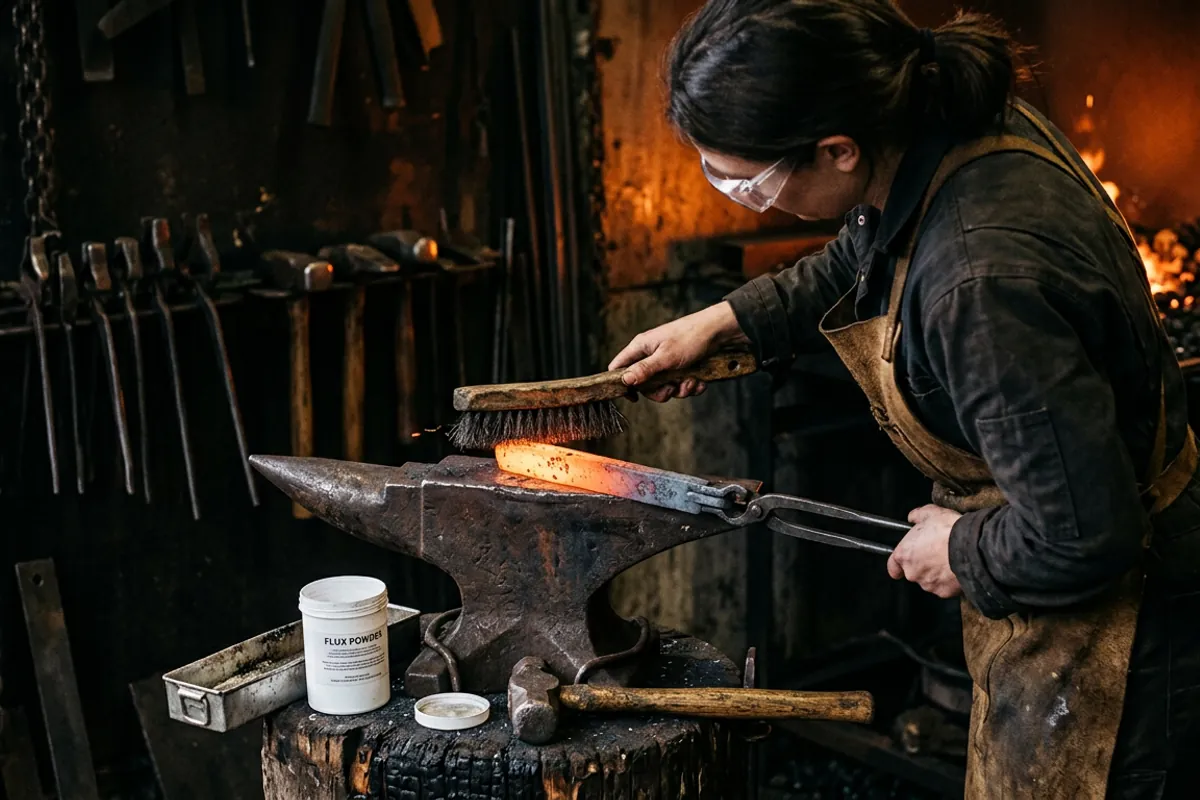
Superior Flux lists EZ-Weld, Cherry Heat and Climax as the same metal bearing forge welding flux under different labels, at approximately 40 percent metal, described as adhering to ferrous metals at relatively low heat and suited to lap, split, butt or jump welding. Stableweld is the same idea at 12 percent metal. Centaur Forge's listing for the one pound can of EZ-Weld repeats the approximately 40 percent figure and the low temperature claim. None of them publish a melting point for the compound.
This is farrier lineage. It was made for shop work in mild steel, toe caulks and repairs, where a bit of iron in the joint is no problem and a lower welding heat saves fuel and time. The tradeoff is exactly what you would expect and I would not buy it as a first flux. It costs several times what a bag of borax costs, it leaves metal in the seam, and it does not solve anything a clean scarf and a good fire were not already solving.
Anti-Borax is a brand name, not a description
This one costs people money every week, so it gets its own section.
"Anti-Borax" is Superior Flux's product family, and most of what carries that name is not for forge welding. Their Anti-Borax No. 1 is a cast iron welding flux for farm equipment and engine repair. No. 2 is a bronze brazing powder. No. 8 is an aluminum welding flux. A white powdered "Anti-Borax brazing flux" sold in a one pound jar on a marketplace is a brazing product, and it is the single most common wrong click under a search for forge welding flux. Read the description, not the family name.
Crescent is the other one worth knowing about. Superior sells it as a metal free substitute for borax on fine work forgings, finishing heats, toe caulk and plow work, for copper, brass, nickel, alloys 42 and 51, Kovar and some ferrous metals. It is a real product with a real niche and that niche is almost certainly not yours.
Last trap: unlabeled bags. There are plenty of listings that say nothing more than "flux powder for soldering, welding, casting, forging" with no hydration state, no assay and no CAS number. If the seller will not tell you whether it is anhydrous, assume it is the decahydrate and price it accordingly.
What owners say
I have not run every product above, so here is what smiths who have are actually reporting, with the threads.
On anhydrous versus hydrated, the long-running I Forge Iron thread The Absolute Last Final Word on Anhydrous Borax Flux lands where you would expect: the puffing and popcorn behavior everyone complains about with grocery store borax is the water leaving, and drying it in a kitchen oven does not get it out. Smiths who want the anhydrous behavior either buy it or melt and grind their own.
On metal bearing flux, the I Forge Iron thread on EZ-Weld, Cherry Heat and Climax reports the products are the same thing under different labels, and that the iron filings help when welding mild to mild but make a mess in damascus. That matches what the product was designed for.
On flux choice generally, the BladeForums threads including What kind of flux to use for forge welding mostly resolve to plain anhydrous borax, with the disagreements being about mixes rather than about whether the fancy stuff is worth it.
The one point every forge floor thread agrees on, including Will borax damage my propane forge?, is that molten borax attacks soft refractory and that the standard mitigation smiths recommend is a sacrificial hard firebrick or kiln shelf on the forge floor, which is worth planning for when you read up on forge lining and forge parts.
Where the owner signal is thin, I will say so: nobody posts controlled comparisons of these fluxes. There is no test data behind any of it, mine included. It is a lot of experienced people reporting the same impressions, which is worth something but is not the same as a measurement.
Handling flux without getting hurt
Two hazards, and neither of them is the one people expect.
The first is the fume. Borax is not food safe, it is not "just a laundry booster", and it is not harmless to breathe. NIOSH sets a recommended exposure limit of 1 mg/m3 for the anhydrous form and 5 mg/m3 for the decahydrate. There is no OSHA permissible exposure limit for it. If you find the 10 mg/m3 figure quoted somewhere, that is a 1989 PEL that was vacated and is not enforceable, so do not treat it as a legal ceiling protecting you. The acute symptoms NIOSH lists are irritation of the eyes, skin and upper respiratory system, dermatitis, epistaxis, cough and dyspnea, and the IDLH is listed as not determined. Superior Flux's own datasheet for Forge Borax says adequate exhaust ventilation must be present to avoid breathing the fumes that may come from the inorganic borates, and to avoid contact with eyes, skin and mucous membranes. That is the manufacturer, not me being cautious.
I have not found a published measurement of what a hobby forge actually puts in a smith's breathing zone when flux flashes off a billet. That gap is the reason to be conservative rather than a reason to relax. Ventilate the shop properly, keep the hood or the fan pulling the plume away from where you stand, and do not lean over the fire watching your flux run.
The second hazard is mechanical and immediate. Molten flux comes off a billet under the hammer as liquid glass at welding heat, and it travels. It goes through a cotton shirt sleeve and it sticks. Face shield over ANSI Z87.1 rated safety glasses, not one or the other, natural fibers only, leather over your forearms and boots you would not mind ruining. Nothing synthetic anywhere near the anvil while you are welding, because synthetics melt onto skin. The rest of what I would actually wear is in my safety gear guide.
Fuel matters here too. A coal fire is a deeper, more reducing environment and it will do a lot of the oxide work for you, while a gas forge asks more of the flux and asks more of your burner tuning. If you are still deciding which fire to build a shop around, that tradeoff is the whole of my coal versus propane comparison, and the rest of the forge writing lives on the forges hub.
What I would tell a friend
Buy a bag of anhydrous borax, keep it sealed, dust it on early at a dull red, and put your money and attention into fire control instead. That is the entire flux decision for ninety percent of the welding a home shop does.
Skip the metal bearing fluxes unless you are doing farrier work in mild steel and know why you want iron in the joint. Skip anything labeled Anti-Borax that does not say forge welding on it, because the family name spans cast iron, bronze and aluminum products that will do nothing for you. Skip unlabeled flux powder with no hydration state published.
And take the fume seriously. There is no enforceable exposure limit protecting you here, no published measurement of what a hobby forge actually generates, and a manufacturer datasheet telling you to run adequate exhaust ventilation. Ventilate, stand out of the plume, and wear the face shield. The flux is the cheap part of this. Your lungs and your eyes are not.