If you want the short version: for a first gas forge I would buy a single burner kit forge, run it for a year, and spend the money I saved on tongs, a decent face shield, and steel. The Mr Volcano Hero is the version of that I would point a beginner at, and if you already know you want to weld billets or heat long bar, the two burner Hero 2 or the Hell's Forge portable double burner are the sensible step up. The NC Tool Whisper Baby is the one I would buy if I wanted something that lights, runs, and asks nothing of me for the next decade.
Honest framing before we go further: I run a propane forge for most of my day to day work and a coal forge for heavy stock and welding, so I can speak to how these fuels behave from years on the floor. I have not run every model below in my own shop, and I am not going to pretend otherwise. What follows is published specs from makers and retailers, owner reports from the forums, and my own experience of what actually matters in a gas forge, weighed together.
What a gas forge is good at, and where it loses
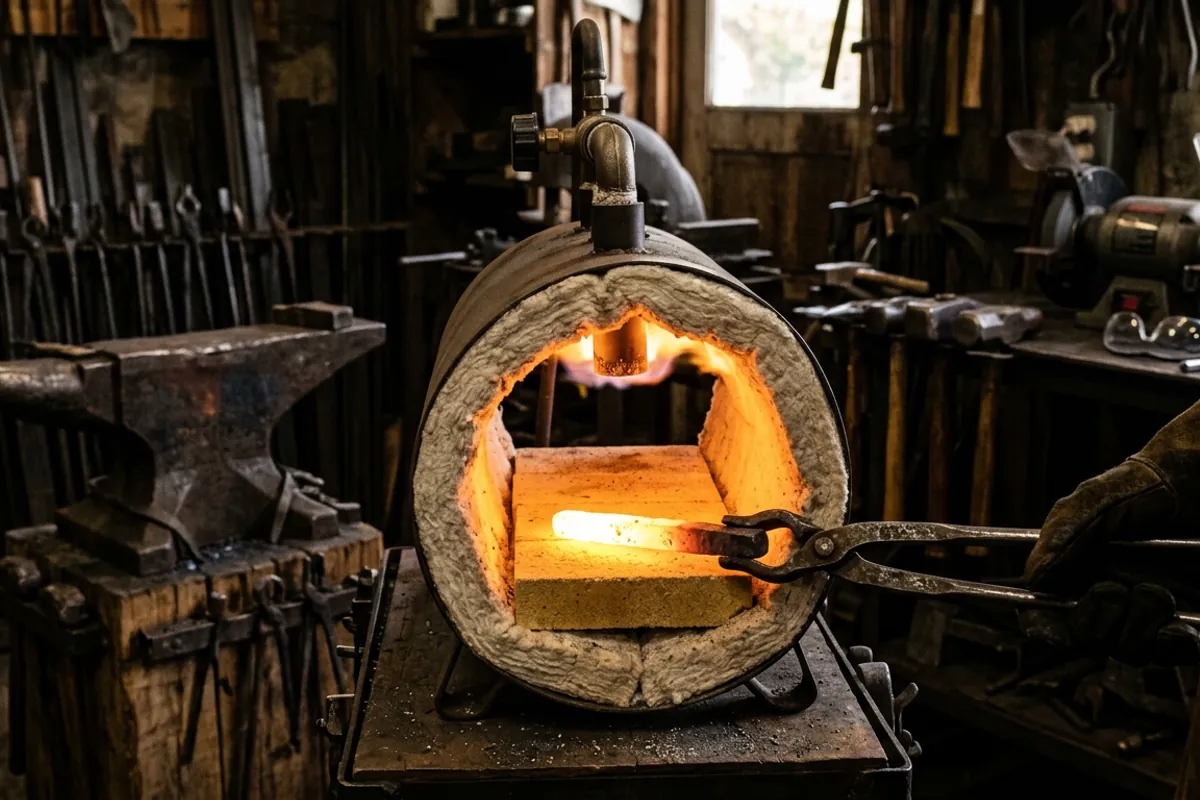
A gas forge is a lined steel box with one or more burners blowing a propane and air mix into it. You open the valve, light it, and in ten to twenty minutes you have an even, repeatable heat you did not have to tend. That last part is the whole argument. With coal I am managing a fire: raking, breaking clinker, watching the sweet spot wander. With propane I set the pressure and go make something.
That evenness is why gas wins for knife work and for anyone doing repeatable heat treatment. A soaking chamber that holds temperature is worth more than raw peak heat when you are normalizing a blade three times before hardening. If you want the metallurgy behind why that matters, read the real testing at Knife Steel Nerds rather than anything a forge maker prints on a box.
Where gas loses: heating one small spot in the middle of a long bar, forge welding big billets without burning fuel like a jet, and cost per hour once the tank runs dry. Coal heats what you bury and nothing else. If most of your work is heavy stock, read the fuel comparison in coal or propane, which first forge makes sense before you spend money, and browse the rest of the forges topic hub while you are deciding.
How I would actually choose one
Chamber size decides everything
This is the number people ignore and then regret. A small chamber gets hot fast, holds heat, and burns less gas. A big chamber swallows fuel and takes longer to come up. Most beginners buy too big because bigger sounds better, then pay for that in propane every Saturday.
For knife blades and general small work, a chamber a few inches across and eight to twelve inches long is plenty. For anything longer, you are better off with a forge that has ports in both ends so you can pass stock through rather than with a cavernous box.
Burner count is a heat budget, not a bragging right
Two burners are not twice as good. They are twice the fuel and twice the noise, spent on a bigger chamber. The reason to want two is chamber length, welding heat, and the ability to shut one off when you only need a short hot zone. Several owners specifically praise being able to run one burner. If you cannot articulate why you need the second one, buy the single.
Insulation is the part that wears out
Nearly every forge in this price range is lined with one inch of ceramic fiber blanket over a firebrick floor. That blanket is consumable. Flux eats it, and a bare blanket sheds fibers you should not be breathing. Unbonded refractory ceramic fiber is listed by IARC as possibly carcinogenic to humans, which is exactly why makers have moved to low biopersistent wools like Superwool. Whatever you buy, rigidize and coat the liner before real use, wear a proper respirator when you cut or handle blanket, and plan on relining a well used forge. That is maintenance, not failure.
The regulator and the plumbing
A forge that ships with a hose and an adjustable regulator is a forge you can use the day it arrives. One that ships without is a shopping trip you did not budget for. Check what is in the box.
The field at a glance
Published figures only. Where a maker does not state a number, it says not published rather than a guess. Sources are linked in each section below.
Scroll horizontally to see all columns.
| Forge | Burners | Published chamber | Published temperature | Liner | Price tier |
|---|---|---|---|---|---|
| Simond Store single burner with stand | 1 | 2.75 in H x 4 in W x 10 in L interior | 2600 F rated ceramic fiber | 1 in ceramic fiber plus firebrick floor | Budget |
| Mr Volcano Hero | 1 | not published by the maker | up to 2600 F | 1 in 8 lb Superwool XTRA blanket | Budget |
| Mr Volcano Hero 2 | 2 | not published by the maker | up to 2600 F | 1 in Superwool XTRA blanket | Mid |
| Hell's Forge portable double burner | 2 | 19 x 6.75 x 3.5 in oval | up to 2300 F | 1 in coated ceramic fiber plus 2 firebricks | Mid |
| NC Tool Whisper Baby | 1 | 8 x 3 x 6.5 in inside | 2350 F, self regulating | not published | Premium |
One thing to be clear about: a "2600 F rated" liner is a rating on the blanket material, not a temperature the forge reaches. Two forges with the same blanket can run hundreds of degrees apart depending on burner and chamber. Read those numbers as materials specs, because that is what they are.
Simond Store single burner: the cheapest entry I would not talk you out of
Simond Store publishes real numbers, which already puts them ahead of half the market. The single burner with stand lists an internal chamber of 2.75 inches high by 4 inches wide by 10 inches long, a body of 1/8 inch thick structural square steel pipe, an SS-304 burner nozzle, one inch of 2600 F rated ceramic fiber, and a refractory firebrick floor, shipping with a stand, hose, clamps, and a brass regulator (Simond Store product page).
That chamber is small, and small is correct for a first forge. Blades, hooks, bottle openers, tong reins, punches: all of it fits. What you are giving up is finish quality and consistency. These come out of a factory that also sells anvils and tongs at the same price point, and the common complaint pattern on budget imports is exactly what you would expect: cosmetic welds, a burner that needs the air adjusted by feel, and a liner you should coat before you use it hard.
If your budget is genuinely tight and the alternative is not smithing at all, this is a reasonable place to start. Check price on Amazon (paid link).
Mr Volcano Hero and Hero 2: the kit that expects you to finish it
Mr Volcano sells these as complete kits, and that framing is the useful part. The Hero 2 assembly manual states the forge reaches temperatures of up to 2600 F, uses Superwool XTRA insulation, and warns that the surface temperature of the forge and components will reach up to 600 F, with instructions to use it only in a well ventilated area or outdoors (Mr Volcano Hero 2 manual). The kits include rigidizer, Satanite refractory mortar for the initial coat plus extra for maintenance, firebrick, and a hose with regulator. The maker's own site does not currently publish chamber dimensions, so I am not going to invent them.
Two things I like about this approach. First, Superwool XTRA is a low biopersistent fiber rather than standard refractory ceramic fiber, which is a real improvement for the person cutting and fitting the liner. Second, shipping rigidizer and Satanite in the box means the maker expects you to seal the blanket, which is what a coated liner needs anyway. It also means the forge is not finished when it arrives. Budget an afternoon plus drying time before you forge anything.
The single burner Hero is the one I would hand a beginner. Check price on Amazon (paid link). If you know you are heading toward longer stock or welded billets, the double burner Hero 2 is the same idea with more chamber and more fuel burn. Check price on Amazon (paid link).
Hell's Forge portable double burner: the long chamber
Hell's Forge builds in the USA and sells direct. The maker states the double burner uses a 19 by 6.75 by 3.5 inch oval chamber, includes a one inch high density rigid coated extended life ceramic fiber blanket plus two full size 9 by 4.5 by 1.25 inch firebricks, and that their forges reach temperatures of up to 2300 degrees (Hell's Forge propane forges).
Note that 2300 F figure, because it is the honest one in this roundup and it tells you something. Forge welding steel generally wants a bright yellow to white heat, and a forge whose maker claims 2300 F is a forge you should expect to work at, not one that welds effortlessly. The nineteen inch oval is the real selling point: it is a lot of usable length for heating bar, and the coated blanket means less finishing work than a bare kit.
Check price on Amazon (paid link).
NC Tool Whisper Baby: the one built to just run
The Whisper Baby is a farrier forge, and it shows in the spec sheet. Centaur Forge lists an inside firebox of 8 by 3 by 6.5 inches, an outside of 11 by 17 by 10 inches, a 3 by 1.5 inch front door opening, 34 lbs, a single atmospheric burner needing no blower, push button ignition, a maximum self regulating temperature of 2350 F, and a complete package including hose, gauge, and regulator (Centaur Forge product listing).
It costs multiples of the budget forges, and you are paying for the thing you cannot see on a spec sheet: a burner design that has been in the field for decades, parts you can still get, and a company that answers the phone. Farriers are hard on gear and buy on reliability, not looks. That is a useful signal. The firebox is small and the door opening is small, so this is a blade and small tool forge, not a gate hardware forge.
There is no Amazon link here because I would buy this through a farrier or blacksmith supplier and get the support that comes with it.
What owners say
I have not run these units down in my own shop, so here is what smiths who have report, attributed and linked.
On the Hell's Forge two burner, a smith on BladeForums says plainly that theirs does not get to welding temps, which lines up with that published 2300 F figure. In the same thread, a member describes the inner shell of a three burner Majestic collapsing after ten months of weekend use, and the discussion that follows is a good reminder that how you choke down a chamber matters: the advice given is to reduce the opening from inside the chamber rather than stacking bricks against the outside, because trapped heat cooks the shell.
A long form owner review of the Hell's Forge double burner is worth reading before you buy any gas forge. That owner reports it heats steel from cold much faster than their solid fuel forge, that it is very noisy, that the burners fire straight down rather than at an angle that would swirl the flame, that flux damages the ceramic blanket, and that a 20 lb propane tank lasts them roughly 4 to 6 hours at 20 psi with both burners running. Those are the real ownership facts nobody puts on a box.
On Mr Volcano, a smith at KnifeDogs reports the single burner unit was nicer built than expected for the money, praises the angled burner as much better than one aimed straight down, and describes coating the liner with Satanite and a topcoat and shaping fillets in the bottom corners to get the flame swirling. Their summary is that it is a decent unit for a beginner or a travel forge, but that the work to finish it is tedious. That is a fair trade at the price, as long as you know it is coming.
On NC Tool, the BladeForums thread on their forges is largely positive: a moderator says they have never had a problem with their Whisper Lowboy, another reports running one non stop from 9 AM to 3:30 PM at a demonstration on about four gallons of propane. The complaints are consistent too: owners call them expensive next to a shop built forge, and note hot spots that mean moving the work around for even heat. Several eventually built a vertical forge for welding billets while keeping the NC for everything else.
Owner signal on the budget Simond Store gas forges specifically is thin. Their solid fuel forge gets discussed on I Forge Iron, but I did not find enough first hand long term reports on the propane units to call anything a consensus, so treat that one as a price bet rather than a proven tool.
Setting one up without hurting yourself
Propane combustion produces carbon monoxide. You cannot smell it and it will kill you in a closed garage. Run a gas forge outdoors or in a space with real cross ventilation and a functioning CO alarm, not a cracked window and optimism. The Mr Volcano manual's instruction to use the forge only in a well ventilated area or outdoors is not legal boilerplate, it is the actual hazard.
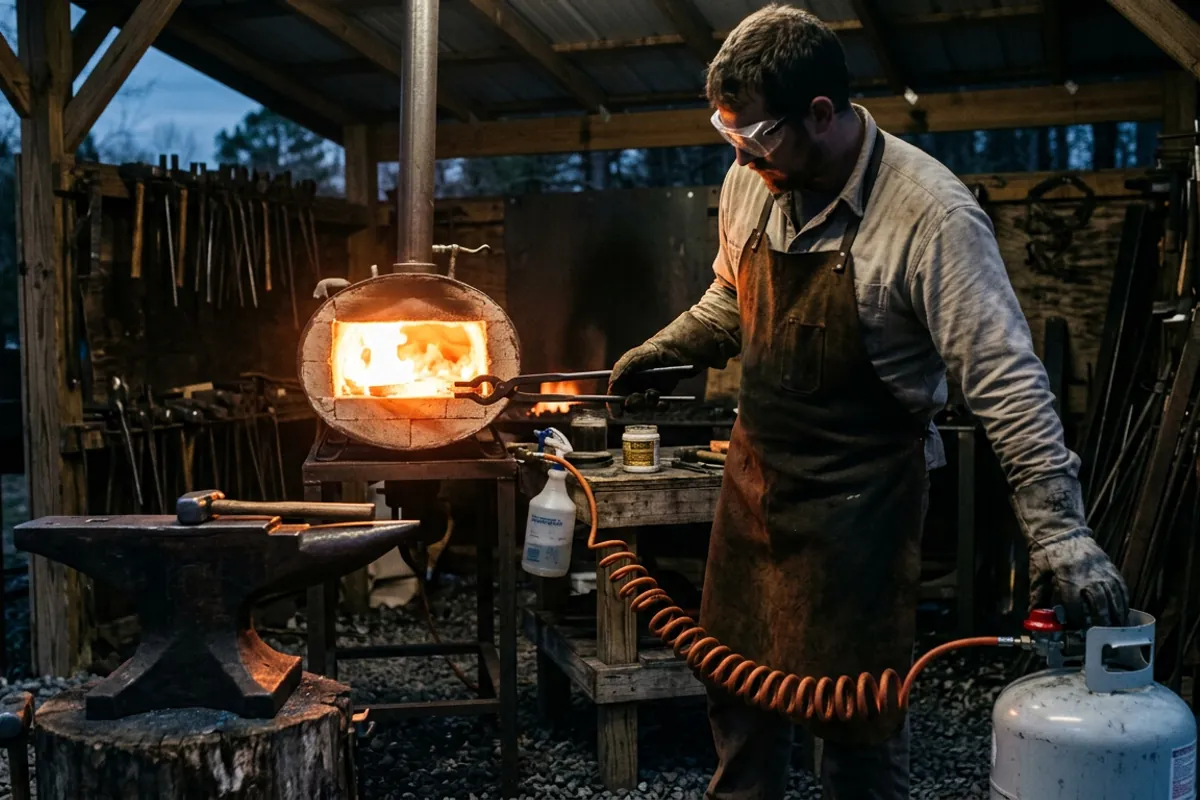
Eye protection is not optional. Get safety glasses that meet ANSI Z87.1, and for staring into a gas forge chamber add IR filtering lenses, since forge glare is a long term cooking of your retinas rather than a single dramatic injury. Wear natural fibers. A synthetic shirt near a forge or a quench tank melts into you rather than burning away. I learned the quench side of that lesson the hard way early on, standing too close to oil that was too cold in a cotton shirt with no face shield: the oil flared, I lost my eyebrows, and I kept my eyesight by luck. Full detail on what gear earns its place is in blacksmith safety gear.
The rest of the setup is plumbing discipline. Leak test every joint with soapy water before the first light, keep the tank away from the forge and out of the radiant heat, do not use a hose that is cracked or older than you can account for, and shut the tank valve, not just the burner valve, when you are done. If the regulator ices up while you run hard, that is the tank chilling as liquid propane boils off, and it is a sign you are asking a small tank to feed a big burner.
Last, do not put the forge on the good workbench. It wants a steel stand on a non combustible floor with nothing above it, and your anvil a comfortable step and a half away, so you can move hot steel from heat to face without walking or turning through anything flammable.
What I would tell a friend
Buy small, buy simple, and expect to finish the liner yourself. A single burner kit forge like the Mr Volcano Hero handles more of what a beginner actually makes than they think it will, and the money you did not spend on the second burner buys tongs that fit your stock, which will improve your work more than any forge upgrade. If you know you want length, the Hell's Forge portable double burner gives you a long, honestly specified oval chamber, and the maker's own 2300 F figure tells you not to plan on easy forge welding. If you can spend real money and want something that will still light in fifteen years, buy the NC Tool Whisper Baby from a farrier supplier.
The one I would skip is any forge sold on temperature claims with no chamber dimensions and no maker documentation. A number with nothing behind it is marketing, and there are enough forges here that publish real specs.
And whatever you buy: ventilation, Z87.1 eye protection, natural fibers, tank outside the radiant heat. A forge that makes good work and takes your eyebrows is not a good trade. If you are still weighing fuels, the deeper propane specific writeup is in the propane forge I would put in a home shop, and the broader beginner setup is in the blacksmith forge I would actually put in a beginner's shop.