I have what I need. Writing the article now.
Here is the article and metadata.
An induction forge for blacksmithing is one of those tools that sounds like the future the first time you watch a bar go from cold to yellow in twenty seconds, and then quietly turns into a specialist purchase once you price the whole setup. So let me lead with the verdict, because it saves you money: for almost every home smith reading this, your first forge should still be gas or coal, and induction is a second heat source you add later for fast, clean, repeatable spot heating. If you are dead set on induction as a real working forge, the tool that actually does the job is a 15 kW water-cooled high-frequency unit like the TECHTONGDA 15KW, not a forty-dollar circuit board. The cheap ZVS modules that show up when you search have their uses, but they are bench experiments, not a forge you can run a shop on. I have not owned an induction forge myself, so everything here leans on published specs and the owner reports I have read and cross-checked against twenty-five years on gas and coal.
What an induction forge actually is
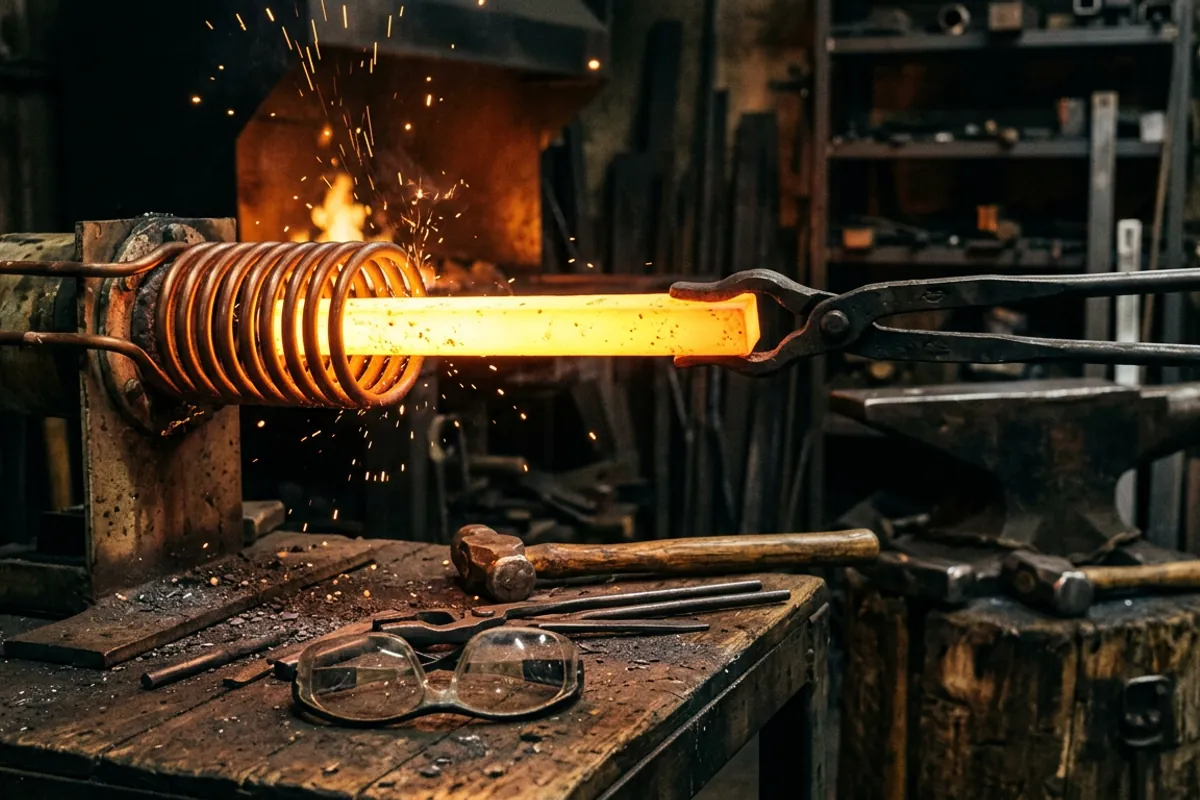
Induction heating puts your steel inside a coil carrying high-frequency alternating current. That changing field drives eddy currents inside the steel, and the steel's own electrical resistance turns those currents into heat. The metal heats itself from the inside out. Nothing touches it, there is no flame, and iron and steel take to it well because they are ferromagnetic, which makes the coupling efficient below the Curie point.
The practical upshot is speed and cleanliness. A smith on Blacksmith Forums running a 15 kW unit reports heating "a 1/2 inch round from cold to forge welding throwing off sparks hot in less than 30 seconds," and a 1.5 inch hammer blank in about a minute (see his writeup). No forge to light, no coal to tend, no burner roar, and your shop stays cool in July. For repetitive production work, spot heating a tang, or setting a specific heat over and over, that is a genuinely useful capability.
The catch is baked into how it works. The coil heats the length of bar inside it and a little to each side, and that is all. The same smith notes he "can heat about a 6 to 8 inch section of a bar but that's about the maximum." You do not get a big soaking heat for scrolling long stock, and forge welding a stacked billet or damascus is a known weak spot because the temperature gradient across the transition is too steep. Induction is a scalpel, not a hearth. If you want the broad picture of the fuel choices most smiths actually live with, my coal or propane guide and the gas forge buying guide are the honest starting point, and the whole Forges topic hub collects the rest.
How I compare the field
Here is the field laid out on published maker ratings. The ZVS module figures are the boards' rated power and voltage; frequency on those consumer boards is a self-resonant ZVS circuit and is generally not published as a hard number, so I mark it that way rather than invent one. Price talk stays in tiers, because marketplace prices move and I will not print a figure that is stale by the time you read it.
Scroll horizontally to see all columns.
| Unit | Rated power | Frequency | Cooling | Realistic heat capacity | Price tier |
|---|---|---|---|---|---|
| Fosa 1800W ZVS module | 1800 W (12 to 48 V DC) | Not published | Fan on the board, you add water | Small stock, short heats, melts | Budget |
| 2500W ZVS kit (coil and pump) | 2500 W (12 to 48 V DC) | Not published | Included pump and copper coil | Small stock, quench and anneal | Budget |
| TECHTONGDA 15KW high-frequency | 15 kW (220 V) | 30 to 80 kHz | Water-cooled, chiller required | 0.5 to ~1.5 in bar, 6 to 8 in heat | Premium |
One thing that table hides: the sticker on a cheap module is not the cost of the setup. Every one of these needs a power supply, cooling, and in the DC boards' case a hefty 36 V supply pushing 20 A or more. The 15 kW unit needs 220 V and a real chiller. Budget the system, not the board.
The 1800W ZVS module: a bench toy, not a forge
The Fosa 1800W ZVS induction heating module is the thing most people find first, and I want to be blunt about what it is. It is a bare driver board rated 1800 W on a 12 to 48 V DC supply, up to about 40 A, with a roughly 70 mm work coil. On a graphite crucible it will melt small amounts of gold, silver, copper, or aluminum, and it will bring a small piece of steel up to color. What it will not do is act as a forge. You are talking a couple of kilowatts at the wall in the best case, no real duty cycle, and a board that runs hot enough that the maker's own note tells you to sort out heat dissipation or it fails.
Where it earns a place is on the experimenter's bench: small heat-treat jobs on tiny parts, softening a spot to drill, melting scrap for casting, or just learning how induction behaves before you spend real money. Treat it as a science project with a real fire risk, not a shop tool. If that is the honest fit for you, Check price on Amazon (paid link).
The 2500W ZVS kit: still a heat-treat tool, not a shop forge
Step up to the 2500W ZVS kit that ships with a copper work coil, a small water pump, and hoses, and you have solved the two things that kill the bare board: no coil to wind yourself, and at least a token cooling loop. Rated 2500 W on the same 12 to 48 V DC range and up to roughly 50 A, it is the version I would point a hobbyist to if they are determined to try induction cheaply, because the included pump means you are not immediately improvising cooling on a board that overheats in seconds.
Keep your expectations correct. This is a quench-and-anneal and small-parts tool, useful for repeatable heat treating of small blades, drawing a tang, or spot work, not for moving bar under a hammer all day. The maker warns plainly against heating oversized stock because it overloads the drive plate, which tells you exactly where its ceiling is. Owners use these to learn the process and to do small controlled heats, and for that narrow job it is a reasonable buy. If you want the kit with cooling included, Check price on Amazon (paid link).
The 15kW high-frequency unit: the real induction forge
This is the one that is actually a forge. The TECHTONGDA 15KW high-frequency induction heater runs on 220 V, is rated 15 kW, operates in the 30 to 80 kHz range, and is water-cooled by design. This is the class of machine the Blacksmith Forums smith is describing when he forge-welds a half-inch round in under thirty seconds, and it is the size range the I Forge Iron crowd keeps landing on. On I Forge Iron the commonly cited working sizes are 15 kW and 25 kW, with some shops running 35 kW for bigger stock. Fifteen kilowatts is the sensible entry point for a one-person shop.
What you get for the money is real: near-instant heat, almost no operating cost beyond electricity, a cool and quiet shop, and repeatability a fire cannot match. What you also get is a water-cooling requirement you cannot skip, coils sized to the work so you may want more than one, and the hard ceiling on heat length and billet welding that no amount of power fixes. The Blacksmith Forums owner had to build his own cooling system after the recommended chiller "proved inadequate," which is the kind of detail that tells you this is a commitment, not a plug-and-play forge. If you have the 220 V service and the budget, this is the tool that does what the marketing promises. Check price on Amazon (paid link).
Induction does not replace the rest of the shop
Here is the point people skip in their excitement. An induction forge only replaces the heat. Once that bar is yellow, you still hammer it on an anvil, you still need tongs, and you still need somewhere to work. Induction gives you a hot bar faster and cleaner; it does nothing about the other ninety percent of the craft. If you are building a shop from scratch, spend on the anvil and the hammer first and add induction later, not the other way around. A solid working anvil in the 66 to 132 pound range under that fast heat is what turns it into forged work, and a budget cast option like the VEVOR single-horn anvil below is a reasonable stand-in while you save for a good used Trenton or Peter Wright.

That ordering matters because induction is the least forgiving place to put your first dollars. A gas forge you can leave in the corner and light in five years; a 15 kW induction rig you did not need is dead money with a water pump attached.
What owners say
For gear I have not run down in my own shop, I go to the forums and report what real owners say, praise and complaints both.
The clearest firsthand account is the Blacksmith Forums thread from a smith running a 15 kW Joyfay-class unit. His verdict is genuinely positive on capability, "1/2 inch round from cold to forge welding throwing off sparks hot in less than 30 seconds" and 1.5 inch hammer blanks in about a minute, but he is equally clear on the two limits: heat length tops out around 6 to 8 inches, and the cooling system is a project in itself, since the supplied chiller could not keep up and he built his own around a five-gallon bucket (Blacksmith Forums).
On KnifeDogs, the knife crowd is more cautious. Owners there use induction for spot heating and for softening tangs on hidden-tang knives, and several point out that consumer induction cooktops, which people ask about constantly, top out far too low to forge with. The consensus is that induction is a spot-heat and heat-treat helper, not a one-tool solution, and that temperature control is by eye and color rather than a readout.
On I Forge Iron, the recurring theme is sizing and cost. The working sizes people actually buy are 15 kW and up, the units want serious cooling, and a 2024 thread asking whether a handheld bolt-loosening induction heater could double as a forge got the honest answer that it cannot. If you want the engineering background rather than shop talk, Ambrell's induction forging primer is a straight technical read.
The owner signal on the cheap ZVS boards specifically, as forging tools, is thin, and I will say so rather than dress it up. People use them for melting and small heat treats and casting, not for production forging, and that is the honest read.
Water cooling, power, and the hidden costs
Cooling is not optional on any of these. The work coil carries huge current and cooks itself without a steady flow through it, and on the real units a chiller failure means a ruined coil in short order. Plan the cooling loop as a first-class part of the build, not an afterthought, and size it larger than the spec sheet suggests. The one owner who documented this ended up on a five-gallon reservoir headed for fifteen, after the bundled chiller could not cope.
Power is the other quiet cost. The 15 kW class wants 220 V service, which many home shops do not have at the wall where the forge lives. The DC boards want a beefy supply pushing tens of amps at 36 V, which is its own purchase. Add coils, hoses, and a pump, and the board price is a fraction of the total. None of this is a reason to avoid induction, but it is the difference between the number on the listing and the number you actually spend.
Safety: induction has its own hazards
Induction is clean, and clean fools people into thinking it is safe. It is not, it is just quiet about it.
The steel comes out every bit as hot as it does from a coal fire, so all the usual rules stand. Eye protection rated to ANSI Z87.1, natural fibers over synthetics near heat, tongs on the hot end, and a real awareness that yellow steel does not look dangerous until it is on your skin. I lost my eyebrows early on to an oil quench I stood too close to in a cotton shirt with no face shield, and the fact that induction hands you that hot steel faster, not slower, is not a reason to relax.
Then there are hazards induction adds. The coil throws a strong high-frequency magnetic field, so anyone with a pacemaker or other implanted medical device stays well clear, no exceptions. Take off rings, watches, and any metal jewelry before you go near the coil, because conductive loops near the field heat up fast and a ring can burn you before you understand why. You are also dealing with real electrical current, mains on the big units and high-amperage DC on the boards, plus water in close company with that power, so wire it properly and keep the cooling loop sound. And you are still making hot steel, which means the same heat-treat discipline applies whether you heat with induction, gas, or coal; my 4140 heat treat guide covers how I think about controlling those heats. Send the metallurgy questions to real testing at Knife Steel Nerds rather than trusting the color alone.
What I would tell a friend
If a buddy asked me straight, here is the short version. Do not make an induction forge your first forge. Buy a gas or coal forge, an anvil, a hammer, and tongs, learn to move steel, and get the fundamentals down. If you are running production, doing a lot of repetitive spot heating, or you simply want the cleanest fastest heat and have the budget and the 220 V service, the 15 kW high-frequency unit is the one that is actually a forge, with the honest caveat that cooling is a project and long heats and billet welding are off the table.
The cheap ZVS boards are fun and genuinely useful for melting and small heat treats, but call them what they are: bench experiments, not a shop forge. Skip the 1800W bare board unless you like winding coils and chasing overheating; if you want to dabble, the 2500W kit with the pump and coil included is the sensible cheap entry. And whatever you heat with, wear the eye protection, take off the ring, and keep anyone with a pacemaker out of the shop. Clean heat is still a fire that can hurt you.