Forge carbon monoxide is the hazard in this craft I would least like to explain to somebody's family, and it is the one most shop advice disposes of in half a sentence. Ventilate, hang a CO alarm, done. I have written some version of that line on this site more times than I can count and it is not wrong, but it is not enough. It does not tell you whose exposure limit is whose, or what the alarm screwed to your wall is actually built to catch, or why the smith who felt fine all afternoon had a headache by dinner and was not imagining it. This page is the long version, written owner to owner from a home shop. It is a reference. There is nothing to buy in it.
What carbon monoxide is, and why your nose is not a detector
NIOSH describes carbon monoxide in its Pocket Guide in four words that should end most of the arguing about this: "Colorless, odorless gas."
That is the whole problem in one line. A forge shop is a sensory place. Coal smoke has a smell you can pick out from across a property. Hot scale, borax flux, quench oil, a wire brush on a black bar: all of it registers. None of it is carbon monoxide. CO contributes nothing to the smell of your shop, nothing to the haze in the light from the window, and no sting in the eyes or throat the way smoke does. A shop that smells like a forge and a shop that is filling with CO are the same shop, and your senses cannot tell you which one you are standing in.
That is also why the folk wisdom fails here. Smiths tell each other that they can tell when the air is bad. What they can tell is when the air is smoky, and smoke and CO are not the same thing and do not have to travel together. A well drafted coal fire can carry its visible smoke up the stack while a propane forge in the same room quietly puts combustion products at head height. You are not equipped to notice this. Nobody is.
Whose limit is 35 and whose is 50
You will see two different numbers quoted as though each were the limit. They come from two different bodies, and knowing which is which is the difference between citing a number and understanding one.
NIOSH publishes a recommended exposure limit of 35 ppm (40 mg/m3) as a time weighted average, plus a ceiling of 200 ppm (229 mg/m3). OSHA's permissible exposure limit is 50 ppm (55 mg/m3) as a time weighted average. NIOSH also lists an IDLH value of 1200 ppm, IDLH meaning immediately dangerous to life or health.
Three ideas are worth separating there. A time weighted average is exactly what it sounds like: an average across the work period, so a quiet morning can mathematically offset a bad hour, which is useful for regulating an industrial process and close to useless for telling you whether right now is fine. A ceiling is a value that is not supposed to be exceeded at any point, not averaged against anything. And IDLH is not a safety threshold at all. It is the concentration at which the only sensible agenda is escape.
These are occupational limits, written for workplaces and workers, by two organizations that did not land on the same figure. That disagreement is not a reason to dismiss them. It is a reason to stop saying "the limit" as if a single line existed between fine and not fine. The same figures appear in my forge coke guide, and they are consistent there for the same reason: they are the published values, and I keep them exactly as published.
Where the carbon monoxide from a forge actually comes from
Carbon monoxide is what you get when a carbon fuel burns without enough oxygen to finish the job. Complete combustion of propane gives you carbon dioxide and water vapor. Starve that reaction and part of the carbon comes out one oxygen short, and that is CO. A coal or coke fire does this by its nature: a deep fuel bed with air forced through the bottom is running an oxygen starved reaction on purpose partway up, which is also why it makes the reducing fire you want for forge welding.
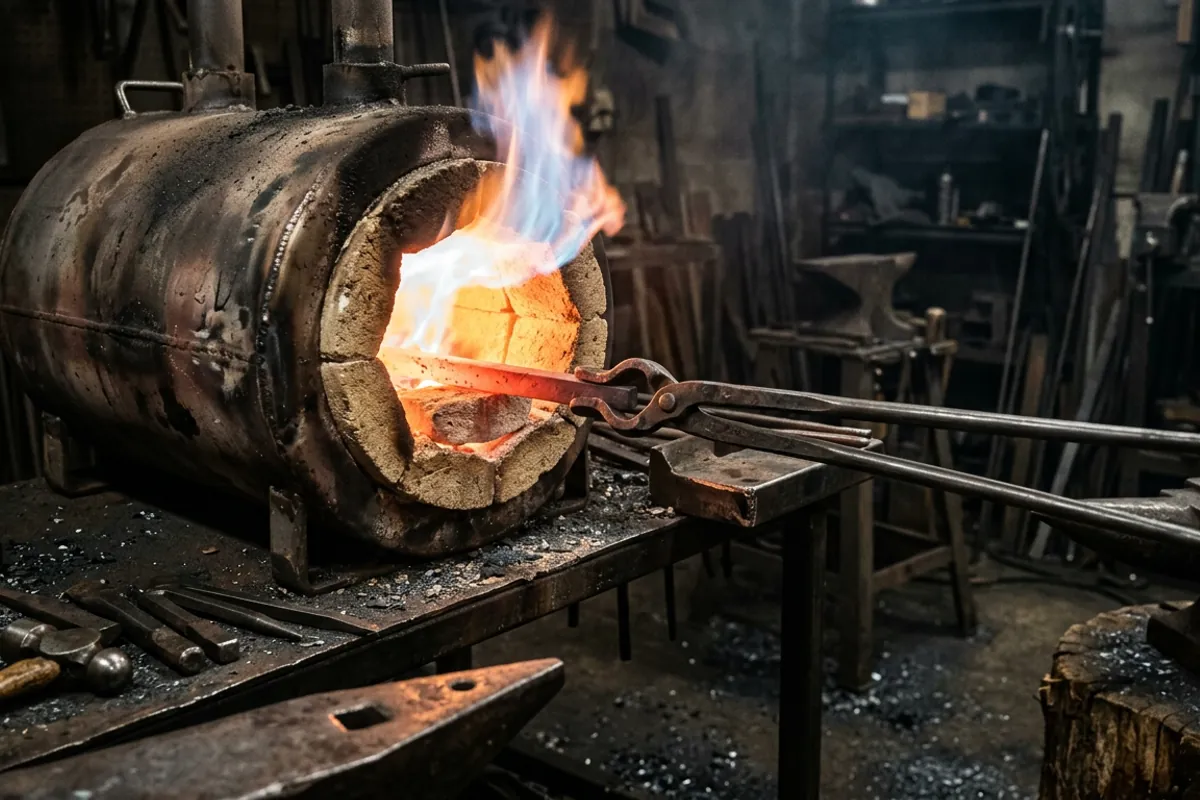
On a gas forge, a rich burner, meaning one running with too much fuel for the available air, makes more CO than one that is tuned closer to neutral. This is where I need to correct something I hear repeated constantly. Dragon's breath, that pale flame licking out of the forge opening, is unburned fuel finding oxygen outside the chamber and burning there. It is a visible sign that the mixture in the chamber is rich. It is not the carbon monoxide. The CO is invisible and it leaves with everything else, whether or not there is any flame at the door to look at.
Two conclusions follow, and both matter. A forge showing dragon's breath is telling you something real about its mixture, and you should take the hint. But a forge showing none is not certifying its exhaust. You did not see the CO in either case.
I am deliberately not printing a psi figure or a flame temperature here. The right settings depend on your burner, your orifice, your forge volume, and how far above sea level you are standing, and a number I invent for you is worse than no number. Burner selection is its own subject and lives in my write ups on propane burners for a forge and the propane gas forge buying guide.
One more thing about sources: the forge is often not the only one. A propane or kerosene shop heater, a gas water heater sharing the space, a generator, a vehicle idling on the other side of a shared wall, all of it adds to the same air. The CPSC's warning about generators is worth reading with a shop in mind, though it is written about generators specifically: "Even with open doors and windows, these spaces can trap CO and allow it to quickly build to lethal levels." I quote that by analogy only. It is about generators, not forges. But the physics of a space that traps air does not care which appliance is filling it.
If you run coal, the hood and stack conversation, which is a real piece of engineering and not an afterthought, is in my coal forge buying guide. What I will add here is the part that catches gas smiths out: a propane forge in most home shops has no stack at all. Every product of that combustion enters the room you are standing in.
Can you run a forge in a garage
This is the question I get most, and the honest answer starts with somebody else's words. The New Jersey Blacksmiths Association, in their guidance on propane gas forge use and safety, puts it this way: "Preferably operate a propane forge outside. If that is impossible or impractical, operate the forge only where very substantial ventilation is provided." And they define what they mean by very substantial, which is the part people skip: either no walls (roof only) or forced ventilation.
Sit with that bar for a second. No walls, or mechanical air movement. A one car garage with the overhead door down and the side door propped open is neither. The garage with a window cracked is not close.
Forced ventilation means air is being driven out of the space and fresh air is being let in to replace it. A box fan pointed at your bench is comfort, not ventilation. It mixes the room and moves the same air around your face faster. Equally, an exhaust fan with no inlet opening fights itself: pull air out of a sealed box and the fan just labors against the vacuum it made. You need both ends of the path.
For a sense of what an industrial builder specifies, MIFCO, a maker of gas fired industrial furnaces, states in its forge operating manual that the exhaust system should be designed to change the total volume of air in the shop at least twenty times per hour. I want to be careful about how that figure travels. That is a commercial equipment maker's design target for its own furnaces in a commercial shop. It is not a hobby standard, and I am not going to tell you that hitting some number of air changes makes a garage safe, because that is not a claim I or that manual can support for your building. It is offered as scale: the people who size ductwork for a living are not thinking in terms of a cracked window.
The same manual flags a "HOT CORNER" that "is hard to ventilate properly" and calls it "both dangerous and uncomfortable." That is worth flagging because it describes where nearly every home smith puts the forge. Out of the traffic path, tucked in the corner, backed against two walls. Convenient, and the worst spot in the building for air exchange. If you are laying out a shop from scratch, the general layout thinking is in blacksmith shops, explained from the floor of one.
And if the garage is attached to the house, understand that you are not making a decision about one room. Attached garages share air with the living space through doors, gaps, and duct chases, and the people asleep on the other side of that wall did not agree to your ventilation plan.
What a UL 2034 alarm is built to do, and what it will never do
This section is the reason I wrote the page.
The CPSC published conformance testing against UL 2034, tabulating the alarm response requirements in Section 39 of that standard. In plain prose: at 70 ppm, plus or minus 5, the alarm must sound somewhere between 60 and 240 minutes. At 150 ppm, plus or minus 5, between 10 and 50 minutes. At 400 ppm, plus or minus 10, between 4 and 15 minutes. And this line: "No indication shall be given for CO concentrations less than 30 ppm."
Read the last one again. A compliant alarm is designed to say nothing below 30 ppm. Not "might miss it." Designed to stay quiet, on purpose, so that alarms do not scream at ordinary background levels and end up in a kitchen drawer.
Now stack that against the exposure limits above. NIOSH's recommended average is 35 ppm and OSHA's permissible average is 50 ppm. The standard's tabulated alarm requirements start at 70 ppm, and even there a unit has up to four hours to make a sound. So a room can sit at a concentration that exceeds both bodies' averaged occupational limits, all afternoon, with a correctly functioning, fully compliant alarm on the wall behaving exactly as designed and telling you nothing.
That is not a defect. It is what the device is for. A UL 2034 alarm is a lethality alarm, timed against accumulations that will hurt you fast. It is not an exposure meter and it was never sold to you as one. If you take one thing from this page, take that: your alarm's silence is not a measurement.
The only hobby shop reading I have found in a source I trust comes from Ron Reil's forge and burner design pages, where he reports a smith who had been exposing himself to levels of roughly 30 to 160 ppm for a long time before a detector revealed it. That is his account of a single case, not a survey, and I pass it on as exactly that. But notice where the bottom of that range sits. At 30 ppm, a UL 2034 alarm is required to stay silent.
I do not know what my own shop reads. I have never measured it, and I am not going to make up a number to fill the gap. Industrial evaluations of CO in commercial settings do not transfer to a one person smithy, and anyone quoting you a typical ppm for a hobby shop is guessing.
Where the alarms go
The CPSC's placement guidance is written for homes, not shops, and I am extending it, so I will say so plainly rather than dress it up as a shop standard. CPSC says to install alarms "on every level of the home and outside sleeping areas," not to install them "in kitchens or above fuel-burning appliances," and that alarms should meet "the current UL 2034 safety standard."
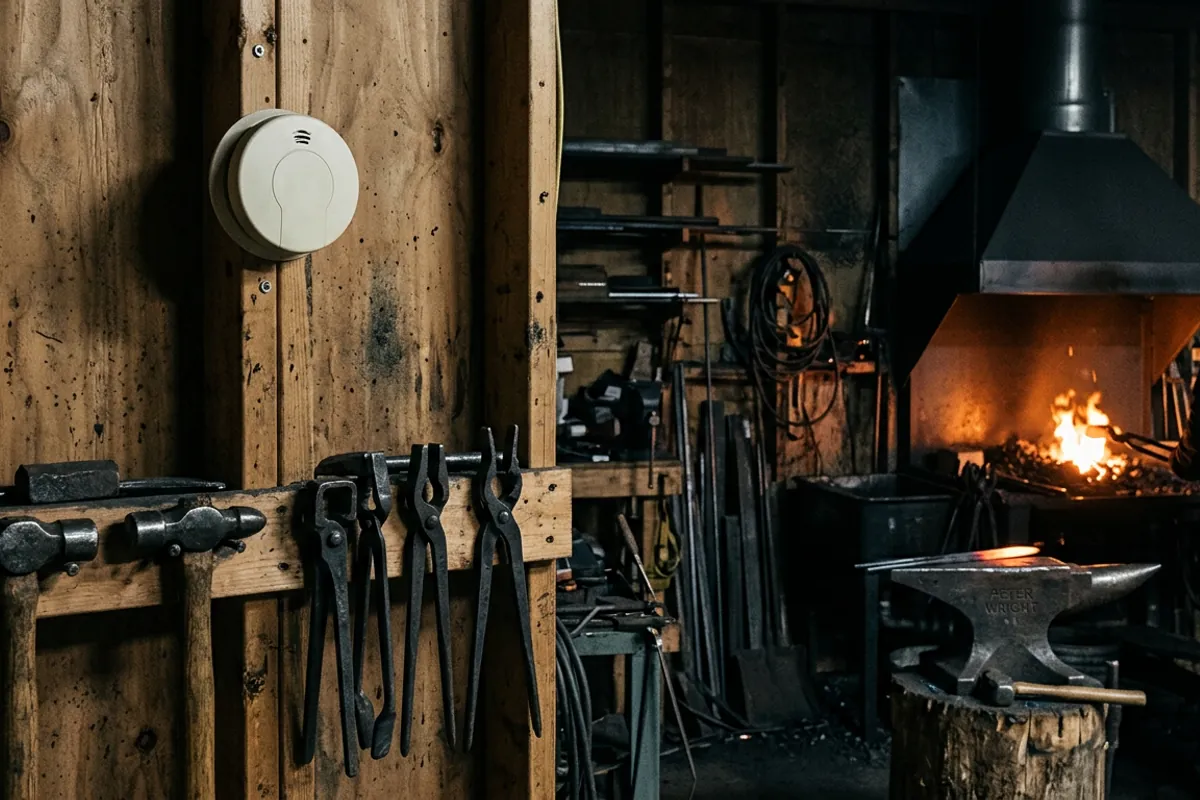
Two of those carry straight into a shop. Outside sleeping areas matters enormously if your shop shares a structure with the house, because the alarm that wakes people is the one that saves them, and it is not the one out by the anvil. And the rule against mounting above fuel burning appliances means do not hang it over the forge. You will get nuisance alarms from ordinary operation, you will get tired of them, and the alarm will come off the wall. An alarm you removed protects nobody.
Alarms also age out. They have a service life stamped on them by the manufacturer, and the sensor is a consumable. Check the date on yours and honor it.
The symptoms, and the rule I do not argue with
NIOSH lists the signs of carbon monoxide exposure as headache, tachypnea (rapid breathing), nausea, lassitude, meaning weakness and exhaustion, dizziness, confusion, hallucinations, and cyanosis.
Now look at that list from the point of view of a smith four hours into a session. Hot shop, heavy hammer, sweating, probably under-hydrated. Headache, weakness, a little dizzy, slightly stupid: that is also just what a long day at the forge feels like. There is no symptom on that list your body cannot produce for entirely innocent reasons, which is precisely why people talk themselves out of leaving.
Confusion is the cruel one. The symptom that would make you act is the same symptom that degrades your ability to decide. You do not get to reason your way out of this in the moment. You need a rule you follow before you need it.
The NJBA guidance gives one, and I use it verbatim: "If you ever suffer a headache while working with any combustion equipment, get out of there!" No debating it, no finishing the heat, no "let me just quench this one." Go outside.
If you or anyone with you is affected, get out, get fresh air, and call emergency services. That is the entirety of what I will tell you about the medical side. I am a hobby smith with about twenty five years at this, not a medic, and there is no home remedy worth typing here.
Pets count too. So does anyone in the house on the other side of an attached garage wall.
What I actually do, and what it does not prove
My propane forge is the one I run most days, and it runs with the big door open and air actually moving through the building, not with the shop buttoned up because it is January and I would rather be warm. That is the specific trade every smith in a cold climate faces, and it is the one that gets people hurt, because the exact conditions that make you seal the shop are the conditions that make CO accumulate. If it is too cold to ventilate, it is too cold to forge indoors. The coal forge runs under a hood and stack. There are alarms, and they are not mounted over either fire. When I have weekend beginners in the shop, the ventilation conversation happens before anything gets lit, not after somebody feels off.
None of that is a measurement, and I will not present it as one. It is a working setup that follows the guidance above. What it does not do is tell me my numbers.
If you want to actually know what your air is doing, an alarm is the wrong instrument, because it is built to alarm rather than to measure. Equipment intended for measurement is a different category of tool. I have not used any of it, I cannot tell you which units read honestly, and I am not going to name one on the strength of forum posts and call it a recommendation. Ask ten smiths and you will get ten answers, most of them secondhand.
What I can tell you without hedging is the shape of the thing. CO is invisible and odorless. Two bodies publish two different occupational averages, 35 and 50 ppm, and neither is a bright line for your garage. The alarm on your wall is designed not to speak below 30 ppm and may take four hours at 70. Ventilation is the control that actually works, and the bar set by people who have thought hardest about it is outdoors, or no walls, or air moved mechanically. Everything else on this page is detail hanging off those four facts.
The rest of the safety material, eye protection standards, clothing, hearing, and the gear I actually wear, sits on the Safety and PPE hub.