If you have room for exactly one forge and you are not sure yet what you want to make, buy a single burner propane forge. That is the whole verdict. A one burner box with a chamber around five inches square and ten inches deep will heat everything a hobby smith touches in the first two years, it costs less to run than a double, and it lights in the time it takes you to put your gloves on. My step up pick is a two burner unit, but only if you already know you are forging long stock or welding billets. My buy once pick is an NC Whisper Baby, which costs more than the rest of this list put together and will outlive all of it.
Being straight with you about what this guide is: I run a propane forge every week and a coal forge for the heavy work, so I can speak to how these things behave. I have not run every unit below in my own shop, and I am not going to pretend otherwise. The picks lean on published maker specs, retailer spec sheets, and owner reports from the forums, weighed against what I know about how gas forges act on a cold morning.
How these picks were made
Three filters, in this order.
First, published specs I can point you at. If a maker will not publish a chamber size, I will not invent one. You will see "not published" in the table below more than once, and that is deliberate. A chamber dimension is the single most useful number on a gas forge spec sheet, because it tells you the longest and thickest piece you can get to heat, and a maker who hides it is telling you something.
Second, burner count matched to real work rather than to bravado. Everybody wants the biggest forge on the shelf until the first propane bill. Two burners roughly double your fuel burn for a chamber you will use a third of.
Third, owner signal. Not marketing copy, not review counts, but what people say two years in, when the ceramic blanket has been fluxed and the burner has been relit a thousand times. Where that signal is thin, I say so.
If you are still deciding between fuels at all, read coal or propane: which first forge makes sense? before you spend anything, and the wider Forges topic hub for how the pieces fit together.
The field at a glance
Published figures only. Blank cells mean the maker does not publish that number where I could verify it, not that the number is bad.
Scroll horizontally to see all columns.
| Forge | Burners | Published chamber | Rated temp | Insulation | Price tier |
|---|---|---|---|---|---|
| Simond Store single burner, one door | 1 | 5.4 in H x 5.4 in W x 9.8 in L | 2600 F | 1 in pre rigidized ceramic fiber blanket, 10 density, plus 1 in firebrick | Budget |
| Simond Store single burner, two doors | 1 | 4.8 in H x 4.8 in W x 10 in L | 2600 F | Same as above | Budget |
| Hell's Forge single burner (HF1) | 1 | Not published on a source I could verify | Not published on a source I could verify | Ceramic fiber blanket with refractory coating | Budget to mid |
| Hell's Forge MAX double burner (HF-2 MAX) | 2 | Not published on a source I could verify | Not published on a source I could verify | Ceramic fiber blanket with refractory coating | Mid |
| NC Whisper Baby | 1 | Firebox 3 in x 7 in x 6.5 in, open end ports 1.5 in x 3 in | Not published | Cast refractory | Premium |
Sources for the above: the Simond Store single burner product page and its two door sibling for the Simond figures, and Canadian Forge and Farrier for the Whisper Baby firebox and port dimensions, which also lists the included regulator, gauge, and 8 ft hose. Current NC pricing is on Centaur Forge, where the Whisper Baby sits at the bottom of a range that climbs past a thousand dollars for the larger Whisper models.
On the Hell's Forge rows: the maker's own site would not load cleanly for me while I was writing this, and the only numbers I could find were on marketplace listings and content farms repeating each other. I am not going to launder those into a spec table. Buy Hell's Forge on its reputation and on owner reports, not on a chamber dimension I cannot show you.
Simond Store single burner, one door
This is where I would start, and it is where most of the beginners I teach on weekends actually start. A rectangular steel shell, one atmospheric burner, a firebrick floor, and a brick door on one end so you can close the chamber down or open it up to pass longer stock through.
The published internals are 5.4 inches high by 5.4 inches wide by 9.8 inches long, lined with one inch of pre rigidized ceramic fiber blanket at 10 density plus an inch of firebrick, rated to 2600 F by the maker. That chamber will take a knife blank, a set of tongs in progress, a hook, a bottle opener, scrolls, most of a hammer head. It will not take a 24 inch fire poker sideways, which is what the open end door is for.
The tradeoffs are the honest ones for the price. The steel shell is thin, the burner is a plain atmospheric design, and the fit and finish are what you expect at this tier. It is a forge that works, not a forge that impresses anybody.
Check price on Amazon (paid link)
If you want the version with a door on both ends, so long stock passes straight through, that model publishes a slightly smaller chamber at 4.8 by 4.8 by 10 inches. Same money, same rating, better for long work and slightly worse at holding heat, because two open ends is two open ends.
Hell's Forge single burner
Hell's Forge builds in the USA and has been the default beginner recommendation in gas forges for years, which is worth something on its own. The single burner unit (their HF1) is an oval chamber design with the burner firing down into it, ceramic fiber blanket with a refractory coating over the top of it, and a high pressure regulator and hose in the box.
That refractory coating matters more than it sounds. Bare ceramic wool is fragile, it sheds fibers, and hot flux eats it. A coated liner buys you time on all three counts. Whether the factory coat lasts as long as a coat you brush on yourself is a fair argument on the forums, and one I have no clean answer to.
Where this unit earns its money over the cheaper import boxes is support and consistency. Where it does not is chamber size: a single burner oval is a single burner oval, and if your plan is Damascus billets you are buying the wrong end of the line.
Check price on Amazon (paid link)
Hell's Forge MAX double burner
Two burners side by side in a long chamber, the MAX version of their two burner unit. This is the forge to buy if you already know what you are making and it is long, or thick, or a welded billet.
Understand what the second burner costs you. It roughly doubles your propane consumption for a chamber you will half fill most days, and it makes the forge louder. One owner running the double burner reports getting four to six hours out of a 20 lb tank with both burners at 20 psi, and stretching that considerably by running one burner at half to three quarters throttle, in a long writeup on Gallivanting Craftsman. That matches what I see with my own gas forge: fuel burn is set by how much chamber you are heating, not by how much steel is in it.
The same writeup confirms the thing people actually want to know, which is that it will forge weld, and flags the thing people find out later, which is that flux will melt ceramic blanket wherever it lands. That is not a defect in this forge, it is what flux does to every gas forge liner ever made. Plan on a sacrificial firebrick floor and plan on relining eventually.
Check price on Amazon (paid link)
NC Whisper Baby
The buy once option, and the only forge on this list I would call a lifetime tool. Single burner, cast refractory rather than blanket, a firebox published at 3 by 7 by 6.5 inches with 1.5 by 3 inch open end ports, push button ignition, and regulator, gauge, and hose in the box.
Look at that firebox. It is small, deliberately, and small is why it is efficient and why farriers have run them for decades. Cast refractory takes flux abuse and mechanical knocks that would gouge a blanket liner, and it does not shed fibers into your lungs when the burner blast strips it.
The price is the whole objection. At Centaur Forge the Whisper Baby lists at $670.00, which is three to four times what the import single burners cost. My honest read: if you know you are going to be smithing in ten years, buy it now and never think about forges again. If you are not sure yet, buy a cheap single burner, find out whether you love this, and put the NC on the list for later. That is not a cop out, it is how I would spend my own money.
Burners, chamber size, and what actually limits you
New smiths shop for temperature ratings. Temperature ratings are close to useless as a buying criterion, because every one of these forges will get mild steel to a working orange and hold it there. What actually limits you is chamber volume, door arrangement, and fuel burn.
Chamber volume sets your maximum stock. Nothing heats if it does not fit, and a piece that fits diagonally with the door bricks pulled out is a piece that heats unevenly and burns propane while you fight it.
Door arrangement sets what long work is possible. A closed back holds heat better and costs you the ability to pass a poker through. A pass through costs you efficiency. Pick the one that matches what you want to make, not the one with the better number.
Fuel burn sets whether you actually light the thing on a Tuesday evening. This is the quiet reason I keep pushing single burners at beginners. A forge you can run for an hour after work without watching the tank gauge is a forge you will use.
Heat treating is where propane genuinely shines over solid fuel, because you can hold a soak temperature instead of chasing it. If you are getting into blade steel, get your numbers from real testing rather than forum lore: Knife Steel Nerds publishes actual heat treat data, and our steel selector tool will point you at a starting steel.
What owners say
Everything in this section traces to a thread or writeup I actually read, attributed by source. None of it is a hands on test by me.
The most consistent complaint about every propane forge in this class, across every forum, is noise. Atmospheric burners roar. The Gallivanting Craftsman review of the Hell's Forge double burner calls it very noisy and recommends outdoor use, and that matches what I hear from everybody who runs a gas forge in a garage. Budget for hearing protection the way you budget for gloves.
The second recurring theme is ceramic wool. There is a long running argument on I Forge Iron about whether rigidizer is necessary, with experienced smiths on both sides about whether the wool hardens on its own. Read it and draw your own conclusion, but note what nobody in that thread disputes: burner blast strips loose fibers off bare wool over time, and you do not want to breathe them. Refractory ceramic fibers are classified by the International Agency for Research on Cancer in Group 2B, possibly carcinogenic to humans. Rigidize it, coat it, or floor it with firebrick, and do not dry sweep the shop floor afterward.
The third theme is ventilation, and the forums are unanimous and blunt about it. The propane forge in a garage thread on I Forge Iron and the carbon monoxide thread in the same forum's safety section both land in the same place: an under ventilated space starves the burner, incomplete combustion makes carbon monoxide, and carbon monoxide does not announce itself. The same advice runs through BladeForums and the American Bladesmith Society's gas forge venting discussion.
Where the signal is genuinely thin: long term durability data on the import single burners. Plenty of people report a good first year. Very few threads follow the same unit out to five years. Treat the cheap boxes as consumables and you will not be disappointed.
Ventilation, ceramic fiber, and the rest of the safety bill
I am not going to soften any of this.
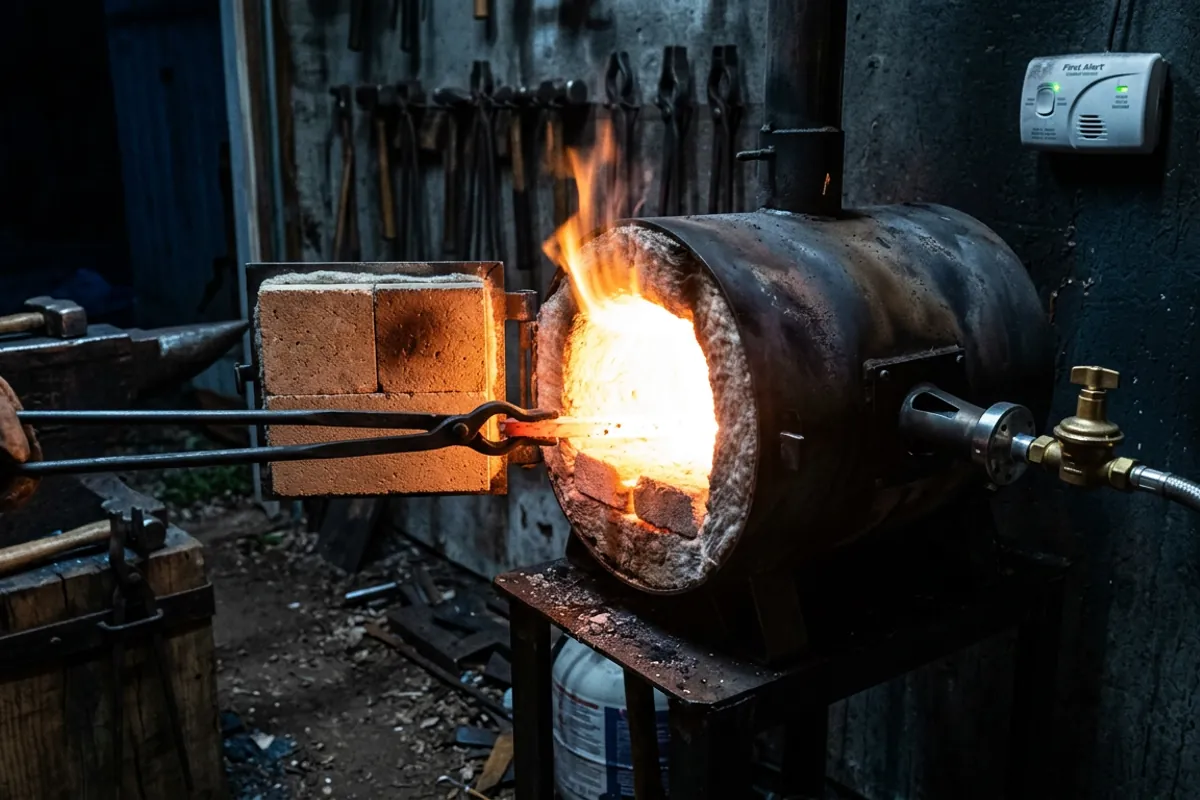
Run the forge outdoors, or in a space with a genuinely open path for exhaust and a fresh air inlet. A cracked window is not ventilation. Put a carbon monoxide detector in the shop, at head height, and replace it on schedule. Carbon monoxide poisoning does not have to kill you to permanently damage you.
Keep the propane cylinder outside the building, upright, with the hose run in. Check every fitting with soapy water when you set up and after any time you move the forge. Close the tank valve when you are done, not just the forge valve.
Eye protection is ANSI Z87.1 rated, full stop, and it goes on before the forge is lit and stays on at the grinder. Many smiths add a shaded or didymium lens for staring into a hot chamber, which is a comfort and eye strain question rather than an impact one, and it does not replace the Z87.1 rating.
Wear natural fibers. Cotton, wool, leather. Synthetics melt onto skin, which turns a burn into a graft. I learned the fire side of this the hard way early on, quenching a blade in oil that was too cold, standing too close in a cotton shirt with no face shield. The oil flared and took my eyebrows, and I kept my eyesight on luck alone. Luck is not a safety system. There is more detail in blacksmith safety gear: what matters and what to skip.
Last one: a gas forge shell gets hot enough to burn you through a glove and to set a bench on fire. Give it a non combustible stand and clear space around it.
What I would tell a friend
Buy the single burner. The Simond Store one door unit (paid link) is the cheapest way into propane that still does real work, and its published chamber of 5.4 by 5.4 by 9.8 inches covers everything a first year smith makes. If you would rather buy from a US maker with a longer track record, the Hell's Forge single burner is the same idea with better support.
Skip the double burner unless you have already decided you are welding billets or forging long stock. It burns twice the fuel to heat air you are not using.
If money is not the constraint and you know you are staying with this, buy the NC Whisper Baby and stop shopping. Cast refractory, published firebox dimensions, and a design farriers have trusted for decades.
Then spend the money you saved on the rest of the shop, because the forge is only one leg of it. A forge with nothing to hit on is a space heater: see what size anvil do you actually need? and the black smith tools you actually need to start. And whichever forge you buy, install the carbon monoxide detector the same day. That is the one line item on this page that is not optional.