Bituminous coal for blacksmithing is the fuel most smiths mean when they say "coal." It is the mid-rank coal that softens, swells, and cokes when it heats, and that coking behavior is the whole reason a forge fire behaves the way it does. I have run a coal forge for most of the twenty-five years I have been at this, alongside a propane forge for the day-to-day work, and the coal side of the shop lives and dies by what I shovel into it. Get good bituminous coal and the fire is quiet, hot, and easy to steer. Get bad coal, and you spend the afternoon fighting smoke, digging clinker, and wondering why your welds will not take. This is a reference piece, owner to owner, on what bituminous coal actually is, why it is the standard smithing fuel, how it burns, and what separates the good stuff from the bin scrapings.
What bituminous coal actually is
Coal gets sorted into ranks by how far the original plant matter has been cooked by geology. From lowest to highest rank the broad classes are lignite, sub-bituminous, bituminous, and anthracite. Rank tracks carbon content and energy density: the higher the rank, the more fixed carbon and the less water and volatile gas locked inside.
Bituminous sits in the upper-middle of that ladder. It is denser and hotter-burning than the lignite and sub-bituminous coals you would find in a lot of power-plant supply, and it still carries a fair load of volatile matter, which is the tarry, gassy fraction that burns off as smoke and flame when the coal first hits heat. Anthracite, the rank above it, is nearly pure carbon and burns clean and hot, but it does not coke and it is stubborn to light and keep going in an open forge fire.
That middle position is exactly why bituminous is the blacksmith's coal. It has enough carbon to make real heat, and it has the specific chemistry to coke. Coal marketed as "smithing coal," "blacksmith coal," or sometimes "metallurgical coal" is bituminous coal selected for the traits a forge fire cares about. I go deeper on the naming and grades in my piece on blacksmith coal, explained from the forge floor, and there is a companion on smithing coal that covers the same ground from the buyer's side.
Why coking is the whole point
Here is the behavior that makes bituminous coal special. When you heat it away from the main fire, the volatile matter cooks off as smoke and gas, and the coal softens, swells, and fuses into a light, gray, porous mass. That mass is coke: mostly fixed carbon, with the smoke already driven out of it. Coke is what actually does the work in the heart of a coal fire. It burns hot, it burns cleaner than raw coal because the volatiles are gone, and it holds its shape well enough to build a fire structure.
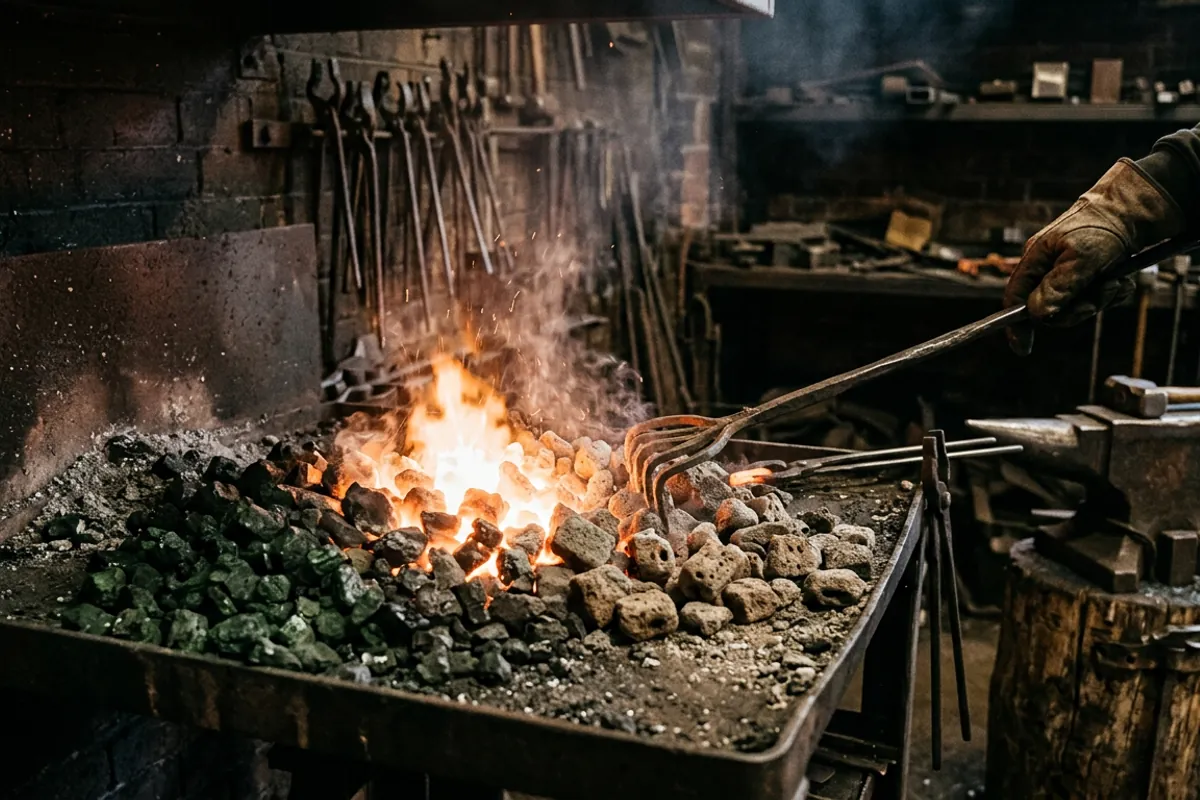
In a working coal forge you do not dump raw coal onto the hot spot. You bank fresh wet coal around the edges of the fire, called green coal, and let the heat coming off the center coke it slowly. As the center burns down you rake the fresh coke inward and push new green coal out to the edge. Done right, the fire builds a hollow dome of coked fuel over the air blast, sometimes called the fire's "cave" or "oven," and inside that dome you get a clean, oxygen-controlled pocket of heat. That is where forge welds happen. You cannot build that structure with a fuel that will not coke. It is the reason a good bituminous fire feels like a tool you are steering rather than a pile you are burning.
If you are still deciding whether to run coal at all, I lay out the tradeoffs against gas in coal or propane: which first forge makes sense, and the buildout side lives in the coal forge I would actually build a shop around.
What separates good smithing coal from bad
Not all bituminous coal is worth burning in a forge. Two coals can both be bituminous and behave nothing alike. The traits that matter to a smith are sulfur, ash, coking quality, and how much fine dust is in the bag.
Sulfur
Sulfur is the one I care about most. When it burns it comes off as sulfur dioxide, which is the sharp, throat-catching stink of a bad coal fire, and beyond the nuisance, sulfur migrating into hot steel promotes what smiths call hot short, where the metal cracks and crumbles at forging heat instead of moving cleanly. The forgers I trust all say the same thing: buy low-sulfur coal, and the good blacksmithing coals are generally sold as under one percent sulfur. I treat a number printed on a supplier's sheet as real only when the supplier stands behind it; I treat a random pile of "coal" with no provenance as an unknown and burn it with the shop doors open before I trust it.
Ash and clinker
Ash is the non-combustible mineral left when the carbon is gone. In the fire, ash and other impurities fuse into clinker, the glassy, sometimes metallic-looking chunks that grow down over your air grate and choke the blast. Every coal fire makes some clinker. High-ash coal makes a lot, and you spend real time digging it out mid-session with a poker or a clinker breaker. Low-ash bituminous coal makes a fire you can run longer between cleanouts. This is the single biggest quality-of-life difference between good and cheap coal, and it is why I never judge a coal by price alone.
Coking quality and dust
Some bituminous coals coke into a strong, cohesive mass that builds a good fire dome. Others cook down into a weak, crumbly coke that collapses into the fire. Strong coking coal is what you want. And a bag that is half fine dust and slack will pack down, smother the blast, and blow away when you fan it. A little fines is normal; a bag that is mostly powder is a bad buy. I get into sourcing and what to actually put in the bin in the coal forge coal I would actually buy.
Sizing: nut, pea, and stoker
Coal is sold in size grades, and the names you will hear around a forge are usually borrowed from the old heating-coal trade: lump, nut, pea, and stoker or slack from largest to smallest. For a hand-fed blacksmith fire, most smiths land on nut or pea size, roughly walnut down to pea, because those pieces coke well, air moves through them, and they are easy to rake and feed. Very large lump has to be broken up. Very fine stoker and slack packs tight and smothers the fire unless you are wetting and managing it carefully.
There is no single correct size for every forge, and firepot geometry matters, but if you are buying your first coal and do not know, nut or pea bituminous is the safe default. You can always break bigger pieces down with a small hammer; you cannot un-crush dust.
How bituminous coal burns in the forge
Running a coal fire is a rhythm, and the fuel drives that rhythm. You light a small starter, coke or charcoal or a bit of the fuel that has already cooked, get a blast on it, and let a compact center of burning coke build. Then you feed green coal around it, keeping the fresh coal off the hottest spot so it cokes instead of just smoking. The visible smoke you get when you first bank new coal is the volatiles burning off; that smoke should thin out as the coal cokes and gets raked into the working fire.
A well-managed bituminous fire runs with a tight, clean center and only a thin haze off the green coal at the edges. If your whole fire is pouring black smoke the entire session, you are usually feeding raw coal into the hot center instead of letting it coke first, or you have poor coal, or your air is wrong. The fuel rewards patience: coke slow, rake in, keep the pot fed but not buried.
Keep a can of water and a small rake or poker at the forge. Wetting the green coal at the edges is normal practice; it helps it cake up and coke and it keeps the fire from spreading where you do not want it. That is why you will hear smiths talk about "wet coal" as a good thing at the rim of the fire even though a soaked center is a dead fire.
The real hazards, and I mean it
I do not soften this part. I lost my eyebrows early on to a quench-oil flare-up because I stood too close in a cotton shirt with no face shield, and I kept my eyesight by luck. Coal has its own list, and it is worse than gas on the air-quality side.
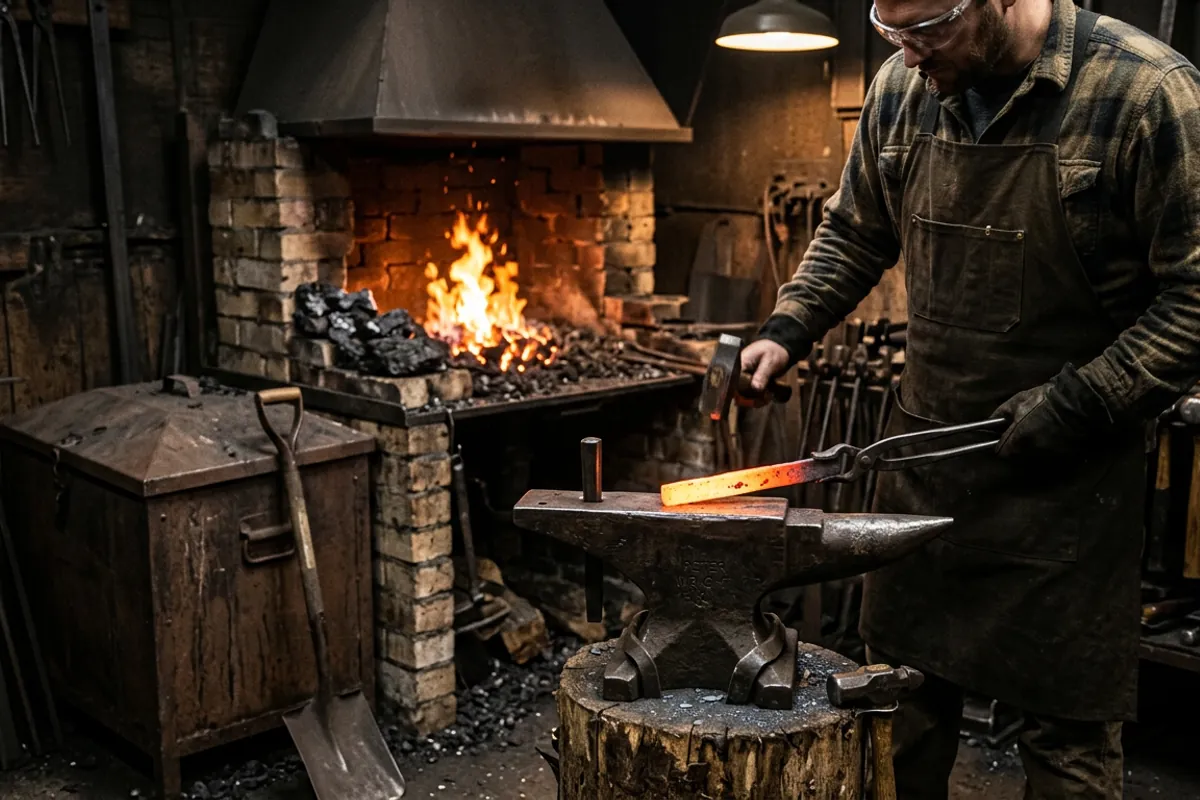
Carbon monoxide is the one that kills quietly. A coal fire produces it, it has no smell, and it accumulates in a closed shop. A coal forge belongs under a working hood and flue or fully outdoors, with real cross-ventilation, every single time. This is not a comfort issue, it is a do-not-die issue. Sulfur dioxide from the coal adds a sharp, lung-irritating gas on top of the CO; good ventilation handles both, poor ventilation handles neither.
Coal dust is a nuisance and an irritant, and the fire throws sparks and pops, especially when you first put green coal on. Wear eye protection rated to ANSI Z87.1 at the forge, not fashion sunglasses. Dress in natural fibers, cotton, wool, leather, near the fire; synthetics melt onto skin when a spark finds them. Keep the water can within reach. I put the full rundown of what matters and what is marketing in blacksmith safety gear: what matters and what to skip, and none of it is optional around a coal fire.
Storing and handling it
Bituminous coal keeps well if you keep it dry and contained. I store mine in a covered metal bin or a lidded drum, out of the rain, off a bare dirt floor. Wet coal is not ruined, you wet the green coal at the fire anyway, but a soaked bin is heavy, messy, and slow to light, and standing water leaches the coal and makes a black mess of everything around it.
Coal fines and dust are the handling headache. A bag that traveled rough arrives with more slack than it left with. I keep the dust down, sweep it up rather than let it drift, and I do not store coal against anything I care about staying clean. Keep it away from ignition sources for the obvious reason, and keep the storage area ventilated for the same CO logic as the shop.
Where bituminous fits against the other fuels
Bituminous coal, coke, charcoal, and propane all make forging heat, and each has a place. Coke is bituminous coal with the volatiles already cooked out, so it lights harder but burns cleaner with almost no smoke; some smiths in tight neighborhoods buy metallurgical coke for exactly that reason. Charcoal, real lump charcoal, forges fine and was the historical fuel for centuries, but it burns fast and you go through a lot of it. Propane is clean, even, and neighbor-friendly, which is why it is my day-to-day heat.
What bituminous coal gives you that gas does not is a small, intensely hot, shapeable fire that you can drive to forge-welding heat and localize to one spot on a long bar. That control, plus the low running cost when you have a good local source, is why coal shops still exist. If you want the wider view of how a coal setup comes together, the forges topic hub at Forges collects the coal and propane and charcoal guides in one place.
None of this makes bituminous coal the only right answer. It makes it a specific tool with specific behavior: a mid-rank coal that cokes, and once you understand the coking, the fire stops being a mystery pile and starts being something you run.