Bituminous smithing coal, washed and screened, in nut or pea size, is the coal forge coal you want, and everything else in this guide is a footnote to that sentence. If you are buying online, start with a small box or a bucket from a seller who at least says the words "blacksmith" and "bituminous" on the label, burn it, and only then decide whether to chase a pallet or a local supplier. I run a coal forge for heavy stock and forge welding, and a propane forge for most of the day-to-day work, so I have shoveled a fair amount of good coal and a fair amount of garbage over about twenty-five years.
Be clear about what this guide is. Coal is not a product you can review the way you review a hammer. Two bags with the same brand name can come off different seams in different years, and the only real test is your own firepot. So what follows leans on published supplier specs, on what smiths report on the forums, and on general fire-management experience from running a coal fire next to Bessie, my 148 lb Trenton. It is not a bench test of specific bags, and I will not pretend otherwise.
What to look for in coal forge coal
Coal is graded by rank: lignite at the soft, young end, then bituminous, then anthracite. Blacksmiths want bituminous, and specifically the low sulfur, low ash end of bituminous that gets sold as smithing coal or metallurgical coal. The reference write-up at SustainLife puts it the same way most old smiths do: bituminous is the coal of choice, lignite is poorly suited because of the clinker it throws, and the mineral matter that will not burn melts and coagulates in the bottom of the firepot into the sticky mass we call clinker, which blocks air flow and pulls heat out of the fire.
Four things matter when you are choosing:
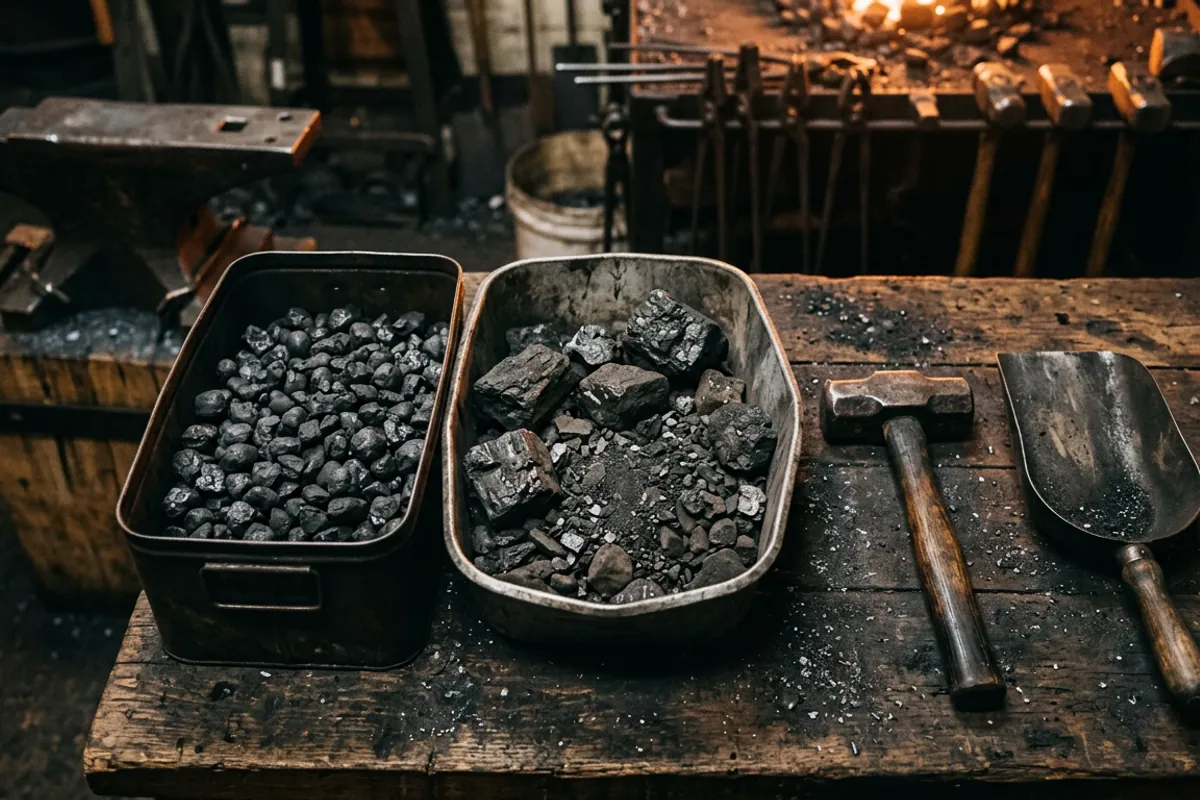
It has to coke. Good bituminous, pushed to the edges of the fire and wetted down, drives off its volatiles and fuses into light, silvery chunks of coke. That coke is what actually gives you a clean, deep, welding-capable fire. Coal that never fuses, that just burns down to powder and ash, will fight you all day.
Sulfur, as low as you can get. Sulfur makes worse coke, sours the fire, and in enough concentration it gets into hot steel and makes it short and crumbly under the hammer. It also makes an acidic smoke that eats tuyeres, hoods, and lungs. Centaur Forge publishes 1.5 percent sulfur on their bagged smithing coal, which is a useful benchmark for what a commercial smithing grade actually looks like.
Ash, as low as you can get. Ash is future clinker. Centaur publishes 8.0 percent ash and 6.0 percent moisture, and 13,000 BTU per pound, on the same bag (Centaur Forge smithing coal). Most sellers publish nothing at all.
Size, washed and screened. Nut and pea size feed a firepot well. Centaur publishes a size of 1-1/4 inch by 3/8 inch with a maximum of 6 percent passing 3/8 inch, which tells you how little dust a properly screened product carries. Bags full of fines burn fast, pack tight, and choke the blast. Fines are not useless, you can wet them and pack them into the fire, but you should not be paying shipping on a box of them.
If you are still deciding whether a coal fire belongs in your shop at all, read Coal or propane: which first forge makes sense? before you buy fuel. And if you have not bought the forge yet, the coal forge buying guide and the rest of the forges topic hub cover the hardware side.
Coal specs side by side
Only published figures below. Where a seller does not publish an assay, that cell says not published, because inventing a sulfur number would be worse than admitting nobody stated one.
Scroll horizontally to see all columns.
| Fuel | Rank | Size grade | Package | Published sulfur / ash | BTU per pound |
|---|---|---|---|---|---|
| Centaur Forge bagged smithing coal (benchmark) | Bituminous | 1-1/4 in by 3/8 in, max 6 percent minus 3/8 in | 50 lb bag | 1.5 percent sulfur, 8.0 percent ash | 13,000 |
| Bituminous blacksmith coking coal, half cubic foot | Bituminous | Crushed and screened | About 25 lb box | Not published | Not published |
| Bituminous blacksmith coal, 50 lb | Bituminous | Crushed to 1 to 3 inch chunks | 50 lb | Not published | Not published |
| Pennsylvania smithing coal, nut size | Bituminous, Blaschak product per USA Knifemaker | Nut, washed and screened | 5 gallon bucket | Not published | Not published |
| Anthracite nut coal, small bucket | Anthracite | Nut | 10 lb bucket | Not published | Not published |
The pattern is the point. The supplier that sells to working smiths publishes an assay. The marketplace listings mostly do not, so you are buying on the seller's word and your own eyes. That is fine for a first box. It is not fine for a pallet.
Bituminous coking coal, about 25 pounds
This is the one I would tell a first-time coal buyer to start with: a half cubic foot box, roughly 25 pounds, of crushed and screened bituminous sold specifically as blacksmith coking coal. It is enough coal to light a fire, learn to bank it, coke a batch, and find out whether the stuff fuses properly, without committing to a freight shipment of something you may hate.
The published detail worth having is the shape of the product rather than an assay: crushed and screened bituminous, boxed, with the fines mostly screened out. There is no published sulfur or ash figure, so treat any low sulfur claim on a marketplace listing as a sales claim, not a lab result. Judge it in the fire: does it fuse into coke, how much clinker do you pull after two hours, does the smoke sting.
Check price on Amazon (paid link)
The honest tradeoff: buying coal by the box is the most expensive way per pound to buy coal, by a wide margin. Shipping rock is shipping rock. You are paying for a trial, not for a fuel supply.
A 50 pound bag of crushed bituminous
Once you know a coal works in your pot, the 50 pound quantity is the normal unit of purchase. The commonly listed marketplace option is bituminous crushed to roughly 1 to 3 inch chunks and shipped in a lined box to keep it out of the weather.
Two honest notes. First, 1 to 3 inch chunks are bigger than the classic nut or pea smithing size, and big chunks want breaking before they will build the tight, banked fire that coal forging depends on. Keep a small sledge or a length of bar near the coal bin. Second, "burns hot and works in coal stoves" is stove-coal marketing, not smithing-coal marketing. Stove coal and smithing coal overlap, but they are not the same buying criteria: a stove does not care whether your fuel cokes, and you do.
Check price on Amazon (paid link)
Pennsylvania nut size smithing coal in a bucket
The one I would point a beginner to if the box above is out of stock is nut size Pennsylvania smithing coal in a 5 gallon bucket. USA Knifemaker sells the same product and identifies it as Blaschak bituminous, washed and screened, described as low smoke and high heat with high gas content for quick firing. They do not publish sulfur, ash, or BTU, and they say plainly that there can be some dust in it.
Nut size is the practical advantage here. It feeds a small firepot without breaking, it banks well, and washed and screened coal means less of your money is sand. The bucket is also genuinely handy in a shop: lid on, no coal dust migrating across the floor, and it doubles as the thing you carry coke back to the fire in.
Check price on Amazon (paid link)
The tradeoff is quantity. A bucket is a weekend or two, not a season, and per pound you are paying box prices again.
Anthracite, and the small bucket that tells you if you like it
Anthracite comes up constantly, usually because someone found a cheap source of stove coal. It is worth understanding what you are getting into, and the honest answer is that smiths disagree.
The skeptical camp is well represented on BladeForums, where the consensus in that thread is that anthracite is nearly impossible to coke properly, that forging wants low sulfur soft coal like Pocahontas No. 3, and that anthracite is a heating fuel that is bad for forging. One poster there describes trouble holding heat with a 50/50 anthracite and bituminous blend.
The other camp says it works if you change your technique. In a long alt.crafts.blacksmithing thread, smiths who stuck with it report that anthracite burns very hot and will reach welding temperature, but only with an electric blower kept going hard, only if you light it off charcoal or wood rather than paper, only if you add it gradually onto an established fire, and only if you rake clinker out of the firepot roughly every hour. It also does not like being stirred and moved around the way bituminous does.
Both of those can be true. Anthracite is a denser, harder carbon that does not fuse into coke, so it needs a constant blast to stay lit and it punishes the fiddling that a bituminous fire tolerates. If you want to find out where you land, buy ten pounds, not a ton. A small bucket of anthracite nut coal costs about what lunch costs and answers the question in one evening.
Check price on Amazon (paid link)
For most beginners, I would skip it. Learn fire management on coal that cokes. Come back to anthracite when a cheap local source makes the experiment worth your time.
What owners say
Owner signal on specific bags of marketplace coal is thin, and I want to say that plainly rather than manufacture a consensus. Coal listings turn over, sellers change seams, and one person's excellent bag and another person's dusty one may both be honest reports about different shipments. What the forums do agree on, consistently, is the shape of the problem rather than the brand.
On rank and coking, the thread linked above at BladeForums lands hard on low sulfur soft coal for forge work, and treats anthracite as a heating fuel. The alt.crafts.blacksmithing regulars who made anthracite work did it by changing how they ran the fire, not by finding a better bag. Nobody in either discussion claims a marketplace listing is a substitute for a known local seam.
On price, the recurring theme in the I Forge Iron solid fuels section is that shipped coal is expensive coal and local coal is cheap coal, with reports ranging from a few dollars for a 50 pound bag bought locally to several dollars per pound when someone is shipping it to you. I have not read every one of those threads end to end, so take that as the general drift of that subforum rather than a quoted figure.
On sourcing, the advice that keeps coming back is to go to a hammer-in or a local ABANA affiliate meeting. Clubs buy coal by the ton and sell it to members by the bag, and that is how most working hobby smiths I know actually get fuel. A box off a marketplace is for testing, for a first fire, or for the smith who has no club within a day's drive.
Burning it: coking, clinker, and fire management
Good coal rewards a specific method, and beginners who hate coal usually hate it because nobody showed them this.
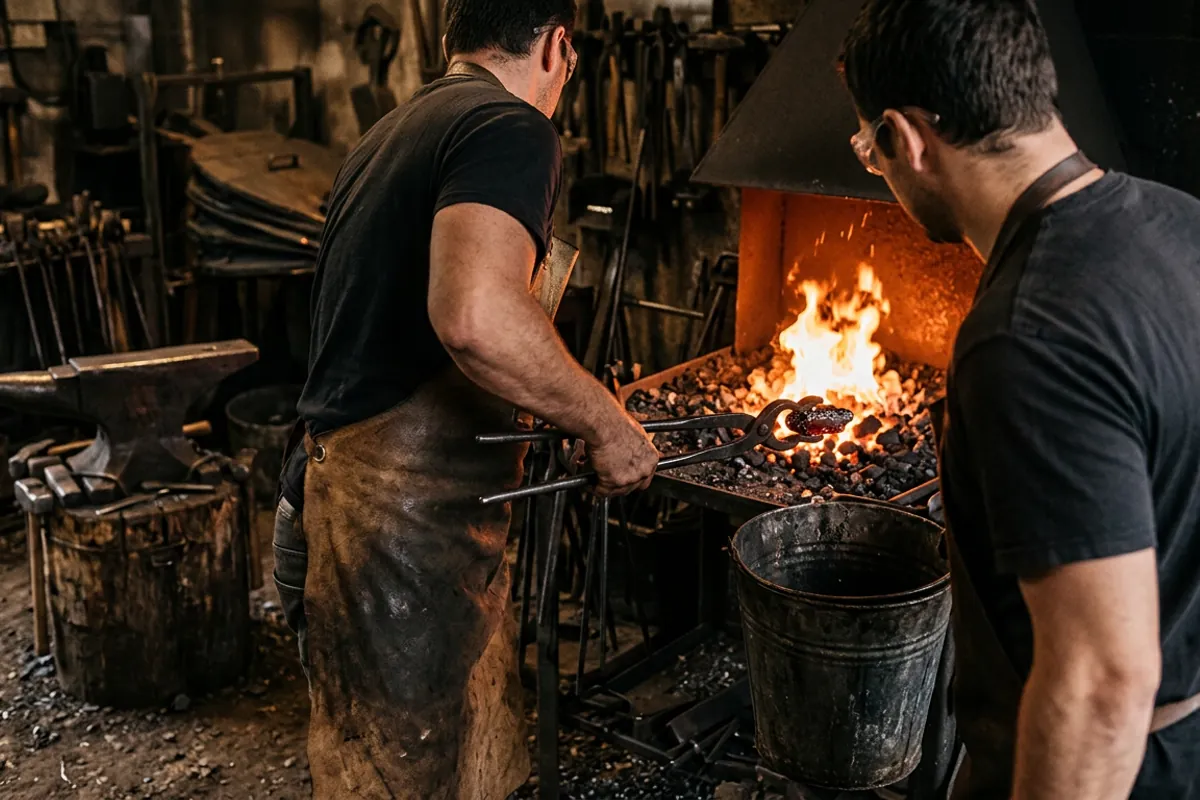
Build the fire small and deep. Light a bit of paper or wood, get a coke bed going, and keep the raw coal in a wet ring around the outside of the fire rather than dumped on top. That wet ring bakes: the volatiles cook out as smoke, and the coal fuses into coke. You rake coke into the center as you need it and push fresh green coal outward to replace it. That is the whole cycle, and the smoke that bothers your neighbors mostly comes from the first twenty minutes and from every time you dump green coal into the middle of a hot fire.
Water is a tool here. Keep a can with a sprinkler head or a cup of water from the slack tub and wet the outside of the ring. It shapes the fire, controls smoke, and stops the whole pile from burning at once.
Clinker is not optional and it is not a sign you bought bad coal. It is the noncombustible mineral matter fusing at the bottom of the firepot. Every hour or so, break the fire and pull it: a poker down to the tuyere finds it as a hard, glassy lump that will not give like coke does. Get it out with a rake or long tongs. Never reach into a firepot with a gloved hand looking for it. A clinker fresh out of a working fire can be soft, sticky, and hot enough to end your week.
If you find yourself pulling large clinkers every twenty minutes, that is the coal, and that is your signal to buy elsewhere before you commit to a pallet.
Safety around a coal fire
Coal smoke is the hazard people underrate. A coal forge produces carbon monoxide, and carbon monoxide will not warn you. Coal forges belong outdoors, under an open shed, or under a real hood and stack with genuine cross ventilation. A closed garage with the door cracked is not ventilation. Put a carbon monoxide alarm in the shop and treat it as required equipment, not a nicety.
Sulfur in the coal comes off as an acidic, throat-catching smoke when green coal first hits the fire. If it is stinging your eyes and nose, you are breathing it, and it is corroding your hood at the same time. Stand upwind, feed coal to the edges, and if a bag gives you that smoke every time, it is a bad bag.
Coal dust and fines deserve a dust mask when you are shoveling or breaking chunks. This is not fussiness, it is the cheapest health insurance in the shop.
Everything else is the standard forge discipline, and I do not soften it. ANSI Z87.1 rated eye protection, on your face before you light anything, and a face shield over it for grinding. Natural fibers only near the fire: cotton, wool, leather. Synthetics melt into skin. I learned that lesson the expensive way, quenching a blade in oil that was too cold, standing too close in a cotton shirt with no face shield. The oil flared, took my eyebrows, and I kept my eyesight on luck alone. Nobody should have to buy that lesson twice. The full rundown is in blacksmith safety gear: what matters and what to skip.
Store coal dry and covered. Wet coal is heavier to move, harder to light, and coal piles that sit wet and unturned for a long time can heat themselves. A lidded bucket or a covered bin under a roof solves it.
What I would tell a friend
Buy a small box or bucket of bituminous smithing coal, nut or pea size, washed and screened. Burn it in your own firepot. Watch three things: does it fuse into good coke, how much clinker comes out per hour, and how bad the smoke is. If the answers are yes, a little, and tolerable, then find the same product in quantity, or better, find a local club that sells it by the bag and stop paying to ship rock across the country.
Skip anthracite as a first fuel. Skip anything sold purely as stove coal with no mention of forging. Skip the pallet purchase until a small bag has proved itself.
The safety note that matters most is not about the steel. It is carbon monoxide and coal smoke. Get the fire outdoors or under a real stack, put an alarm on the wall, wear Z87.1 eye protection and natural fibers, and pull your clinker with tools rather than hands.
If the coal fire ends up feeling like more work than you want on a weeknight, that is a legitimate conclusion and not a failure. Plenty of smiths keep a coal fire for welding and heavy stock and do everything else on gas, which is exactly how my shop is set up. The propane forge guide covers that side, and if you want a fuel that behaves more like coal without the coal, the charcoal forge guide is the next stop.