Smithing coal is the fuel a solid-fuel forge is built around, and getting it right is the difference between a fire that welds steel and a fire that fights you all afternoon. I have run a coal forge alongside a propane one for years, and coal is the fuel I reach for when I am working heavy stock or forge welding. But "coal" covers a lot of ground, most of it useless to a smith. The stuff sold at the hardware store for a stove, the stuff in a landscaping bag, the stuff a neighbor pulls out of an old bin: none of it is what you want in a forge. This is a plain walk through what smithing coal is, why smiths burn one narrow kind of it, how it behaves in the fire, and how to buy and store it without wasting your money or your lungs.
If you want the shorter owner-to-owner version and the buying side, I keep those in Blacksmith coal, explained from the forge floor and The coal forge coal I would actually buy, and what to burn instead. This piece is the reference: what the fuel is and why, from the ground up.
What smithing coal actually is
Smithing coal is a low-sulfur, low-ash bituminous coal chosen because it cokes well. Every word in that sentence is doing work, so let me unpack it.
Coal is fossilized plant matter that spent a very long time under heat and pressure. Depending on how far along that process went, you get different grades, called ranks, and they burn very differently. The coal a smith wants sits in a narrow band: it has enough volatile matter to bake down into coke, low enough sulfur that it will not poison the fire and the steel, and low enough ash that you are not shoveling out garbage every twenty minutes.
That is a much tighter spec than "black rock that burns." Most coal in the world was never meant to be worked by hand in an open fire a foot from your face. Power-plant coal, home-heating coal, and metallurgical coal are all real products with real uses, and only a slice of that last category overlaps with what belongs in a forge. When smiths say "smithing coal" or "blacksmithing coal," they mean that slice specifically, and it is worth buying from a supplier who sells it as such rather than guessing at a bulk pile.
Why bituminous, and what the coal ranks mean
Coal is ranked, roughly, by how much of the original plant material has been driven off and how much fixed carbon is left. From lowest to highest carbon content the common ranks are lignite, sub-bituminous, bituminous, and anthracite.
Lignite and sub-bituminous coals are soft, wet, and full of volatiles and impurities. They smoke badly, throw a lot of ash, and do not coke into anything useful. Skip them entirely.
Bituminous coal is the middle rank, and it is what smithing coal almost always is. It carries enough volatile matter that, when you heat it at the edge of the fire, those volatiles cook off and the coal bakes into coke. Good bituminous smithing coal is sometimes sold as coking coal or metallurgical coal, though not every metallurgical coal is clean enough for open-fire hand work.
Anthracite is the highest rank, the hard, shiny stuff. It is nearly pure carbon, burns hot and clean, and is what a lot of home coal stoves are designed to burn. Smiths generally do not use raw anthracite in a traditional side-blast or bottom-blast forge because it is hard to light, needs a steady forced draft to stay lit, and does not coke the way bituminous does. It has its place in some forge designs, but if a beginner asks me what to buy, the answer is clean bituminous coal every time.
The reason bituminous wins is the coking behavior, so that is the next thing to understand.
How coal becomes coke in the fire
This is the single most important idea about smithing coal, and it is the thing most people watching a coal fire for the first time do not realize is happening.
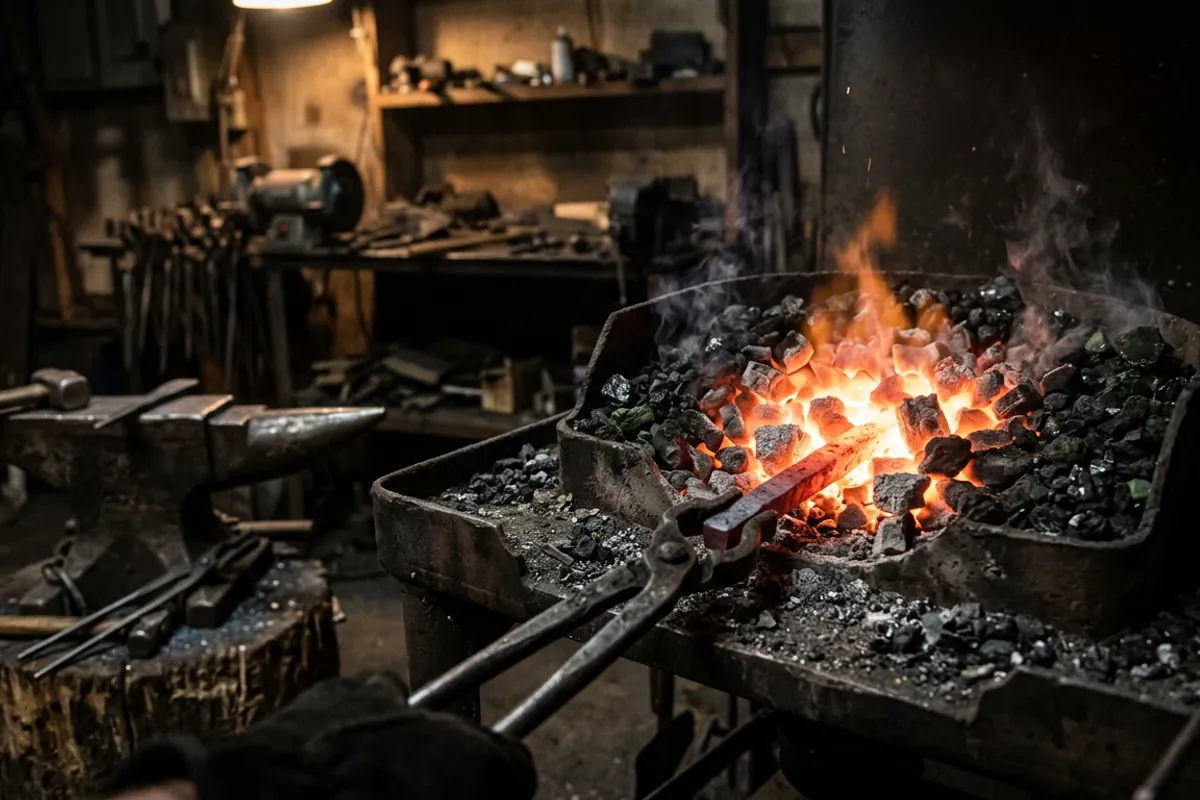
You do not actually forge in the raw coal. You forge in coke. Coke is what is left after the volatile gases, tars, and moisture have been driven out of bituminous coal by heat. It is a light, gray, porous carbon that burns clean and very hot, and it is the part of the fire that gets your steel to a working heat and lets you forge weld.
In a working fire the coal sorts itself into zones. At the center is the hot core of burning coke, the heart of the fire. Around it is a ring of coke that has already baked but is not yet fully consumed. Outside that is green coal, the raw wet stuff you keep raking inward from the edges. As green coal moves toward the heat it bakes, gives off its yellow smoke, and turns to coke, feeding the core. A smith running a coal fire is constantly managing that migration: raking coke into the center, pushing fresh green coal to the edges to cook, and keeping a domed, banked shape over the fire so the heat stays where the steel goes.
This is why cheap coal or the wrong rank ruins the day. If the coal will not coke, you never build that clean-burning core. You just get a smoky, low, dirty fire that will not reach welding heat and coats everything in soot. Good smithing coal cakes together lightly as it cokes, so you can build and hold a proper fire. That caking property is exactly what a home-heating anthracite lacks, and it is why the two fuels are not interchangeable.
Clinker, and why your fire quietly dies
Clinker is the other half of the story, and it is the thing that frustrates new coal smiths most.
Clinker is the fused, glassy lump of non-combustible junk left behind when the impurities in coal melt together in the heat of the fire. It is mostly ash, along with mineral matter and, depending on your coal, iron and sulfur compounds. It does not burn. It pools at the bottom of the fire, right around the air blast, and if you leave it there it slowly chokes off your air, kills your heat, and clogs the tuyere or grate.
You cannot prevent clinker entirely, because no coal is perfectly pure. But the amount of clinker you fight is a direct report card on your coal. Low-ash, low-sulfur smithing coal makes a little clinker that you can lift out in one or two clean lumps with a poker once the fire cools a bit. Dirty coal makes constant clinker that fuses hard to the grate and buries the airflow. When I hear a new smith complain that their fire "just keeps dying," the coal is usually the reason, and clinker is usually how it shows up.
Learning to feel for clinker, hear the fire go dead, and hook it out is a basic coal-forge skill, and it is a lot easier to learn on clean coal. That is one more reason not to economize on the fuel while you are still learning to read a fire.
Sizing, and what to ask for when you buy
Smithing coal is sold by size as well as by rank, and the size matters more than beginners expect.
You want coal in small pieces, roughly walnut sized down to pea sized, sometimes sold by names like nut or pea or stoker. Small coal cokes faster and more evenly and is far easier to bank around a fire than big chunks. Some suppliers sell smithing coal already crushed to a workable size; some sell larger lump you break down yourself. If you are buying loose lump, expect to do some crushing, and expect a certain amount of fine dust at the bottom of the bag.
That dust, by the way, is not waste. Wet down and packed, coal fines help you build and hold the banked wall around a fire. Old-timers deliberately keep a bucket of damp fines at the forge for exactly this. So do not throw the bottom of the bag away.
When you buy, the questions worth asking a supplier are simple: is it bituminous, is it low sulfur, is it sold specifically for blacksmithing, and what size is it. A supplier who sells to smiths will answer all four without blinking. A general fuel yard selling heating coal usually cannot, and that alone tells you it is probably the wrong product. For the buying decision itself, including where to actually source it, I go deeper in The coal forge coal I would actually buy, and what to burn instead.
Storing coal so it keeps
Coal is not fragile, but it is not indestructible either, and how you store it affects how it burns.
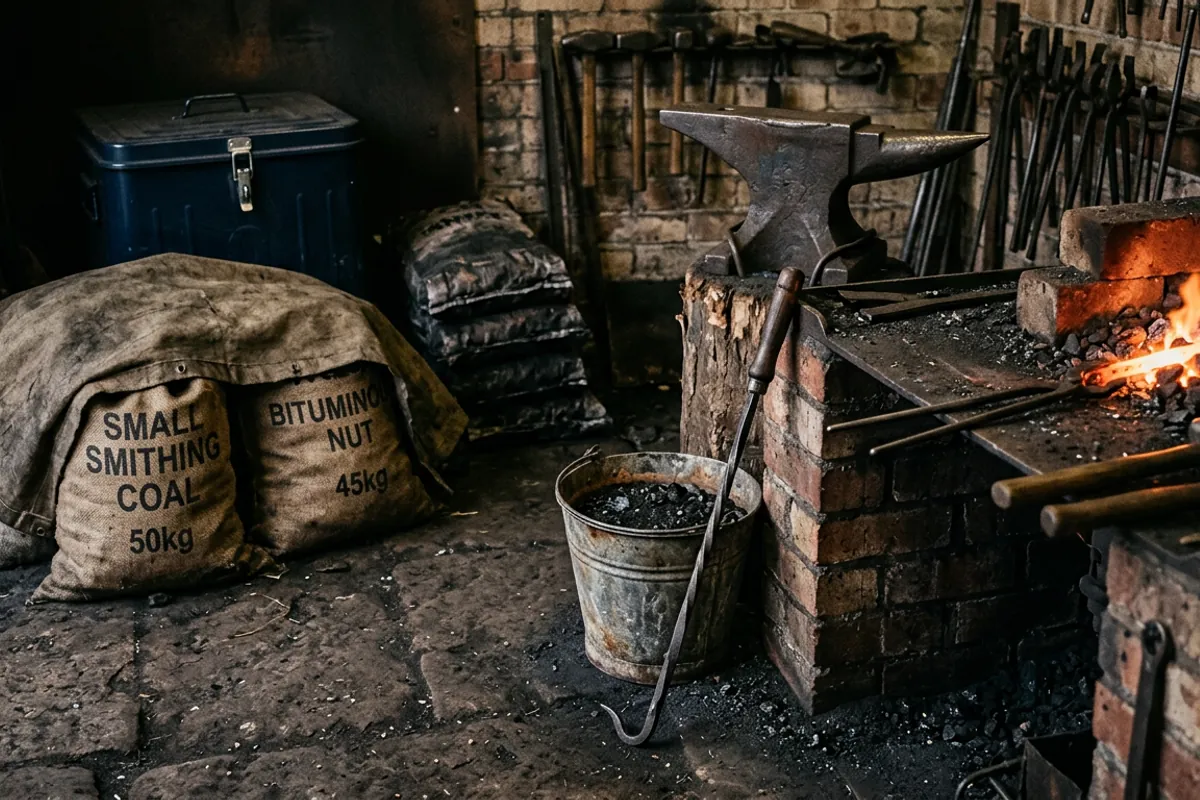
Keep it dry and keep it contained. A covered bin, a lidded metal can, or heavy bags under a tarp all work. Wet coal is not ruined, but it steams and smokes more and takes more of your fire's energy to drive the water off before it will coke, so a soaking-wet pile is a slower fire. Some surface dampness on the green coal at the edge of the fire is actually fine and even useful, because it helps the coal cake as it bakes, but a saturated storage pile is just harder to work with.
The bigger reasons to keep coal contained are dust and mess. Coal dust gets on everything and tracks through a shop, and a fine coal dust cloud is genuinely a combustion and inhalation concern in large enough quantity, though a hobby smith's few bags are not a mine hazard. Buy in a quantity you will actually use in a reasonable time, store it in something with a lid, and you will not think about it much. Coal does not spoil the way a fuel with a shelf life does, so a well-stored supply will sit happily until you burn it.
The safety that is not optional
I lost my eyebrows early on to a quench-oil flare-up because I was careless, so I do not treat any forge hazard as optional, and coal has real ones. None of this is meant to scare you off coal. It is meant to keep you from learning the hard way.
The first is carbon monoxide. A coal fire produces it, and carbon monoxide is colorless, odorless, and can kill you before you know anything is wrong. A coal forge belongs in a well-ventilated space with a real means of getting the smoke and gas out, whether that is an outdoor setup, an open-sided structure, or a proper forge hood and chimney with genuine draft. An enclosed garage with the door cracked is not ventilation. If you run coal indoors, a carbon monoxide detector in the shop is cheap insurance, and I would not run a solid-fuel fire in a closed space without one.
The second is sulfur. Even good low-sulfur smithing coal gives off some sulfur dioxide, and dirty high-sulfur coal gives off a lot. It smells sharp, it irritates your eyes and airway, and it is one more reason ventilation is not negotiable. High sulfur in the coal is also bad for your steel, because sulfur can migrate into hot iron and cause hot-shortness, where the metal crumbles and cracks at forging heat. So low sulfur is both a health choice and a metalworking choice.
The third is the ordinary forge stuff that applies no matter the fuel. Wear rated eye protection at the fire and especially at the grinder, ANSI Z87.1 stamped, because sparks and scale come off hot work constantly. Wear natural fibers, cotton or wool or leather, not synthetics that melt onto skin near heat. Keep a way to put out a fire nearby. I lay all of this out in Blacksmith safety gear: what matters and what to skip, and it is the one guide on the site I will not let anyone treat as optional.
Coal against the other fuels
Coal is not the only way to heat steel, and it is worth being honest about where it wins and where it does not, because the fuel you pick shapes the whole shop.
Coal's strengths are real. A well-run coal fire reaches very high, concentrated heat, which makes it excellent for forge welding and for heating heavy stock, and you can shape the fire to the work, heating a small spot in the middle of a long bar without heating the whole thing. Its costs are also real: it is smoky, it is dirty, it demands serious ventilation, it takes skill to run a clean fire, and clinker management never fully goes away.
Charcoal is the other solid fuel, older than coal in the trade, and it behaves differently again. If you are weighing solid fuels against each other, I compare them in Blacksmith charcoal, explained from the forge floor. Propane is the other major path, and for a lot of new smiths it is the easier first forge because it is clean, even, and forgiving, with no fire to build and no clinker to hook out. I lay the whole decision out in Coal or propane: which first forge makes sense?, and it is the first thing I point a beginner to before they spend a dollar on either.
None of that makes coal wrong. It makes coal a choice with tradeoffs, and smithing coal specifically, the clean low-sulfur bituminous kind that cokes well, is what makes the coal side of that choice actually work. Buy the right fuel, build the fire in coke rather than raw coal, keep the clinker out, and ventilate like your life depends on it, because with carbon monoxide it can. Do those four things and a coal forge is one of the most satisfying tools in the shop. For where a coal forge itself fits and how to set one up, the rest lives in the Forges topic hub and in The coal forge I would actually build a shop around.